Virtual Shopping Experience: Top Mattress Picks for 2026
A mattress shopper visits your showroom on Saturday, lies on a plush hybrid, runs a hand across the ticking, asks about the quilt package, and nods when your RSA explains the foam layers. Then they go home, pull up the product page, and see three flat images, a spec list, and a price.
That's where a lot of bedding brands lose the sale.
The problem usually isn't interest. It's translation. The showroom gave the shopper confidence. The screen removed it. A good virtual shopping experience closes that gap by helping people understand what they're buying when they can't touch the mattress, compare floor models side by side, or ask someone to unzip the story behind the comfort build.
Why Mattress Shoppers Need More Than Photos
Most mattress PDPs still treat a bed like any other boxed product. Front view. Angle shot. Maybe a lifestyle image in a nice room scene. That works fine for simple goods. It doesn't work nearly as well for a purchase where feel, construction, height, and fit all shape the decision.
A mattress shopper doesn't just want to know what the product looks like. They want to know what's inside it, how tall it sits with their frame, whether the gusset looks premium, whether the quilt reads soft or stiff, and whether the comfort story sounds believable enough to justify the price.
Where standard mattress imagery breaks down
A flat image can show color and silhouette. It usually can't explain:
Construction logic: Why this foam stack feels different from another 13-inch hybrid.
Material trust: Whether the quilt, ticking, and side panel details feel premium or generic.
Scale confidence: How a king or queen will sit in a bedroom.
Comfort understanding: What the shopper is paying for when two models look similar from the outside.
That gap hurts online conversion, but it also weakens the value of the showroom. Your retail team may have done a strong job on the floor, yet the product page still asks the shopper to make a leap of faith later.
A mattress isn't sold by beauty alone. It's sold by confidence.
This gets even trickier for manufacturers and private label programs. If you've invested in differentiated specs, upgraded covers, or a more compelling layer story, poor digital presentation flattens those differences. The shopper sees “another white mattress.”
For a closer look at why product visuals often underperform online, Bedhead's article on images on e-commerce is a useful benchmark for bedding teams reviewing PDP quality.
The showroom-to-screen problem is fixable
The answer isn't more copy pasted into bullet tabs. It's better visualization and better interaction.
When a shopper can inspect a mattress more like they would in-store, they get closer to the same decision confidence they felt on the floor. In bedding, that's the job of a virtual shopping experience.
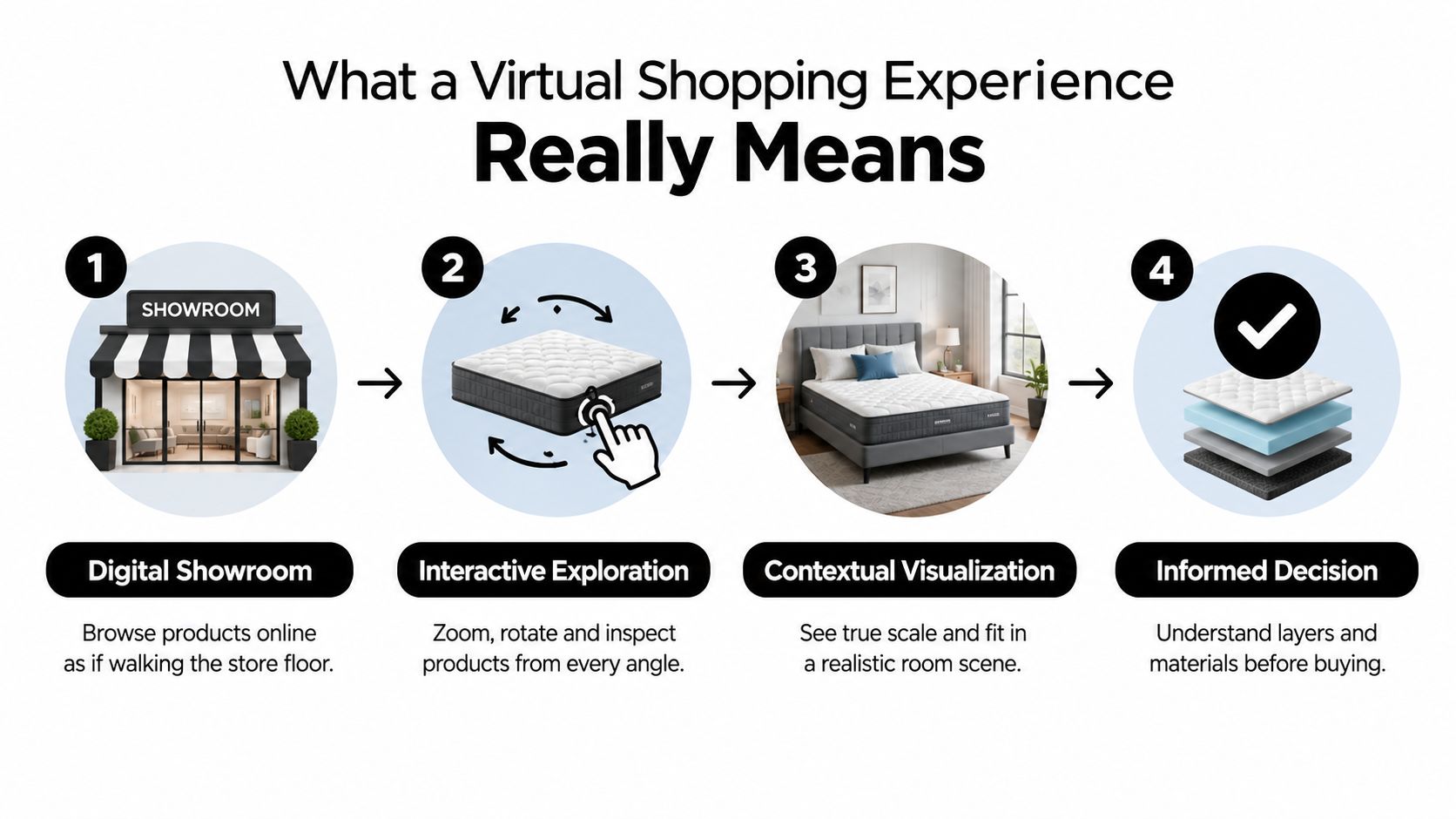
What a Virtual Shopping Experience Really Means
Think of it as bringing the showroom walk-around to the screen.
Not the whole store. Not a gimmicky headset demo. Just the parts of the in-store process that help someone decide. Looking at the bed from different angles. Understanding the build. Seeing scale in context. Comparing options without guessing.
What counts as a virtual shopping experience
For mattress brands, a true virtual shopping experience usually includes some mix of these elements:
Interactive product viewing The shopper can rotate, zoom, and inspect details instead of flipping through static gallery shots.
Construction storytelling Layer peel visuals, cutaways, or Digibun-style breakdowns help explain foam layers, coils, and cover materials.
Spatial context Room scenes and AR placement help shoppers judge bed height, footprint, and fit with their bedroom furniture.
Decision support Clear comparisons, feature callouts, and guided interactions reduce the “they all look the same” problem.
A standard image gallery isn't enough. It shows the mattress. A virtual experience helps the shopper evaluate it.
Why the distinction matters in bedding
Mattress brands often confuse “more media” with “better experience.” They're not the same.
You can upload ten photos and still leave a shopper unsure about firmness, profile, edge shape, or why one model costs more than the next. By contrast, even a simpler interactive setup can do more work if it answers the right questions.
That's where a lot of smart UX thinking comes in. If you're reviewing digital merchandising flow more broadly, Nerdify's piece on effortless shopping journey tactics is a practical companion because it focuses on reducing friction, which is exactly what mattress PDPs need.
The best virtual shopping experience doesn't feel like tech. It feels like clarity.
A mattress-specific definition
In plain language, a virtual shopping experience for bedding is an interactive way to help shoppers inspect, understand, and trust a mattress before purchase.
That might mean:
a clean 360 product spin for a promotional all-foam model
a room scene that shows how a 15-inch profile looks on an upholstered base
a layered construction view that explains pressure relief and support zones
an AR scale check that helps the shopper confirm size in their actual room
Those are different tools, but they serve the same purpose. They replace uncertainty with understanding.
How Presence and Immersion Drive Buying Confidence
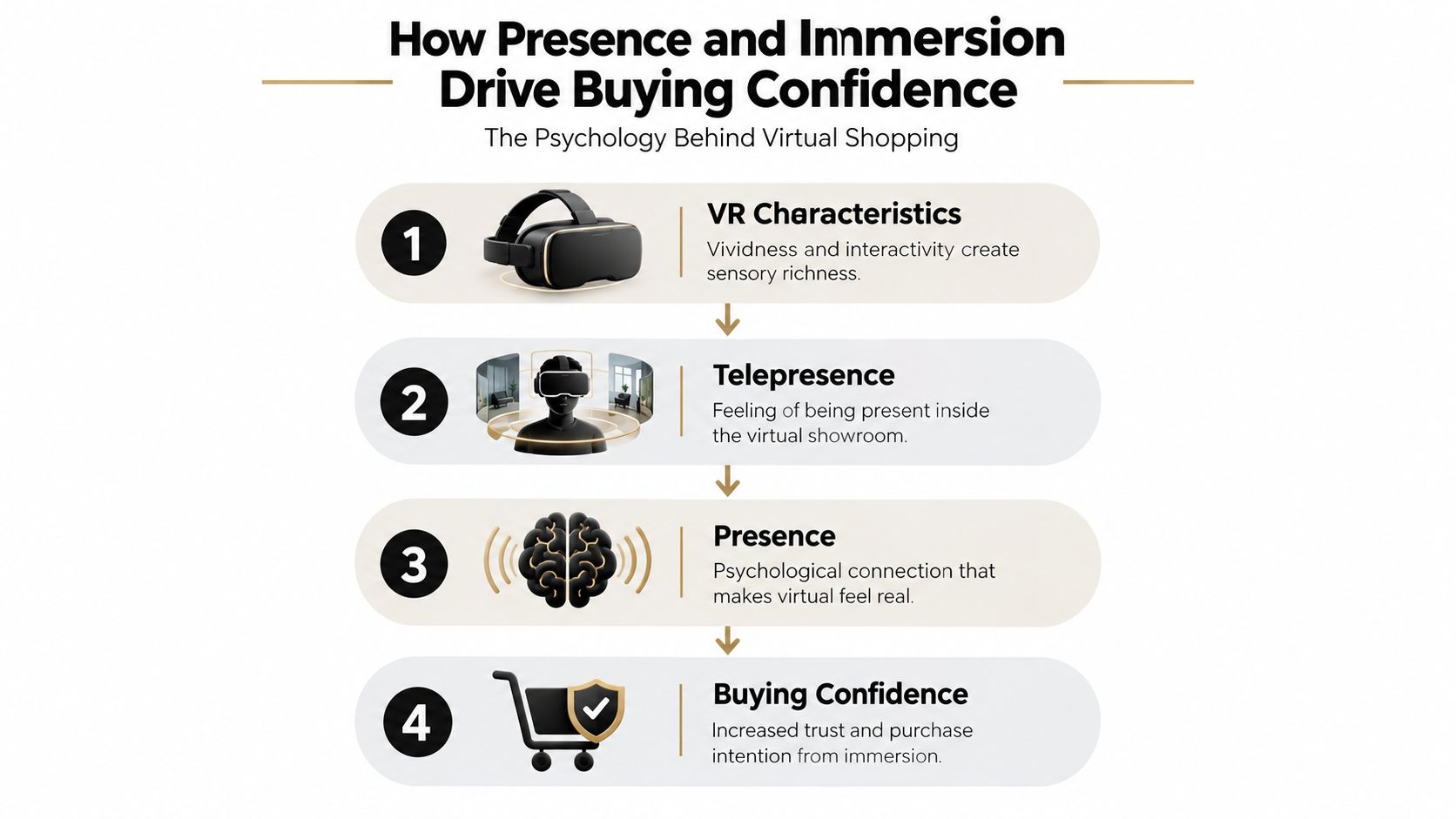
Some virtual shopping tools feel helpful right away. Others feel clunky, distracting, or oddly exhausting. The difference usually isn't whether the graphics are flashy. It's whether the experience creates presence.
A literature review of 72 VR-shopping studies found that VR characteristics and the user's VR experience are the main drivers of purchase and non-purchase behavioral intentions, with user experience standing out as a stronger predictor than the hardware itself, according to the Journal of Business Research review.
What presence looks like in mattress retail
Presence is the feeling that the digital environment is coherent enough to hold attention and support judgment. In a bedding context, that can mean a shopper feels oriented, in control, and able to inspect the product without friction.
That matters because a mattress decision is unusually interpretive. Shoppers are trying to estimate comfort, height, support, and finish quality from a screen. If the interface interrupts them, confidence drops fast.
Research summarized in a virtual fashion context also found that immersive virtual reality outperformed desktop virtual reality on hedonic value, utilitarian value, and overall user experience, while other work points to telepresence inputs like control, color, graphics vividness, and 3D authenticity as important factors in engagement and evaluation, as reviewed in the immersive and desktop VR study summary.
What actually improves confidence
For mattress brands, the practical lesson is straightforward. Don't chase complexity first. Build an experience that feels stable and understandable.
Focus on:
Control: Let shoppers rotate, zoom, and reveal layers without awkward gestures or hidden menus.
Visual coherence: Quilting, side panels, handles, and profile height should read consistently from angle to angle.
Navigation ease: The shopper should know where to click next without hunting.
Sensory logic: Product detail, labels, and scene design should support the comfort story instead of competing with it.
Practical rule: If the interface makes the shopper think about the interface, it's hurting the sale.
A virtual mattress display can even outperform a physical environment on perceived presence in some conditions, which is a useful reminder that digital doesn't have to be second best when it's designed well.
Where executives often misread the problem
The common mistake is assuming fidelity alone will carry the experience. It won't.
A detailed render with slow loading, jumpy motion, or confusing controls can underperform a simpler model that loads quickly and communicates clearly. Bedding shoppers don't need a tech demo. They need a trustworthy path from curiosity to conviction.
If you want a mattress-specific look at that bridge between visualization and buyer understanding, Bedhead's overview of augmented reality product visualization is a useful reference.
Technology Options for Mattress Brands Compared
Not every mattress brand needs the same stack. A regional retailer with strong showroom traffic has a different problem than a DTC startup selling three boxed hybrids online. The right virtual shopping experience usually comes from choosing the right combination of tools, not buying the most immersive thing available.
Start with the problem, not the platform
If shoppers don't understand what's inside the mattress, you need construction storytelling.If they can't judge fit in a bedroom, you need spatial context.If the PDP feels passive, you need interaction.
That's why the comparison matters.
Technology | Best For | Mattress Example | Consideration |
|---|---|---|---|
3D rendering and Digibuns | Explaining construction and premium details | A cutaway showing quilt, comfort foams, transition layers, coils, and base support in a hybrid mattress | Requires accurate modeling so the visual matches the actual build |
Silhouettes and room scenes | Clean PDP presentation and lifestyle context | A queen mattress shown on a platform bed in a realistic bedroom with true profile height | Strong for consistency, but less interactive on its own |
Augmented reality | Size and placement confidence | A shopper places a king mattress in their bedroom to judge footprint and height | Best when scale matters and the interface is simple |
360 spins and interactive imagery | Shopper control without full VR buildout | A user rotates the mattress, zooms into gusset stitching, and inspects the top panel | Useful middle ground, but it won't explain internal construction by itself |
Configurators and guided selectors | Comparison and decision support | A selector helps a shopper compare plush, firm, and profile-height variants | Needs clean logic or it can overwhelm the shopper |
Where each one wins
Digibuns and construction visuals win when the sales story depends on what the customer can't see from the outside. That's common in foam-heavy assortments, zoned support builds, and premium hybrids where the internal story carries the margin.
Room scenes and silhouettes win when the catalog needs consistency across multiple SKUs, dealers, and campaigns. They're especially useful for manufacturers supplying retailers who need clean, standardized assets fast.
For brands exploring broader inspiration around campaign concepts, Silver Spoon Agency has a few augmented reality customer engagement ideas that can help teams think beyond the product gallery.
The practical stack for most bedding brands
In most mattress programs, the strongest mix isn't all-in VR. It's a layered system:
Base layer: high-quality silhouettes and room scenes
Trust layer: Digibun or cutaway construction storytelling
Interaction layer: 360 viewing or guided comparison
Context layer: AR for size, scale, or in-room preview
For teams evaluating what kind of asset pipeline supports that mix, Bedhead's article on 3D product visualization software gives a useful grounding in the production side.
Business Benefits That Matter on the Mattress P&L
This isn't just a creative upgrade. It's a margin conversation.
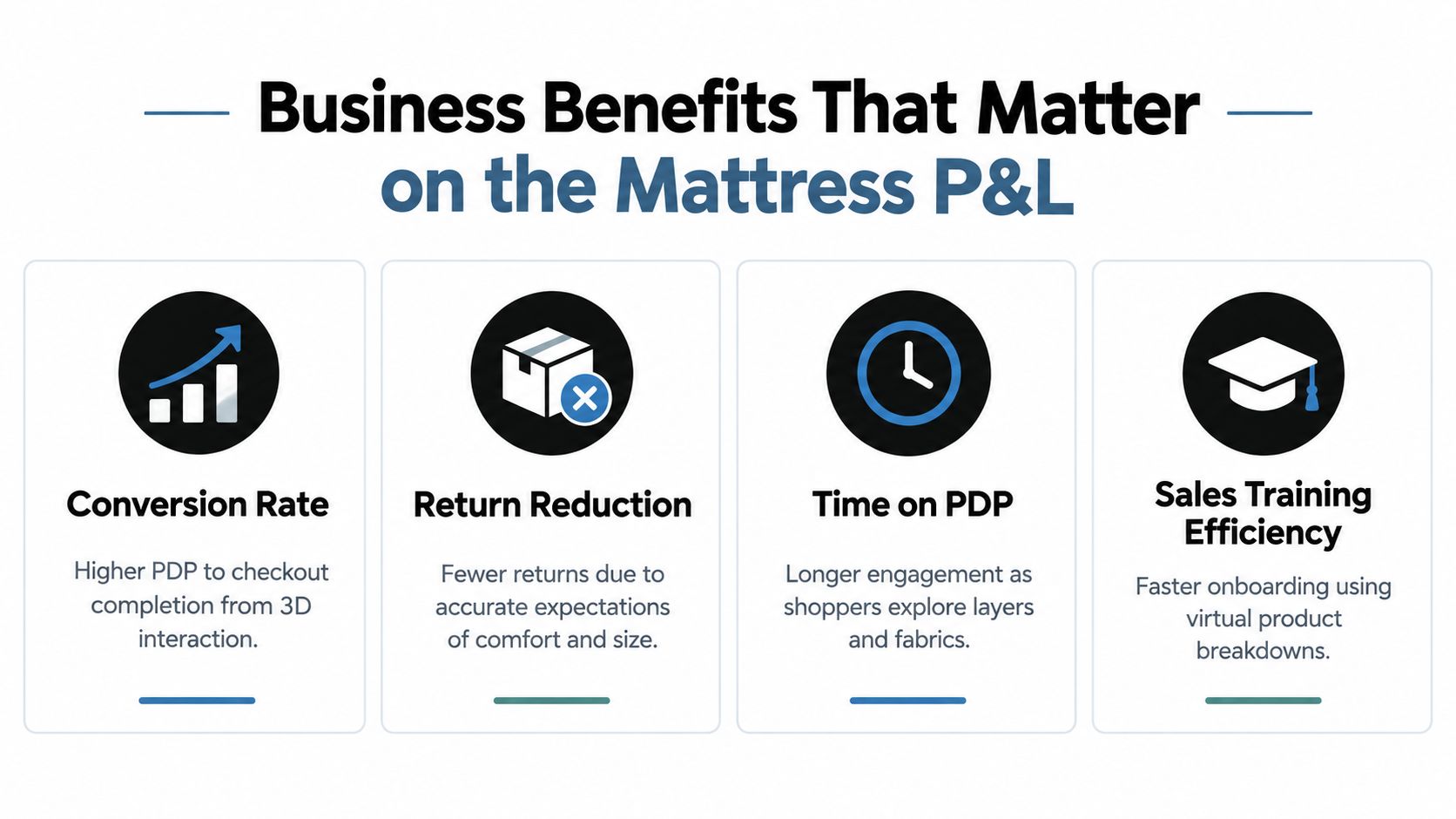
One market analysis projects the virtual try-on market at $15.18 billion in 2025 and $48.10 billion by 2030, implying a 25.95% compound annual growth rate, while also noting that only about 1% of e-commerce businesses currently offer virtual try-on even though 71% of consumers say they would shop more with AR try-on. The same source reports conversion lifts of 20% to 35% and return reductions of 25% to 40% tied to these tools, which is why the adoption gap matters for retailers that still rely on flat merchandising alone, according to virtual try-on market statistics.
Why this matters more in mattresses
A mattress return is expensive. So is a low-converting PDP for a product with healthy average order value and long consideration cycles.
When shoppers misunderstand height, support story, or construction differences, they either hesitate before purchase or regret the purchase later. Better visualization helps on both ends. It supports conversion by improving pre-purchase confidence, and it can protect margins by narrowing the expectation gap.
A separate peer-reviewed ecommerce study in online clothing found conversion rose from 2.5% to 4.3% after AR implementation, which the paper describes as a 72% increase, while product return rates fell by 41.7%, according to the AR ecommerce performance study. That's not a mattress study, but the logic carries over strongly to bedding because mattresses also depend heavily on confidence before checkout.
Benefits beyond the product page
The upside isn't limited to ecommerce.
Retail training: RSAs can learn product construction and talking points through virtual breakdowns instead of relying only on physical floor samples.
Dealer sell-in: Manufacturers can present layered stories, silhouettes, and room scenes without shipping every model for every meeting.
Ad creative reuse: The same 3D assets can support PDPs, paid media, marketplaces, and sales decks.
Margin defense: Better explanation helps justify premium models that otherwise look too similar in static photography.
Virtual shopping earns its keep when it helps the shopper understand why this mattress is worth buying, not when it simply adds motion.
For teams comparing digital showroom value more broadly, this guide to virtual showroom benefits is a useful outside perspective on how visual environments can support product understanding and selling efficiency.
How to Build a Virtual Shopping Experience Step by Step
Most failed launches don't fail because the idea was wrong. They fail because the brand started with a flashy front end before building accurate product assets and a clear use case.
A better path is simple. Build the foundation first, then add interaction where it improves decisions.
Step 1 through Step 2
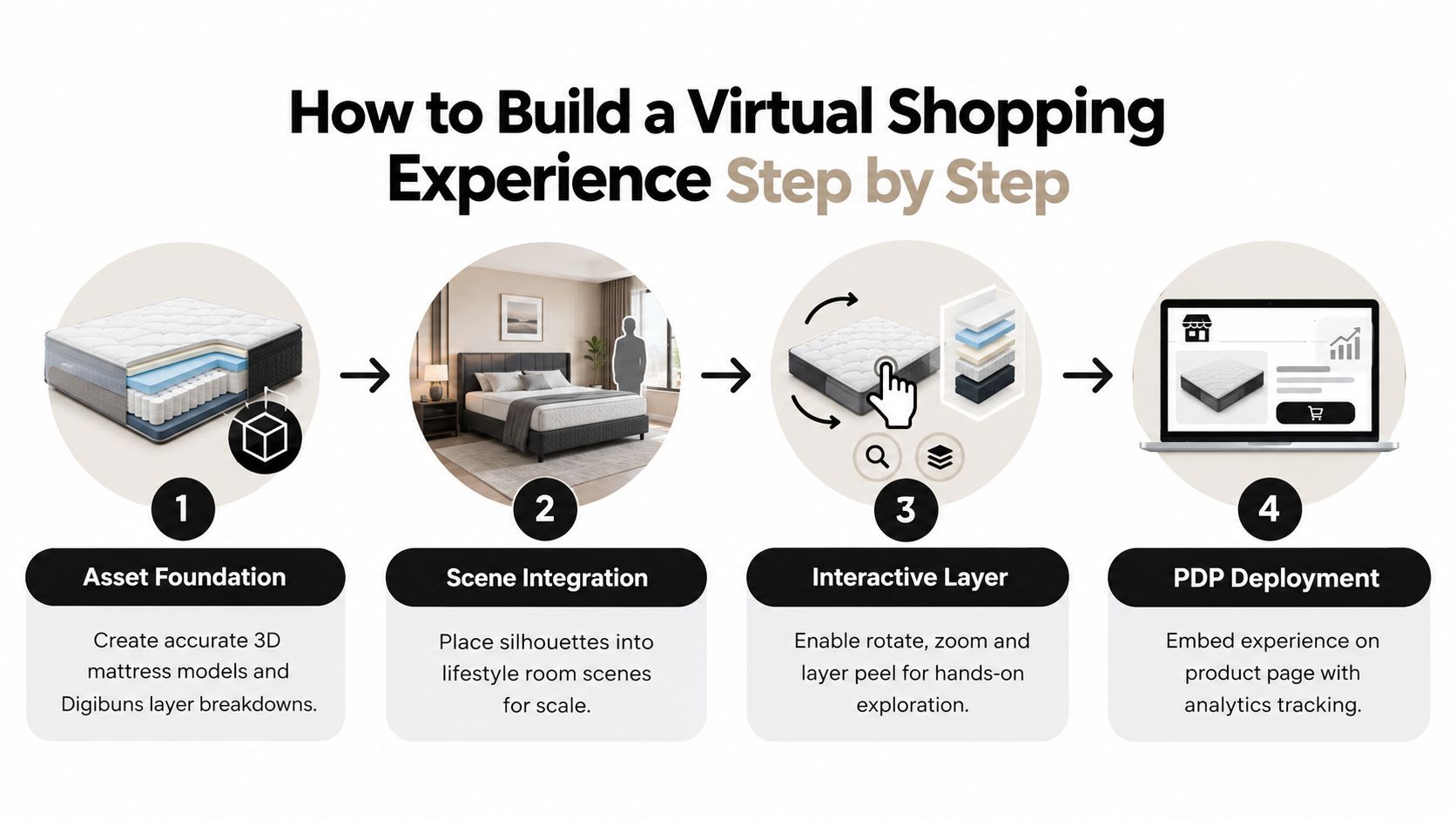
Create accurate base assets Start with the actual product, not a stylized approximation. The model should reflect profile height, edge shape, quilting pattern, gusset treatment, handles, labels, and construction details. If you want to explain what's inside, build the layer structure accurately too.
Choose the main shopping question Don't ask one experience to solve every problem. Decide whether the first version is meant to explain foam layers, show bedroom fit, improve comparison, or support retail training. That decision determines the interface.
A team might use BEDHEAD for this asset layer because it produces mattress-specific 3D visuals such as Digibuns, silhouettes, and room scenes, but the larger point is vendor-neutral. The assets have to be technically accurate and commercially usable.
Step 3 through Step 4
Add interaction where it reduces doubt Rotate, zoom, peel layers, swap profile views, or trigger feature hotspots. Keep each interaction tied to a buying question. If it doesn't help a shopper decide, leave it out.
Deploy on the PDP with performance in mind Loading speed, stability, and intuitive controls matter more than novelty. A beautiful experience that stalls on mobile won't support presence or conversion.
Useful checkpoints include:
Mobile behavior: Make sure touch controls feel natural.
Scene discipline: Keep room scenes realistic enough to help with scale, but not so busy they distract.
Measurement plan: Track which interactions correlate with stronger product understanding, not just clicks.
Sales alignment: Give retail teams the same visuals so the in-store story and online story match.
The privacy tradeoff many brands skip
Rich environments can create trust, but they can also create discomfort if they feel too invasive.
Research on virtual shopping and privacy points to a real tension here. Full-body avatars may make virtual stores feel easier to use, yet they can reduce perceived privacy compliance, while hands-only avatars can increase a sense of control even if they ask more cognitive effort from the user, according to the privacy and identity management review.
That matters in mattresses because the purchase is personal. Shoppers often want confidence and guidance without feeling tracked, watched, or overexposed. If you're evaluating tools in this category, Bedhead's overview of interactive product demo software is a practical place to compare experience formats.
Mattress Examples and Your Next Move
A good virtual shopping experience becomes easier to understand when you map it to real bedding use cases.
Three mattress-native examples
Hybrid explanationA shopper lands on a premium hybrid PDP and opens a layered view. They see the quilt, pressure-relief foams, transition layers, coil unit, and base support in sequence. That reduces the “why is this one more expensive?” problem.
Bedroom fit checkA shopper considering a king mattress uses AR or a realistic room scene to judge footprint and profile height next to nightstands and a headboard. That's more useful than a dimension table alone.
Retail and dealer trainingA manufacturer builds a virtual product walkthrough for RSAs and dealer reps. Instead of moving floor models or relying on static slides, the team can show ticking details, gusset finishing, and internal construction in a consistent way.
What to evaluate first
If you're deciding whether to invest, start with three questions:
Where do shoppers lose confidence now? On size, construction, comfort story, or premium justification?
Which products need explanation most? Usually hybrids, feature-rich premium models, and private label programs with lookalike exteriors.
Can the assets work across channels? The strongest programs feed PDPs, ads, sales decks, and showroom training from the same visual system.
If your current product page would force an RSA to explain everything over the phone, the page needs better visualization.
There's also a broader market signal worth noting. A U.S. survey reported that 44% of respondents had used virtual try-on on a retail site, and 49% said they were likely or very likely to buy from a brand that offers it, according to Chain Store Age's virtual try-on survey coverage. That doesn't mean every mattress brand needs the same feature set. It does mean shoppers are already comfortable with interactive buying aids.
For bedding brands, the opportunity is to use that comfort in a way that improves decision quality. Not just novelty. Not just motion. Clearer understanding, stronger confidence, and fewer expensive surprises after delivery.
If you're reviewing your current imagery, compare your best-selling mattresses first. Can a shopper quickly understand the quilt, ticking, gusset, foam layers, height, and fit without calling the store? If not, that's where the work starts. And if you want a free mattress-industry hub for insights, training, news, networking, directory access, and business tools, visit Bedhead Network.
Bedhead Marketing is a mattress-industry-focused agency and 3D design studio that helps manufacturers, retailers, private label brands, and sleep startups turn product complexity into clear digital selling tools. If you're building a virtual shopping experience, updating PDP visuals, or need assets like Digibuns, silhouettes, room scenes, SEO support, or sales training materials, visit BEDHEAD.