Social Media Marketing Services for Mattress Brands
Your mattress ads are getting clicks, but the product page doesn't explain the hybrid's construction, and showroom staff don't recognize the offer shoppers bring in. You're paying for attention without giving buyers a clear next step. Social media marketing services should close those gaps, connecting product proof, campaign execution and the retail handoff, not filling a posting calendar.
For mattress brands, the useful question isn't how often an agency posts. It's whether the team can translate what's inside the mattress into a reason to investigate, visit or buy, then measure the outcome without claiming credit for every sale.
What Social Media Marketing Services Include
Social media marketing services are the planning, production, paid media, community work and measurement a mattress brand buys to move a shopper from feed to purchase. A shopper sees your hybrid on Instagram, then lands on a page using different layer names and no explanation of the support system. More posts won't fix that mismatch. Six components do the work, and most brands only need two or three of them done well.
Social media marketing services by component
Service | What It Covers | Mattress Example | Who Usually Needs It |
|---|---|---|---|
Creative production | Static, video and 3D assets built for feeds and ads | Digibun layer breakdown of a hybrid mattress | Manufacturers launching a new line |
Paid social | Targeted ads on Meta, TikTok and YouTube | Promotion aimed at households within a store's drive radius | Retailers and eCommerce brands |
Community management | Replies to comments and direct messages | Answers on firmness, trial periods and returns | eCommerce managers |
Creator partnerships | Sourcing and managing sleep-focused creators | Creator review of quilt and gusset construction | Startups and private label brands |
Local and retail content | Location-specific posts and ads tied to store pages | Ad linking to a specific showroom appointment page | Brick-and-mortar retailers |
Measurement and reporting | Campaign tracking, benchmarks and attribution checks | Monthly report separating awareness from sales | All clients |
Creative production makes construction understandable. Digibuns reveal internal layers, Silhouettes provide clean product views, and Room Scenes place the mattress in a bedroom setting. Community management handles the questions those assets can't settle, including how firmness is described and which trial or return terms apply. Paid social distributes the message, while creator partnerships add a person's explanation and demonstration. Neither should run without approved product information. A creator can describe the quilt's appearance and their own experience, but shouldn't improvise specifications or promise how every sleeper will feel.
Buy the missing capability
Manufacturers usually need launch assets and dealer support. Retailers need local paid social and appointment tracking. Private label brands and sleep product startups often need the full package, and paying for all six components before the product page explains the construction is the most common waste of budget.
For teams establishing a shared vocabulary, Gainsty's explanation of what social media marketing means covers the basics. The commercial scope is substantial: global social advertising approached US$250 billion in 2024, according to DataReportal's Digital 2025 overview, which makes media planning a serious responsibility rather than an extension of posting.
BEDHEAD is a digital marketing agency and graphics design studio focused on the mattress and bedding industry, offering digital marketing, eCommerce strategy, creative asset creation, product storytelling, high-end visual content, website design and 3D visualization.
Mark the two service rows that match your biggest gaps. Buy against those needs before buying a larger content calendar.
How a Social Campaign Moves from Brief to Report
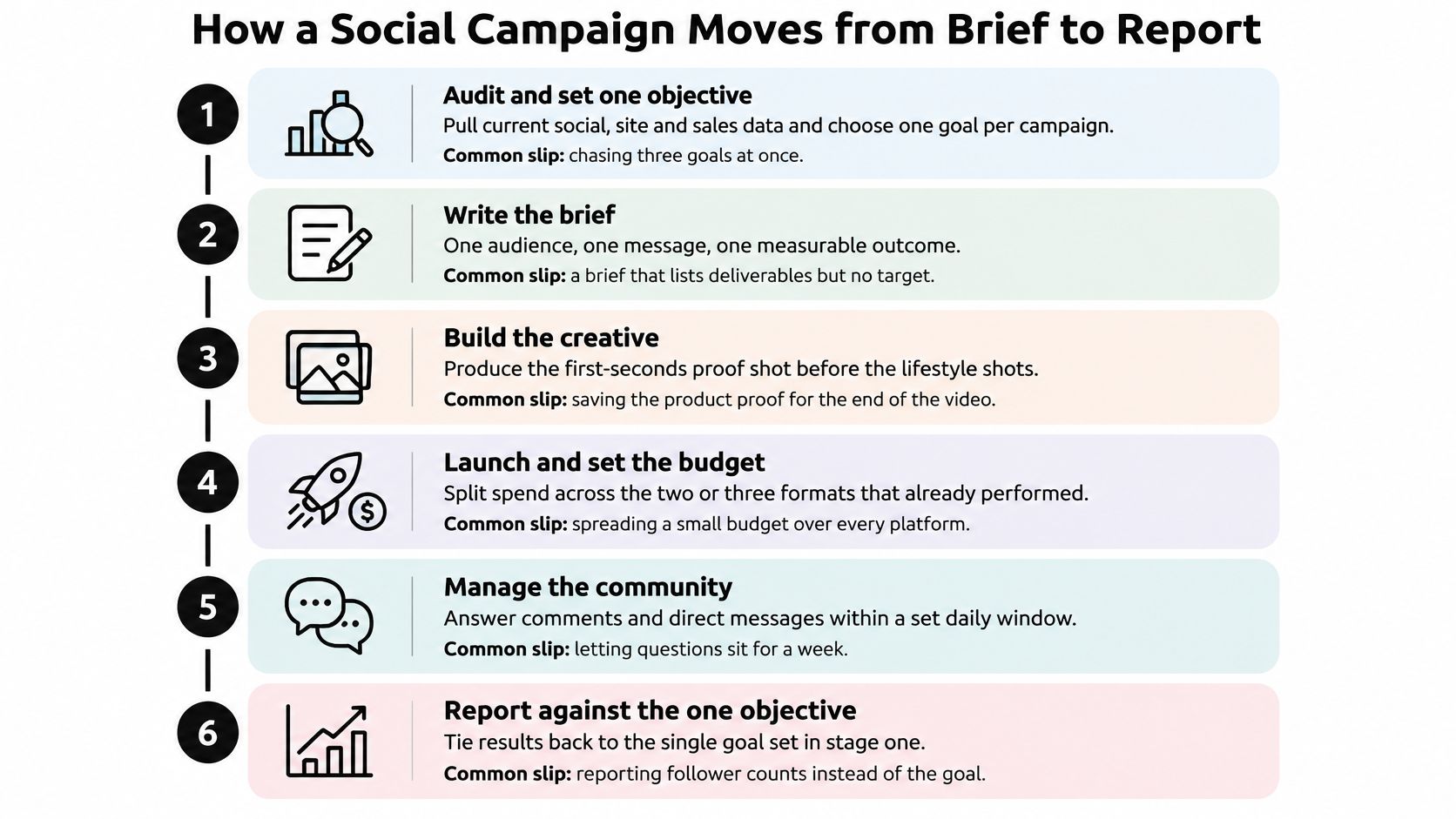
A campaign needs a repeatable operating process, with clear approvals and someone responsible for each handoff. The workflow below helps prevent an attractive asset from reaching launch without a usable destination or measurement plan.
Build around a decision
Audit and set one objective. Pull current social, website and sales information, then choose awareness, traffic, leads or sales as the campaign's primary job. The common slip is asking the same campaign to introduce an unfamiliar brand, educate buyers and close purchases immediately.
Map audience and platform. Separate consumer shoppers from dealer prospects, and match the message to their buying situation. Copying the same post everywhere ignores differences between a local shopper looking for a floor model and a retailer evaluating a new line.
Write the creative brief. Specify the product proof the opening must show, the approved claim and the intended action. A brief that asks the ad to explain cooling, support and value equally gives the production team no clear priority.
Build and launch. Set audiences and budgets, add campaign tags, verify conversion events and check the destination on a phone. A common failure is launching an offer that the landing page doesn't repeat, leaving shoppers and reporting teams with different versions of the campaign.
Test deliberately. Compare controlled variants against a consistent audience and budget, allowing enough delivery to assess the outcome. Changing the opening, offer, audience and destination together makes it difficult to explain why performance changed.
Optimize and report. Move spend toward stronger evidence, not merely the variant with more reactions. Report against the original objective and record what the next creative brief should keep, remove or investigate.
Keep the operating rhythm manageable
Use a weekly performance check to catch broken tracking, exhausted creative and unanswered questions. Review the creative mix monthly and reconsider the broader plan quarterly, treating those intervals as a working cadence rather than a promise of results.
Community work belongs throughout the process. Assign responsibility for public comments, private messages and questions that need a retailer or customer-service response, so launch doesn't create an unattended inbox.
Practical rule: Every report should end with a decision someone can act on, not another page of unexplained charts.
Choosing Platforms by Where Mattress Buyers Spend Time
US adult social media use by platform, 2025
The figures below come from Pew Research Center's survey of 5,022 U.S. adults, conducted February 5 through June 18, 2025: 84% had used YouTube, 71% Facebook, 50% Instagram, 37% TikTok and 32% WhatsApp.
Platform | US Adults Who Use It (2025) | Best Job for a Mattress Brand |
|---|---|---|
YouTube | 84% | Long-form product education and dealer training |
71% | Local retail events, dealer promotions and local ads | |
50% | Room scenes, carousels and side-by-side comparisons | |
TikTok | 37% | Short demos of edge support, bounce and motion isolation |
32% | Direct customer questions and sales conversations |
Reach isn't purchase readiness. These adoption figures help establish where an audience might be available, not whether its members need a mattress or want to hear from your brand.
YouTube suits explanations that need space: hybrid construction, model comparisons and dealer education. Facebook gives local promotions a practical home, while Instagram works well for visually organized comparisons. TikTok demands demonstrations that make sense quickly, and WhatsApp needs a team ready to handle conversations.
Give each channel a commercial job
Start with a focused platform mix, establish a measured baseline and expand only when the team can support the additional production and response work. An underfunded presence across every channel leaves little room to learn which message works.
For example, a regional retailer could prioritize Facebook and Instagram ads linked to individual showroom pages, while maintaining YouTube as a product-education library. Judge local campaigns on qualified appointments and educational videos on meaningful viewing, rather than forcing both into the same scorecard.
The destination matters as much as the platform. BrightLocal's local-business search findings report that 61% of consumers began their most recent local-business search on Google, reinforcing the need to coordinate social promotions with accurate search and location information.
Match the store. Send shoppers to the advertised location, not a homepage that makes them search again.
Confirm availability. Identify which showroom carries the promoted mattress and whether shoppers can try it.
Make contact easy. Show accurate address, phone number, hours and an appointment path.
List your existing channels and assign each a job from the table. Pause any channel that has no defined audience, purpose or owner.
Creative That Shows Proof in the First Seconds
An ACM-published analysis of TikTok eCommerce advertising found that 85.2% of viewers exited during the first 25% of a video's duration. For mattress creative, that's a reason to put the differentiator before the logo animation or bedroom reveal.
A product-led opening gives shoppers something concrete to evaluate.
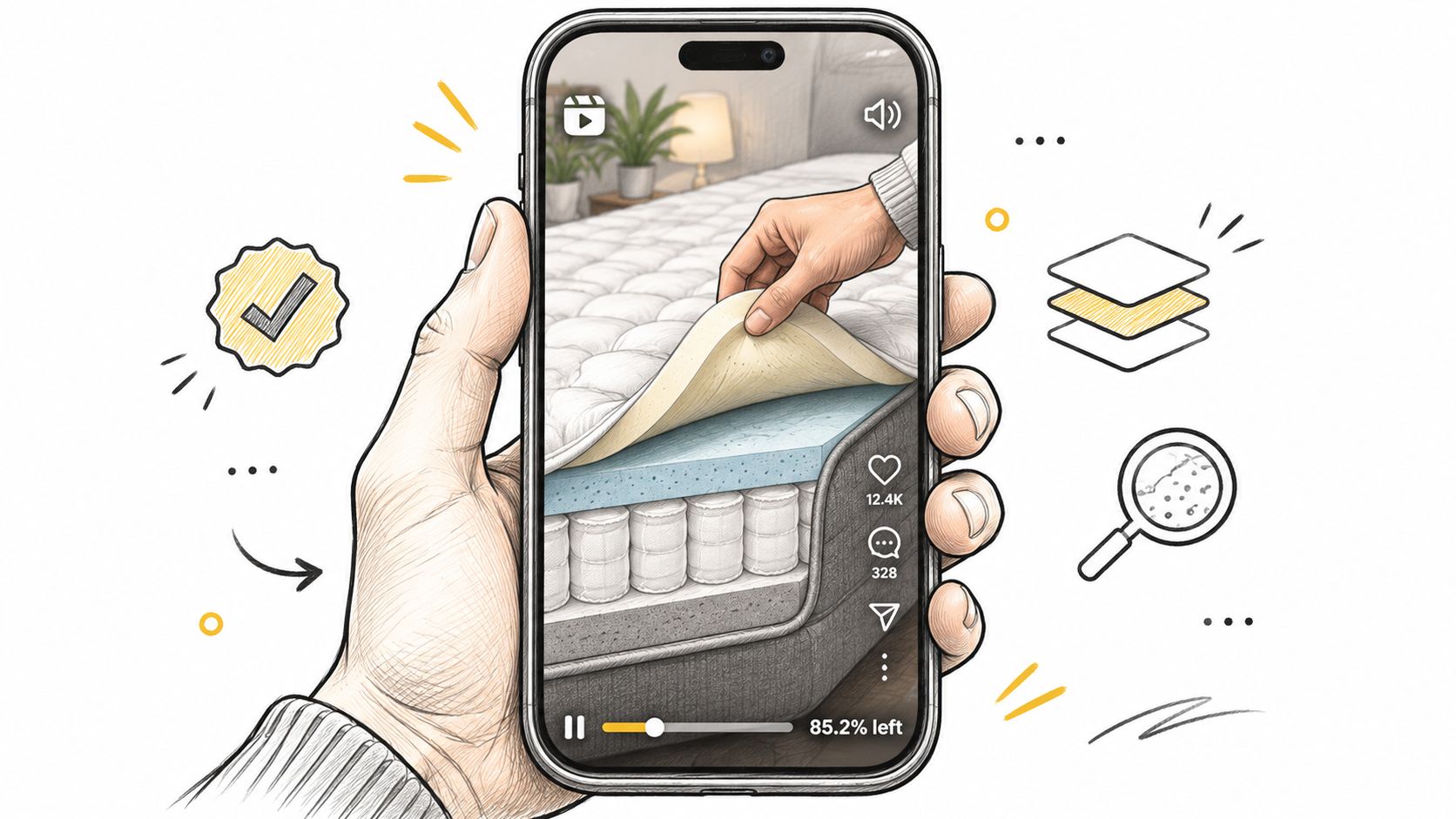
Show a motion-isolation demonstration with a glass of water, a documented cooling-material test or a concise hybrid-versus-all-foam comparison. A pressure-relief body outline can explain a design concept, but it shouldn't resemble measured pressure-map evidence unless that evidence exists.
Match the asset to the explanation
Digibuns explain construction. Use layer breakdowns to identify foam layers, support components, ticking and quilt construction. Connect each component to an approved benefit instead of displaying unexplained material names.
Silhouettes clarify the product. Clean views help shoppers recognize the actual model across feeds, product pages and marketplace listings.
Room Scenes establish context. Lifestyle renders show the mattress in a bedroom and can support showroom displays without replacing construction details.
Short demonstrations show behavior. Edge compression, bounce and motion transfer need consistent filming conditions so comparisons remain meaningful.
Our 3D design studio supports these visual formats, and our services include website design and 3D visualization for mattress and bedding brands. That makes it possible to align the ad's explanation with the product page rather than commissioning disconnected assets.
For authentic customer perspectives, use our guide to creating user-generated content to plan participation and permissions. Teams exploring how to create videos with AI through ClipNova should treat generated output as production material requiring product review, not automatic evidence.
Test the opener without confusing the result
Vary the opening frame, claim, demonstration or caption separately while holding audience and budget as constant as practical. Track hook retention, completion, landing-page engagement and conversion separately.
Say a private label brand compares a Room Scene opener with an edge-support demonstration. The demonstration shouldn't win solely because more viewers stayed; it must also attract shoppers who investigate or convert.
A compelling demonstration earns attention. A consistent product page gives that attention somewhere useful to go.
Choose a single substantiated claim, then write the opening frame before writing the script.
Disclosing AI-Generated Visuals Without Losing Trust
In Emplifi's consumer survey on digital authenticity, 91% of consumers expected brands to disclose AI use in marketing. A realistic image isn't necessarily a trustworthy image, particularly when it depicts product details that shoppers will later inspect in a showroom.
For bedding, the issue is more specific than whether a bedroom looks artificial. A generated surface can suggest a deeper quilt, a different gusset or foam layers that aren't in the production model.
Establish approval rules before production
Label material synthetic content. Disclose AI-generated or materially AI-edited visuals wherever viewers could reasonably mistake them for photographs of the actual product. Distinguish generated imagery from specification-built 3D visualization rather than treating every digital asset as the same thing.
Check the product representation. Verify every specification depicted or stated, including coil count, foam density, ticking and quilt construction, against approved documentation and the production sample. Keep an approval record so an outdated render doesn't return in a later promotion.
Restrict invented evidence. Don't generate customer testimonials or fabricate comfort and performance claims. Preserve consent records for real customer quotations and likenesses.
AI Video Detector's synthetic content guide can help a marketing team establish shared terminology before writing its disclosure policy. The policy still needs to address your actual production workflow and approval responsibilities.
Use automation without changing the mattress
Say a manufacturer's generated Room Scene shows a plush top layer that the production model lacks. Adding a disclosure doesn't fix the misrepresentation: rebuild the product from the approved specifications, then identify the scene appropriately as a styled illustration.
AI can assist with caption drafts, resizing and report summaries without intentionally changing the product. Those tasks still need human review for inaccurate claims, cropped disclosures and misleading interpretations.
Write the disclosure and approval rules on a single page and attach them to every creative brief. Include accessible alt text and retain original files so the team can explain what was photographed, rendered or generated.
Benchmarks That Match Each Campaign Objective
Social campaign metrics and reference values by objective
WordStream's 2025 Facebook benchmark, based on 1,180 campaigns run from April 2024 through June 2025, reported an all-industry traffic-campaign click-through rate of 1.71% and lead-campaign conversion rate of 7.72%, with some sectors exceeding 10% lead conversion.
Campaign Objective | Metrics to Track | All-Industry Reference (2025) |
|---|---|---|
Awareness | Reach, qualified video views, cost per thousand reached | Establish an audience- and format-specific baseline |
Traffic and consideration | Click-through rate, engaged sessions | 1.71% traffic-campaign CTR |
Lead generation | Lead conversion rate, cost per qualified lead, dealer inquiry quality | 7.72% lead-campaign conversion rate |
Sales and demand | Cost per acquisition, revenue, assisted conversions | Set against contribution margin and your sales baseline |
These are reference points, not mattress-category targets. Compare your own results with your established baseline first, then use the relevant external benchmark to identify questions worth investigating.
A higher click-through rate doesn't prove that acquisition became cheaper. Shoppers can click enthusiastically on a promotion and abandon the product page when they discover delivery exclusions, unavailable sizes or an offer that doesn't apply to their preferred model.
Define the outcome before evaluating the cost
For a manufacturer, a dealer inquiry needs a quality definition. Capture business identity, market, role and buying intent, then distinguish a prospective retail account from a consumer asking about a warranty.
For a retailer, an appointment request isn't automatically a completed showroom visit. Connect the booking record with attendance and, where possible, the eventual transaction before describing it as revenue-generating demand.
Awareness: Evaluate relevant reach and qualified viewing, with a clear definition of what makes a view useful.
Consideration: Review click-through rate alongside engaged sessions and visits to meaningful product information.
Lead generation: Measure qualified inquiries and their progression, not merely submitted forms.
Sales: Examine acquisition cost and revenue alongside discounts, fulfillment costs and returns that affect margins.
Our guide to social media marketing goals helps connect these measurements to campaign decisions rather than a dashboard's default metrics.
Diagnose before replacing the audience
Suppose a manufacturer's dealer-lead campaign converts below its chosen reference. Inspect the form and landing page first: does the page explain the line, identify the distribution opportunity and make clear who should inquire?
A narrowly qualified lead form may convert less often while producing more useful conversations. Removing qualification questions can make the dashboard look better without improving the sales pipeline.
Measurement standard: A cheaper action is only better when its commercial value holds up.
Establish a baseline for each objective during the initial reporting period, then write that baseline and the success metric into every campaign brief.
Proving Revenue Without Overclaiming Attribution
Last-click reporting can miss the interaction that introduced a mattress brand. A shopper may discover a hybrid through social, compare it elsewhere and later buy in a showroom, leaving the final transaction disconnected from the original exposure.
Measurement difficulties aren't unusual: Nielsen's Annual Marketing Report found that 28% of marketers cited difficulty measuring newer channels as a major obstacle to digital-advertising ROI measurement. More platform-reported revenue doesn't automatically resolve that problem.
Separate observed actions from inferred influence
Direct conversions are purchases or inquiries connected to tracked social interactions under a stated attribution rule. Assisted conversions include journeys in which social contributed but didn't receive the final click.
Awareness and consideration influence requires different evidence. An increase in branded searches or showroom interest may support an explanation of campaign impact, but it doesn't assign every additional sale to social.
A credible measurement plan combines methods rather than presenting a single dashboard total as the complete answer:
Incrementality tests: Withhold advertising from a suitable comparison group to estimate what happened because of the campaign.
Geographic lift tests: Compare advertised markets with matched control markets, accounting for local promotions and distribution differences.
Branded-search trends: Monitor changes in interest without treating correlation as proof.
CRM matching: Connect eligible campaign and customer records using appropriate permissions and platform capabilities.
Retailer-specific codes: Identify redemption by store while recognizing that codes can circulate beyond the original audience.
Post-purchase questions: Capture remembered discovery sources without assuming customers recall every interaction accurately.
Report uncertainty as part of the result
Say a manufacturer advertises in selected metros and leaves comparable markets untreated. Compare changes in showroom sales while documenting stock availability, floor-model placement, pricing and retailer participation, because those differences can distort the result.
Report an estimated range and explain whether confidence is high, medium or low. Label modeled revenue as modeled, and don't add overlapping platform totals as though they represent separate purchases.
Our guide to measuring marketing attribution provides a foundation for discussing these trade-offs. The strongest reporting also distinguishes gross sales from commercially useful revenue after discounts and returns.
Ask a prospective provider how it would test a channel's sales impact, what could invalidate the comparison and what it would recommend if the test showed no lift. An honest answer should allow for improving the execution, changing the offer or stopping the spend.
Vetting a Social Media Provider Before You Sign
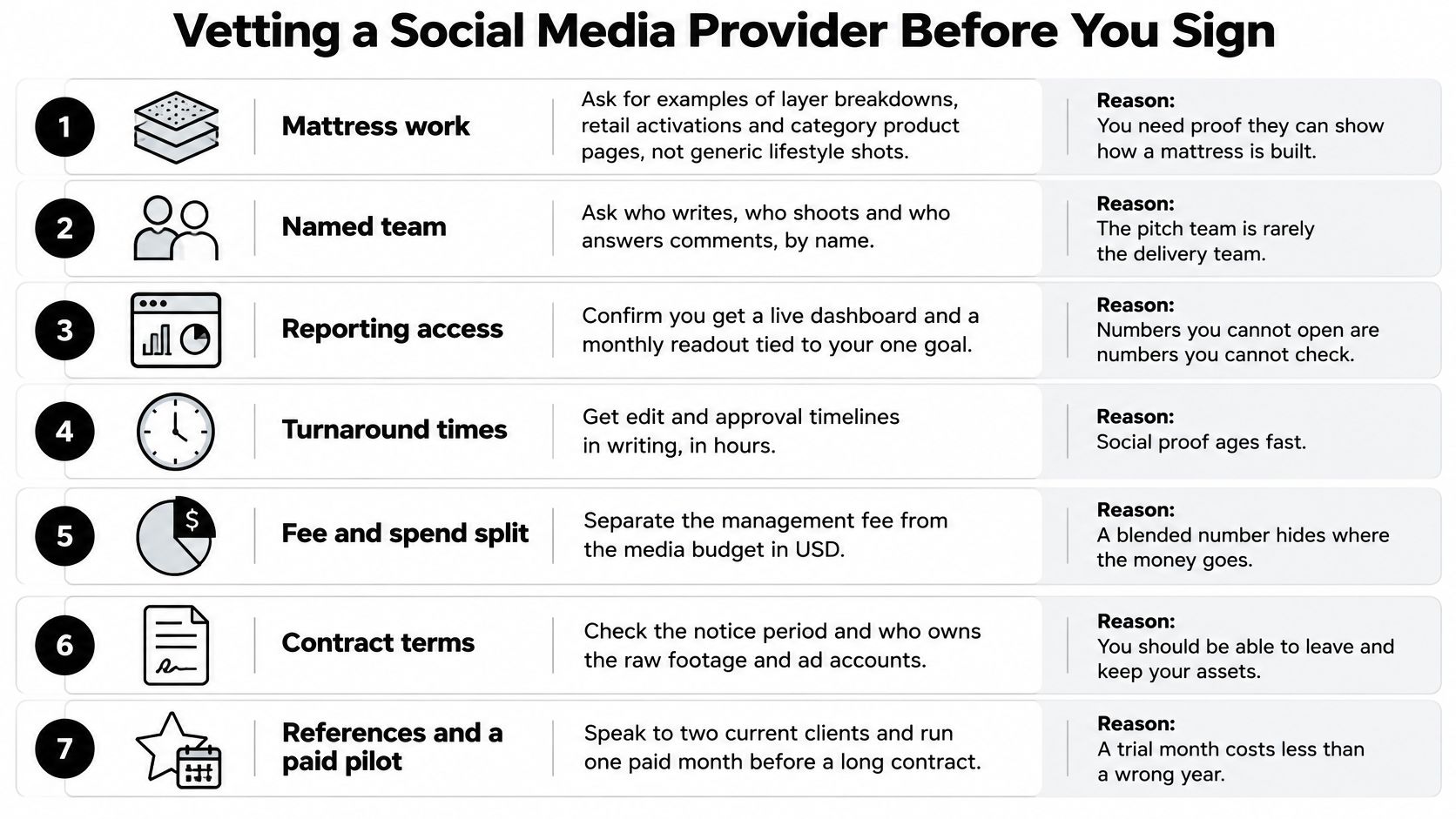
A portfolio shows production ability. A contract and measurement plan show what you're buying.
Check the delivery behind the pitch
Mattress work. Request layer breakdowns, retail activations and category product pages. Accurate ticking, quilt and gusset terminology matters more than a generic lifestyle portfolio.
Measurement plan. Require a named objective, success metric, attribution method and confidence level for sales claims. Ask for a sample report so you can see how the provider will separate activity from commercial impact.
Disclosure policy. Review written rules for synthetic imagery, comfort claims and testimonials. Product accuracy needs an approval process, not an informal promise.
Scope and ownership. Establish who owns renders, source files, footage, accounts and usage rights after the relationship ends. Identify who produces assets, approves edits and answers customer comments.
Retail handoff. Include store destinations, offer details and a staff briefing before launch. Showroom associates need to recognize the promotion and explain the featured floor models.
Honest outcomes. We don't guarantee specific results; outcomes can vary with budget, price, product, competition and factors beyond our control. A proposal shouldn't turn a forecast into a promise.
Fee structure. Separate media spend from management fees and clarify whether 3D production is project-based or included in a retainer. Otherwise, comparing proposals becomes guesswork.
Our guide to evaluating a social media ads agency can help frame your shortlist. Bring the checklist to the first call and ask each provider to walk through a recent report and a recent creative brief.
Consultation inquiries and questions about our Terms and Conditions can go to info@bedheadmarketing.com or our contact form.
BEDHEAD offers mattress-focused social media planning, paid media, 3D creative, product storytelling and high-end visual content to connect what shoppers see with what they can buy. Visit BEDHEAD to discuss your current creative, retail handoff and measurement gaps.