Social Media Marketing Goals for Mattress Brands
That buying journey includes foam layers, ticking, quilt patterns, gussets, hybrid construction, floor models, retailer recommendations, online product pages, and sometimes a salesperson who turns uncertainty into a purchase. Social should support that journey, not sit beside it as a separate reporting line. The practical question is simple: which social actions help create qualified demand, assist a retail sale, or improve ecommerce performance?
Why Mattress Brands Struggle With Social Media Goals
A common monthly report starts with good news. A mattress post featuring a layered hybrid construction has attracted strong engagement. The creative team points to the comments, the account manager highlights follower growth, and the brand feels visible.
Then the sales team asks a less comfortable question: How many people visited a showroom? Which retailers received inquiries? Did product-page sessions increase? Can anyone connect the post with a quote request, a retailer referral, or an ecommerce order?

Likes and follower counts aren't useless, but they're incomplete. A retailer may receive high engagement from people outside its delivery area. A manufacturer may attract consumers while needing wholesale leads. A private label brand may generate video views without clarifying where shoppers can buy the finished product. The report looks active, yet the commercial path remains invisible.
Why the mattress category needs a different standard
Mattresses are high-consideration products. Shoppers often need help interpreting firmness, materials, support, motion isolation, height, foundation compatibility, warranty terms, and return policies. A beautiful room scene can create interest, but it won't answer every question about a quilted cover or the feel of a particular foam layer.
Retail salespeople also influence the final decision. Social content may create recognition before a customer enters a store, while an RSA explains the difference between two floor models and closes the sale. Last-click reporting will often credit the retailer visit or branded search, even when social created the initial familiarity.
Practical rule: If the social report can't show what happened after the interaction, it isn't a complete performance report.
The right response isn't to abandon brand content. It's to give every campaign a job. A manufacturer might want qualified retailer inquiries. A brick-and-mortar retailer may need showroom appointments or product-page visits. An ecommerce operation may focus on product engagement, add-to-cart activity, purchases, and returns. Those goals require different audiences, landing pages, creative, and measurement.
Visual quality still matters because social is a discovery environment. Teams that want to improve their product-led content can review how to build your photography following, then adapt the principle to mattress-specific assets such as Silhouettes, Room Scenes, and Digibuns layered images. The goal isn't to post more often. It's to make each post useful at a defined point in the buying journey.
A SMART Goal-Setting Framework for Bedding Brands
A useful SMART goal starts with a business outcome, not a platform feature. “Grow Instagram” is an activity. “Increase qualified retailer inquiries from manufacturer-focused social traffic” is a direction that a marketing and sales team can act on.
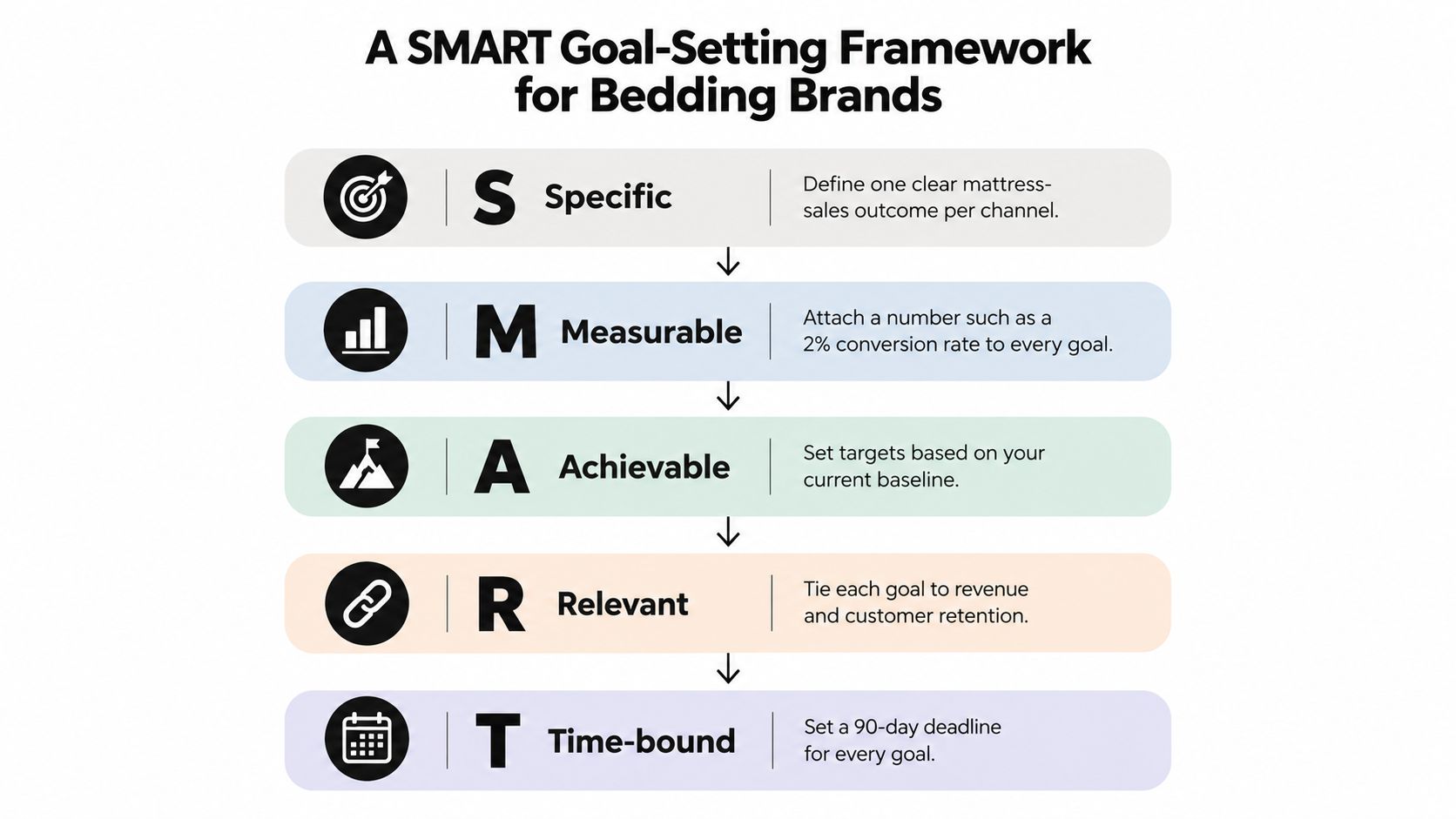
Build the goal in five decisions
Specific: Name the audience, offer, channel, and commercial action. A hybrid manufacturer could target retailer decision-makers on LinkedIn and send them to a product activation page. A direct-to-consumer retailer could target local shoppers with a showroom booking offer.
Measurable: Choose one primary KPI and supporting diagnostics. The primary KPI might be qualified leads, product-page visits, retailer referrals, or purchases. Supporting metrics can include reach, video completion, saves, profile visits, click-through rate, and cost per lead.
Achievable: Start with a baseline from the brand's own previous periods. A small marketing team shouldn't copy a competitor's target without knowing its audience size, media budget, creative capacity, and sales follow-up process.
Relevant: Connect the goal to margin, revenue, customer retention, retailer support, or another operating priority. If the business needs wholesale demand, follower volume isn't the main measure.
Time-bound: Set a review window and define what happens next. A campaign needs a start date, end date, attribution window, and decision rule for continuing, revising, or stopping it.
A practical template is: “For [audience], generate [business action] from [channel] using [offer or creative], measured by [primary KPI], with [supporting diagnostics], reviewed after [defined period].”
Keep the commercial context visible
A mattress brand should also distinguish between a lead and a qualified lead. A form submission from a consumer looking for one mattress is different from a retailer asking about floor samples, margins, delivery, and product training. CRM fields should capture lead type, territory, retailer, product interest, and sales status.
Customer value matters as well. A useful customer lifetime value framework helps teams avoid judging every social interaction only by its immediate transaction. A retailer relationship, repeat purchase, referral, or post-purchase review may justify a different goal from a one-time ecommerce sale.
BEDHEAD works in this specialized space as a mattress-focused agency, 3D design studio, brand development partner, consultation resource, and sales training organization. That combination is relevant when the social goal depends on more than captions. The creative must explain the product, the landing page must support the claim, and the retail team must know how to use the resulting demand.
Mapping Social Goals to the Mattress Buying Journey
A mattress shopper rarely moves from a single post directly to checkout. The path may begin with a short video showing a hybrid mattress construction, continue through a product page, move to a retailer locator, and end with an in-store conversation. A social goal should reflect the stage it is designed to influence.
At the discovery stage, focus on qualified reach, impressions in target markets, video views, completion behavior, follower growth, branded searches, and share of voice. These measures help answer whether the brand is reaching the right consumers, retailers, designers, or sales representatives. Broad visibility can be appropriate for a new product line or an unfamiliar private label brand, but audience quality still matters.
At the consideration stage, the signals become more deliberate. Track saves, shares, comments that indicate buying questions, profile visits, link clicks, click-through rate, product-page engagement, retailer-locator use, downloads, and direct inquiries. A consumer saving a post about firmness or construction may be showing more useful intent than someone who taps a reaction and moves on.
At the conversion stage, measure social sessions, tracked forms, conversion rate, booked appointments, quote requests, sample requests, retailer referrals, pipeline, purchases, and attributable revenue. For a manufacturer, a conversion may be a qualified partner inquiry. For a retailer, it may be an appointment or sale. For an ecommerce business, it may be an order that survives the return period.
Use separate goals for separate audiences
A manufacturer and a retailer can promote the same mattress while needing different outcomes. The manufacturer may want showroom adoption and retailer education. The retailer may want local traffic, product comparisons, and sales. A DTC brand may prioritize product visualization and conversion-rate improvement, while a private label company may need partner inquiries.
Audience definition should follow that commercial reality. The buyer persona process can help separate the shopper seeking comfort guidance from the buyer evaluating assortment, margins, and training support.
Social listening adds another layer. Repeated questions about firmness, materials, edge support, delivery, or warranty terms can become content topics, product-page improvements, RSA training prompts, and FAQ responses. Consumer evidence summarized by Sprout Social found that 45% of surveyed users use social media for product ideas, while 73% expected to contact brands through social during the holiday period. The same source reported that 55% said brands don't do enough to act on social insights. Those findings support a broader goal: use social not only to distribute messages, but also to identify the questions blocking a sale. (Sprout Social consumer research)
Choosing Between Awareness and Conversion Focus
Awareness and conversion campaigns solve different problems. Treating them as interchangeable creates poor expectations. A new hybrid mattress entering an unfamiliar market may need reach, qualified video exposure, and branded search growth before a conversion campaign can perform efficiently. A retailer running a limited promotion may need product-page visits, store appointments, or purchases immediately.
The choice should follow the business situation, not the platform dashboard. A campaign that introduces a new quilt design or explains foam layers may be judged by completion and saves. A campaign supporting a sale or a retailer promotion should be judged closer to the transaction.
Metric Category | Awareness Focus | Conversion Focus |
|---|---|---|
Primary purpose | Build recognition and reach relevant audiences | Generate an action with commercial value |
Useful signals | Qualified reach, impressions, video views, completion, follower growth | Form submissions, retailer referrals, appointments, purchases, revenue |
Creative emphasis | Product story, construction, expertise, lifestyle, education | Offer, product proof, location, urgency, clear next step |
Landing destination | Brand story, education page, product overview | Product page, retailer locator, booking form, checkout |
Main risk | High visibility without demand quality | Short-term optimization that weakens future brand preference |
Use a portfolio, not a false choice
A quarterly plan can contain both goals. Awareness activity introduces a brand or product, while consideration content answers objections about support, firmness, ticking, and construction. Conversion activity then captures existing intent through paid search, retargeting, retailer pages, or ecommerce offers.
Creative format should match the job. A Room Scene may help a shopper understand how a mattress fits a bedroom. A Digibuns layered visual may explain internal construction. A clean Silhouette may work better in a product comparison or retailer asset. For teams producing video, reviewing practical platform specs for video ads can help avoid technical problems that distract from the product message.
Brand awareness still needs discipline. A useful brand awareness improvement process should connect visibility to the audiences and markets the business serves. Conversion focus also needs restraint. If every post pushes an offer, the brand may fail to build the trust needed for a considered purchase.
Tracking Social Performance and Attribution
A social media marketing goal should include a measurable method for attributing traffic and conversions, not merely a target such as “increase awareness.” Google Analytics recommends adding campaign-tracking parameters to destination URLs used in non-Google campaigns. For campaign-data imports, the required parameters are , , , and . (Google Analytics campaign tracking)

That structure lets a mattress brand distinguish retailer campaigns, manufacturer promotions, paid social placements, and organic posts. Google also supports for paid keywords and for differentiating similar links or creative variations. Use those fields consistently when comparing a manufacturer-focused video with a retailer-focused carousel, or one call to action against another. (Google Analytics UTM guidance)
Make offline influence visible
The hardest attribution problem is the showroom sale. A customer may see social content at home, search the brand later, visit a retailer, speak with an RSA, and purchase a mattress without clicking the original post. Last-click reporting will often miss the social influence.
Use a combination of signals:
Tagged destinations: Give each campaign, audience, platform, and creative a consistent UTM structure.
Retailer-level tracking: Use retailer-specific landing pages, QR codes, referral codes, or campaign offers where practical.
CRM matching: Import lead status and connect records to campaign IDs. Deduplicate contacts before reporting pipeline.
Post-purchase questions: Ask buyers how they discovered the product, including social, retailer staff, search, and referrals.
Controlled comparisons: Where feasible, use a geo split, audience holdout, or platform lift study to compare exposed and unexposed groups.
A qualified lead matters more than a cheap click. Report cost per qualified lead, lead-to-opportunity rate, pipeline value, and revenue alongside CPM and click-through rate. Include creative production, agency labor, media spend, and sales follow-up in the investment denominator when calculating ROI. The academic definition of ROI is benefits generated minus investment, divided by investment, multiplied by 100. (Sprout Social strategy guidance)
Teams can document the full process with a marketing attribution measurement approach. The reporting view should show both direct conversion and assisted influence, especially for products that depend on retail expertise.
Practical Examples and Implementation Checklist
A manufacturer might set a goal to generate qualified retailer inquiries from a LinkedIn campaign promoting a new hybrid construction. A regional retailer might focus on product-page visits and showroom appointments from localized social traffic. A private label brand could measure partner inquiries from a product story built around its quilt, gusset, and foam-layer options.
Before launching, check:
Business outcome: Is the goal tied to leads, appointments, product engagement, purchases, retention, or revenue?
Audience: Are you separating shoppers, retailers, manufacturers, and RSAs?
Creative: Does the asset explain the product clearly through photography, 3D renders, Digibuns, Silhouettes, or Room Scenes?
Tracking: Are UTMs, pixels, CRM IDs, retailer codes, and offline imports ready?
Quality: Can sales distinguish qualified opportunities from casual inquiries?
Review: Have you defined the baseline, time period, attribution window, and decision rule?
Social media marketing goals work when marketing, sales, ecommerce, and retail partners share the same definition of progress. BEDNET, the free Bedhead Network, gives mattress industry professionals a hub for marketing insights, news updates, networking, training resources, an industry directory, and business tools.
BEDHEAD can help mattress manufacturers, retailers, private label brands, and sleep product startups connect social strategy with product visualization, SEO, paid media, product-page optimization, and sales training. Visit BEDHEAD to discuss a measurable social plan that supports both ecommerce performance and the showroom teams closing the sale.