How to Put Advertisement on Website for Mattress Brands
A mattress brand can have excellent products, strong margins, and a polished showroom, yet still waste advertising budget because the ad sends people to a weak product page. That's the practical challenge behind how to put advertisement on website. The code is usually easy. Choosing the right model, creative, placement, audience, and conversion event is where bedding businesses either gain useful demand or create expensive noise.
A mattress buyer needs more than a product name and a discount. They want to understand foam layers, quilt construction, ticking, gusset details, firmness, warranty terms, delivery, and whether the mattress will feel right in a real bedroom. Manufacturers, retailers, private-label brands, and sleep product startups need advertising that supports that decision process rather than interrupting it.
Why Mattress Brands Approach Website Advertising Differently
A retailer may want to promote a new hybrid mattress, a manufacturer may want qualified retailer inquiries, and a private-label brand may need to introduce a collection without making unsupported comfort claims. All three can place an advertisement on a website, but they shouldn't use the same landing page or creative.
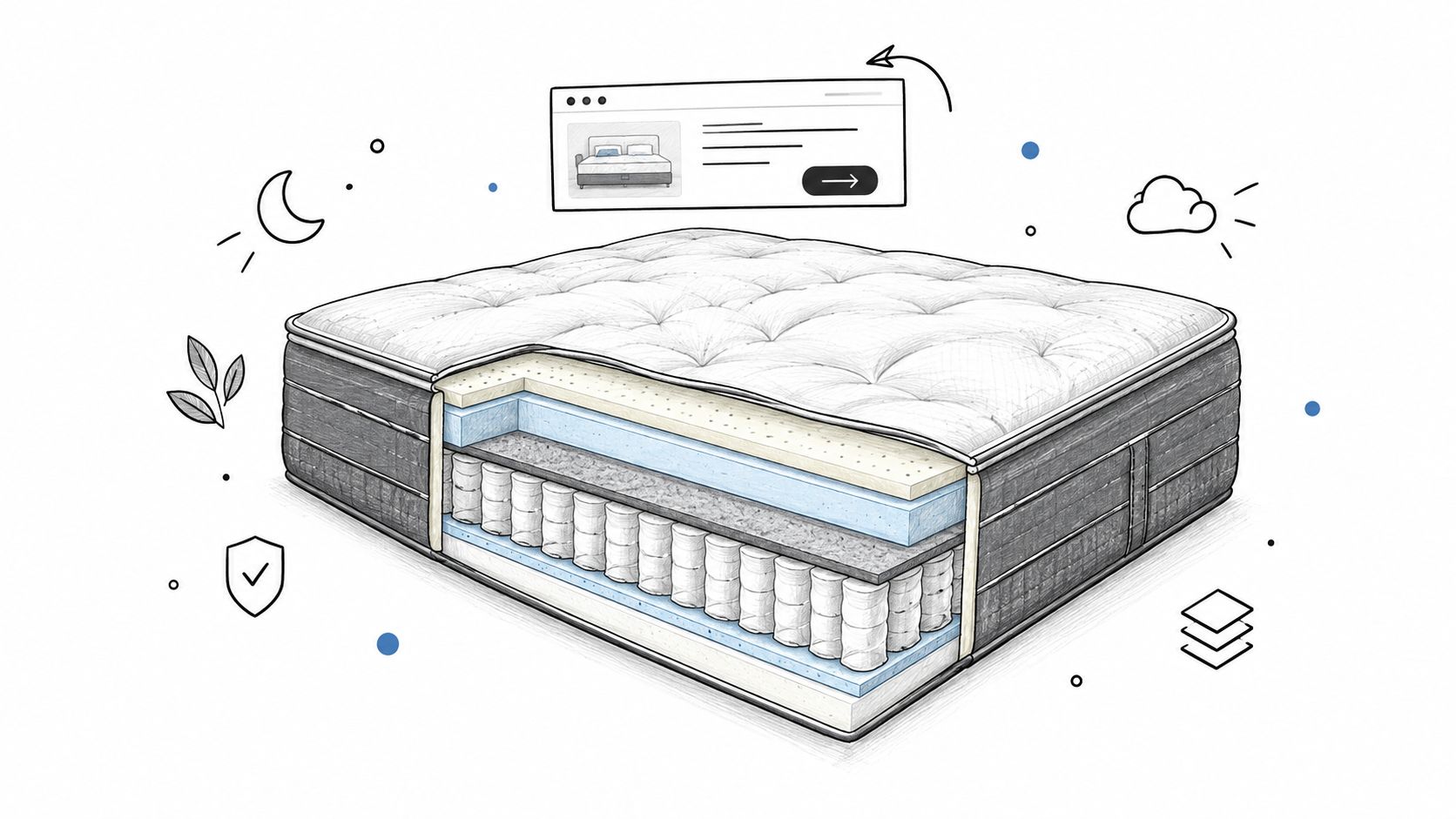
A banner showing a neatly dressed bed can build awareness, but it may not explain what distinguishes the product. A close-up of a quilted cover can communicate construction, while a Digibun layered visual can show the internal foam and coil arrangement that ordinary photography can't reveal. A short video or room scene can help a shopper connect the product with a showroom experience, but only if the landing page continues the same story.
Digital advertising is now a central marketing channel rather than a peripheral one. In the United States, digital advertising revenue reached $259 billion in 2024, with search advertising at $102.9 billion, display at $74.3 billion, and digital video at $62.1 billion, according to the IAB's 2024 digital advertising revenue report. Those categories suit different mattress objectives. Search captures active demand, display supports reach, and video demonstrates construction, comfort features, warranties, or showroom experiences.
Mattress advertising rule: the ad earns attention, but the product page earns trust.
A generic guide might tell a business to paste a script into the header and choose the largest available unit. That approach can damage a premium bedding experience. Ads placed over financing disclosures, retailer inquiry forms, product specifications, or sizing information make the customer work harder at exactly the moment they're evaluating a high-consideration purchase.
Bedhead Marketing works only with the mattress and bedding industry, supporting manufacturers, brick-and-mortar and eCommerce retailers, private-label brands, and sleep product startups. That specialization matters because mattress advertising sits at the intersection of product visualization, retail activation, search demand, and sales training. The broader distinctions between paid, owned, and earned channels are also useful in this overview of media types in advertising, but the execution still has to reflect how people shop for beds.
Choosing the Right Advertising Model for Your Mattress Business
The right model depends on what you're trying to achieve. A mattress manufacturer seeking retailer leads needs control over audience and lead quality. A content-rich sleep publisher may prioritize automated revenue. A retailer promoting complementary products may prefer commissions instead of selling inventory.
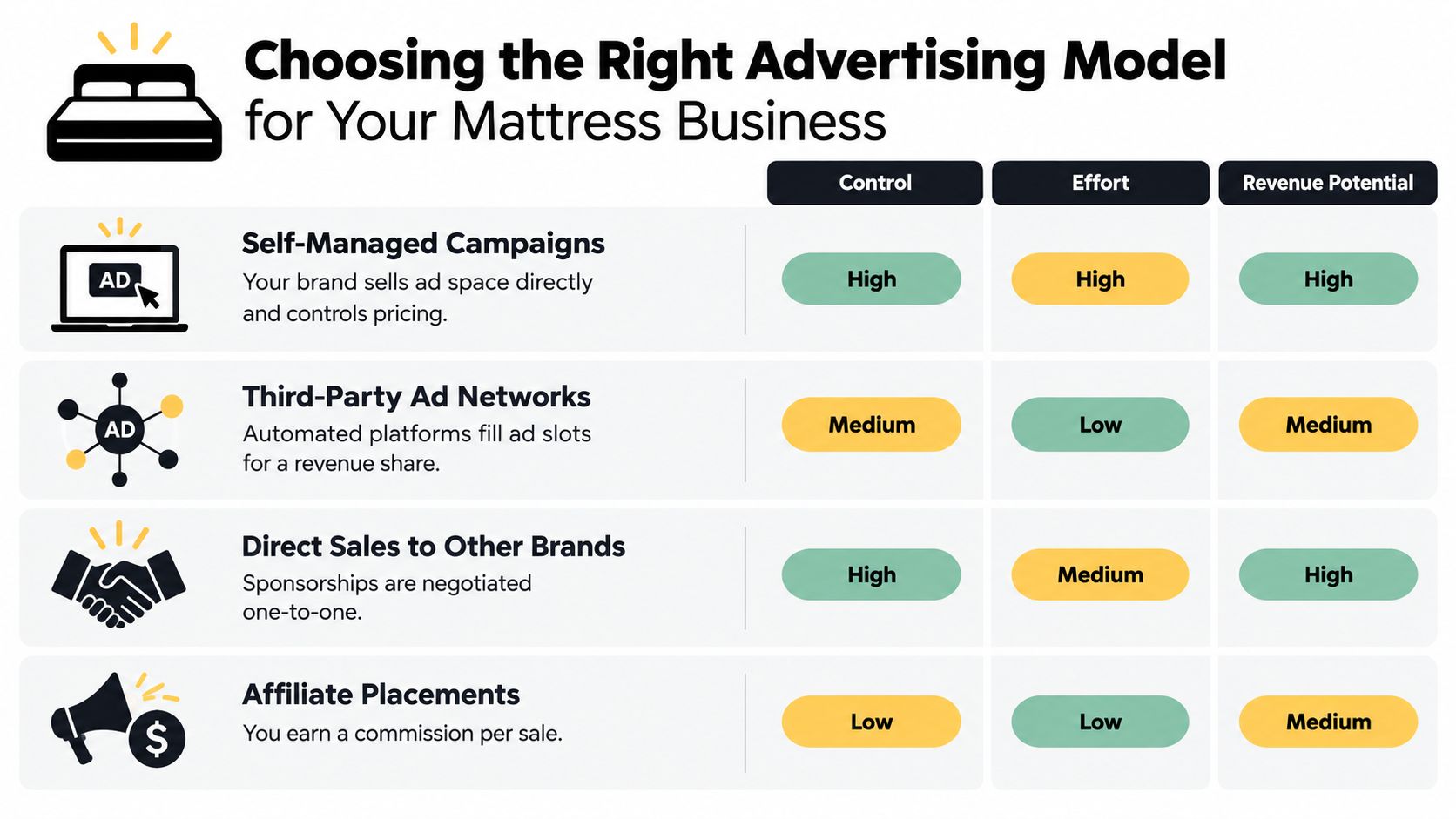
Self-managed campaigns
With a self-managed campaign, the brand controls the audience, budget, creative, and landing page through a platform such as Google Ads or Meta. Google explains that an auction runs whenever someone searches or visits a website displaying ads. Eligibility, targeting, bid, ad quality, landing-page quality, competition, search context, and expected asset performance all influence which ads can appear and in what order, as described in Google's explanation of the ad auction.
This gives a mattress brand flexibility, but it also creates work. You need accurate product claims, responsive creative, campaign segmentation, and a page that makes the next action obvious. A campaign for “mattress retailers” should not send traffic to a consumer product page, just as a local showroom campaign shouldn't send every visitor to a manufacturer catalog.
Third-party ad networks
A network can fill available placements automatically and reduce the effort required to find advertisers. Google AdSense requires original, high-quality content, access to the website's HTML source code, compliance with publisher policies, and an account holder who is at least 18 years old, according to Google's AdSense eligibility guidance.
This option suits a site with useful sleep education, buying guides, or retailer content. It's less suitable when the site is primarily a product catalog and every page is needed to support conversion. Google also advises publishers to maintain unique content, clear navigation, and a good user experience, while warning against scraped or copyrighted content in its publisher preparation guidance.
Direct sales and affiliate placements
Direct sponsorships can work well when a mattress audience overlaps with adjustable bases, bedroom furniture, bedding accessories, sleep technology, or local retail services. You negotiate the placement and message directly, which can produce stronger contextual relevance than an automatically selected ad.
Affiliate placements operate differently. You earn a commission when a visitor completes a qualifying action, so the commercial risk shifts from selling space to generating useful product recommendations. Both models need clear labeling, sensible product fit, and careful protection of the brand environment.
For a deeper look at campaign structure, landing pages, and paid channel decisions, the digital ads campaign guide provides a useful planning reference. Start with the model that matches your traffic, content quality, sales process, and ability to manage creative. More control isn't automatically better if nobody has time to maintain the campaign.
Implementing Ad Placement on Your Mattress Website
Start by defining what the advertisement is supposed to do. A product launch, retailer recruitment campaign, catalog download, and showroom visit all require different creative and destinations. A mattress page should preserve the core buying information, including dimensions, firmness guidance, construction, warranty, delivery, financing, and the retailer or checkout path.
Prepare the site and account
If you're applying for AdSense or another network, confirm that the site has original content, readable navigation, policy compliance, and technical access to the HTML source. For a campaign you manage yourself, create the account, define the audience and location, select keywords or placements, set the budget, and build a dedicated landing page.
Use the website's existing system carefully. In WordPress, a tag may be installed through the theme, a header tool, or Google Tag Manager. In a custom storefront or commerce platform, involve the developer before placing scripts in templates. The method matters less than knowing exactly where the code fires and which pages it affects.
Choose placements that respect the product journey
The largest unit isn't always the strongest unit. The MRC and IAB viewable ad impression guideline generally defines a viewable impression as at least 50% of an ad's pixels being visible in an active browser tab for one continuous second. Large display units of at least 242,500 pixels may use a 30% pixel threshold for one second under the stated standard.
For mattress pages, test an inline placement alongside substantial educational content, a position near the lower portion of the screen, and a near-end placement after the shopper has reviewed construction or comparison details. Reserve responsive space so ads don't cause layout shift, and lazy-load creative below the fold. Remove any unit that blocks a retailer inquiry form, obscures a quilt or foam-layer explanation, or increases exits.
Ads should support the showroom story, not cover the virtual mattress.
Manage direct inventory
If you sell directly to complementary businesses, create a simple inventory sheet showing page, format, audience, device experience, creative requirements, dates, and reporting method. Standard formats such as leaderboards, rectangles, and skyscrapers give advertisers a shared vocabulary, as outlined in the IAB's digital advertising standards.
Label sponsored placements clearly. For advertorials, native recommendations, or sponsored product content, follow the FTC's guidance that disclosures should be clear, prominent, readable, and close to the relevant material, as explained in its native advertising guide for businesses. The practical guide to getting advertisers for your website can help organize the partner outreach side without treating every available pixel as inventory.
Tracking Ads and Measuring Mattress-Specific Results
Impressions and clicks can tell you whether an ad was seen or used. They can't tell you whether a retailer is commercially relevant, whether a catalog requester represents the right market, or whether a showroom lead moved forward.
Choose one primary conversion first. For a mattress manufacturer, that might be a qualified retailer inquiry or sample request. For a retailer, it could be a showroom appointment, financing application, catalog request, or completed purchase. Google's recommended setup is to create the conversion action, install one Google tag across the site, configure a conversion linker across pages, and trigger the event only after a validated action, as described in its conversion tracking setup guidance.
Build a clean event path
The base tag should be available throughout the site. The conversion event belongs on the confirmation page or on a validated form submission, not on every page load. If a visitor clicks a button but abandons the form, that interaction shouldn't be counted as a qualified lead.
Preserve the Google Click ID, or GCLID, through redirects and cross-domain journeys. If a shopper moves from a manufacturer site to a retailer locator or external booking system, losing that identifier can prevent the platform from connecting the outcome to the original campaign.
Track useful context with each lead:
Product category: Record whether the inquiry concerns foam, innerspring, hybrid mattresses, adjustable products, or bedding accessories.
Lead type: Separate retailer inquiries, sample requests, catalog downloads, showroom visits, and consumer support contacts.
Market and campaign: Preserve territory, audience, creative, keyword group, and landing-page variant.
Lead identity: Use a unique transaction or lead ID, deduplicate browser and server events, and reconcile advertising data with CRM records weekly.
A click can be valuable, but a qualified lead is the business outcome. Teams trying to reduce wasted ad spend with AI should still verify the underlying conversion definitions before automating decisions. Bad inputs can make an efficient platform optimize toward the wrong customer.
Measurement standard: optimize for qualified-lead rate and cost per qualified lead, not impressions alone.
Review results by device and page template. A mobile visitor may interact differently from a desktop buyer, and a product-detail page may produce a different type of inquiry from an educational article. The conversion tracking setup resource is a useful implementation reference, but the CRM remains the practical test of whether the leads are worth pursuing.
Protecting Accessibility and Privacy in Your Ad Strategy
Third-party advertising can create accessibility problems that the site owner still needs to catch. A 2025 study examining 430,000 website elements, including nearly 100,000 ad elements, found that 67% of websites experienced increased accessibility violations because of ads. The study also reported that 27% of ads used alternative text that misrepresented the ad's information, while identifiable data was collected through interactions on 94% of the websites examined, according to the ICSE 2025 accessibility study.
Separate research from University of Washington researchers audited more than 8,000 ads across 90 websites and found that most ads contained inaccessible elements, with more than half missing, empty, or non-descriptive alt text. Those findings matter on mattress sites because shoppers may spend substantial time comparing layers, measurements, warranty details, and retailer options.
Test the experience before launch
Ask someone to move through the page using only a keyboard. Check whether focus remains visible, whether an ad opens an unexpected panel, and whether the user can close it without a mouse. Test screen-reader announcements, mobile zoom, contrast, and whether alt text describes the actual ad rather than repeating a product slogan.
Practical checks include:
Focus order: Ensure advertising doesn't trap keyboard users or move focus unexpectedly.
Alternative text: Confirm that the description matches the image and its purpose.
Controls: Avoid hover-only interactions and provide usable close buttons.
Reporting route: Give visitors a clear way to report an inaccessible placement.
Teams that need a broader accessibility checklist can use this guide to make your site WCAG compliant. Responsibility doesn't disappear because a network supplied the creative. Your brand owns the customer experience.
Treat consent as a market decision
The audience, advertising model, and jurisdiction determine what data may be collected. IAB Europe's Transparency and Consent Framework 2.3 calls for clearer vendor disclosure, plain-language processing purposes, and a mechanism for users to reopen and change preferences, with an implementation deadline of February 28, 2026, as summarized in this TCF 2.3 compliance update.
Separate consented and non-consented measurement, document vendors and retention periods, and understand how retargeting pixels behave when a visitor refuses consent. Contextual advertising around sleep education, bedroom design, or mattress construction can preserve relevance with less dependence on behavioral profiling. For a high-consideration purchase, a transparent experience often supports trust better than aggressive personalization.
Next Steps for Mattress Brands Implementing Website Ads
The cleanest way to begin is to treat advertising as part of the mattress sales system, not as an isolated script. Your product imagery, landing page, showroom message, consent process, and CRM should tell the same story.
A manufacturer promoting a hybrid mattress to retailers might use search advertising to reach active buyers, a Digibun to explain the layer stack, and a short inquiry form tied to a qualified-lead event. A retailer might use a room scene in a campaign, then send visitors to a page with delivery terms, financing, floor-model availability, and a clear showroom action. A private-label brand may need a simple sponsored placement on an educational page while protecting its premium product pages from unrelated ads.
Use this launch checklist
Content readiness: Confirm original content, clear navigation, accurate construction claims, usable product information, and relevant landing pages.
Model selection: Match self-managed campaigns, networks, direct sponsorships, or affiliate placements to your control and staffing needs.
Creative preparation: Build responsive assets, Silhouettes, room scenes, product demonstrations, and layer visuals for the audience and placement.
Placement testing: Compare inline, lower-page, and near-end positions without covering specifications, financing, or inquiry forms.
Technical setup: Install the sitewide tag, configure the conversion linker, preserve click identifiers, and test events before launch.
Lead quality: Record product category, market, lead type, campaign, creative, and landing-page variant in the CRM.
Accessibility review: Test keyboard focus, screen readers, alt text, zoom, contrast, and ad controls.
Privacy review: Document vendors, consent behavior, retention, deletion, and measurement differences across markets.
BEDHEAD should appear in this system as a specialist option, not as a substitute for internal ownership. Its work spans mattress SEO, paid media, product-page optimization, 3D mattress rendering, Digibuns, Silhouettes, Room Scenes, sales training, USP development, presentation decks, and retail product activation. That combination helps connect the ad with the product story and the salesperson who ultimately has to explain the mattress on the floor.
Bedhead also provides education through Bedhead University, while the free Bedhead Network gives mattress professionals access to marketing insights, news updates, networking, training resources, an industry directory, and business tools. Advertising decisions change as platforms and regulations change, so review current requirements at the time of implementation.
A practical first move is to audit one campaign and one landing page. Remove placements that interfere with the buying journey, replace generic imagery with construction-led visuals, and measure qualified actions through to the CRM. That's how to put advertisement on website without sacrificing the showroom experience or the commercial clarity your mattress brand needs.
If you're evaluating your current product imagery, landing pages, or paid campaigns, BEDHEAD can help connect mattress-specific 3D assets, SEO, paid media, product-page optimization, and sales activation. Visit the team to discuss a focused advertising and conversion plan built around your manufacturers, retailers, private-label products, or sleep brand.