Data Driven Decision Making for Mattress Brands
Data-driven decision making can produce 5% to 6% higher output and productivity in organizations that adopt it, according to research on large publicly traded firms, but the advantage comes from changing decisions, not buying more dashboards. In mattress businesses, that means connecting return rates, showroom conversion, product margins, and advertising efficiency to specific operational action.
A familiar scene plays out across the bedding category. A retailer keeps a slow-moving floor model because it once sold well, while a manufacturer adds another hybrid mattress because the sales team believes the market wants more foam layers and pocket coils. Meanwhile, the website receives traffic, paid media keeps running, and nobody can explain which product story is helping shoppers choose.
Data-driven decision making gives those conversations a firmer foundation. It connects the ticking, quilt, gusset, foam layers, pricing, inventory, customer behavior, and sales outcome in one operating conversation. The objective isn't to replace experienced mattress professionals. It's to make experience more useful by testing it against current evidence.
Why Mattress Brands Need to Move Beyond Gut Feeling
Retail owners and manufacturing leaders often have excellent instincts. Years spent watching shoppers lie on floor models, hearing objections about firmness, and negotiating component costs creates knowledge that no dashboard can fully capture. The problem starts when old experience becomes the only evidence used for a new market, product, channel, or customer.

A showroom may feel busy, yet its conversion rate can remain weak. An eCommerce product page may look polished, yet returns may reveal that shoppers misunderstood the mattress height, edge support, or feel. A manufacturer may celebrate wholesale shipments while retailer sell-through remains slow. These are different signals, and treating them as one broad impression creates expensive blind spots.
Research on approximately 50,000 American manufacturing establishments found that the share using rigorous data-driven decision making nearly tripled, from 11% in 2005 to 30% in 2010. The researchers required strong data availability and use, tracking of at least 10 key performance indicators, and both short- and long-term targets, showing that this practice involves management discipline rather than casual reporting (MIT Initiative on the Digital Economy research).
Replace opinions with decision records
For a mattress company, the shift can begin with a simple register:
Product decision: Keep, revise, or discontinue a SKU based on margin, sell-through, returns, and retailer feedback.
Media decision: Increase, reduce, or redirect spend based on qualified leads, attributed sales, and incrementality.
Retail decision: Change floor placement or sales training based on shopper objections and conversion by product family.
Content decision: Expand a product explanation when customers engage with it but fail to complete the purchase.
Zero-party data, such as a shopper's stated comfort preference or sleep position, can add useful context to behavioral data. Bedhead's explanation of what zero-party data means for mattress marketing is useful when teams want to combine declared preferences with browsing and purchase behavior.
Practical rule: Don't ask whether the business has enough data. Ask which decision the data is supposed to change.
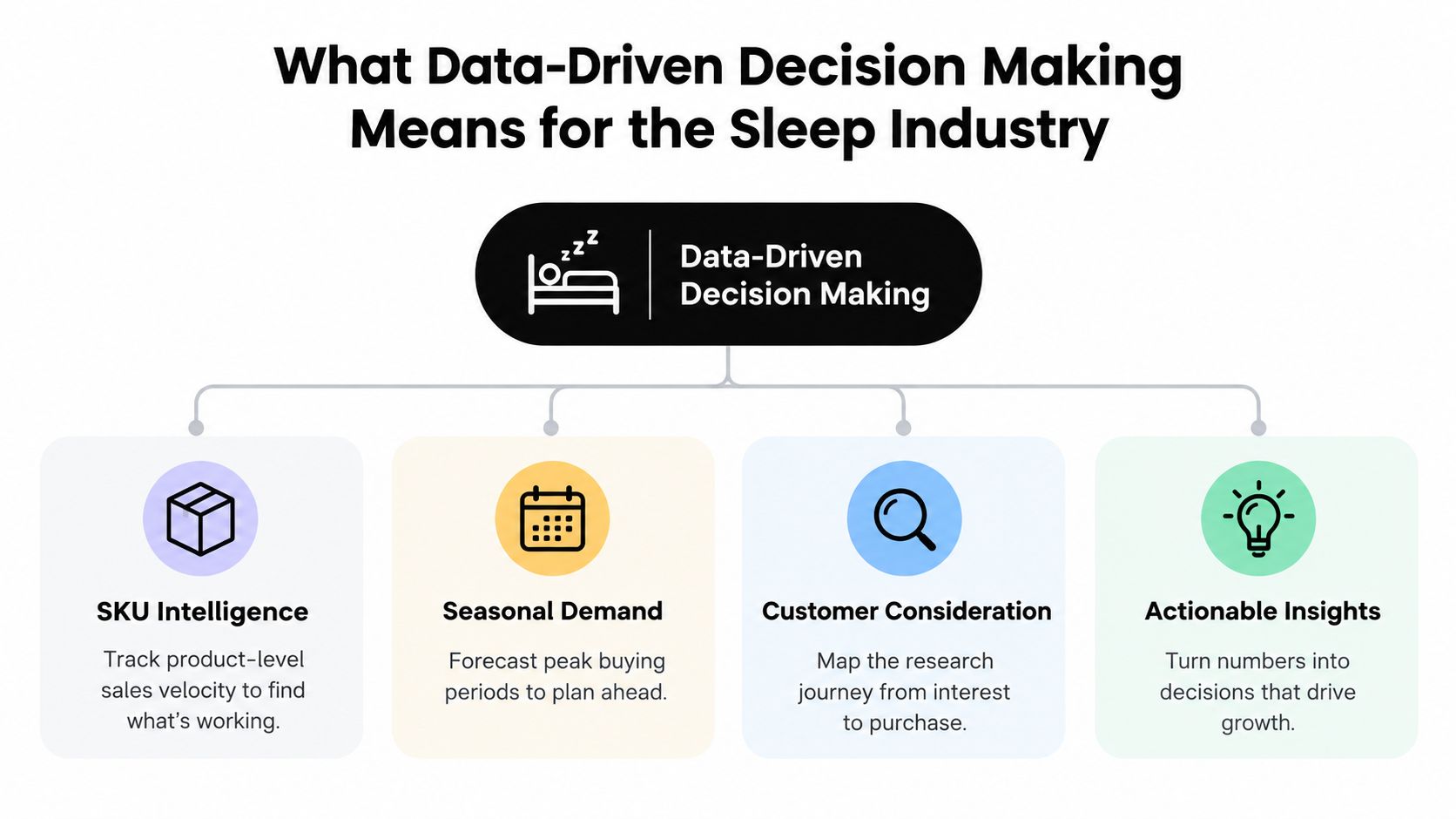
What Data Driven Decision Making Means for the Sleep Industry
Data-driven decision making is the systematic use of reliable evidence to guide a decision, measure its result, and improve the next decision. In the sleep industry, the evidence must follow the product from factory floor to showroom, product page, checkout, delivery, and return.
That makes mattress measurement different from a simple eCommerce traffic report. A manufacturer needs to connect production yield, component cost, defect rate, wholesale orders, and retailer sell-through. A retailer needs to connect floor traffic, salesperson behavior, financing, conversion, average order value, delivery experience, and return reasons. A private label brand may need both views, plus marketplace performance and supplier consistency.
The process becomes practical when every metric answers a business question:
SKU intelligence: Which mattress earns margin after promotions, freight, returns, and support costs?
Seasonal demand: Which buying periods require inventory, creative, or staffing changes?
Customer consideration: Which questions about firmness, height, materials, and warranty block purchase?
Actionable insight: What will the team change, who owns it, and when will the result be reviewed?
Reporting isn't the same as management
A dashboard can show that a hybrid mattress has strong page engagement. It can't, by itself, prove that the hybrid caused a sale or that the page deserves more media budget. Seasonality, retailer quality, promotional timing, distribution expansion, and existing customer intent can create misleading correlations.
A study of 179 large publicly traded U.S. companies associated data-driven decision making with output and productivity approximately 5% to 6% higher than expected, after accounting for other investments and information-technology use. The same research observed stronger asset utilization, return on equity, and market value, but those findings describe an organizational relationship, not a guaranteed result for an individual campaign (Strength in Numbers research).
Teams new to experimentation can use this Otter A/B data guide to structure hypotheses, controls, and outcome reviews. For mattress brands, the useful discipline is straightforward: define the intervention, identify the comparison, and record what changed beyond the number on the report.
Marketing attribution also deserves careful treatment. Marketing attribution for mattress businesses helps frame the customer journey, but attribution should inform allocation rather than become a substitute for causal testing.
The Four Pillars of Implementation, People, Process, Data, and Tech
A bedding company can buy an analytics platform and still make poor decisions. The operating system has four parts, and weakness in any one of them limits the value of the others.
Pillar | Key Focus Area | Actionable Step |
|---|---|---|
People | Interpretation and accountability | Give executives, marketers, sales associates, and production managers role-specific metrics and named decision owners. |
Process | Review and follow-through | Schedule recurring reviews that end with an action, threshold, owner, and date for checking the result. |
Data | Definitions and reliability | Standardize SKUs, campaigns, channels, product attributes, returns, and sales outcomes across systems. |
Tech | Access and analysis | Connect point-of-sale, CRM, GA4, Google Tag Manager, advertising platforms, inventory, and reporting tools at a useful level of complexity. |
People need decision literacy
A retail associate doesn't need to build a regression model. They do need to understand why a return reason matters, how a product comparison affects conversion, and when a customer objection should reach merchandising. Marketing managers need to distinguish a lead from a sale, while executives need to see contribution and margin rather than engagement alone.
Data literacy programs work better when they use authentic business situations, collaborative learning, and follow-up after training. A 2025 systematic review of 16 studies found those elements produced the strongest improvements in data-literacy knowledge and self-efficacy, while many programs still emphasized analysis more than applying findings to decisions (Frontiers systematic review).
Process turns evidence into action
Start with one weekly commercial review and one operational review. The first might cover product-page conversion, qualified leads, paid media, and showroom outcomes. The second might cover production defects, inventory availability, wholesale sell-through, and return patterns.
Record five items for every material decision:
The decision being made.
The metric and data source.
The threshold that triggers action.
The person responsible.
The post-decision result.
Tech should reduce manual reconciliation, not create a new reporting hobby. Teams comparing business intelligence platforms should judge them by data connection, usability, governance, and decision speed. Bedhead's analytics implementation guide provides a useful reference for connecting measurement to marketing operations.
Key Metrics Every Mattress Manufacturer and Retailer Should Track
Raw traffic rarely tells a mattress executive what to do next. A stronger scorecard links each metric to a commercial or operational decision.
Manufacturing and wholesale signals
Manufacturers should monitor gross margin per SKU, not just units shipped. A model with attractive wholesale volume may consume margin through component cost, freight, warranty exposure, promotional allowances, or returns. Production yield and defect rates help determine whether the design is commercially sound and consistently buildable.
Wholesale sell-through deserves separate attention from wholesale orders. A retailer can accept inventory without moving it quickly, leaving the manufacturer with a misleading sense of demand. Comparing shipment data with retailer movement, inventory age, and product-level returns gives the sales team a more realistic view.
Retail and eCommerce measures
Retail operators should connect:
Showroom conversion: How many qualified shoppers purchase, by associate, product family, and traffic source.
Average order value: Whether pillows, foundations, protectors, and adjustable bases are being matched appropriately.
Return rate and return reason: Whether the issue involves comfort expectations, delivery, product information, or fit.
Advertising efficiency: Whether campaigns produce qualified inquiries and profitable sales rather than inexpensive clicks.
Product-page behavior: Whether shoppers engage with layer breakdowns, room scenes, specifications, reviews, and comparison tools.
Google's data-driven attribution model estimates how ad interactions affect the probability of a key event by examining converting and non-converting paths. It can account for time between interaction and conversion, device type, exposure sequence, creative format, and other signals (Google Analytics attribution documentation).
Google recommends at least 200 conversions and 2,000 ad interactions from supported networks within 30 days before using data-driven attribution (Google Ads attribution requirements). If an account doesn't meet those thresholds, simpler comparisons may be more dependable than fractional channel credit.
For a broader KPI checklist, key eCommerce metrics that matter can help teams audit their scorecard. Mattress brands should then connect those measures to customer lifetime value, including the wider value of accessories, repeat purchases, referrals, and service experience.
Real World Examples, How Top Bedding Brands Use Data
The practical difference appears in the question a team asks.
A traditional product meeting might sound like this: “The market wants a premium hybrid, so let's add more coils and a thicker comfort layer.” A data-informed meeting asks which customer segment, price point, retail channel, margin target, and return pattern justify the change. It then compares component cost, production feasibility, retailer feedback, product-page behavior, and post-purchase outcomes before committing to a broad launch.
That approach doesn't eliminate judgment. It makes judgment accountable.
Product storytelling can become measurable
A mattress has attributes shoppers can't fully inspect online. They can't unzip the ticking, see the quilt construction, or understand the relationship between foam layers and support without clear explanation. A product page with a Digibun, showing the internal layer breakdown, can turn a technical specification into a visual story. Silhouettes clarify shape and height, while room scenes help shoppers understand scale and bedroom context.
The measurement question isn't only whether the render looks good. Track interaction with the visual, progression to comparison or checkout, assisted conversion paths, and return reasons associated with misunderstood product characteristics. If the content earns engagement but not purchase, the issue may be price, trust, financing, delivery, or the offer rather than the image.
Retail execution needs the same discipline
A store owner may believe a floor model deserves prime placement because it has strong gross margin. A data-led review adds conversion by traffic source, time on bed, associate recommendation, attach rate, and customer objections. Sales training can then focus on the actual friction, such as explaining firmness, comparing a hybrid with an all-foam model, or presenting the foundation without making the interaction feel forced.
Causal measurement matters here. Predictive models can identify associations, but confounding factors can produce false conclusions. Randomized A/B tests are preferable when feasible, while difference-in-differences, matched controls, or interrupted time-series analysis can help when randomization isn't practical (research on causal data-driven modeling).
Common Pitfalls and How to Avoid Them
The biggest mistake is assuming more data automatically creates better decisions. A 2025 GigaOm survey found that almost half of organizations identified poor data quality as their top barrier to effective AI adoption, while more than one-third said data silos hindered real-time decision making (GigaOm survey insights).
Mattress companies see the same problem when the product catalog names a hybrid differently in the ERP, website, CRM, and advertising account. Broken conversion events and stale inventory can make an available product look sold out, or make a profitable campaign appear weak.
NIST identifies eight data-quality attributes: accuracy, completeness, update status, relevance, consistency, reliability, appropriate presentation, and accessibility (NIST Research Data Framework). Use them as a pre-analysis checklist.
Reconcile definitions: Confirm that SKU, channel, order, return, and conversion mean the same thing across systems.
Assign ownership: Give someone responsibility for correcting product, inventory, and campaign errors.
Set evidence thresholds: Delay high-risk decisions when the data is incomplete, triangulate sources when possible, and label directional evidence clearly.
Limit the scorecard: A small set of decision-linked metrics beats a wall of charts nobody uses.
Your Next Steps Toward a Data-Driven Bedding Business
Start with one decision that affects margin. It could be whether to keep a floor model, increase spend behind a product family, revise a product page, or investigate a return pattern.
Write down the baseline, the data sources, the owner, and the action threshold. Then review the result after the decision instead of moving straight to the next campaign. That loop is how a bedding company moves from reporting activity to operational learning.
A practical first pass looks like this:
Choose one commercial outcome: Margin per SKU, showroom conversion, return rate, qualified leads, or sell-through.
Map the customer and product path: Connect advertising, product-page behavior, CRM, POS, inventory, and sales records where available.
Audit reliability: Check product naming, missing fields, current pricing, inventory status, and conversion tracking.
Improve the story: Use accurate specifications, Digibuns, Silhouettes, Room Scenes, comparison content, and sales materials to answer shopper questions.
Test the change: Use a control or comparison where feasible, and don't confuse correlation with lift.
Review and repeat: Keep what improves the decision, remove what creates noise, and train the people who act on the findings.
Data-driven decision making isn't a software project. It's a shared way to decide what to build, promote, stock, show, and sell. For industry education, Bedhead University offers resources for mattress professionals at Bedhead University, while the Bedhead Network, or BEDNET, is free for mattress industry professionals and provides marketing insights, news updates, networking, training resources, an industry directory, and business tools at www.BedheadNetwork.com.
If you're evaluating your product imagery, attribution, or mattress marketing scorecard, BEDHEAD can connect SEO, paid media, product-page optimization, 3D assets, sales training, and reporting to the decisions your manufacturing or retail team makes. Visit BEDHEAD to discuss a practical measurement and product-storytelling plan built for your bedding business.