Analytics Implementation Guide for Mattress Brands
If you're running marketing for a mattress brand, this probably feels familiar. Google Ads says branded search closed the sale. Meta says paid social influenced it. Your CRM shows the customer talked to a store two days earlier. Finance says the order later flipped because the financing app failed, then reopened under a different payment method. By the time leadership asks what drove revenue, the room gets quiet.
That's why an analytics implementation guide for mattress brands has to do more than install GA4 and call it done. In bedding, the buyer journey runs through product pages, financing steps, showroom visits, sleep quiz paths, follow-up email, and sometimes a return window that changes how you judge the original sale. Bedhead Marketing works in that reality every day, across digital marketing, 3D design, brand development, consultation, and sales training built specifically for mattress manufacturers, retailers, private label brands, and sleep product startups. The stack has to support the way people shop for hybrid mattresses, compare foam layers, inspect ticking and quilt construction, and bounce between ecommerce and store conversations before they buy.
Why Most Mattress Brands Fly Blind on Data
A mattress team can spend heavily across Meta, Google, and a showroom event, then still struggle to answer a basic question: which channel produced last month's sales mix.
That confusion isn't usually caused by a lack of tools. It happens because mattress retail has a messy buying path. A shopper may land on a PDP, compare firmness options, leave, come back from branded search, start financing, fail that step, visit a store, then purchase after speaking with an RSA. If the product later returns inside the sleep trial window, revenue reporting gets even harder.
Where the reporting usually breaks
Most brands I've seen go wrong in one of three ways:
They trust last-click reports too much. GA4 gives a neat answer, but mattress buying is rarely a single-session decision.
They over-credit ad platforms. View-through reporting can make upper-funnel channels look cleaner than they are, especially when the same customer also clicks paid search, email, and direct.
They measure orders, not business outcomes. A financed order that later collapses, a refunded trial, or a showroom close with no clean digital tie-back can distort performance.
Mattress analytics fails when the team tracks web activity but not the real sales path.
This is the bigger point. Analytics implementation isn't a tagging project. It's the process of tying every event, integration, and reporting view back to a business question that a marketing lead can defend in a quarterly review.
If your team needs a quick reset on the basics, this primer on understanding web analytics tools is useful because it frames analytics around decisions, not dashboards. For mattress brands that are sorting out attribution specifically, Bedhead's own guide to measuring marketing attribution is worth keeping close while you build.
Adoption is still the real problem
Even strong implementations fail when nobody uses them. BARC reported that in 2024, only 25% of employees on average actively used BI and analytics tools, with minimal growth over the prior seven years, while 50% of data and analytics leaders said usage had increased a lot (BARC survey summary). That mismatch shows up inside mattress businesses too. Leadership thinks the reports are there, so the business must be data-driven. Meanwhile, store ops, ecommerce, and marketing are still working from separate versions of the truth.
Build a Measurement Plan Before You Touch a Tag
The cleanest implementations start with one hard business question. Not a wishlist. Not “track everything.” One question.
For a mattress retailer or DTC brand, a good example is this: Which mattress collections and traffic sources produce assisted conversions that survive the sleep-trial window? That question is specific enough to build around, and commercial enough to matter.
The implementation approach in Implementing Analytics follows a practical sequence: problem statement, data exploration, model or decision strategy, performance iteration, and governance. It also treats governance as an audit-and-control layer instead of a final cleanup step (O'Reilly chapter reference). That structure works especially well in mattress because it forces a decision owner before anyone starts adding tags.
What belongs in the plan
Three documents usually keep the project on track:
KPI sheet Define the primary KPI first. Then list the supporting KPIs that explain it.
Tracking requirements sheet Map each KPI to the events, parameters, and dimensions needed to calculate it.
Stakeholder sign-off page Get marketing, ecommerce, store operations, and whoever owns CRM aligned before GTM work begins.
Here's a simple starting format.
Business Question | Primary KPI | Supporting KPIs | Required Events | Required Dimensions |
|---|---|---|---|---|
Which mattress collections and traffic sources produce assisted conversions that survive the trial window? | Completed purchase tied to retained order status | PDP views, add to cart, financing start, financing approval or decline, showroom request, return status | view_item, add_to_cart, begin_checkout, add_payment_info, purchase, financing events, showroom lead events | collection, size, firmness, price tier, traffic source, device, financing status |
Mattress segments that actually matter
Generic segmentation won't help much here. Mattress brands need reporting slices that match real buying behavior:
By size: Twin and king don't behave the same.
By firmness or feel: Plush, medium, and firm often split buyer intent differently.
By price tier: Entry foam, premium hybrid, and luxury collections have different sales cycles.
By financing status: Approved, started, and declined are not the same outcome.
By sales path: Ecommerce-only, store-assisted, and lead-first journeys need separate views.
A lot of teams also treat an email signup and a completed order as if they carry equal weight. That usually poisons optimization early.
Practical rule: If a KPI can't change a budget, staffing decision, or merchandising call, it shouldn't lead the implementation plan.
Before any GTM work begins, make sure the team has approved the KPI hierarchy, attribution windows, naming rules, and customer segments. If you need a sharper segmentation lens, Bedhead's post on what customer segmentation means in practice is a good reference point for mattress-specific planning.
Design an Event Taxonomy and DataLayer for Mattress Commerce
The taxonomy has one job. It tells your site, GTM, GA4, and downstream tools how to describe customer behavior the same way every time.
Most mattress sites already know the standard ecommerce events they need. The problem is that the implementation gets fuzzy once configurable products, financing flows, and showroom lead forms enter the picture.
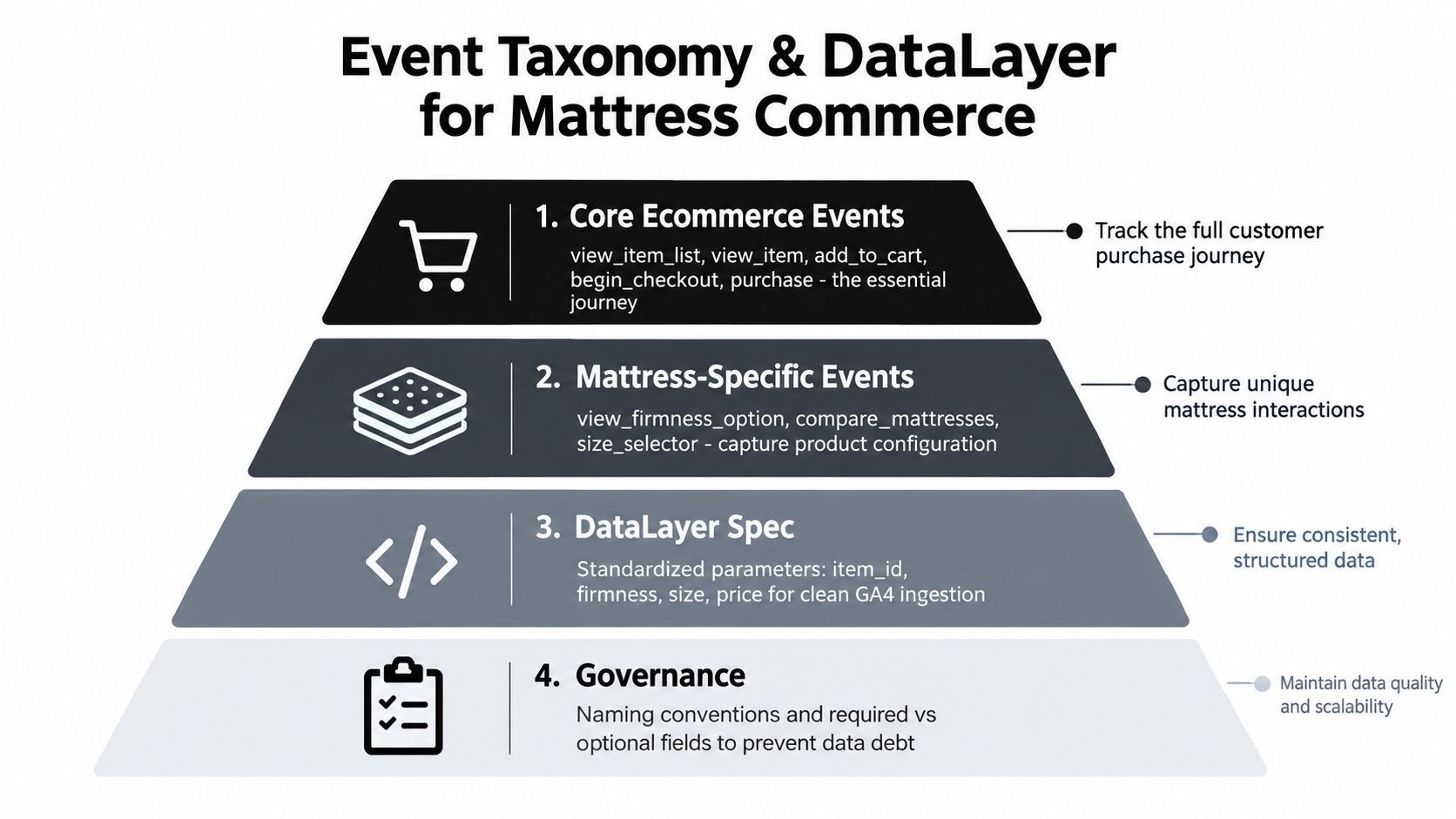
Core events and mattress-specific additions
Your base event set should include standard commerce steps such as , , , , , and .
Mattress commerce usually needs more than that. I'd add:
for fit or comfort quiz completion
when promotional financing messaging is opened
when an application fails or stalls
for white-glove or scheduled delivery paths
when a customer books or requests a store visit
These events matter because they capture friction and intent that standard GA4 ecommerce reporting will miss.
A usable dataLayer spec
The spec should be plain enough for a marketer to review and structured enough for a developer to build. A typical push for a mattress PDP should include:
tied to the SKU or product ID
tied to the sellable product name
such as foam mattress, hybrid mattress, adjustable base
carrying useful configuration like size and firmness
using the displayed product price
if applicable
for purchase events only
For layered products, I also like passing custom context fields that help reporting later, such as collection family, comfort level, or whether the SKU includes a gusseted cover, premium quilt package, or zoned foam layers. Keep them standardized. Don't improvise labels from page copy.
The breakpoints to watch
Two failures show up constantly on mattress builds:
Theme-driven PDP behavior Shopify themes and headless front ends often load product data asynchronously. The page looks fine, but the ecommerce event fires before variant data is ready.
Finance steps inside embedded flows If the financing status sits behind an iframe or third-party handoff, the browser event may never hit the site-level dataLayer.
One fix is process, not code. Create a one-page taxonomy document with event names, trigger conditions, required parameters, optional parameters, and examples. Then keep a versioned JSON schema so marketing and development are reading from the same source of truth.
A clean taxonomy sounds boring. It saves projects.
Set Up GA4, GTM, and Ecommerce Schema the Right Way
A solid setup sequence prevents weeks of cleanup later. For most mattress brands, the easiest brief is one GA4 web stream per brand domain, then GTM handling the event layer, and structured product schema on PDPs so search engines can read what you sell.
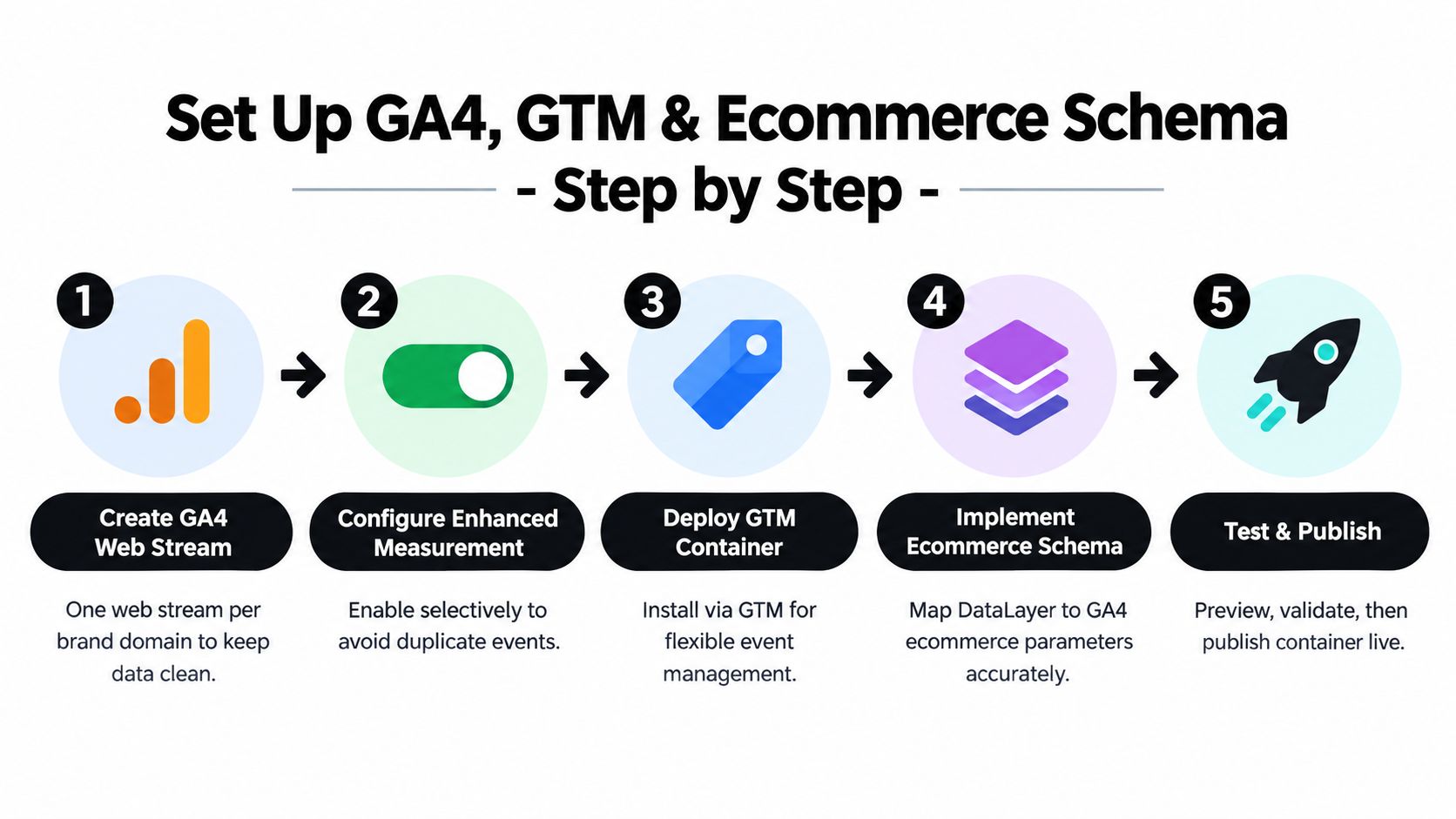
The setup order that tends to work
Start with the GA4 property and web stream for the active store domain. Then install the GTM container snippets in the site head through your platform or development team. After that, decide which enhanced measurement features help and which ones create noise.
I usually recommend selective use of enhanced measurement. On mattress sites with custom lead forms, financing interactions, and sticky carts, leaving every automatic option on can create duplicates or muddy naming.
Then wire the ecommerce event sequence in order:
Map each one to a GA4 ecommerce tag in GTM using GA4's ecommerce event structure, not improvised custom event naming for standard purchase flow.
Mattress-specific build notes
Configurable products create the most confusion. A queen plush hybrid and a king firm hybrid might live on one PDP, but they should still pass clean variant detail in the event parameters.
Watch these implementation details closely:
Variant handling: Size and firmness should map consistently in .
Financing as payment context: If financing is a path, not just page copy, it needs event coverage.
Split delivery logic: White-glove orders and delayed ship dates can break clean purchase reporting if the values update after the purchase event.
If the SKU, size, and firmness don't survive from PDP to purchase event, your merchandising reports won't be trustworthy.
Don't skip schema on the PDP
GA4 tells you what happened. Product schema helps search engines understand the product itself.
On mattress PDPs, your product markup should reflect SKU, price, availability, and review information where available. This is especially important when product pages have configurable options, financing messages, and deep content blocks about quilt build, support layers, and cooling materials. Those pages often become the center of both paid and organic acquisition, so the data structure matters beyond analytics.
If your product detail pages need cleanup before tracking can work well, the best place to start is this guide on product detail page optimization. Bad page architecture makes clean analytics harder than it should be.
Wire Up Conversion Tracking, Ads, and CRM Integrations
Once site events are stable, the next step is deciding what each platform needs to receive.
That's where teams either gain signal or create reporting clutter. Sending every event everywhere sounds thorough. It usually isn't.
What each platform should care about
In GA4, the core key events for a mattress brand are usually and a properly defined qualified lead event. For some brands, showroom bookings, financed approvals, or trial enrollment milestones also deserve promotion into key event status. But that should happen only if they represent meaningful business progress.
Then connect the ad platforms and CRM around that same logic.
Event | Google Ads | Meta CAPI | CRM |
|---|---|---|---|
Purchase | Yes | Yes | Yes |
Qualified lead | Yes | Yes | Yes |
Showroom booking | Sometimes | Yes | Yes |
Financing approved | Sometimes | Yes | Yes |
Sleep trial signup | Sometimes | Sometimes | Yes |
Financing declined | No, usually keep for analysis only | No, usually keep for analysis only | Yes |
Verification matters more than the connector list
A connection isn't real because the toggle says “connected.” Verify it.
Check the chain all the way through:
In GA4 DebugView: Confirm the event arrives with the expected parameters.
In Google Ads diagnostics: Confirm the imported conversion is active and receiving data.
In Meta test events: Confirm the browser and server event can deduplicate correctly.
In CRM records: Match the order ID or lead record to the original event path.
This matters more now because analytics is moving beyond basic reporting. A 2025 AI and BI survey reported that 43% of organizations were already using AI-powered analytics in production, 56% named improved decision-making as their top goal, 24% planned to triple the number of employees using advanced analytics tools within 12 months, and only 8% of employees in most firms currently use advanced analytics tools. The same report identified compliance as the top adoption challenge (AI and BI survey summary). For mattress brands, that means your conversion framework has to be both usable and governable.
If you want a practical implementation reference for the platform handoff side, Bedhead's conversion tracking setup guide is aligned with this exact workflow.
Handle Privacy, Consent, and Server-Side Tracking
Privacy isn't the legal footer. It's part of the measurement architecture.
That's become unavoidable as teams deal with lower browser visibility, consent gating, and modeled reporting. Recent implementation guidance around the cookieless shift puts the focus on first-party cookies, server-side tracking, consent management, modeled conversions, and documented data flows rather than just dropping scripts onto pages (privacy-first GA4 implementation guidance). For mattress brands with ecommerce, lead gen, and showroom traffic in separate systems, that change is a big deal.
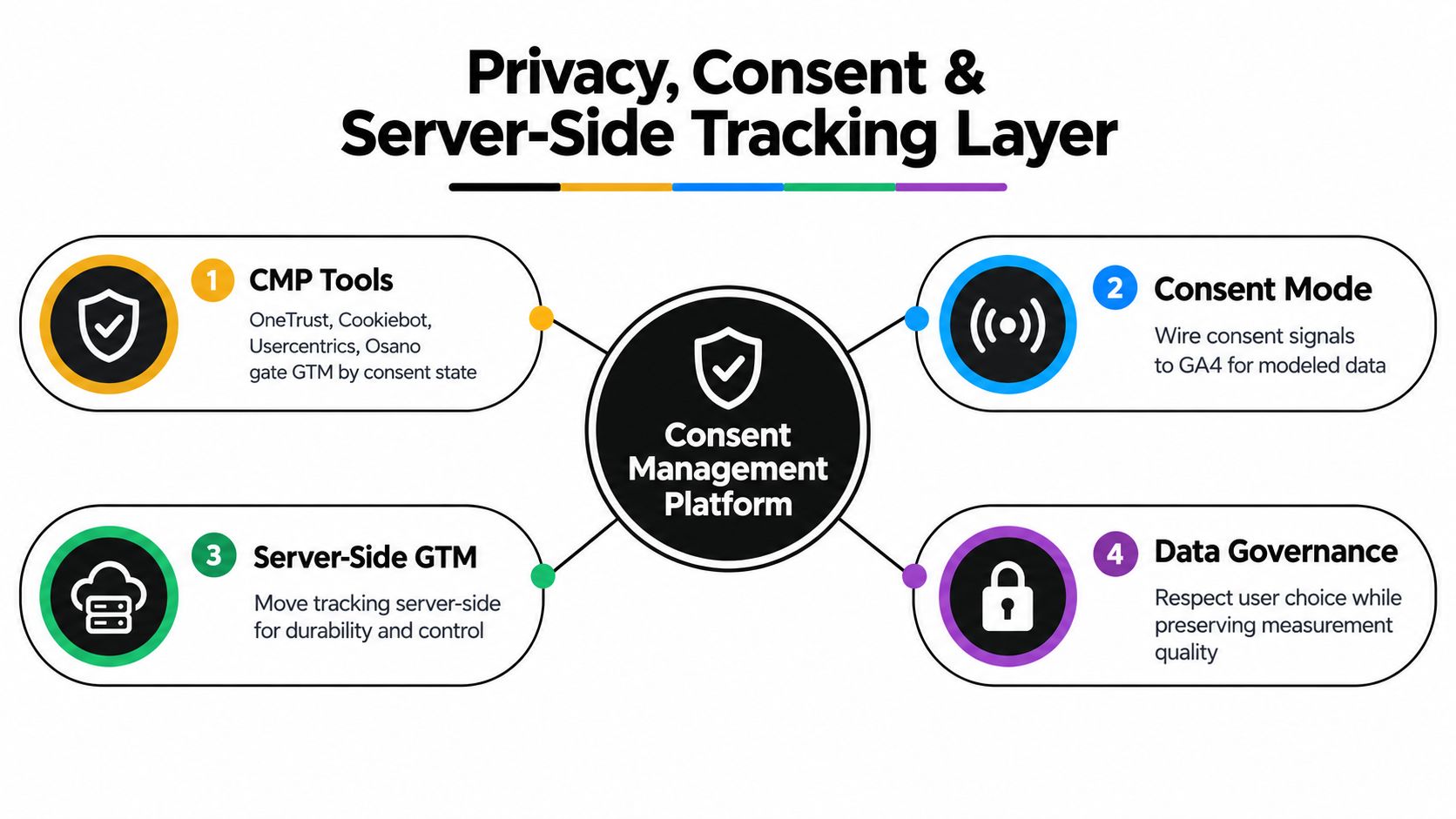
What the privacy layer should include
At minimum, the stack should include:
A consent management platform that controls whether GTM and related tags fire by consent state
Consent Mode v2 signals for analytics and advertising behavior
A server-side tracking path that improves control over routing and data quality
Documented retention and deletion rules so customer requests can be handled cleanly
For mattress marketers, the practical impact is simple. You should expect observable traffic and conversions to change when consent is enforced correctly. That doesn't always mean demand changed. Sometimes measurement changed.
Where teams get tripped up
The common mistake is assuming privacy work can wait until after the launch. It can't. If you add consent logic late, your baseline breaks and your before-and-after reporting becomes harder to trust.
A second mistake is sending too much. Email and phone data should be handled carefully and only where the platform and implementation support compliant hashing and routing. That's one reason many teams move to server-side processing earlier than they expected.
The question isn't whether privacy will affect attribution. It's whether your implementation can separate tracking loss from real performance change.
QA, Launch, and Troubleshoot Like a Pro
Good plans either hold up or unravel.
A lot of analytics projects fail in the final stretch because the team assumes the tags that fired in preview mode are the same as a working reporting system. They aren't. One benchmark summary says only 42% of organizations fully meet analytics objectives within 12 months, and inadequate training is cited as a cause in 28% of implementation failures. The same summary points to broader reporting that cites 70% to 80% BI project failure and about 15% success for big-data projects (industry benchmark summary). That's why mattress teams need a launch checklist, not just a setup checklist.
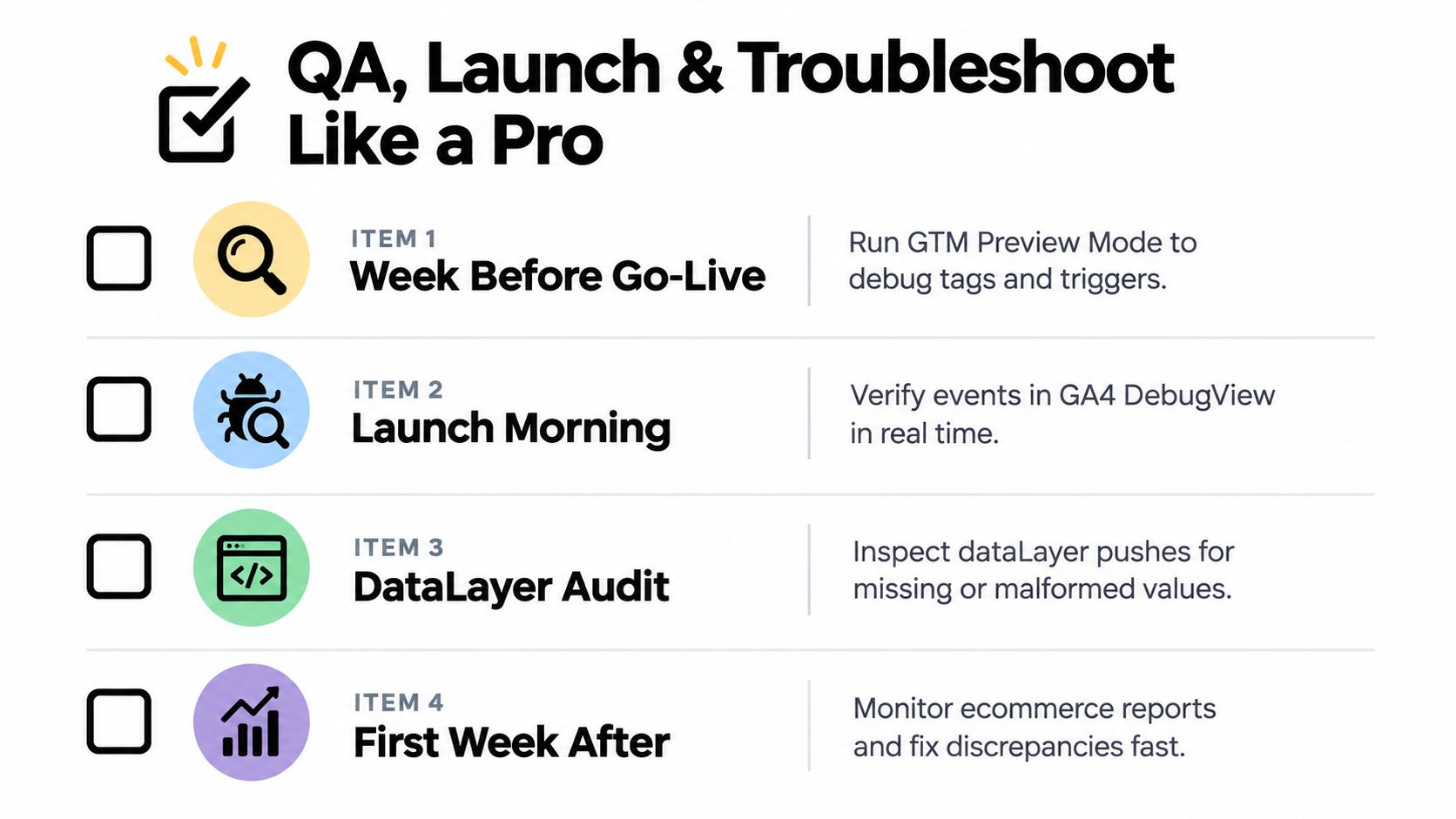
The week before go-live
Run a full QA pass on the pages and actions that matter most:
Check product pages: Confirm sends the correct SKU, collection, size, firmness, and price.
Test cart behavior: Sticky carts and AJAX mini-carts often duplicate .
Walk checkout end to end: Verify shipping, payment, and purchase sequence in GTM preview and GA4 DebugView.
Validate showroom forms: Make sure showroom requests aren't all being lumped into a generic lead event.
Review structured data: Use a rich results validation tool on major PDP templates.
If you sell configurable builds, test multiple combinations. A hybrid mattress in queen medium may work while the king firm variant drops the item parameter set entirely.
Launch morning checks
Open the site as a customer would and validate the whole path again.
Use this order:
Browse collection pages
Open a PDP
Change size and firmness
Add to cart
Start checkout
Complete a test order or approved internal flow
Check whether the event appears in GA4
Confirm the conversion path reaches the ad platform and CRM where expected
Keep notes while you do it. Most launch-day fixes are easier when the team can point to the exact step that broke.
The mattress-specific issues that keep showing up
These are the failures I see most often:
Missing purchase value because shipping or tax gets appended after the purchase event already fired
Financing declines counted as wins because the event naming treats application start as a success event
Duplicate cart actions caused by sticky add-to-cart modules or theme scripts
Lead inflation because showroom requests, newsletter signups, and financing inquiries all map to the same generic lead bucket
Another issue is trust after launch. A 2026 survey on data and AI analytics trends found persistent stack fragmentation, inconsistent semantic layers, and governance and observability gaps, which points to a deeper problem: organizations often struggle less with collection than with trust in the pipeline (analytics trends survey summary). That's why I recommend a weekly comparison between GA4 and a second source of truth such as CRM, OMS, or store sales reporting. For mattress brands, that cross-check is often more valuable than another dashboard tab.
A focused 30-day rollout
If your team is small, sequence the work.
Week one: Instrument checkout, lead forms, and financing events.
Week two: Connect Google Ads, Meta, and CRM workflows.
Week three: Stand up consent mode and server-side routing.
Week four: Review event quality, retire weak events, and brief leadership on what's newly measurable.
One practical option some bedding teams use alongside GTM, GA4, and CRM work is BEDHEAD University, which helps internal teams build category-specific fluency around marketing and sales execution. That's useful when the reporting project exposes operational gaps, not just tagging gaps.
For mattress brands, the stuck points are usually the same. Product data isn't normalized. Ecommerce and store systems don't share identifiers. Financing happens in a separate flow. Returns and trial outcomes don't get reconciled back to acquisition. Those aren't abstract analytics problems. They're mattress-industry reporting problems.
Bedhead helps mattress manufacturers, retailers, private label brands, and sleep startups connect GA4, GTM, CRM data, product-page behavior, and real sales outcomes into reporting that leadership can use. That work often sits alongside our mattress-specific SEO, paid media, 3D assets like Digibuns, Silhouettes, and Room Scenes, plus sales training for store teams because the cleanest analytics setup still has to reflect how bedding gets sold. If you want help tightening your stack without generic advice, visit BEDHEAD.