Virtual Merchandising Software for Mattress Brands
Your shopper can't lie on a mattress online, and your showroom floor model doesn't show every size, firmness or cover option. Meanwhile, a retailer's product page may still show the old quilt pattern and a construction diagram you replaced last season.
Virtual merchandising software should solve those problems before it adds visual spectacle. For mattress brands, the first job is keeping product information and imagery accurate wherever someone buys. The second is proving whether a better product experience reduces uncertainty, supports sales associates or improves profitable sales.
Which Virtual Merchandising Software Fits Your Business
Start with the gap between the floor model and the full assortment. A shopper testing a medium hybrid still needs to understand what changes in the firm version, how the taller profile looks on their base and whether the pictured ticking matches what will arrive.
The right purchase isn't always a platform. Sometimes it's an asset library, a better product record or a narrowly scoped configurator.
Virtual merchandising fit by business type
Business type | Main problem | Capabilities to prioritise | Sensible first step |
|---|---|---|---|
Mattress manufacturer with multiple retailer accounts | Inconsistent imagery and specs across partner sites | Reusable 3D assets, shared source of truth, version control | Build a master asset library for flagship lines |
Brick-and-mortar retailer | Floor models that do not show the full range | In-store tablet configurator, room scenes, floor-model replacement visuals | Pilot on the top 10 mattresses by floor traffic |
eCommerce sleep brand | Low add-to-cart rate and high returns | Product page configurator, layer reveals, analytics, mobile performance | Test one configurator on a single best-selling line |
Private label brand or startup | Limited budget and few SKUs | Silhouettes, a hero room scene, lightweight configurator | Start with asset-led work before a software licence |
For a manufacturer, partner consistency comes first. A beautiful direct-to-consumer site won't correct outdated specifications on dealer pages, so organise approved assets before paying for more presentation features.
A store operator needs a selling aid that fits the conversation beside the bed. Our guide to digital tools at mattress retail provides useful context for connecting screens with the showroom experience rather than distracting from it.
Buy against the actual bottleneck
An eCommerce brand should connect interactions to product-level outcomes. If shoppers select a firmness but abandon when the price changes, a more elaborate bedroom scene won't resolve that confusion.
A private label startup should first make its small assortment understandable. Clean product silhouettes, an accurate construction view and a room scene may be more useful than software the team can't maintain.
For the broader work of organising assortment, product information and presentation, NanoPIM's guide to improve your online store merchandising is a helpful companion to the mattress-specific decision.
Buying rule: If you can't name the five SKUs most exposed to weak visuals, start with a visual audit, not a software licence.
Capabilities That Separate Real Platforms From Image Galleries
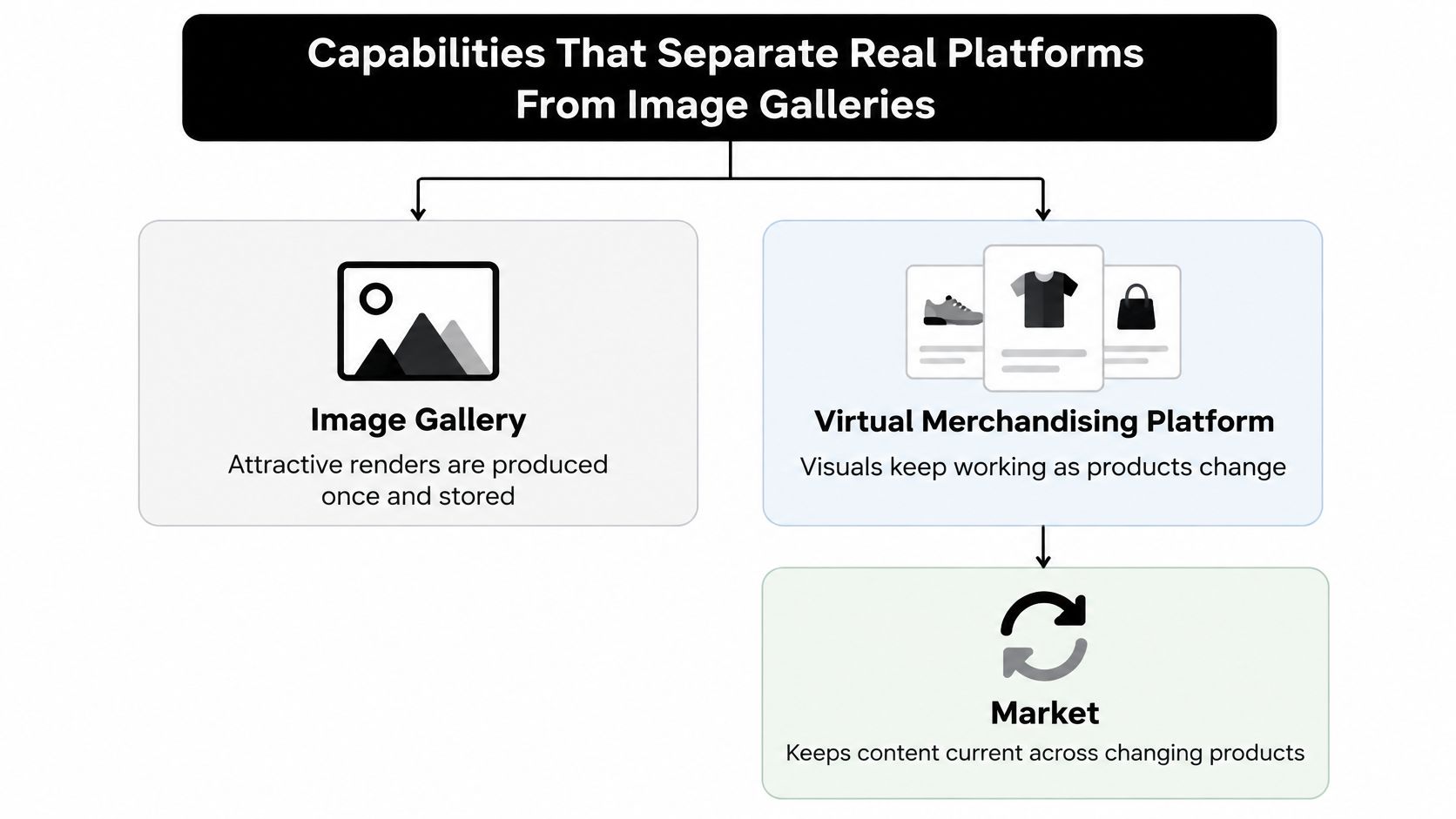
An image gallery stores attractive renders. A virtual merchandising platform manages how shoppers interact with products and how those experiences respond when an approved product changes.
Dataintelo's virtual merchandising platform analysis describes the category as combining 3D visualization engines, augmented-reality features, product-configuration systems and analytics dashboards. Treat those as distinct capabilities to verify, not interchangeable labels.
What each capability must do for mattresses
Construction visualization should show the ticking, quilt package, gusset and foam layers accurately. For hybrid mattresses, the relationship between comfort materials, transition layers and the support unit must remain understandable without implying that an illustrative separation represents actual air gaps.
Configuration needs rules, not just buttons. Changing size, firmness or fabric should retrieve the correct combination of appearance, specifications and price, while preventing combinations you don't manufacture.
A new fabric still needs an approved material representation. Software doesn't eliminate asset preparation; it should let your team reuse approved geometry and materials rather than rebuild every combination.
In-room placement must preserve scale and distinguish the mattress from the complete bed assembly. A shopper shouldn't mistake a staged headboard, foundation or bedding set for included merchandise.
Analytics should identify the SKU, selected configuration and relevant interaction. A catalogue-wide count of viewer openings won't tell you which product needs attention.
Make the demo operational
Use the same product for these checks:
Change construction: Swap an approved foam layer and confirm the relevant construction view updates through the stated workflow.
Change size: Verify that dimensions, price and specifications follow the selected variant.
Test an ordinary phone: Open the viewer over mobile data, not just the vendor's office connection.
Move the data: Demonstrate a usable export to your product information management system.
Inspect reporting: Retrieve interaction and sales events for the demonstration SKU.
Our guide to product configurators can help frame the configuration questions.
A vendor that can't demonstrate these workflows may still produce excellent assets. But it hasn't demonstrated a complete merchandising platform. Don't pay for operational control when the deliverable is a gallery and a folder of files.
Side-by-Side Criteria for Shortlisting Vendors
Compare a full-stack suite, an asset-led studio and a plug-in configurator before comparing individual vendors. They solve different problems, require different internal owners and leave different work on your team's desk.
A suite suits a broad assortment distributed across channels. A studio suits a team whose immediate problem is visual quality. A plug-in suits a controlled test on an existing eCommerce site.
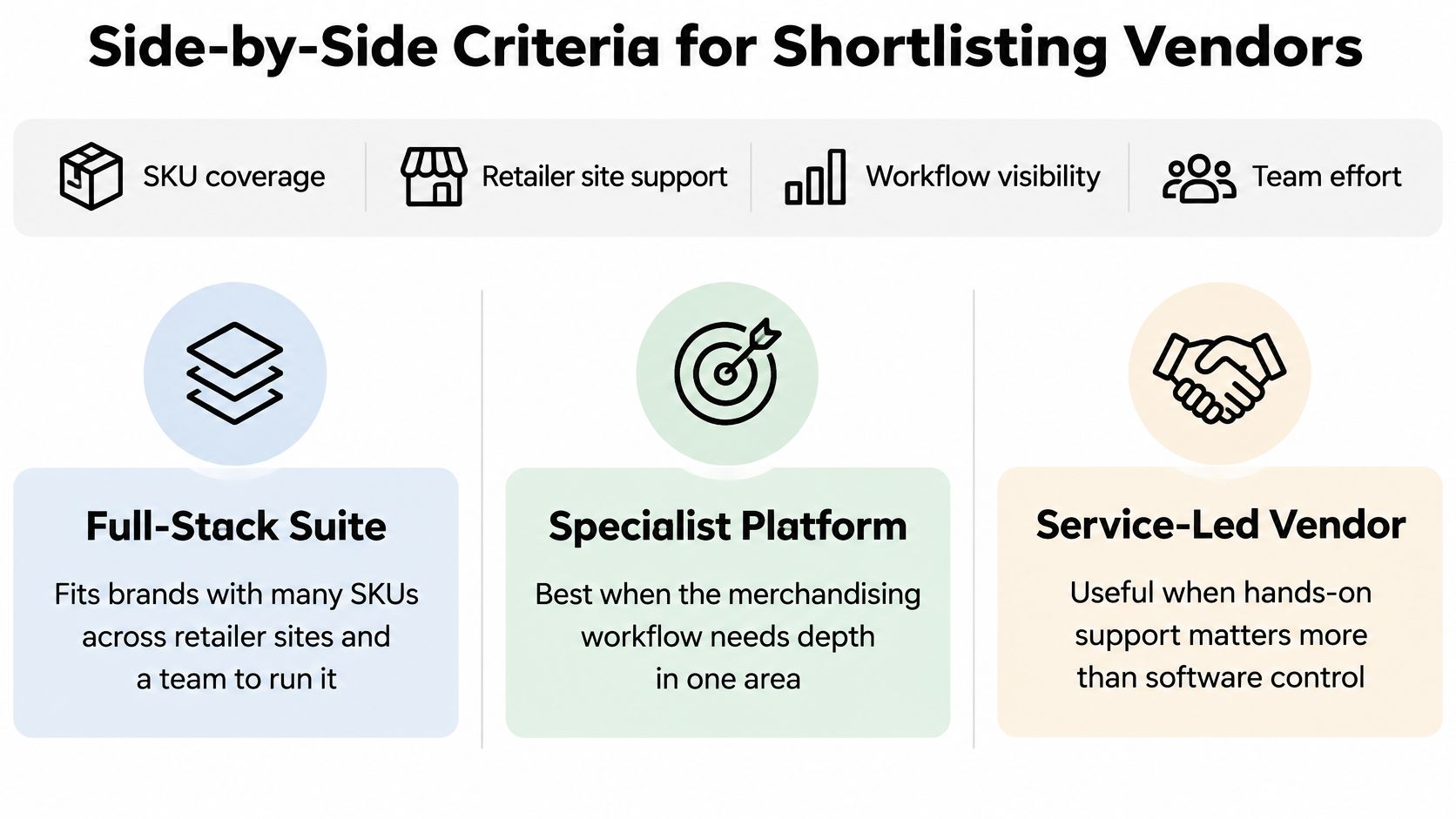
The graphic uses broader specialist and service-led categories. The table translates those approaches into practical buying options, not guaranteed features in every vendor's package.
Three vendor archetypes compared on buyer criteria
Criteria | Full-stack suite | Asset-led studio | Plug-in configurator |
|---|---|---|---|
Layered construction views | Built in | Custom-built per line | Limited or none |
Room scene visualization | Templates and custom scenes | Custom, high-quality scenes | Usually not included |
Size, firmness and fabric configuration | Native | Built per product | Native for standard options |
Analytics and A/B testing | Built in | Via your own analytics stack | Basic event data |
PIM and eCommerce integration | Connectors for major platforms | File delivery, manual upload | Script or widget install |
Mobile and AR viewing | Yes | Web-ready images; AR requires compatible files and a viewer | Yes, lightweight |
Time to launch | Written schedule after integration and data review | Written schedule after asset scope and approvals | Written schedule after theme and catalogue checks |
Judge the deliverable, not the category label
Layered construction comes first. A suite may provide the viewing mechanism, but somebody still has to build the mattress correctly. Choose custom asset work when a distinctive quilt, perimeter construction or layered story is central to the sale.
For room scenes, compare control over lighting, bedding and mattress visibility. A template is useful for repeatable production; a custom scene makes sense when the product needs a particular visual identity.
With configuration, ask whether the vendor supports your actual option rules. Firmness may change construction without changing the exterior, while a different height can change the silhouette and fitted-sheet appearance.
Analytics and integration determine the internal workload. Built-in reporting needs a named owner, and a connector still needs field mapping, error handling and approval rules. File delivery offers simplicity but leaves publishing and reconciliation with your team.
Mobile performance and launch responsibility
Smartphones represented 59.8% of augmented-shopping adoption in Market Research Future's market estimate, making mobile usability a buying criterion rather than a decorative extra. Test touch controls, readable labels and a usable static fallback before adding AR.
For time to launch, require milestones for data acceptance, asset approval, integration testing and release. A fast widget installation isn't the same as a production-ready customer experience.
Choose the suite when integration and reporting justify the overhead. Choose the studio when visuals are the bottleneck. Choose the plug-in when a single-site test can answer the buying question.
Before signing, identify who fixes a broken variant, who updates an asset and who checks the published result. If those responsibilities remain unclear, the quotation is incomplete.
Keeping Product Data Accurate Across Every Channel
Treat visual failures as product-data failures until proven otherwise. A render can be beautifully lit and still misrepresent the mattress height, cover pattern or layer order.
The DHL E-Commerce Trends Report highlights the importance shoppers place on accurate sizing, clear imagery and detailed product information when they can't inspect an item physically. For bedding teams, that means judging an asset by its correctness as well as its appearance.
Establish a product record people can trust
Create a source of truth that holds dimensions, firmness labels, layer composition, certifications, adjustable-base compatibility and size-specific visual differences. Assign an owner to each field rather than assuming marketing can approve technical construction.
Keep customer-facing terminology separate from internal component codes. A supplier substitution may preserve the approved product claim, but manufacturing and marketing still need to establish whether the construction image requires revision.
Say a hybrid moves to a different quilt package. The update should trigger a review of the silhouette, room scene, construction view, retailer downloads and sales presentation, not just the main website image.
Build these controls into publication:
Approval workflow: Product management confirms specifications; marketing checks presentation; the responsible compliance reviewer approves regulated or certification-related claims.
Version control: Tie released assets to a product revision and preserve the approval history.
Retailer rules: Adapt naming, dimensions and file formats without changing the underlying specification.
Obsolete-asset checks: Flag discontinued SKUs and files associated with superseded product records.
Accessible presentation: Retain readable specifications and descriptive alternatives outside the interactive viewer.
Our guide to product listing ads is relevant when those same records feed paid shopping placements. Advertising teams shouldn't operate from a separate, manually maintained version of the mattress.
Put integration questions in the contract
Ask which PIM and eCommerce systems connect natively, and what requires custom development. Then request a sample export in the formats your actual retail partners accept.
Does the platform flag obsolete assets, or merely store whatever someone uploads? Can your team identify every destination using a superseded render?
Finally, establish ownership and replacement responsibility after a supplier change. Specify who retains editable files, who approves the revision and how replacement timing is agreed.
Operational test: A product change isn't finished when the new render is approved. It's finished when the wrong version is no longer offered to shoppers.
What Virtual Merchandising Costs at Each Business Size
Build the budget around asset production, platform access and integration work. A subscription quote alone doesn't tell you what it costs to launch an accurate mattress assortment.
Separate recurring software fees from project fees for modeling, material preparation and room scenes. Then identify per-product or per-line licensing, usage restrictions and hybrid packages that bundle creative work with platform access.
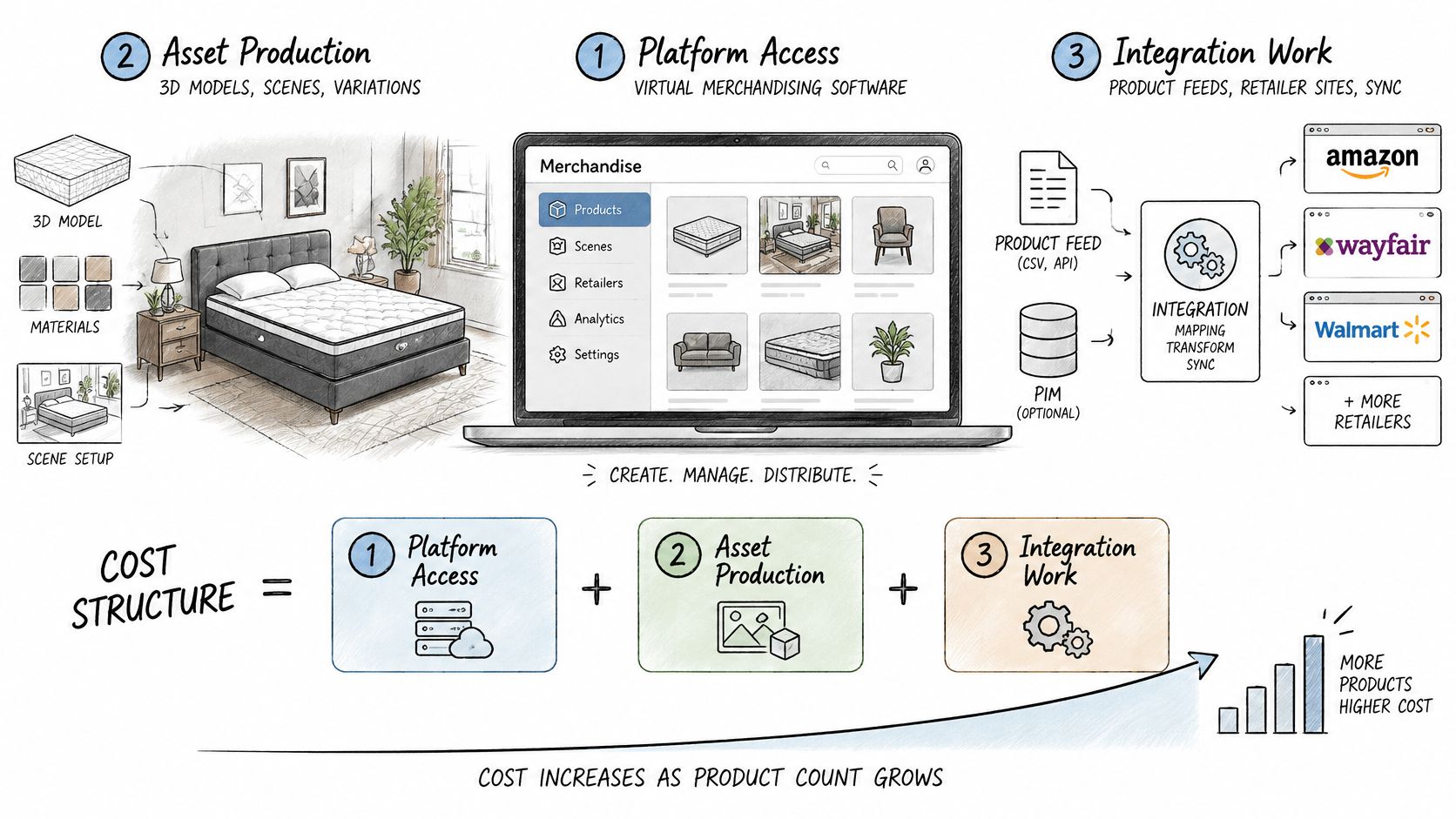
Budget by operating scope
The table below maps spending to assortment scope. Request itemised quotations against the same product list and deliverables, because two quotes for the same platform rarely cover the same work.
Where the budget goes at each business size
Business size | Assortment scope | Where the budget goes | Payback metric to track first |
|---|---|---|---|
Private label startup | One line built around a few hero SKUs | Hero assets and one configurator | Add-to-cart rate on the hero SKU |
Regional retailer | A regional assortment carried across stores | Floor-model visuals and in-store devices | Store conversion on configured versus unconfigured sales |
Mid-size manufacturer | Multiple lines shared with several retailer accounts | Master asset library and syndication to partners | Return rate and partner-page consistency |
National brand or large retailer | The full catalogue across channels | Full platform plus analytics staff | Revenue per session and gross margin per session |
A startup should avoid funding infrastructure for an assortment it hasn't established. Commission reusable source assets and confirm what transferring them into a future platform would require.
A regional retailer needs to include devices, connectivity and associate training. Treat comparisons between configured and unconfigured showroom sales cautiously, because associates may use the tool more often with particular shoppers.
A manufacturer budgets for partner-specific adaptations and distribution. A national business needs staff who can maintain rules, investigate reporting and act on results; licence approval is the smallest part of that job.
Price the changes as well as the launch
Include re-rendering after component changes, product-data cleanup, retailer exports and showroom training in the scope. Ask for a clear distinction between correcting an error and commissioning a product revision. A swapped foam layer or a new gusset option should carry a quoted price before the work starts.
Channel allocation matters too. Tilburg University findings discussed in Bedhead's guide to contextual imagery reported sales increases of 94% and 435% across two tested websites, while the same effect didn't transfer to Amazon. Use that gap as a reason to test spending by channel instead of assuming identical returns.
BEDHEAD offers digital marketing, eCommerce strategy, creative asset creation, product storytelling and high-end visual content. For teams without an internal studio, that work can cover layered construction views, clean product views and room context before a software licence enters the budget.
Request the cost of maintaining those assets alongside the cost of producing them; the cheaper launch often becomes the more expensive operating model. The metric you track first tells you what you bought: a return-reduction tool or a conversion experiment, each with a different payback clock.
Measuring Whether Virtual Merchandising Pays Off
More interaction doesn't necessarily mean more buying. A peer-reviewed study published by Taylor & Francis found that augmented reality significantly increased engagement compared with standard product imagery, yet produced no notable improvement in product attitudes or purchase intentions.
That makes a view-count dashboard insufficient evidence of commercial value. Test whether the experience changes a meaningful decision, not just whether shoppers open it.
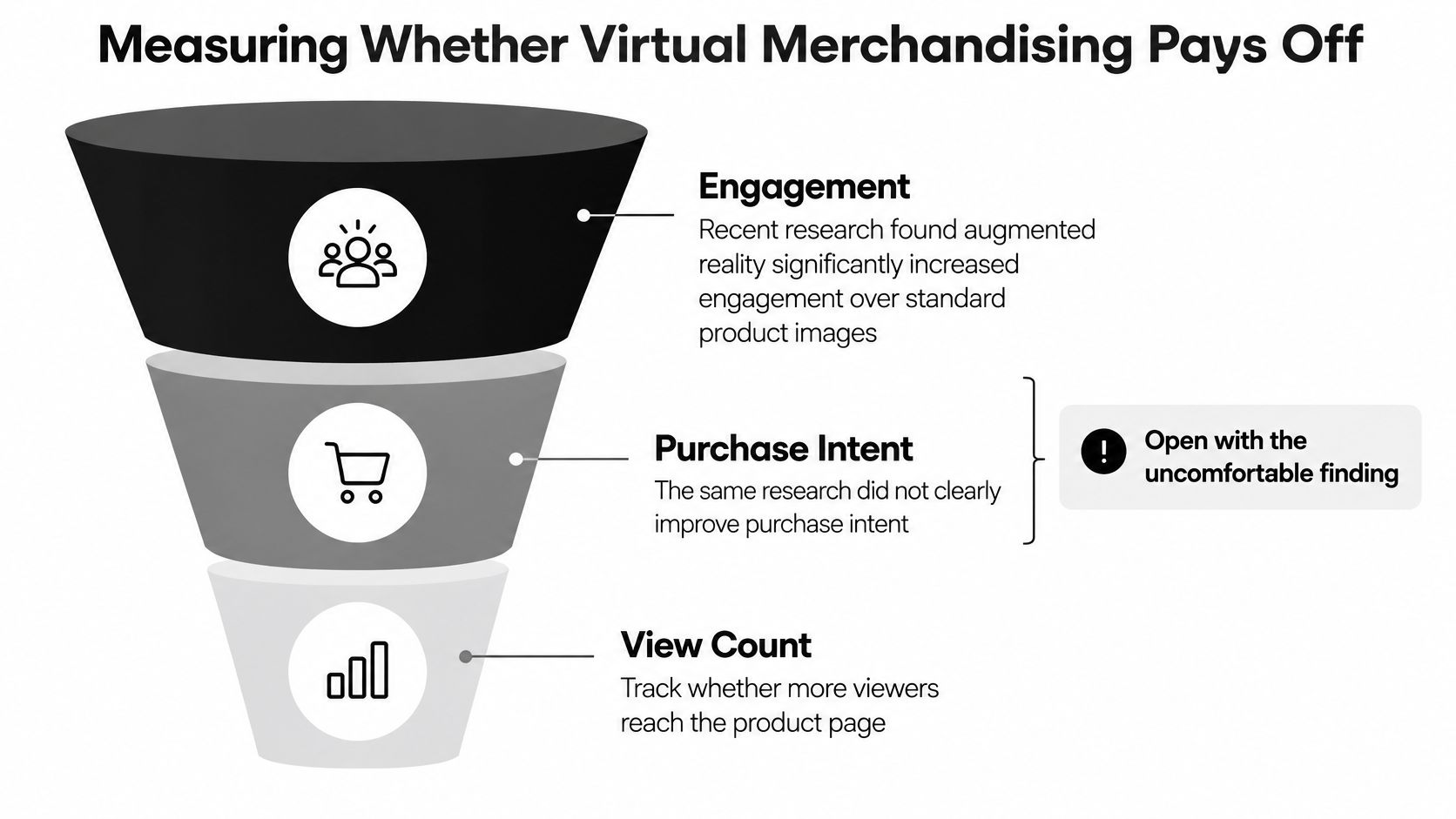
Compare against good static imagery
Randomly assign eligible visitors to an interactive experience or your best static imagery on the same products, running both concurrently. If you must compare different SKUs, match them carefully and recognise that product differences weaken the conclusion.
Keep pricing, promotions and stock availability aligned. Confirm that the platform can segment audiences, assign variants and record events, while allowing merchandising rules to be tested independently from creative assets.
Use a measurement plan with distinct jobs:
Add-to-cart and conversion: Determine whether shoppers advance and buy.
Returns and cancellations: Check whether expectations match the delivered mattress.
Assisted showroom sales: Record tool use without assuming it caused the sale.
Session duration: Diagnose interest or friction, rather than treating longer sessions as automatically better.
Cost per activated SKU: Include production, publishing and maintenance effort.
Our analytics implementation guide provides a foundation for making those events usable.
Set the commercial threshold before launch
Agree the required sample, test duration and minimum commercially useful improvement before results arrive. There isn't a universal traffic or margin threshold; calculate yours from baseline performance, expected contribution and implementation cost.
For context, a 2025 U.S. furniture eCommerce dataset cited in Bedhead's online furniture selling guide reported add-to-cart rates of 13.5% to 14.0%, cart abandonment of 86.0% to 86.5% and category conversion rates of 1.2% to 1.6%. These are furniture benchmarks, not mattress targets, but they illustrate why an early funnel improvement doesn't establish final profitability.
Match the asset to the claim. Room placement helps explain scale; it can't demonstrate pressure relief, temperature regulation or edge support the way a substantiated explanation and showroom trial can.
Schedule return reviews at 30 and 90 days as operational checkpoints, then retain a final review aligned with your actual return policy. Report results per SKU and account for return timing, so a successful hero product doesn't conceal expensive failures elsewhere.
Risk reduction and sales enablement may be the result worth buying, even when direct conversion lift remains unproven.
Confirm Your Shortlist Before Booking Demos
A useful shortlist starts with work your team can finish before a salesperson shares a screen. Make the buying question specific enough that a demonstration can answer it. "Can the viewer keep ticking, quilt and foam-layer specifications accurate across every channel" produces a yes or a no. "Does it look impressive" produces a yes from everyone.
Take these actions this quarter
Audit your ten highest-traffic products. Mark missing construction views, outdated specifications and channels displaying different images for the same SKU. Record the responsible owner and the corrective action, not just a screenshot of the problem.
Request demonstrations using your product data. Match your operating model to the appropriate vendor category, then send an approved product record and asset sample. Score the demonstrated workflows, including update handling, mobile use, export and SKU-level reporting, rather than the polish of the vendor's sample catalogue.
Approve a bounded experiment. Write down the business question, success threshold, implementation cost and decision owner. Include a stop condition if the viewer slows the page, displays incorrect options or breaks event tracking.
VWO's Small Test, Big Wins benchmark describes online retailers typically running tests for one to three weeks. Treat that as planning context: your traffic, buying cycle and measurement requirements decide when a result is readable.
A vendor that renders your worst-behaving SKU correctly is worth more than one that renders its own demo set beautifully.
Choose support that matches the work
BEDHEAD is a marketing agency and graphics design studio for the mattress industry, working with manufacturers, brick-and-mortar and eCommerce retailers and emerging bedding businesses. Services cover website design, photorealistic 3D graphics, interactive imagery and dynamic videography, alongside digital marketing, eCommerce strategy, creative asset creation and product storytelling.
That combination matters for a merchandising pilot. The same studio producing your 3D product views can run the social media, email, digital ad and SEO work around them, and can build virtual shopping experiences that carry accurate construction details from the product page through every downstream channel. Keeping asset creation and campaign execution under one roof removes a handoff where specifications usually drift.
BEDHEAD offers mattress-focused 3D visualization, website design and eCommerce strategy to connect accurate product information with useful shopping experiences. Visit BEDHEAD to discuss a visual audit or a scoped pilot, bringing your priority product line, current assets and the outcome you need to measure.