SEO Services Agency for Mattress Brands: What to Expect
Only 0.63% of users click through to the second page of Google results, according to ranking research compiled by Webvello. For a mattress brand, being indexed isn't the same as being found. An SEO services agency should help shoppers discover the right hybrid or foam model, help retailers understand your range, and make sure search tools describe your products accurately.
That work reaches beyond rankings. A fast product page with unclear firmness options can still lose the sale. A visible showroom listing with outdated floor-model information can disappoint the shopper. The useful question isn't whether an agency can increase traffic. It's whether it can connect search visibility to qualified demand, retailer inquiries, and better buying decisions.
What an SEO Services Agency Covers in Practice
A strong agency scope connects the technical website, the product story, and the next action a buyer needs to take. For a bedding business, that scope usually falls into six areas.
Six service areas a bedding SEO agency should cover
Service area | What the agency does | Mattress-specific example |
|---|---|---|
Technical SEO | Fixes crawling, indexing, page speed and URL structure | Oversized hero render on a hybrid queen page slows loading |
Content and category architecture | Plans guides, category pages and internal links | Hybrid, memory foam and latex guides linked to the matching model pages |
Product and variant markup | Maps SKUs and sizes to structured data | One product family across twin, queen, king and split-king |
Local and retailer visibility | Manages store pages and business listings | Showroom floor models and local stock shown in local search |
Brand and claims review | Checks that product statements are supported before publishing | Comfort, durability and cooling claims reviewed against evidence |
Visual support | Supplies renders, layer breakdowns and room scenes for pages | Foam-layer breakdown image on a hybrid product page |
Start with the website shoppers actually use
Technical SEO covers whether search engines can reach and index your important pages. On a hybrid queen page, the immediate problem might be an oversized hero render. Elsewhere, size filters might generate disconnected URLs that compete with the main product page, splitting the signals that page needs to rank.
Category architecture determines how those pages fit together. A memory foam guide should help shoppers understand the construction, then lead them toward relevant models. Google's SEO Starter Guide recommends descriptive URLs and grouping topically similar pages into directories, a practical foundation for separating mattresses, adjustable bases, guides, and retailer resources.
Product markup adds machine-readable product information. Google's ecommerce structured-data guidance identifies Product and ProductGroup markup for products and related variants. An agency should map the family carefully: one hybrid model in four sizes is a product group, not four unrelated mattresses, and different prices across sizes belong in accurate offers rather than a single flattened figure. Clean markup also shapes how search features and AI-generated answers describe the model, so accuracy here reaches further than the blue link.
Connect discovery with the product story
Local work should answer a showroom question: Can I try this model at this location? A store page should distinguish a mattress available to order from a floor model available to test. Don't promise live local inventory unless the retailer can maintain it.
Claims review belongs in the publishing workflow. Writers need approved language for comfort, cooling, and durability before they turn specifications into sales copy, and that language should stay consistent across product pages, guides, and retailer support material.
Visual support makes specifications understandable. A foam-layer diagram shows what sits inside the mattress, a product-only render presents it cleanly, and a lifestyle room scene supplies context. Each asset needs a job on the page rather than adding download weight.
BEDHEAD is a digital marketing agency and graphics design studio serving the mattress and bedding industry. Its services include digital marketing, ecommerce strategy, creative asset creation, product storytelling, website design, and 3D visualization, the same combination of search work and visual content described in the table above.
Scope check: Mark the two rows your current team already covers reliably. Start an agency conversation with the unmarked rows, not a request for more blog posts.
Why Organic Search Decides Who Gets Found
A shopper types hybrid mattress queen into Google. Review sites, retailers, and marketplaces appear before the manufacturer's own page. Even when that manufacturer supplies the product, someone else may explain its construction, frame the comparison, and receive the inquiry.
BrightEdge found that organic search generated approximately 53.3% of trackable website traffic, compared with about 15% from paid search, while a separate 2024 Conductor benchmark of more than 800 domains across seven industries put organic search at 33% of overall website traffic on average, as summarized in Rank.ai's SEO statistics.
Those aren't contradictory estimates. Different samples, traffic definitions, and measurement methods produce different channel shares. Treat them as evidence that organic search can represent roughly one-third to one-half of measurable visits, not as a forecast for your mattress website.
Match the page to the buyer
Manufacturers need discoverable product specifications and retailer-support resources. Retailers need category pages and store information that connect online research to a showroom visit. Component suppliers need technical content buyers can understand without first downloading an unexplained specification sheet.
An agency adds value by deciding which page should answer which question. A shopper comparing hybrid and memory foam construction needs an explanation. Someone searching a model name and size needs price, availability, and a clear buying path. Our guide to keyword research explains the underlying work of matching search language to intent.
Useful execution includes:
Clear ownership: Assign each important search intent to a suitable category, model, guide, or location page.
Connected information: Link construction explanations to relevant mattresses instead of leaving educational content isolated.
Commercial next steps: Offer a store locator, specification download, or product selection action appropriate to the visitor.
The technical workflow below supports that discovery work by keeping product pages usable.
We help mattress brands, bedding manufacturers, and retailers grow, but channel priorities still need to fit the business. List the three pages that should earn organic visits this quarter. Note which one you can't currently find on Google, then investigate whether the issue is indexing, relevance, or competition.
Technical Fixes That Move Mattress Product Pages
Say a queen hybrid page uses a 4 MB hero render. That's a hypothetical asset size, but the situation is familiar: the page looks responsive on an office desktop and loads poorly on a shopper's mobile connection. A desktop laboratory score doesn't settle the question.
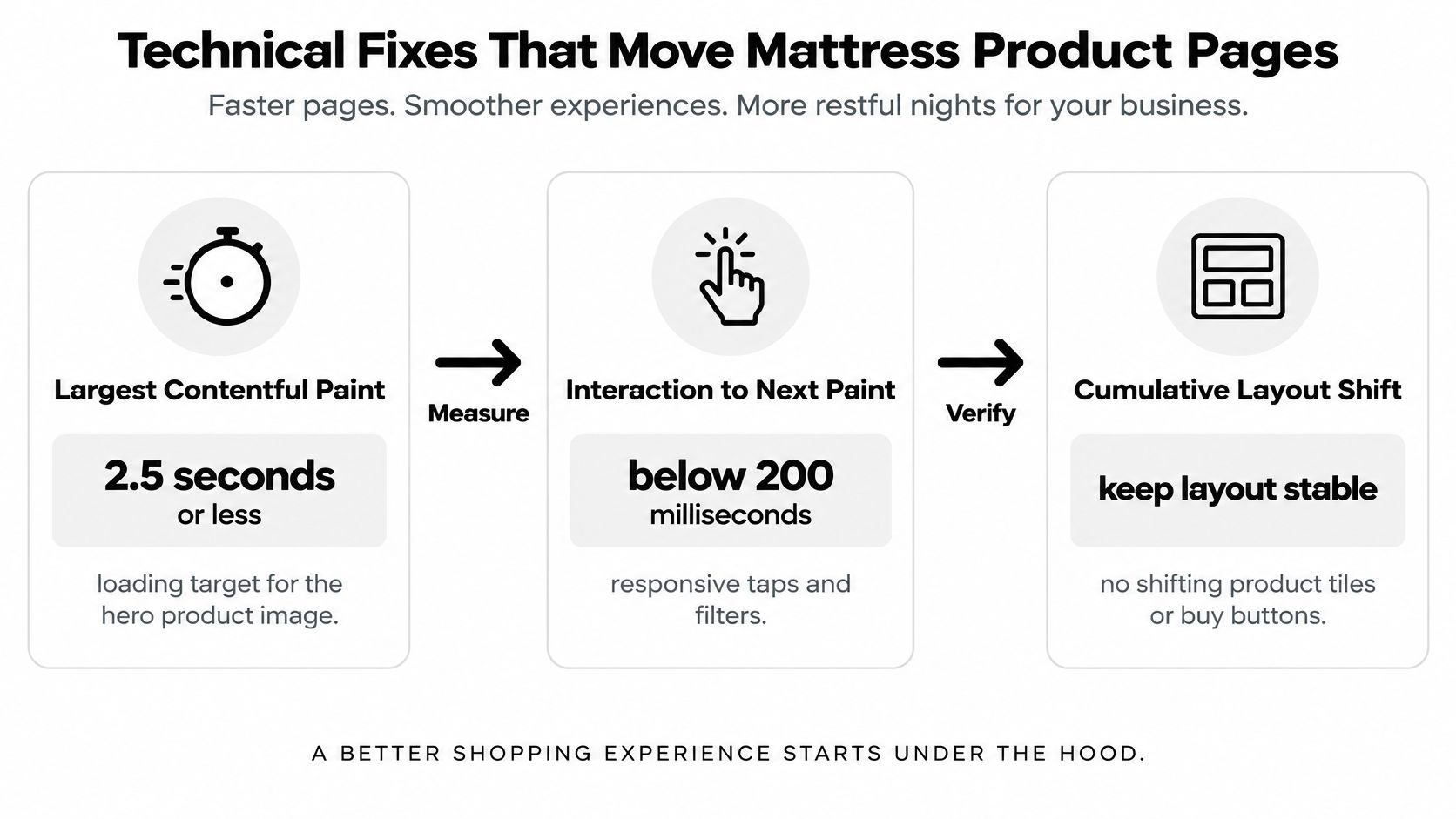
Google's Core Web Vitals guidance identifies the engineering targets below: LCP of 2.5 seconds or less, INP below 200 milliseconds, and CLS below 0.1.
Core Web Vitals thresholds for bedding pages
Metric | Threshold | What it measures |
|---|---|---|
Largest Contentful Paint (LCP) | 2.5 seconds or less | Loading speed of the largest visible element |
Interaction to Next Paint (INP) | Below 200 milliseconds | Responsiveness to taps and clicks |
Cumulative Layout Shift (CLS) | Below 0.1 | Visual stability while the page loads |
Bedding websites have legitimate reasons to use substantial visual content. Shoppers need to inspect ticking, quilt details, gussets, and internal construction. The trade-off isn't imagery versus speed. It's useful imagery delivered appropriately, rather than full-resolution assets loaded everywhere.
Fix the cause, not just the score
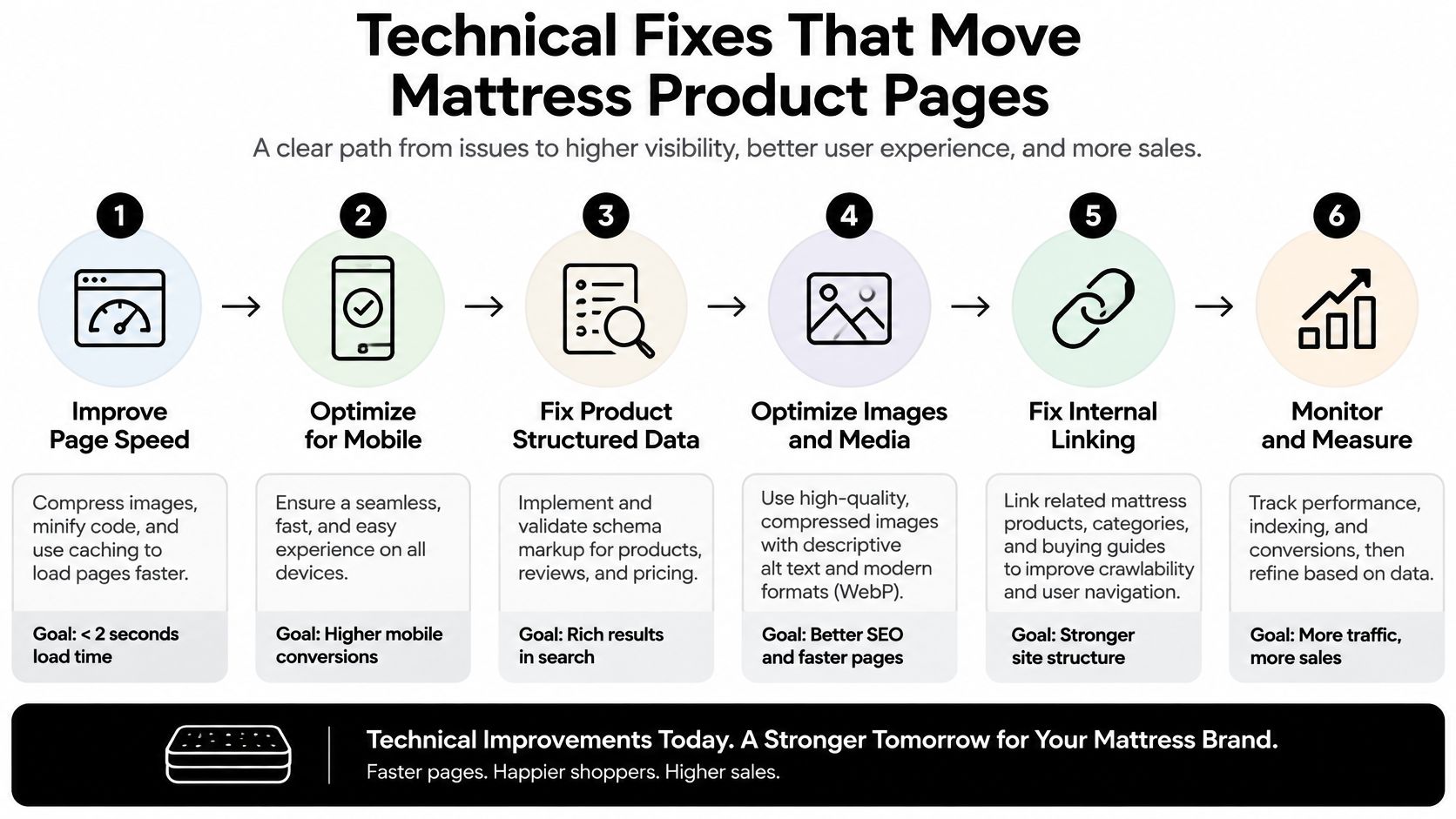
Separate the templates. Pull available field data for product, category, and guide pages, split by mobile and desktop. Don't let a lightweight article template hide problems across the catalog.
Identify the largest visible element. Use browser performance tools to determine what becomes the LCP element. It might be the hero image, not the asset your developer assumed.
Deliver screen-appropriate images. Serve responsive WebP or AVIF files. A mobile shopper doesn't need the same image dimensions as a large desktop display.
Control loading and layout. Preload only the true LCP asset. Reserve dimensions for images, videos, and promotional banners so the buy button doesn't move during use.
Reduce unnecessary script work. Defer non-critical JavaScript and investigate long main-thread tasks. Chat widgets, analytics, configurators, and virtual-shopping tools should justify their loading cost.
Validate the product information. Check size and firmness variants, then compare markup with visible price and availability. A technically fast page still fails commercially if its offer information is inconsistent.
Use this workflow to assign fixes to the right owner.
Keep rich results and conversion in perspective
Google's Product structured-data documentation explains that valid markup can make product information eligible for enhanced search presentation. It doesn't guarantee rich results or higher rankings. Reviews must describe the actual product and correspond to content shoppers can see.
For implementation detail, use our guide to improving page load speed. When reviewing the broader purchase path, Wistec's resource on how to optimise ecommerce sites for conversions provides a complementary ecommerce perspective.
Track the share of real mobile visits meeting all three performance targets, organized by template. Keep desktop results separate so improvements reflect the shoppers you're trying to serve.
How to Choose the Right Agency for Your Business Type
A generalist agency can know search mechanics without understanding mattress merchandising. Your candidate needs to distinguish ticking from quilt construction, explain foam layers accurately, and understand why hybrid builds, floor models, margins, and direct-to-consumer returns change the assignment.
Start with your business model rather than the agency's package names.
SEO priorities and questions by mattress business type
Business type | Priority SEO scope | Question to ask the agency |
|---|---|---|
Mattress manufacturer | Category architecture, retailer-facing spec pages, technical markup | How do you handle dealer and wholesale URLs that repeat product content? |
Brick-and-mortar retailer | Local listings, store pages, promotional content, buying guides | How do you connect showroom questions to pages that earn organic visits? |
Direct-to-consumer eCommerce brand | Product-page performance, variant markup, returns-related content | How do you measure product-page conversion, not only sessions? |
Private label or sleep startup | Foundational technical audit, brand authority, core guides | What does the first 90 days look like with a limited product range? |
Component supplier | Technical specification pages, B2B search content | How do you make foam and material specification pages findable by buyers? |
Test category understanding with a live page
Give candidates a model page and ask what they'd change first. A useful answer should distinguish a technical defect from a merchandising problem.
For a manufacturer, repeated dealer copy requires decisions about ownership, syndication, and URL handling. It doesn't justify automatically applying the same canonical strategy to every dealer. For a retailer, an adjustable-base buying guide should address the compatibility questions sales associates receive.
A DTC brand needs someone who can discuss conversion rates alongside returns-related expectations. More confident product selection is a sensible objective, but an agency shouldn't promise fewer returns without evidence. A component supplier needs precise material terminology, not consumer copy pasted onto a B2B page.
Use the following visual as a candidate-review checklist.

Compare deliverables and accountability
Ask candidates to separate audit work, implementation, content, reporting, and creative production. Scope and fees should account for SKUs, size variants, dealer or retailer sites, and whether the assignment includes 3D assets.
For a limited launch, ask how the first 90 days would be staged, which dependencies could delay implementation, and when the first measurable change might appear in the reporting measures below. A forecast without a baseline isn't a useful commitment.
Watch for:
Guaranteed first-place rankings: The agency doesn't control competing sites or search results.
No product-page discussion: A content-only proposal may ignore the pages that generate revenue.
No structured-data or measurement plan: Ask who implements, validates, and reports the work.
No claims review: Category familiarity includes knowing which statements need approval.
If link acquisition is included, review Free AI Directories' guide to what to demand in backlink reports. Ask candidates to explain placement relevance and how they document the work, rather than accepting a backlink count as the outcome.
A credible proposal makes responsibilities visible, including the work your merchandising, development, and sales teams must supply.
We don't guarantee specific results. Competitor decisions, retailer policies, search changes, and other factors outside our control can affect marketing outcomes. Expect a credible agency to acknowledge that uncertainty and report what changed, what it implemented, and what remains unresolved.
Measuring SEO Beyond Rankings and Sessions
More organic sessions doesn't automatically mean SEO is working. Traffic to a broad sleep article can increase while qualified product visits remain flat. A manufacturer can also influence a dealer's decision before that buyer ever submits a trackable form.
Google's AI search features guidance states that AI Overviews and AI Mode traffic appear within Search Console's overall Web performance reporting. That doesn't give marketers a dedicated, transparent account of every citation or description inside AI-generated answers.
Say a retailer ranks well for a hybrid comparison query, but an AI answer attributes an unsupported comfort claim to its model. A ranking report can look healthy while missing that product-information problem entirely.
Build a business-level scorecard
Use this model to connect discovery, page usefulness, and commercial action.
SEO measures for mattress and bedding businesses
Measure | What it shows | How to read it |
|---|---|---|
Branded search demand | Shoppers searching for the brand name | Rising branded queries after a campaign suggest awareness is building |
Qualified organic visits | Visits to product, category and guide pages | Compare against pages with a clear next step such as a size guide or store locator |
Core Web Vitals pass rate | Share of real visits meeting the loading, responsiveness and stability targets | Track by template: product, category and editorial |
Retailer or dealer inquiries | Requests from stores after reading brand pages | Count only inquiries that can be tagged to organic sources |
AI answer accuracy | Whether AI tools describe materials, comfort and certifications correctly | Review each quarter against a list of approved claims |
Product-detail engagement | Clicks to specifications, size guides and 3D renders | Strong traffic with low engagement points to content worth investigating |
Read these measures together. Rising branded demand may reflect paid advertising, showroom exposure, or broader distribution, not SEO alone. Tagged retailer inquiries provide stronger evidence of commercial action, but they won't capture every offline conversation.
Product-detail engagement also needs context. Few clicks on a construction accordion might mean shoppers aren't interested, or that the page already answers their question. Check page layout and purchase behavior before ordering more content.
Make uncertainty explicit
Set a baseline, then review a chosen template monthly. Use consistent event definitions for specification downloads, store-locator use, dealer forms, and render interactions. Our analytics implementation guide provides a starting point for organizing that instrumentation.
For AI-answer reviews, record the prompt, date, answer, cited pages, and disputed product attributes. Treat those checks as observations, not a complete census of what every shopper sees.
Attribution rule: Report what you can connect to revenue, label what remains directional, and don't count visibility as a sale.
Don't accept a report that stops at rankings. Request these measures in the first report, together with the limits of each one.
Claims, Disclosures and Other Costly Mistakes
A landing-page headline promising back-pain relief shouldn't pass review because a customer mentioned feeling better. The content team needs to distinguish that person's experience from a claim about what the mattress will do for other buyers.
The FTC's endorsement guidance says performance claims in endorsements require adequate substantiation, including competent and reliable scientific evidence where appropriate. It also explains that specific-result testimonials generally imply similar results for others, and that “results not typical” doesn't by itself resolve that implication.
SEO landing pages, comparison guides, reviews, and retailer-facing copy don't escape advertising scrutiny because they attract unpaid search traffic.
Review the claim behind the wording
For a pain-relief headline, identify exactly what outcome the wording promises and whether the evidence supports it. For a percentage improvement in sleep, retain the evidence and confirm that the tested product, conditions, and population match the proposed statement.
A cooling statement needs similar care. Identify whether you're describing a material, a measured thermal property, or an expected sleeper experience. Those aren't interchangeable.
For hybrid durability, don't turn a component specification into an unsupported promise about the finished mattress. Keep the evidence file connected to the model and approved copy, especially when construction changes.
Close the publishing gaps
The FTC endorsement rules require honest endorsements and disclosure of unexpected material connections, with disclosures that are clear and conspicuous. Build those checks into approval rather than leaving them to the writer's discretion.
Common mistakes include:
Undisclosed relationships: Publishing retailer testimonials or influencer reviews without addressing paid or gifted arrangements.
Unsupported competitor criticism: Describing another hybrid as less durable without evidence supporting the comparison.
Invented certifications: Allowing AI-generated descriptions to attribute certifications the brand doesn't hold.
Unrepresentative results: Highlighting an exceptional experience without adequately addressing generally expected performance.
Assign a named reviewer to measurable claims before publication. That reviewer should be able to locate the supporting source, confirm the approved wording, and identify any disclosure needed. Every measurable claim needs a named source before it goes live.
Start With a Product Page Audit Before You Sign
A handful of pages reveals more than a full crawl report. Pull three revenue-relevant ones: a hybrid, a memory foam model, and a foundation or adjustable base. Run each through our product detail page optimization guide to turn observations into a prioritized work list.
Test mobile use. Note delayed hero images, shifting banners, and controls that are difficult to tap.
Reconcile variants. Compare size names, firmness, prices, and availability against the product feed.
Check evidence. Locate the named source for every measurable cooling, durability, or pain-relief statement.
Answer the buying question. Explain construction differences or which base configuration fits a split king.
Choose priorities. Mark the two or three gaps that matter most for your business type.
Put the same pages in front of every agency you interview. Ask them to audit what you found and show how they would report branded demand, qualified visits, retailer inquiries, and AI-answer accuracy. An agency quoting ranking positions alone is measuring the easiest part of the job.
Clarify the engagement before you sign
Questions about scope, deliverables, or our Terms and Conditions can go to info@bedheadmarketing.com or our contact form.
BEDHEAD pairs mattress-focused SEO with website design, 3D visualization, ecommerce strategy, creative asset creation, and product storytelling for brands, manufacturers, and retailers. Bring your priority product pages to BEDHEAD and start a conversation about the technical, visual, and measurement work your business needs.