Social Media Management Pricing for Mattress Brands
Social media management pricing typically runs $500 to $5,000 per month, with agency retainers most commonly falling between $1,000 and $2,499. Ad spend is excluded from these figures.
For a mattress brand, the important question is what happens before a post gets scheduled. Someone has to verify the foam layers, distinguish a quilt change from a construction change, and make sure the dealer-facing message matches the product on the showroom floor.
The main price driver is product education and approval work, not just posting frequency. A package that leaves those tasks with your marketing director can cost less on the invoice while consuming more internal time.
Social Media Management Costs at a Glance
What does social media management cost for a mattress brand? The broad monthly management range is $500 to $5,000, according to Ames Create's pricing overview, but your position within that range should reflect the work you're outsourcing.
The agency market clusters toward smaller retainers: HeyOrca's agency pricing guide reports that 49% of surveyed agencies charge $1,000 to $2,499 monthly, 31% charge under $1,000, and 3% charge above $5,000. Those are agency-wide pricing bands, not mattress-specific package definitions.
Monthly Management Fee by Scope Tier
The scope descriptions below are practical buying categories, not proof that every agency in a price band supplies those services. Ad spend is excluded from every row.
Scope tier | Typical monthly fee | What it usually includes |
|---|---|---|
Posting only, one platform | Under $1,000, 31% of agencies | Scheduled posts, basic captions and a monthly report |
Standard management, multiple platforms | $1,000 to $2,499, 49% of agencies | Content calendar, strategy, community responses and reporting |
Three-network benchmark | About $2,107 | Roughly three posts per week per network, 5 to 10 hours of weekly community management and reporting |
Full-service with specialized production | Above $5,000, 3% of agencies | Custom photography, 3D imagery, video, product education and paid campaign oversight |
The specific $2,107 monthly three-network benchmark, including roughly three posts per week per network, 5 to 10 weekly community-management hours, and reporting, comes from Bujify's provider-survey summary. Treat it as a comparison point, not a guaranteed quote or a promise that custom production is included.
Buying rule: Compare the work transferred to the agency, not just the work appearing on your feed.
A retailer supplying approved floor-model photography needs a different service from a manufacturer launching hybrid mattresses with new construction details. The manufacturer may need technical copy, dealer adaptations and visual explanations before publishing can begin.
Place your own workload against these tiers before requesting quotes. Identify what your team will supply, what the agency must create, and who owns final product approval. That makes a lower quote easier to evaluate without assuming it represents equivalent work.
What Drives the Price of Your Retainer
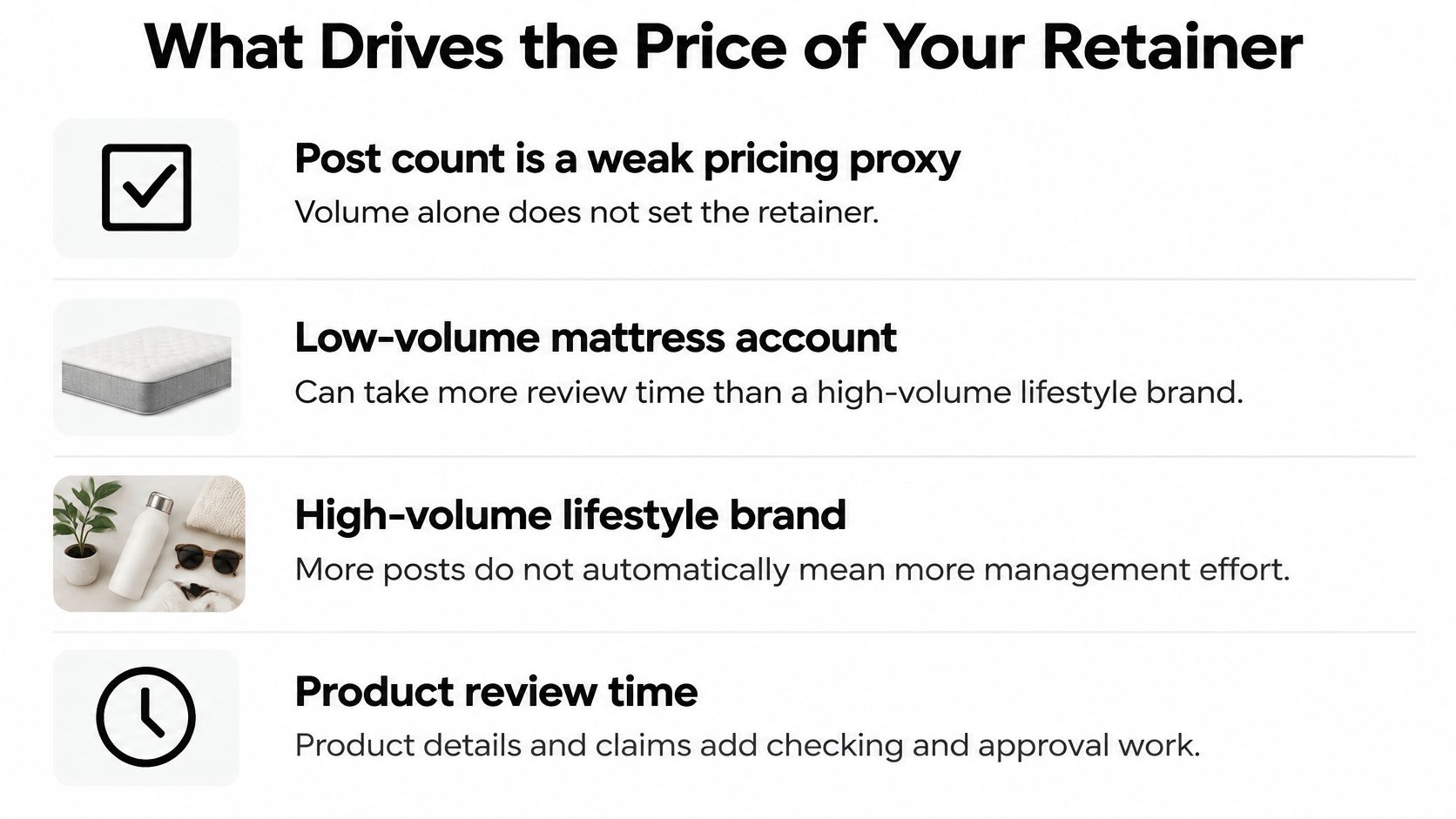
Post count is a weak pricing proxy. A mattress account publishing four posts a week can consume more review time than a lifestyle brand publishing daily, because each asset has to carry accurate firmness descriptions, construction details and product claims.
A caption about comfort needs a quick brand check. A layer-breakdown animation needs someone to confirm the sequence of materials, the representation of the support core, and whether the ticking, quilt and gusset match the actual SKU. The second asset absorbs hours of specialist attention before it ever reaches the scheduling tool.
The Work Behind the Publishing Calendar
Make these workload drivers explicit when scoping a retainer:
Product lines and SKUs: Each construction needs an approved explanation, not a recycled comfort claim.
Dealer content: Co-branded assets require retailer names, offers, locations and product availability checks.
Approval layers: Sales, manufacturing and legal reviewers need a defined sequence, and every added reviewer adds revision rounds.
Custom production: Photography, 3D assets and video require separate specifications and revision boundaries.
Launch support: Seasonal introductions can add urgent asset changes and retailer requests.
Response expectations: Delivery questions, warranty concerns and product-selection messages need different escalation paths.
The labor benchmarks explain why these details matter. HeyOrca's 2024 survey of more than 100 agency and freelance social media managers found an average hourly rate of $66.96; Hudo's summary of HeyOrca's experience-based findings reports $92.23 per hour for freelancers with seven or more years of experience.
At those rates, a monthly workload of 20 hours costs roughly $1,340 to $1,845 in labor, and a $2,500 retainer covers about 27 to 37 hours of professional work before media spend or specialized production. When two quotes differ by $1,000, the gap usually sits inside those hours. Ask each bidder to itemize SKU education, dealer adaptations and revision rounds as separate line items from ad spend.
Match the Role to the Workload
If you're considering an individual hire, Virtustant's social media manager for small business resource provides a useful role-comparison starting point. Evaluate whether the role covers coordination and publishing or also requires technical product storytelling and paid-media expertise.
BEDHEAD offers digital marketing, ecommerce strategy, creative asset creation, product storytelling and high-end visual content. When evaluating social media marketing services, separate those capabilities into deliverables rather than assuming they're all included in a retainer.
Choosing Between Flat, Percentage and Hybrid Pricing
Billing Models Compared
Billing model | How it is billed | Best fit | Main risk |
|---|---|---|---|
Flat monthly fee | Fixed retainer for agreed deliverables | Stable scope with a defined posting plan | Scope creep when launches or SKU education add work |
Percentage of ad spend | 10% to 30% of managed spend, often declining as spend rises | Large, scaling paid budgets | Fee too small at low budgets; 10% of $3,000 is $300 |
Hybrid | Onboarding fee, monthly minimum and declining percentage above spend tiers | Brands running organic and paid social together | Harder to compare quotes unless line items are clear |
Freelance hourly | $15 to $100 per hour | Narrow scope on one platform | Limited capacity and potentially limited strategy depth |
Impact Origins' advertising-agency pricing analysis places percentage fees at approximately 10% to 30% of managed spend and reports a survey-based finding that 51.8% of providers use flat fees, while 23.9% combine a flat fee with a percentage. Landingi's 2024 pricing overview gives the $15 to $100 hourly freelance range, depending on expertise and scope.
Where Percentage Pricing Breaks
Percentage pricing looks straightforward until the media budget is small. As GrowthPair's paid-social pricing guide illustrates, 10% of $3,000 in monthly ad spend produces a $300 management fee, which may not cover tracking checks, campaign builds, creative testing, weekly optimization and reporting.
Keep those lines visible:
Management fee: Payment for campaign execution and accountability.
Media spend: Payment to the advertising platform for delivery.
Creative production: Payment for the assets campaigns need.
For a mattress retailer, the tracking work still exists even when the advertising budget is modest. Someone must confirm that appointment requests and dealer-page visits are being measured appropriately before judging campaign performance.
A management fee should cover the work required to run the account responsibly, not simply follow the size of the media invoice.
A Practical Structure for Bedding Brands
A hybrid arrangement is often the most defensible choice when organic publishing and paid social operate together. Define onboarding separately, establish a recurring execution minimum, and specify how management charges change when media spend expands.
Don't confuse that structure with performance-based compensation. Social Cloud's discussion of outcome-linked fees for DTC growth teams is useful when considering incentive arrangements, but any agreement still needs clear attribution rules and a definition of the outcome being rewarded.
Also define channel boundaries. A social retainer shouldn't absorb Google Ads, email or SEO responsibilities; a review of marketing channel examples can help your team assign each responsibility to the correct budget.
How to Budget for Management and Ad Spend
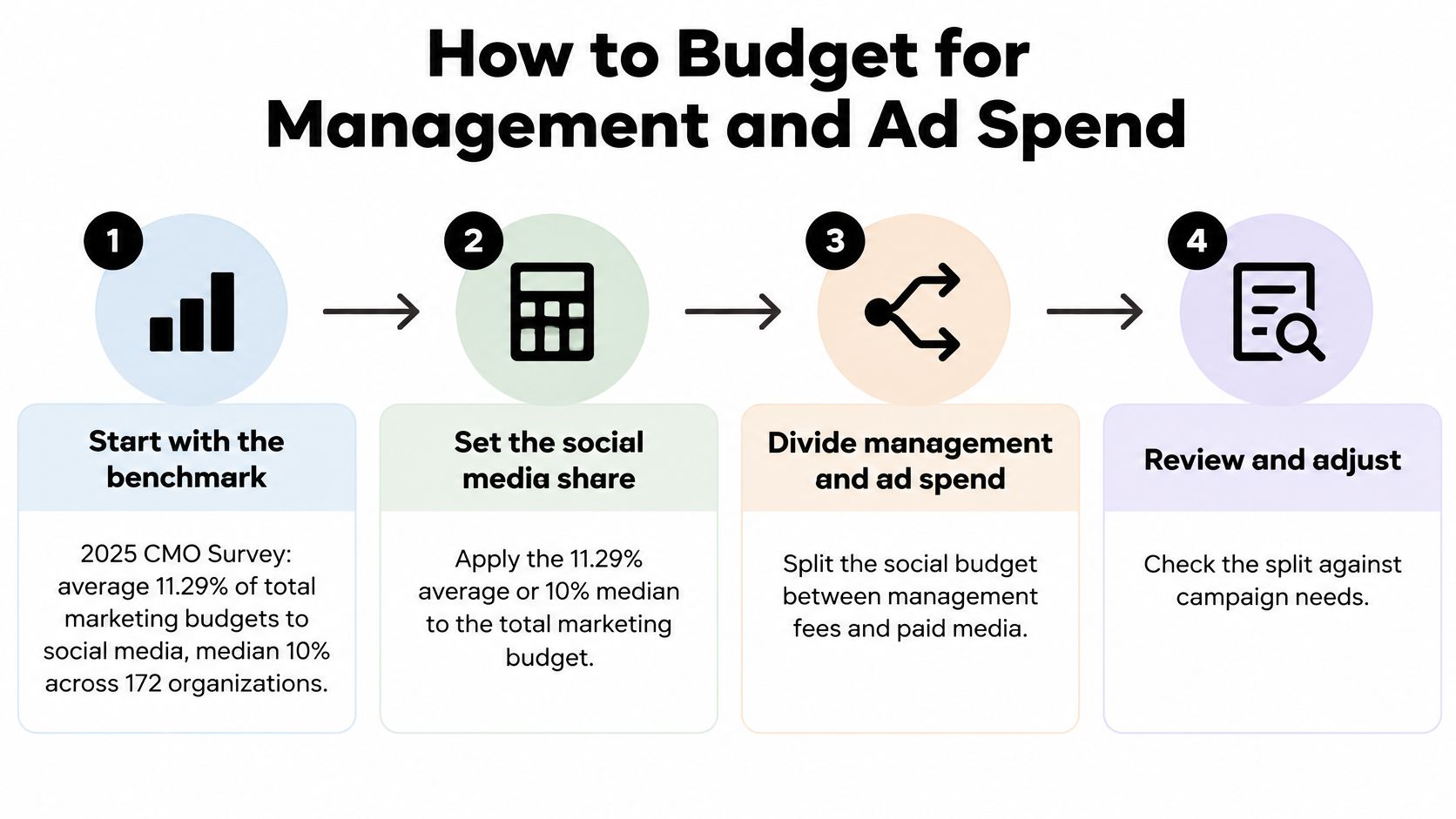
The 2025 CMO Survey found an average social allocation of 11.29% of total marketing budgets, with a 10% median across 172 organizations. Among 171 responding organizations, the expected share was 13.34% within the next 12 months and 18.37% within five years.
For a hypothetical $100,000 annual marketing budget, the survey average implies approximately $11,290 annually, or $941 monthly, for social before separating management, production, advertising and tools. That's a total allocation exercise, not a suggested agency retainer.
Build the Allocation Before Buying Services
Set the annual marketing budget. Include the company's broader commitments, such as dealer support, product launches and website work. Social shouldn't be planned without those competing needs.
Apply the survey's median or average as a starting point, not a spending requirement. Then test whether the resulting allocation can support your actual workload.
Create separate expense lines. Record management fee, creative production, paid media and tools independently. Otherwise, you can't tell whether you're underfunding execution or distribution.
Decide whether paid social belongs inside the social allocation or within a central media budget. Document the choice so finance doesn't count it twice.
Reserve setup costs outside the recurring retainer. Account access, tracking configuration and strategy development need an explicit funding source.
Plan any increase around additional work, such as paid campaigns or video production. The survey's expected increase is a planning reference, not evidence that your brand should automatically spend more.
Review the allocation quarterly. Compare spending with reporting, launch requirements and the team's capacity to approve new work.
Let Performance Change the Split
The same survey recorded social's share falling from 12.1% in fall 2024 to 11.3% in 2025, while digital marketing spending grew 7.3%. Channel allocations can move downward even when broader digital investment expands.
Adwave's guide to how much to spend on ads offers additional planning context. For bedding teams, the more important operational distinction is between social media advertising and marketing: producing useful content and paying to distribute it are related, but they need separate resources.
What Your Media Budget Buys in Impressions
CPM means cost per 1,000 ad impressions. It measures media delivery, not the agency's management fee, unique shoppers or guaranteed sales.
The following estimates use Gupta Media's 2025 average social advertising CPM benchmarks: Meta at $8.32, TikTok at $4.09, YouTube at $7.05, Snapchat at $8.78 and Pinterest at $4.74. The impression estimates are calculated by dividing the hypothetical media budget by CPM and multiplying by the CPM impression unit.
2025 Benchmark CPM and Impressions per $1,000
Platform | 2025 average CPM | Impressions per $1,000, approximately |
|---|---|---|
Meta | $8.32 | About 120,000 |
TikTok | $4.09 | About 245,000 |
YouTube | $7.05 | About 142,000 |
Snapchat | $8.78 | About 114,000 |
$4.74 | About 211,000 |
These figures describe media spend only. Management fees are additional. Targeting, auction fluctuations, geography, creative performance and campaign objective can all change actual delivery.
A lower CPM isn't automatically a better mattress campaign. Say a shopper watches a layer-breakdown video on TikTok but visits a showroom weeks later. The inexpensive impression may contribute to consideration without generating an immediate purchase that your online dashboard can identify.
Measure More Than Delivery
Use a measurement ladder that reflects how shoppers buy bedding:
Baseline reporting: Verify spend, delivery and tracking before interpreting performance.
Engagement quality: Review whether comments and saves concern product selection, construction or local availability.
Website and dealer traffic: Track visits to relevant product pages, store locators and dealer destinations.
Lead tracking: Distinguish appointment requests and qualified inquiries from low-intent interactions.
Incrementality testing: Where feasible, test whether advertising adds outcomes beyond what would have happened without it.
A social media management cost overview from MPH Marketing distinguishes management services from additional ad spend. That distinction matters when judging ROI: the full campaign cost includes more than the platform invoice.
BEDHEAD doesn't guarantee specific results from its services, and marketing outcomes can vary based on numerous factors beyond our control. For mattress ecommerce, include returns, visualization quality and product-page conversion rates in the evaluation rather than treating platform engagement as revenue.
Use CPM to estimate delivery capacity. Use qualified customer behavior to decide whether that delivery was useful.
A Worked Budget for a Regional Mattress Brand
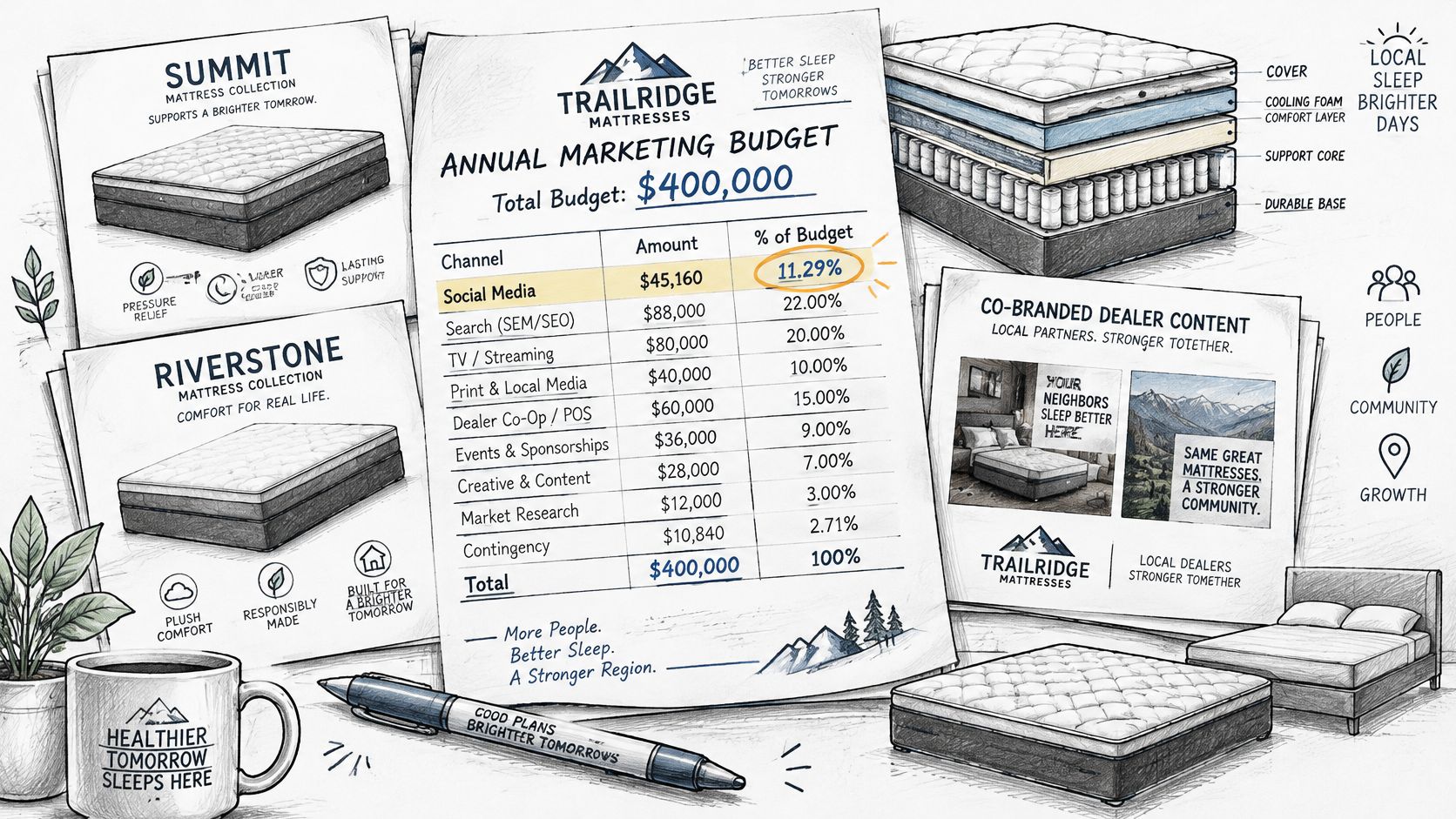
Consider a hypothetical regional mattress manufacturer with a $400,000 annual marketing budget, two product lines, and a dealer network that needs co-branded content. Applying the survey-average social share produces an illustrative allocation of $45,160 annually, or approximately $3,763 monthly.
Those are scenario calculations, not a quote or a claim about what regional manufacturers typically spend. The example uses the allocation, management and media benchmarks already established, with rounded monthly amounts for planning.
Give Every Expense a Home
Budget line | Illustrative monthly allocation | Intended work |
|---|---|---|
Management retainer | $2,107 | Three-network publishing, weekly community management and reporting |
Paid media | $1,200 | Platform advertising spend, separate from management |
Creative production reserve | About $456 | Product education visuals and dealer assets, amortized across the year |
Total | About $3,763 | Rounded monthly social allocation |
At the Meta benchmark CPM, the hypothetical media line could buy approximately 144,000 impressions before targeting effects. That estimate doesn't establish whether the campaign will generate showroom visits, retailer inquiries or profitable orders.
The proposed management agreement would use a hybrid structure: a monthly execution minimum, separately scoped onboarding, and a defined percentage mechanism if media spending expands. A percentage-only management charge of 10% of this scenario's $1,200 media budget would yield just $120, so the brand shouldn't expect that amount to fund tracking, campaign construction and optimization.
Budget Visual Education as Production
The creative reserve is a spending ceiling to test against quotes, not a promise that it can fund every desired asset. A new render library may require a separate project allocation.
We list website design and 3D visualization among our services for mattress and bedding brands. Those assets can be scoped independently from ongoing publishing:
Digibuns: Layer-breakdown visuals explaining what's inside a mattress.
Silhouettes: Clean product images showing the exterior accurately.
Room Scenes: Lifestyle renders that place the mattress in a bedroom setting.
For dealer content, prioritize assets that help an RSA explain the difference between the product lines while standing beside the floor models. Reuse approved construction language across social posts, product pages and sales materials without assuming every format requires identical creative.
At the 12-month review, test an increase toward the survey's 13.34% expectation only if business needs support it. Decide whether the additional allocation should fund distribution, original production or both, rather than increasing the retainer automatically.
Set a Social Budget You Can Defend
A defensible social budget links the invoice to a defined workload and a business purpose. For a manufacturer, that purpose might be dealer confidence or launch support. For a retailer, it might be qualified showroom appointments while protecting margins.
Before requesting proposals, define what the work must cover:
Match scope to workload. Decide whether you need publishing, community management, product education or coordinated production. Include tasks your internal team currently handles but wants to transfer.
Choose a billing structure. For a program combining organic and paid social, set a clear execution minimum and rules for expanding the work. Specify how launches, retailer requests and construction revisions affect scope.
Set media spend separately. Use delivery estimates to assess platform affordability, then consider whether each channel can reach the shoppers or dealers you need. Lower-cost impressions alone do not make a channel the right choice.
Request Comparable Quotes
Ask each bidder to itemize the same components:
Management fee: Platforms, publishing responsibilities and community-response expectations.
Creative production: Included photography, copywriting, rendering and video.
Paid media: Platform spend, listed separately from service charges.
Setup fee: Strategy, account access, configuration and tracking work.
Revision rounds: Included reviews and the process for changes to product construction.
Reporting scope: Metrics, interpretation and business-outcome tracking.
Account ownership: Control of advertising accounts, creative files and tracking data.
These distinctions make it easier to compare like with like. A publishing-only service and a product-education program do different work, even if both are described as social media management.
Connect the Scope to Commercial Decisions
For each SKU, clarify whether layer breakdowns, Room Scenes and product education are included or quoted separately. Mattress brands often need precise product details and approval from multiple stakeholders, so those requirements can affect production workload and turnaround. Tie reporting to the decisions your team needs to make, using a consistent approach to measuring marketing ROI.
BEDHEAD provides digital marketing, ecommerce strategy, creative asset creation, product storytelling and high-end visual content. Its services for mattress and bedding brands also include website design and 3D visualization.
For additional industry education, visit Bedhead University.
If your social budget needs to cover product storytelling as well as publishing, visit BEDHEAD to discuss management, paid campaigns and mattress-specific creative production. Bring your product list, current assets and dealer requirements to help define what belongs in the retainer and what should be budgeted separately.