Social Media Advertising and Marketing Guide
A shopper watches three cooling-hybrid videos, then walks into a showroom and can't match the ad to the floor model's quilt pattern, gusset height, or foam stack. Social media marketing is the ongoing work of explaining firmness, trial terms, delivery, and who a mattress suits. Social media advertising is the paid placement of those explanations in front of people who don't already follow the brand.
That distinction matters to mattress manufacturers, brick-and-mortar and eCommerce retailers, private-label brands, and sleep startups. Likes can signal interest, but they aren't tickets. For an expensive mattress with a long decision cycle and a complicated return, social should qualify and educate shoppers, then hand them to a product page, a booked showroom visit, or a sales associate. This is the practical starting point for connecting showroom and online experiences.
The Showroom Gap Social Likes Never Close
A social post can earn likes and still leave a shopper unable to identify the mattress on the showroom floor. If the bed in the ad looks different from the model in store, the associate has to rebuild the comparison from scratch: ticking, quilt, firmness, and foam layers.
The problem often begins in the creative. A lifestyle photo can hide the mattress profile. A video can promise a cooling feel without showing the cover or explaining the construction behind it. When the shopper arrives expecting a different product, confidence in both the ad and the retailer can slip.
Practical rule: Make the advertised mattress easy to recognize on the sales floor and easy to understand on the product page.
Social content can prepare shoppers for a useful showroom conversation. Show whether a mattress feels plush or firm, explain how a hybrid differs from an all-foam model, and clarify trial and delivery terms. That gives shoppers better questions to ask and associates a clearer starting point.
Paid advertising can put those explanations in front of people beyond the brand's existing followers. A retailer can promote appointments to nearby shoppers; a manufacturer can explain how a mattress is built and direct interested buyers to a local stockist. Neither guarantees a sale. Each can help create incremental, qualified demand and guide shoppers to the next step.
The goal is to connect the feed with the shopping experience, as in a strategy for linking online and showroom channels. Likes show activity, not purchase intent. For a high-ticket mattress, social should educate and qualify, then hand the shopper to a product page, consultation, or showroom where comparisons and questions can move the decision forward.
Channel Jobs for Social Media Advertising and Marketing
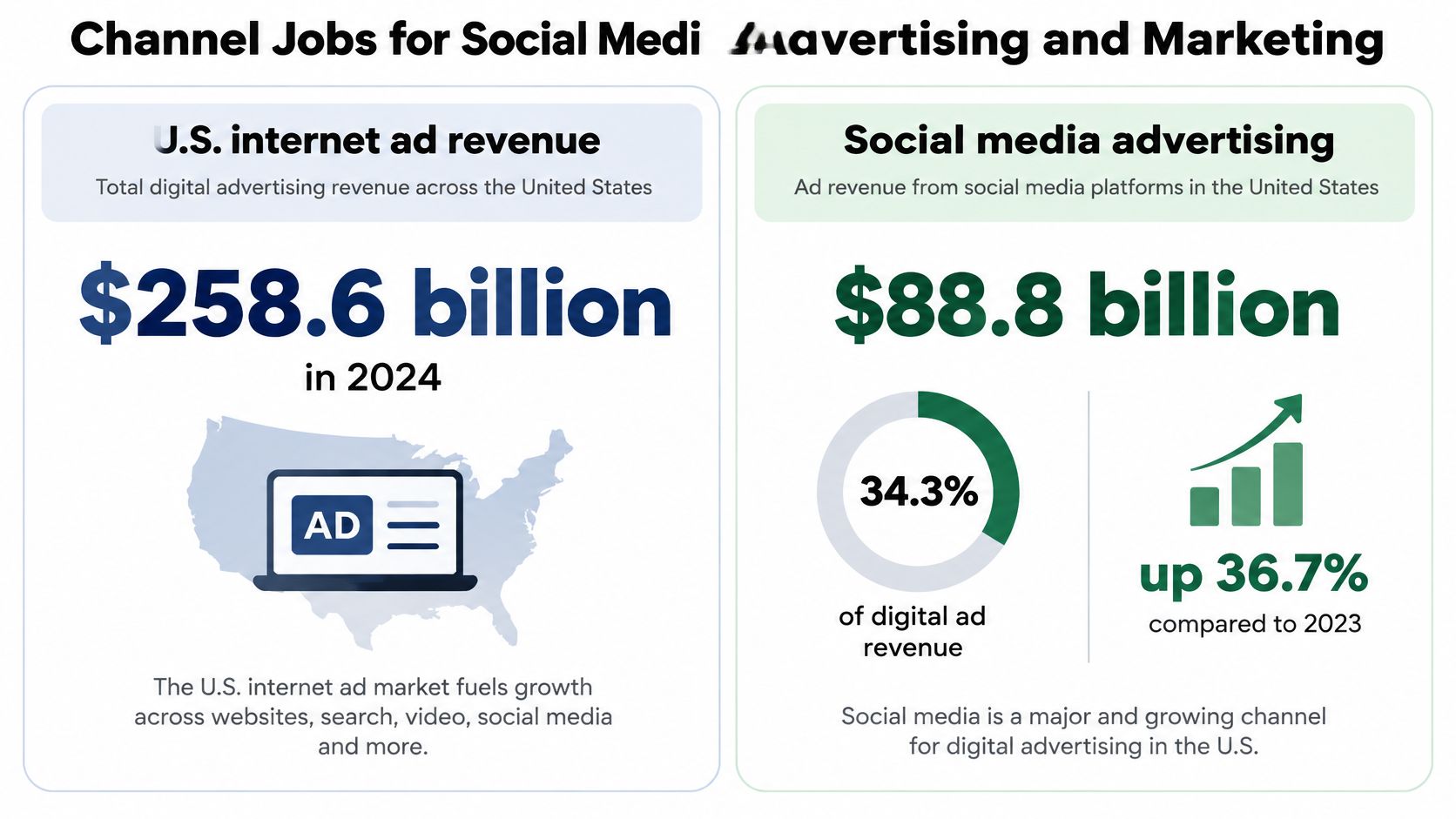
Social is a substantial media-buying channel, but the size of the market doesn't prove that an individual mattress campaign will be profitable. The IAB and PwC's report on U.S. internet advertising revenue says total U.S. internet advertising revenue reached $258.6 billion in 2024. Social media advertising generated $88.8 billion, or 34.3% of digital ad revenue, and grew 36.7% year over year.
Platform planning tools also show the potential scale of social advertising, not guaranteed unique people or actual impressions. DataReportal's Digital 2025 Global Overview reports potential advertising reach of more than 2.53 billion users per month for YouTube across 88 countries and 2.28 billion for Facebook globally at the beginning of 2025. YouTube's reported reach was about 11% larger, but those estimates can include audience overlap and modeled reach.
Which social platform owns which mattress job
Platform | Primary mattress job | Strong formats | Poor fit |
|---|---|---|---|
Meta (Facebook and Instagram) | Local store traffic, retargeting, financing and appointment leads | Reels, carousels, lead ads | Closing a high-ticket hybrid with no education |
YouTube | Construction education and comparison | In-stream demos, Shorts | Impulse checkout |
TikTok | Discovery and firmness or cooling myths | Short demos, creator Spark Ads | Warranty or financing claims without a landing page |
Room planning and guest or kids' rooms | Idea Pins, shopping scenes | Urgent doorbuster promotions |
Treat each platform as a job, not a popularity contest. Meta can connect nearby shoppers with local stores, then follow up with people who've viewed products. YouTube can show a cutaway of a hybrid and explain ticking, coil versus foam, or an adjustable base. For teams weighing creative and audience choices, this guide for DTC paid social teams offers relevant planning context.
TikTok can introduce a sleep problem or challenge an assumption about firmness and cooling. It shouldn't carry a complicated warranty explanation without a page that gives shoppers the details. Pinterest can help someone picture a bed in a guest room or a bedroom refresh, but a last-minute doorbuster usually needs a more direct local promotion.
A regional retailer can start with Meta plus one channel for education. A national manufacturer with a story built around layers and materials has a clearer reason to add YouTube. For a broader overview of how advertising media differ, see this guide to types of media in advertising. The best mix is the one that moves a specific shopper toward a useful next step, not the one with the longest platform list.
How Paid and Organic Split the Mattress Journey
Organic and paid social aren't opposing choices. Organic content builds a useful library: firmness explainers, trial and white-glove delivery posts, retail sales associate tips, and clear answers about hybrid construction. Paid distribution carries the strongest explanations beyond existing followers and puts them in front of people who may be shopping now.
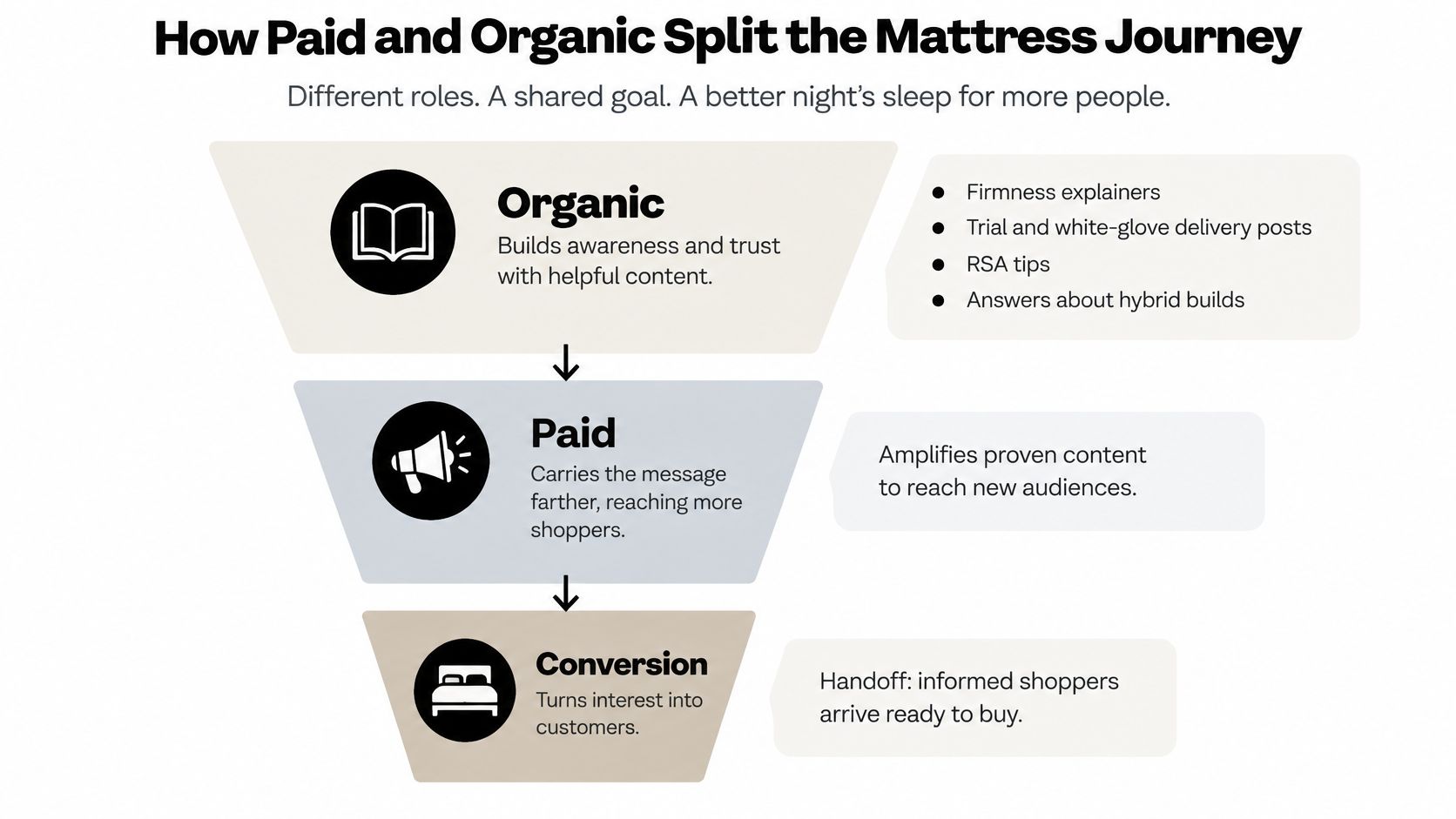
A team can build the journey in three stages:
Discovery: Use an organic short clip to name a problem, such as sleeping hot or needing a better guest bed. A modest paid boost can carry that explanation to potential shoppers beyond the follower base.
Consideration: Give interested shoppers more detail in a longer video or carousel. Explain the foam layers, coil system, cooling cover, or firmness options. Paid retargeting can then focus on people who watched the video or visited a product page, rather than repeating the same broad introduction.
Handoff: Make the next action clear. Lead forms, showroom appointment ads, and retailer locators can connect an interested shopper with a person or place to continue the conversation. An in-feed checkout button isn't the only way to move a sale forward.
A mid-size retailer with a hypothetical $10,000 monthly social budget could put about $3,000 toward organic production and comment replies, $4,000 toward prospecting within store radii, and $3,000 toward retargeting product-page visitors, financing starters, or shoppers who booked but missed an appointment. That's a planning example, not a recommended universal allocation. Review it monthly, then move budget toward the handoff that produces the most qualified consultations.
The weekly organic cadence should be something the team can sustain, including during promotion weeks. If a sale ad has nothing useful behind it, shoppers land on a product page that can't answer their next question. A startup with no reviews has a related problem: paid clicks may reach a thin profile with little explanation. Build a small, honest foundation first, then pay to distribute it.
Teams looking for more ways to organize the paid side can use this paid social advertising guide as a planning resource. The key is to keep the relay intact: organic provides useful material, paid helps the right shoppers find it, and the handoff gets them closer to a confident mattress decision.
Audiences and Creative Shoppers Can Actually Judge
Start with the shopper you can serve. For a retailer, prospecting is usually geographic: target a practical drive-time area around each store, then use relevant interests such as sleep, home, or moving. Exclude recent purchasers where appropriate, along with employees, so spend doesn't chase people who aren't new prospects.
Manufacturers often need a different approach. A national campaign can reach shoppers based on a sleep problem or product type, then direct zip-level demand to retail partners. It shouldn't pretend that every video view leads directly to a sale on the manufacturer's own site.
Retargeting should be narrower than prospecting. Useful audiences include shoppers who have visited a product page, watched more than half of a video, started a financing application, or booked an appointment and missed it. Each group has shown a different kind of interest, so the follow-up creative should answer the question most likely to keep that shopper moving.
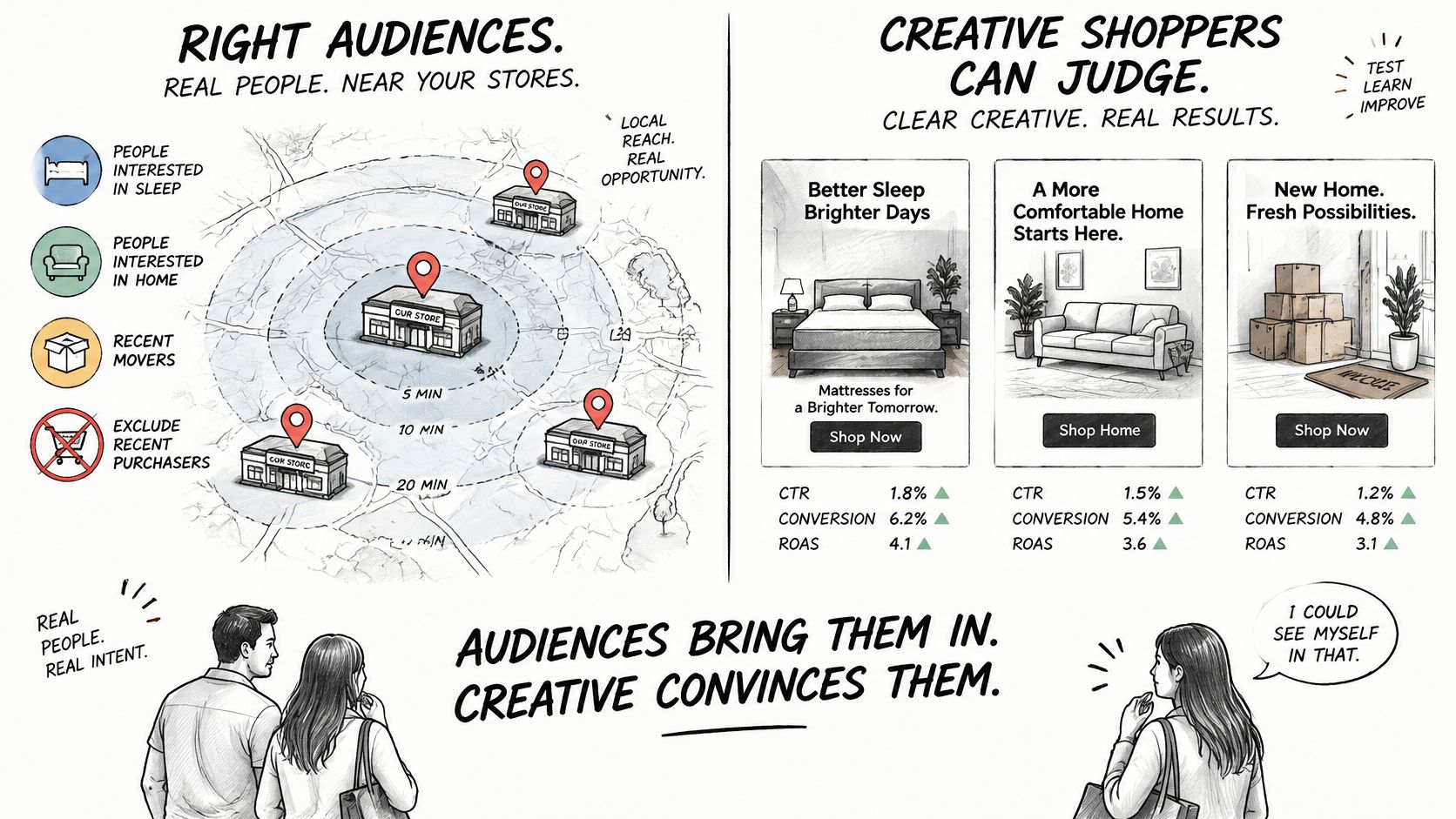
Build the creative in a useful order
A shopper needs to recognize and evaluate the mattress, not just admire the room. Create the assets in an order that answers practical questions:
Room scene: Show scale in a believable bedroom, so shoppers can picture how the mattress sits in a real space.
Clean silhouette: Make the profile, pillow top, and gusset visible at phone size.
Layered cutaway: Show the cover, comfort foam, transition foam, and support core. A hybrid should look like a designed product, not a mystery rectangle.
Buying details: State trial terms, delivery expectations, and financing clearly. Those details can matter more than a generic claim about thread count.
A good creative system also prevents three avoidable mistakes: lifestyle photography that hides the product, creator scripts that invent cooling claims, and carousels that never name firmness. The shopper should be able to understand what's on screen and why the specific bed may fit their needs.
When photography for every SKU is slow or inconsistent, photorealistic renders and clean silhouettes can show the product more clearly. A layer breakdown, sometimes called a Digibun, can make a hybrid's construction easier to explain. Bedhead's education resources for mattress marketers cover product imagery and related category vocabulary, while this guide to creating user-generated content can help teams plan customer-led creative without losing control of product accuracy.
Spend Levels That Give a Test Enough Data
A small budget isn't automatically a useful test. If the campaign can't generate enough delivery or conversion signals, weak results may reflect underfunding rather than a bad creative idea. TikTok's published minimums are a concrete planning reference, even when another platform is the primary buy.
Social test budget floors for mattress campaigns
Test setup | Budget floor | What it means for bedding |
|---|---|---|
TikTok campaign, daily or lifetime | More than $50 | Don't launch a national test under this campaign floor |
TikTok ad group | More than $20 per day | A single ad group below this never leaves learning |
TikTok lifetime ad group, 31 days | At least $620 | Delivery pauses when the lifetime amount is spent |
Web conversions, North America or EMEA | About $30 a day recommended | Practical daily floor for a store or DTC conversion ad group |
Web conversions, APAC | About $20 a day recommended | Lower recommended floor, still not a learning budget by itself |
Deep conversion, known CPA | About 10 times CPA | Purchase or add-to-cart optimization |
No CPA history, deep conversion | About $200 reference | Starting point before a real mattress CPA exists |
Shallow or upper-funnel event | About 50 times CPA, or $100 if no CPA | Too expensive a way to buy cheap views |
The TikTok Ads Manager budget guidance says a daily or lifetime campaign budget must exceed $50 and an ad-group budget must exceed $20. For a lifetime ad group, multiply the minimum daily amount by the scheduled days. A 31-day schedule therefore needs at least $620, and delivery pauses when the allocated lifetime budget runs out.
TikTok separately recommends daily ad-group budgets of $30 for web-conversion campaigns in North America and EMEA and $20 in APAC in its budgeting guidance. Those are platform recommendations, not universal requirements. Its conversion budget best practices also tie spend to the current acquisition cost: roughly 10 times CPA for deep-conversion events such as add-to-cart or purchase, 20 times CPA for installs, and 50 times CPA for shallow or higher-funnel events. With no CPA history, the platform lists $200 as a reference for install and deep-conversion campaigns and $100 for other high-funnel or shallow events.
Suppose a qualified mattress lead costs $40. Using the deep-conversion planning multiple, a purchase-optimized ad group would need about $400 per day. That example illustrates why a retailer shouldn't spend too little, see few purchase events, and call the creative a failure.
Change one variable at a time. Keep audience, geography, and optimization event steady while testing a cutaway against a retailer testimonial.
Judge the test on qualified leads or matched sales, not the cheapest clicks. A national industry revenue figure can show that social is a serious media channel; it can't promise a mattress brand a return on its own spend.
Proof That Social Created Demand You Did Not Already Have
Engagement rate doesn't prove that social advertising created new mattress demand. Likes and video views may show attention, but a shopper can research for weeks, visit a showroom, compare models, and buy in person after seeing multiple ads. A last-click report can easily give social credit for a purchase that was already in motion.
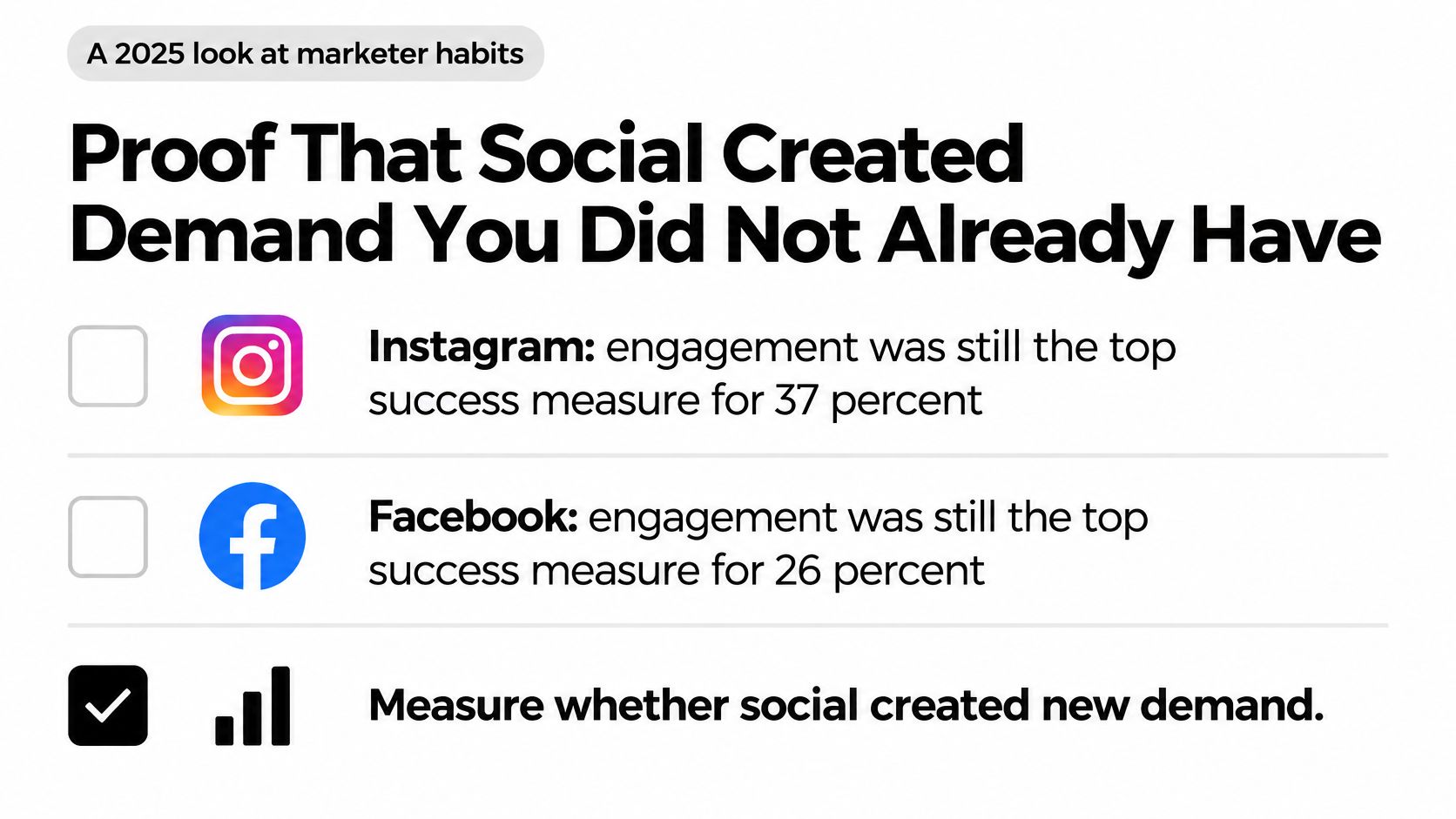
A 2025 Modern Retail report on marketer measurement habits found that engagement remained the primary success metric for 37% of marketers on Instagram and 26% on Facebook. Those measures don't demonstrate incremental sales.
Record events closer to the sale
A practical measurement plan connects the browser, app, CRM, messaging, and physical store. Start with a stable event list that reflects meaningful steps in the mattress journey:
Product viewed
Financing application started
Showroom appointment booked
Mattress purchased
Warranty registered
Meta's Conversions API can send server-side events such as purchases, leads, offline sales, and customer-service interactions for campaign optimization, attribution, and audience creation. A retailer can pair those events with browser Pixel data, app events, or uploaded store sales. The Conversions API documentation explains how server events can be used alongside those sources.
Use consistent event names and pass relevant values, currency, event time, and customer identifiers from the commerce system or CRM. Upload store sales promptly, ideally daily, so they can be matched to campaign activity while the information is fresh. When both browser and server send the same event, use event IDs and deduplication keys to prevent a single ticket from being counted twice.
Choose evidence your budget can support
A small retailer doesn't need a complex analytics stack to ask a better question. Compare booked consultations and matched store revenue in advertised zip codes with a similar area that didn't receive the campaign. A larger regional test can use a geographic holdout and compare appointments and matched tickets across the two groups.
Monthly spend | Proof method | What to read | Minimum window |
|---|---|---|---|
Under a few thousand dollars | Matched store revenue and booked consultations in advertised zip codes versus a similar untreated market | Zip-level sales and consultations | Ongoing, reviewed monthly |
Mid five-figure | Geographic holdout | Matched tickets and appointments in test versus holdout zip codes | 4 to 6 weeks |
Large manufacturer budgets | Marketing-mix view triangulated with a randomized lift test | Incremental sales and assisted purchases | Long enough to cover the planned test and purchase cycle |
Larger manufacturers can compare platform reporting with a marketing-mix view and a randomized lift test. The guide to measuring marketing attribution is a useful starting point for sorting out how the available evidence fits together.
Call a campaign successful when qualified leads, appointments, or matched tickets rise. A lower cost per view is not proof that the campaign found new buyers. The objective is to learn whether advertising changed the outcome, not just whether a platform recorded an interaction.
Three Mattress Campaign Patterns That Hold Up
A mattress campaign should match its handoff to the shopper's stage. These three scenarios show how manufacturers, retailers, and startups can build social around an identifiable product and a useful next step.
The manufacturer launching a new hybrid
A manufacturer introduces a hybrid and starts with clear construction education. The videos show the cover, quilt, comfort foams, and coil unit, so buyers and retail staff can see what distinguishes the product. The campaign then retargets engaged viewers with a retailer locator, while the sales team gives partners a clean silhouette asset that matches the ad and the floor tag.
The handoff is the retailer locator, not a manufacturer checkout page that may not serve the shopper's market. The deciding measure is partner sell-through, supported by locator activity, rather than the manufacturer's own add-to-cart count. The goal is to help shoppers recognize the product and find a store where they can try it.
The multi-store retailer promoting a holiday event
A retailer promotes the event to shoppers near each store, using a room scene that makes the mattress look at home and a clear price band to set expectations. After the first ad, the retailer can retarget product-page visitors with financing details or a booked sleep consultation. The creative should lead with the product and the reason to visit, not a doorbuster that reduces the conversation to a loss-leader pillow.
The handoff is a showroom appointment or store visit. The retailer judges the campaign by appointments and average ticket, then considers whether the promotion ran long enough to include the key shopping weekend. Sales associates should know which models appear in the ad and how the offer connects to the floor lineup.
The sleep startup establishing trust
A new brand can publish clear explanations of firmness, trial terms, and delivery before it buys distribution. Once the profile offers useful answers, it can test one prospecting ad set with a realistic budget and one retargeting ad set that directs shoppers to the trial-terms page. In-platform checkout doesn't need to be the first conversion point.
Social commerce can work, but smooth checkout alone doesn't resolve concerns about an expensive purchase. Deloitte Digital's State of Social research reports that 71% of consumers rated their most recent social-commerce purchase good or excellent, while 34% said easier payment would make them more likely to purchase through social platforms. The same report summarizes separate global research in which 60% of social-commerce shoppers had experienced at least one problem, such as long delivery times or poor communication, and 25% expressed security concerns about social purchase links.
For a mattress, a clear page explaining the trial, delivery, financing, and product fit may be a better destination than instant checkout. The deciding metric for the startup is qualified visits or inquiries that progress to a meaningful conversation, not the number of people who tap a buy button without understanding what happens next.
Pick One Handoff Before You Add Budget
Choose where an ad should send a shopper before increasing spend. More impressions will not fix a product page missing delivery terms, a showroom with no appointment capacity, or a retailer locator that omits nearby stockists. They send more shoppers to the same dead end.
Check that the handoff is ready:
Product page: Trial, delivery, financing, and product details are easy to find.
Showroom: Shoppers can book a visit, and associates can explain how the advertised mattress compares with the floor model.
Retailer locator: Listings show the stocking partners in the campaign's target area.
If none is ready, fix the destination first. Then choose a channel that can direct shoppers there, using a clear cutaway or room scene to identify the bed. Judge the campaign by qualified leads or matched store tickets, not likes alone.
For product imagery, paid media, or related creative, mattress companies can explore Bedhead's mattress marketing and creative services. Its services include photorealistic 3D graphics, interactive imagery, videography, website development, social media, email marketing, digital ads, and SEO.
If you're evaluating a social campaign, Bedhead can help connect mattress-specific creative, paid media, and product visualization to the handoff your shoppers need. Visit BEDHEAD to discuss a consultation, campaign, or product imagery project built for the bedding industry.