SEO Services Packages for Mattress Brands
You're looking at three proposals, all labeled SEO, and none of them answers the only question that matters. Will this work move a shopper toward a showroom visit, a direct order, a dealer inquiry, or a spec request? Judge SEO services packages by that sale, not by a keyword count. The right package names its templates, its product facts, and its proof before you sign.
SEO Services Packages Mapped for Bedding Brands
Say you're a regional mattress retailer. Three proposals land in the same week. One promises blog posts, one promises backlinks, and one promises full SEO management. None says whether the work covers showroom locations, hybrid product templates, or the thin blog calendar you've been handed for the last two quarters.
That mismatch is the problem. A package name tells you almost nothing. The scope inside it tells you everything, and bedding scope changes fast depending on whether you sell one store, twenty stores, a national catalog, or coils and ticking to a manufacturer.
Why search still carries the floor
Organic search remains too large to treat as a side task. BrightEdge research reported that organic search accounted for 51% of trackable web traffic on average, making it the largest digital channel in the study. Earlier BrightEdge research also found that 57% of online traffic was generated on mobile and tablet devices in 2017, so a desktop only keyword plan misses the session that shops.
Treat 51% as a market benchmark, not a promised share for your site. Your mix will swing with brand strength, dealer coverage, and how much demand sits in branded terms. The benchmark still tells you the work has to cover technical fixes, content, local visibility, analytics, and monitoring together. Keyword placement alone won't hold it.
Start by reading proposals against how buyers now ask. It's worth understanding how buyers discover vendors through AI before you pay for a plan built only around blue links. Then use solid keyword research basics to map demand to construction type, firmness, sleep problem, and buying path, not to a generic list.
Four scopes that actually map to bedding
Tier | Best bedding fit | Core scope | Usually left out |
|---|---|---|---|
Foundation | One showroom or early DTC startup | Google Business Profile, basic on-page fixes, light FAQ or blog cadence | Multi-location pages, catalog schema, AI-answer audits |
Retail growth | Multi-store retailer or showroom plus ecommerce | Template fixes, location pages, category copy, conversion tracking | National product-data governance, wholesale lead paths |
Manufacturer or supplier | Brand or component firm selling through dealers and direct | Product templates, spec accuracy, dealer or spec-request paths | Local-pack busywork and consumer coupon content |
Full-funnel bedding program | Brand that also needs page creative and paid support | SEO workstreams plus product storytelling on key templates | Any promise of rankings or revenue |
Foundation suits one showroom or an early direct to consumer brand that's still stabilizing price, construction, and trial terms. You need clean basics and honest tracking, not a national content machine. If you can't yet say what's in the foam layers on every model, you're not ready for scale copy.
Retail growth fits a multi-location operator with ecommerce attached. The money work is category pages that match how people shop, location pages tied to real inventory and floor models, plus appointment or order tracking. A thin blog cadence won't fill a Saturday showroom.
Manufacturer or component scope is different work again. Catalog templates, dealer paths, and spec language around ticking, foam layers, quilting, and gussets carry the sale. Wholesale inquiries matter more than local pack busywork. A supplier sold on city pages and coupons has bought the wrong deliverables.
Full-funnel bedding program makes sense when SEO has to sit beside product storytelling on the templates that decide the purchase. Silhouettes, Digibuns showing layer breakdowns, and Room Scenes explain construction, but they belong where they help a shopper judge the bed. They don't replace technical cleanup.
Match the row to how the bed is sold, not to the cheapest label on the proposal.
I would start every vendor conversation with one line. Name your sale, then ask which row covers it. If the proposal can't answer in plain language, it isn't bedding ready, whatever the tier is called.
How Agencies Price SEO Work in 2026
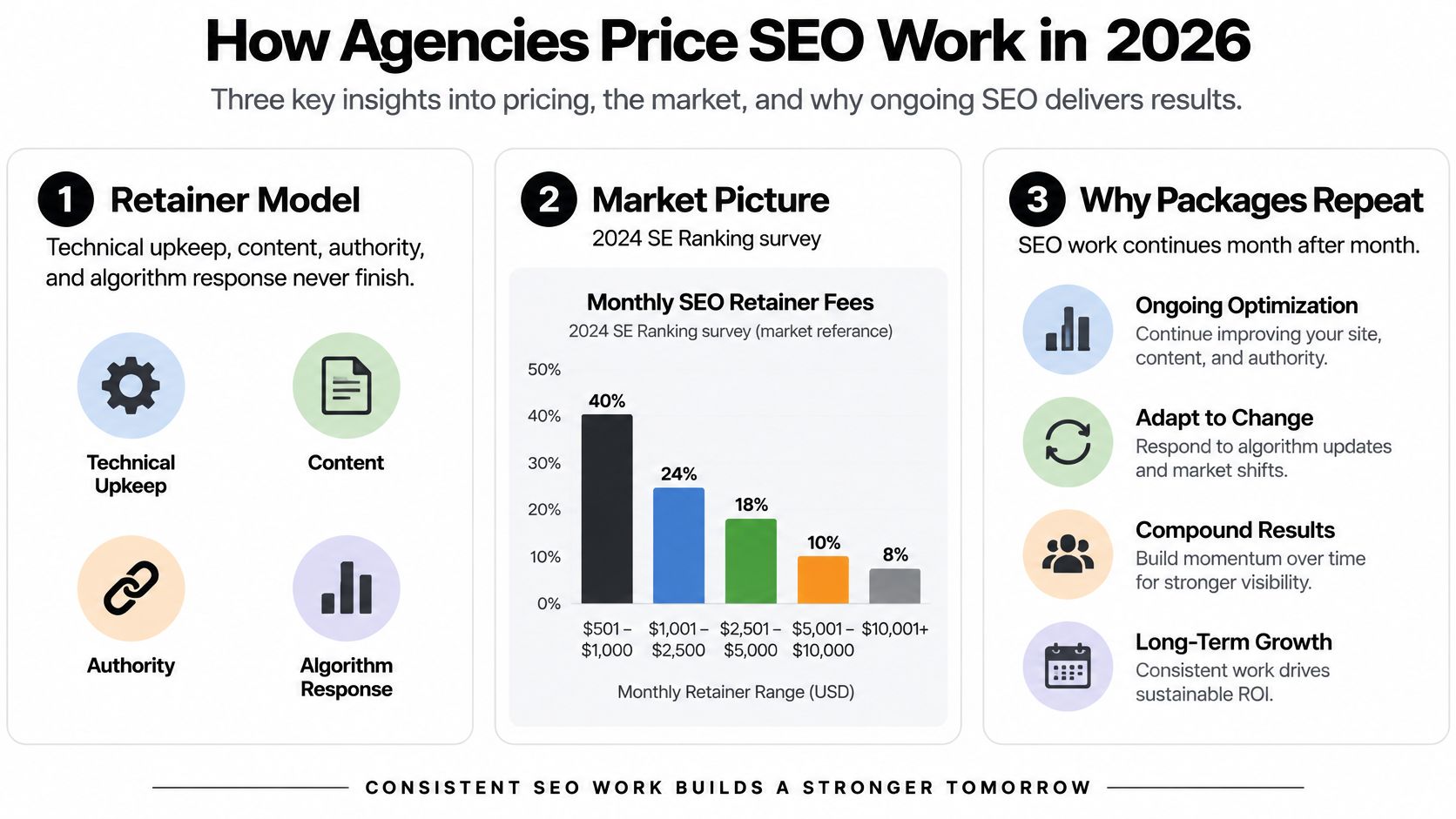
A retainer can make sense for a mattress catalog because the work changes as products, dealer pages, and technical needs change. A dealer locator may break, a hybrid category may need updating, or product information may change. Price should reflect the ongoing work required, not just the SEO label.
Read the survey bands as market context
The 2024 SE Ranking survey offers market context, not a rate card for your business. It reported that 53% of participants preferred monthly retainers, while 85% of agencies bundled SEO work into defined packages. It also found that 64% of agencies charged less than $1,000 per month, 60% set hourly rates below $100, and 66% priced projects below $2,000.
The survey reported that 70% of agencies had recently increased their prices or planned to do so in 2025. A 2026 quote for work on a hybrid catalog and dealer locator may sit above those 2024 bands. Labor, specialist time, and content production affect the price more than the SEO label.
Model | Survey signal | 2024 price band | Bedding fit |
|---|---|---|---|
Monthly retainer | 53% preferred it; 85% of agencies bundle SEO into packages | 64% charged under $1,000 per month | Ongoing local, content, and technical work |
Hourly | 60% set rates below $100 | Below $100 per hour for 60% | Audits, developer handoff, overflow fixes |
Fixed project | 66% priced projects below $2,000 | Under $2,000 for 66% | Migration checks, one-time schema, launch audits |
Where each band breaks in bedding
A retainer under $1,000 may cover ongoing work for one showroom, but it can leave a manufacturer with hundreds of SKUs, dealer pages, and spec sheets short on hours. Fixing templates, writing category copy, and coordinating product data all take time.
Hourly work suits a defined job: an audit, a developer handoff, or a batch of template fixes. Buying hourly time instead of funding category pages over the year can produce isolated tasks rather than sustained work.
A project under $2,000 may suit a migration check or one-time schema pass. It does not cover ongoing product copy, location maintenance, or updates when foam specs change. Those needs call for continuing work.
Compare newer services by their deliverables too. Compare generative engine optimization services against the same scope: template fixes and tracking still need clear ownership.
Practical rule: Price the deliverables. Count URLs fixed, locations covered, pages written, templates governed, and reports tied to leads.
There is no single bedding rate that fits every site. A single store with clean templates has a different scope from a national brand with broken mobile pages. Ask each bidder to price the same deliverable list. If a quote is based only on keyword count, ask what work sits beneath that number.
What Separates a Thin Package from a Mattress-Ready One
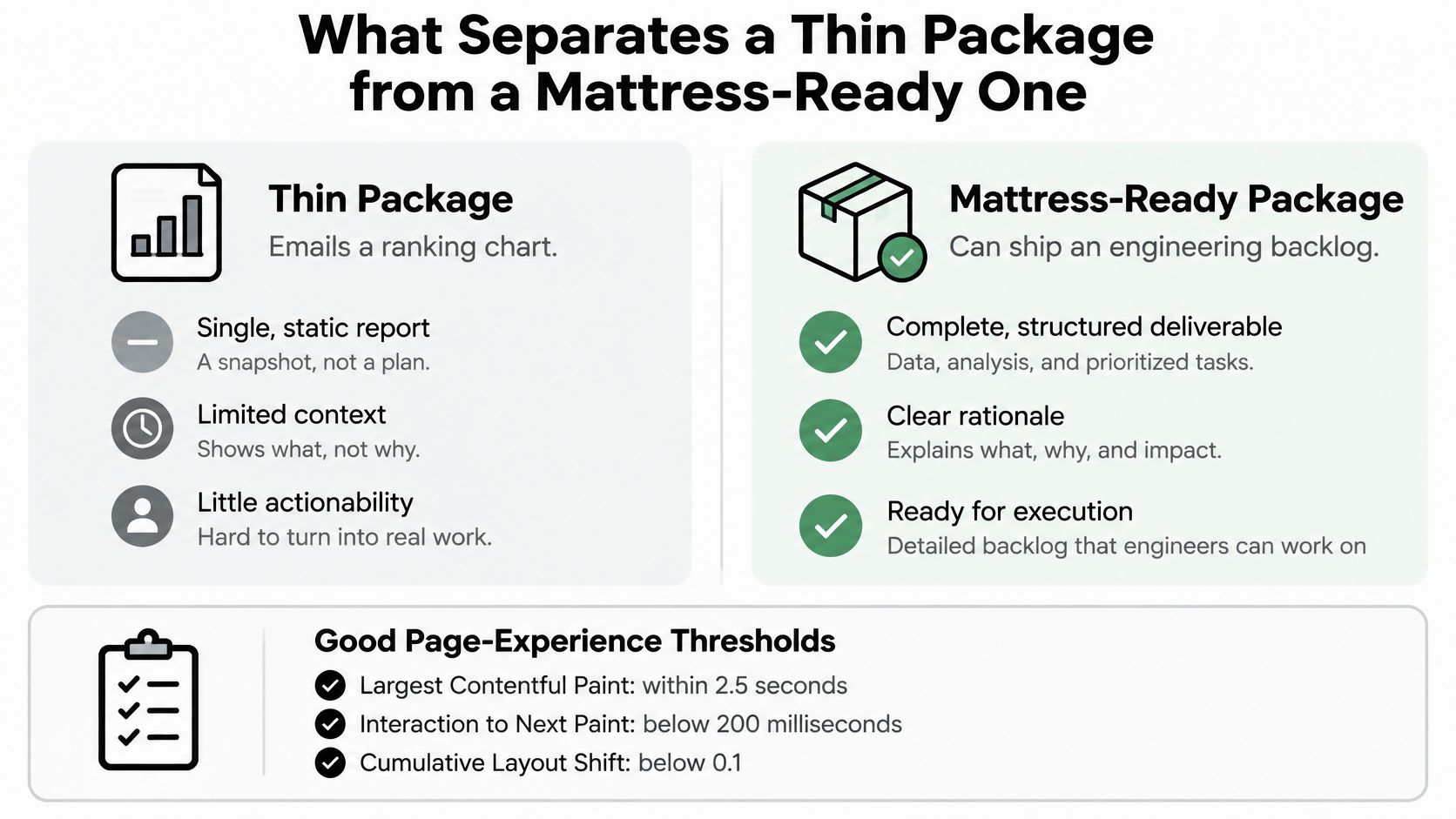
A thin package emails you a ranking chart. A mattress ready package hands your developer a backlog, tells your writer which construction claims to tighten, and shows you which templates lose shoppers on mobile. The difference shows up first in technical reporting.
The three thresholds worth putting in the contract
Google's Core Web Vitals guidance identifies three field measured thresholds for a good page experience, with Largest Contentful Paint within 2.5 seconds, Interaction to Next Paint below 200 milliseconds, and Cumulative Layout Shift below 0.1. A serious package measures those through Search Console or equivalent real user data. It splits mobile and desktop and reports the share of URLs passing each threshold.
That reporting turns speed talk into engineering work. Cut render blocking resources and server latency for LCP. Reduce main thread JavaScript for INP. Reserve layout space for images, ads, and embedded components so CLS stays under control.
Metric | Good threshold | Typical bedding fix |
|---|---|---|
Largest Contentful Paint (LCP) | 2.5 seconds or less | Cut render-blocking resources and server latency on product and category templates |
Interaction to Next Paint (INP) | Below 200 milliseconds | Reduce main-thread JavaScript from room scenes and comparison modules |
Cumulative Layout Shift (CLS) | Below 0.1 | Reserve layout space for images, ads, and embeds |
Bedding templates carry their own drag. Large room scenes, layered foam diagrams, firmness sliders, and comparison modules often sit on the exact page a shopper uses to judge feel. Those assets help the sale when they're fast and stable. They hurt it when the page jumps while someone is trying to read the quilt and comfort layer breakdown.
Ask for template level reporting, not a sitewide average. Product pages, category pages, and mobile landing pages fail for different reasons. A passing homepage doesn't excuse a slow hybrid PDP where the order decision happens.
Content depth is not a blog count
Titles and meta descriptions are hygiene. Fix them, then move on. Growth work looks like firmness and construction guides that help a side sleeper choose between foam and hybrid builds without guessing. Manufacturer work goes further. It governs cooling, certification, trial, and foam claims so the same fact reads the same way everywhere.
Structured data belongs in that governance, not in a tricks list. Markup should mirror facts a shopper can see on the page, and your team should check eligibility and performance by template. We frame related authority work the same way in our guide to backlink building techniques, as support for real pages rather than a monthly count to fill a report.
Consider a product page that says a foam is certified in the copy, omits it in the specs tab, and carries an old trial length in the FAQ. A thin package optimizes the title and leaves the conflict. A mattress ready package treats that page as a product record. One fact, one source, repeated consistently.
Five questions before you sign
Which templates: Name the product, category, location, and landing templates included, and the ones excluded.
Which metric: Require LCP, INP, and CLS reporting by template, split by mobile and desktop.
What percent pass: Demand the share of URLs passing each threshold, not a single average score.
Who implements: Confirm who writes the tickets, who ships the code, and who validates the fix.
How facts stay in sync: Ask who owns firmness, materials, warranty, and trial accuracy across pages and feeds.
If a vendor can't answer those five cleanly, you're buying reporting, not remediation. Rankings may move for a while, but the slow template and the conflicting claim will still be waiting for the next shopper.
Proving SEO Value When Clicks Shrink
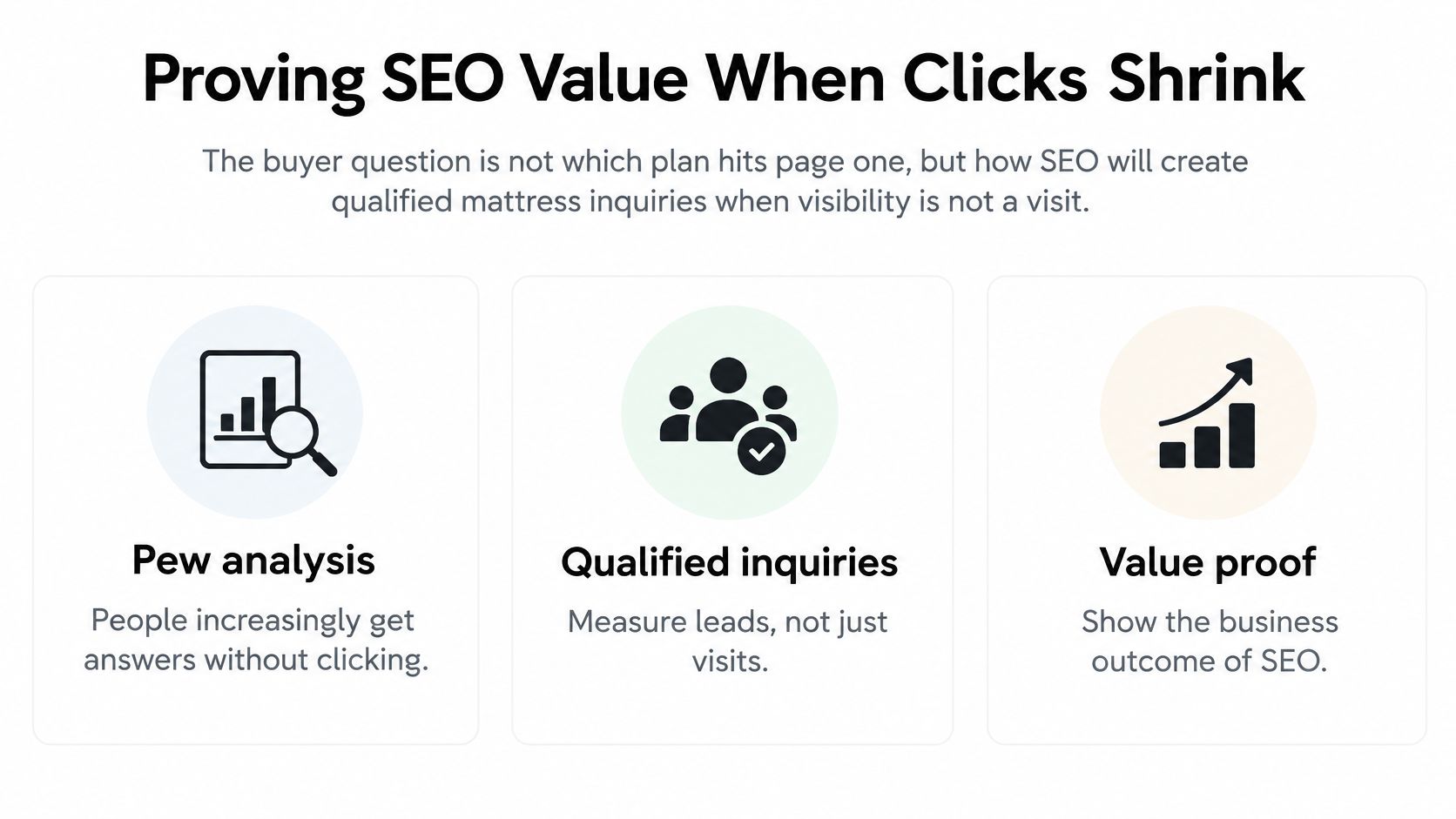
A bedding brand can hold a strong search position and still see fewer visits. The practical question for an SEO package is whether it can show qualified mattress demand when shoppers get answers without clicking through.
The click gap your report has to survive
Pew Research Center analyzed nearly 69,000 Google searches by 900 U.S. adults. As The Decoder reports, when an AI Overview appeared, users clicked a traditional organic result in 8% of searches, compared with 15% when no summary appeared. They clicked a cited source within an AI Overview only 1% of the time.
For bedding brands, that gap matters because shoppers may research firmness, price range, and trial terms in search, then buy from a showroom or a retailer's product page. Sessions can fall while a brand still shapes the shortlist. A rank report alone cannot show whether that influence led to a qualified inquiry.
A manufacturer judged only on sessions might miss a retailer who read a search summary, then called to request product information. The package needs to capture that demand where possible, rather than treating every untracked visit as lost value.
Lock the measurement set before implementation
Branded and non-branded visibility: Track both, then compare changes in branded demand with exposure to non-branded searches.
AI citations or recommendations: Log whether the brand appears for core buying queries and what claims accompany it.
Qualified calls and forms: Separate showroom appointments, dealer inquiries, and sales-ready questions from raw form fills.
Wholesale requests: Report retailer and specification inquiries separately from consumer traffic.
Assisted revenue and offline imports: Connect orders and store sales where the CRM supports it.
Label each metric direct, partial, or correlated. The distinction keeps attribution honest when a shopper researches online and completes the purchase through a retailer. The guide to marketing attribution and its role in crediting outcomes explains why last-click reporting can miss those handoffs.
Reporting tools can show site and search performance, but they cannot define business value for you. RankEngine reports on store SEO health; pair that view with the lead and revenue fields your team uses to judge demand.
Rankings are not the sale. A package earns its keep when it traces visibility toward qualified demand and shows where the trail goes cold.
These measures cannot guarantee an outcome. They provide a fair test: if visibility rises but qualified inquiries stay flat, review the offer, page, and targeting before adding more content.
Keeping AI Answers Honest About Your Mattress
A shopper asks an AI tool whether your hybrid contains memory foam. The answer says no, even though the comfort layer does. Before the shopper reaches your product page or showroom, an inaccurate summary has already shaped their expectations.
The gap between importance and control
The Bluehost AI market study found that only 13% of small businesses were actively optimizing for AI-search visibility, while 31% knew the concept existed but did not know where to start and 22% were encountering it for the first time. Marketers may value being cited in AI-generated results, but measuring the return on that visibility can be difficult.
For a bedding brand, inaccurate answers about cooling performance, foam composition, certifications, warranty, firmness, availability, or suitability can put a shopper off before your product page gets a visit. They can also complicate a retailer conversation if a buyer repeats a claim that conflicts with your spec sheet.
What a stronger package adds
Recurring AI answer checks: Test core buying queries on a schedule and record the exact answers.
Fact source mapping: Tie every claim about layers, trial, and warranty to a source page your team controls.
Product data governance: Align manufacturer pages, retailer listings, reviews, and feeds so product details stay consistent.
Correction workflow: Fix the source, update the feed, notify the retailer, then check the answer again.
Error reporting: Show harmful inaccuracies alongside useful mentions, not buried in an appendix.
If an AI summary says a hybrid contains no memory foam when its comfort layer does, or calls a trial lifetime when the warranty page says otherwise, more generic sleep tips won't fix the error. Correct the product record wherever it is syndicated. Consistent product details give systems clearer information to draw from.
Accurate, specific pages about mattress construction can also support topical authority for mattress brands. A product page that labels each foam layer and matches the specs gives shoppers and AI systems a clearer account than a vague comfort claim.
Keep answer accuracy separate from click reporting. Track whether core facts are returned correctly, how quickly errors are corrected, and which source caused each miss. A monthly error log can reveal product-data problems that a keyword chart cannot.
Match the Package to the Sale You Need
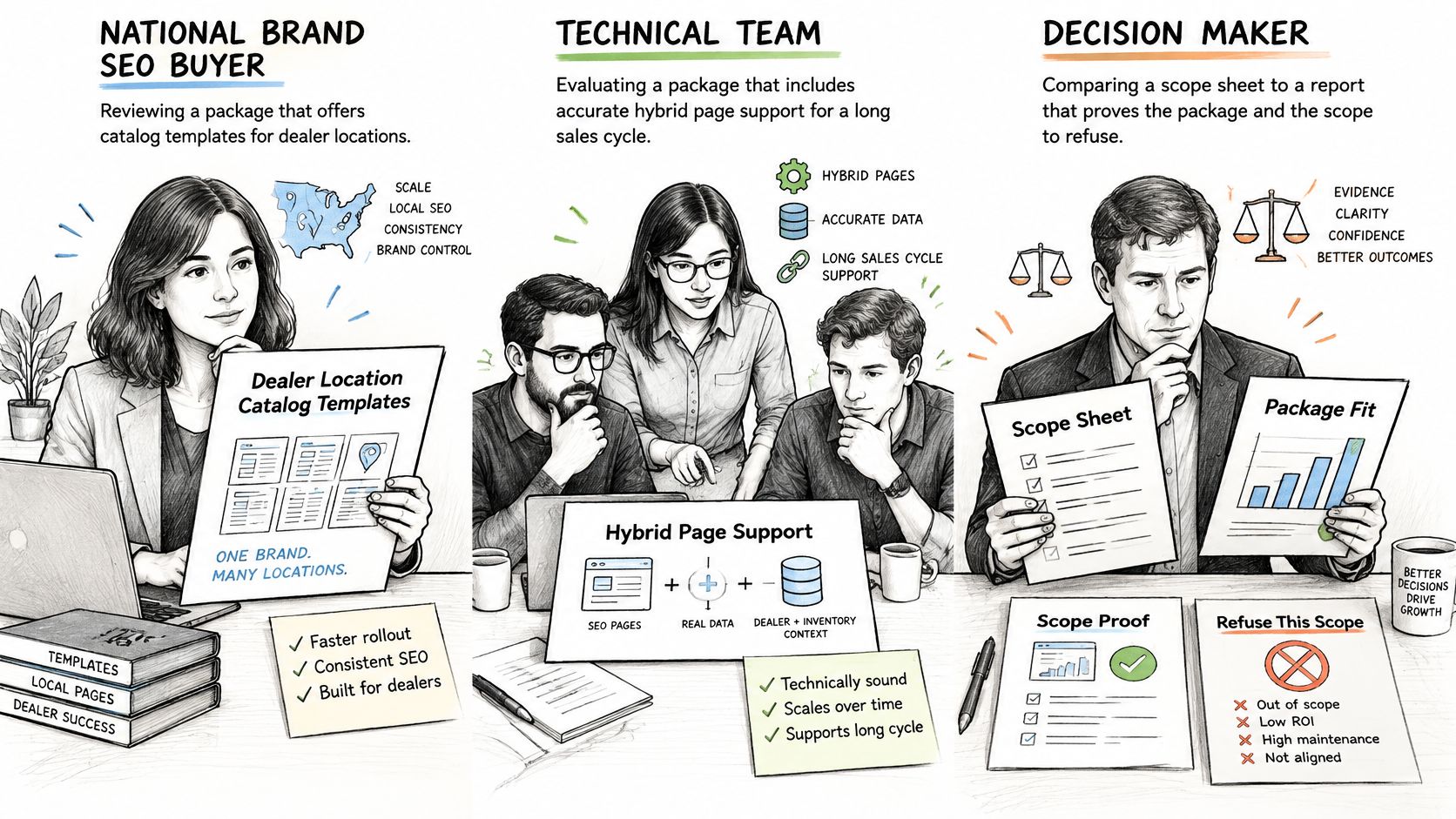
A bedding manufacturer selling through dealers, a retailer with showrooms, and a component supplier need different SEO work. Choose the package around the sale it must support, not a list of deliverables built for another business.
Manufacturer selling through dealers
For a national brand with a long consideration cycle, start with catalog templates. Hybrid and foam pages must describe construction accurately, and the dealer locator should work smoothly on mobile. Qualified wholesale inquiries matter more than raw consumer sessions.
Report this: dealer inquiries, wholesale requests, and product-page engagement by template. Refuse this: a local-map-only package that treats every dealer town as the strategy. Pin maintenance will not fix thin, inconsistent catalog pages, the materials dealers use to sell your products.
Retailer running floor plus ecommerce
Showroom inventory language should match what is actually on the floor. Product pages should explain firmness clearly, helping shoppers compare beds and make a better-informed choice.
Report this: showroom appointments, calls by location, and direct orders. Refuse this: a sleep-tips calendar as the core deliverable. A post about bedroom routines does little for a shopper comparing two hybrids at different price points. Category copy and accurate location pages speak more directly to that decision.
Component supplier selling to manufacturers
Your buyer is a product team evaluating coils, foams, or ticking for a line in development. Pages explaining performance, tolerances, and applications can support that evaluation. Track spec requests so sales can follow up with qualified manufacturer contacts.
Report this: spec requests, sample inquiries, and qualified manufacturer contacts. Refuse this: consumer coupons and city pages. They target the wrong audience and can blur the message about who you serve.
A private-label startup should keep SEO work at the foundation level while construction, trial terms, and price are still changing. Content built around unsettled product details may need rewriting within the quarter.
Four decisions to make before you sign
Name the sale: Decide whether the package should support a showroom visit, direct order, dealer lead, or component spec request. Put that goal in the scope.
Refuse keyword-count pricing: A quote based only on keywords leaves the actual work unclear. Ask how pricing covers templates, pages, locations, and product information.
Require proof that survives fewer clicks: Ask for mobile Core Web Vitals reporting, product-fact governance, and a measurement plan that shows how confidently each result can be attributed.
Place heavy visuals deliberately: Use large room scenes and layered diagrams where they explain construction and quilting. Keep core SEO templates lean enough to protect page speed.
BEDHEAD offers digital marketing, ecommerce strategy, creative asset creation, product storytelling, and high-end visual content. Its services also include website design and 3D visualization for mattress and bedding brands, useful when product pages need to show layers, gussets, and ticking accurately. BEDHEAD does not guarantee specific results; marketing outcomes vary with factors beyond its control.
If a proposal cannot name the sale, the templates, and the proof, ask for a scope review before negotiating a discount.
If you're comparing SEO services packages and none names your sale, templates, and proof, start there. BEDHEAD scopes bedding SEO around showroom visits, orders, dealer leads, and spec requests, with product storytelling and 3D visualization for mattress pages. Bring your current proposal and ask BEDHEAD to review what it covers, what it leaves out, and what it should prove.