How Ad on Products Works for Mattress Brands
An ad on products isn't just the Shopping tile that starts a mattress search. It's also the line printed on the carton, the card clipped to a floor model, and the polo an RSA wears when a shopper asks what cooling means. If those pieces don't agree, the shopper doesn't blame the feed or the printer. They blame the bed in front of them, and they leave or return it.
When the Carton and the Ad Disagree
Say a shopper is comparing two queens on their phone in your parking lot. One ad on products leads with cooling hybrid, the product page shows a foam stack with no temperature test, and the floor model's hangtag promises pressure relief in type larger than the law label beside it. By the time they lie down, they're not testing comfort. They're testing whether your store tells one story or three.
The RSA then has to unwind the mismatch in real time. They explain that the phase change treatment is in the ticking, not through every foam layer, and that the trial terms on the website differ from the retailer's exchange policy. That's not selling. That's defense, and it eats the two minutes you get before a shopper decides a bed feels honest or doesn't.
Who This Decision Hits First
Manufacturers feel it when a carton line outruns what a retail partner stocked. Retail owners feel it when a national campaign lands on a floor with different builds, foundations, and margins. Ecommerce managers feel it when a feed title wins the click and the page can't prove the headline, so the return reason reads not as described instead of too firm.
If a line can't be defended during a short lie-down, it's the wrong line for a short ad.
Good mattress packaging design that keeps claims readable at the bed treats the carton, the page, and the paid unit as one chain. Each link carries only what the next link can show. The ad earns attention with a checkable fact, the page shows the quilt, gusset, and foam layers behind it, and the showroom card repeats the same scoped claim in words an RSA can say without improvising.
That discipline sounds restrictive, but it's what protects conversion. A shopper who finds the same size, trial, certification scope, and material claim in three places stops hunting for the catch. A shopper who finds three versions starts hunting for an exit, then tells the next store exactly why they didn't buy yours.
Three Places an Ad on Products Lives
An ad on products is any paid or printed message whose job is to sell a specific mattress, not the brand in the abstract.
Placement | What the shopper sees | Best job | Claim risk | Mattress example |
|---|---|---|---|---|
Product page and shopping ads | Feed title, price, image, PDP modules | Capture high-intent comparison | Medium if the feed matches the page | Queen hybrid, trial length, firmness label |
Carton, hangtag, and showroom card | Headline, icons, and fine print at the bed | Prove a spec at the moment of choice | Highest, because print is still an ad | Cooling named on the ticking, not the whole bed |
Branded merchandise | Logo on useful items used by people | Repeat recognition after the visit | Lower when no performance claim is added | RSA polo or delivery card with the store name only |
Product Page and Shopping Ads
This row lives closest to comparison. Google Shopping and Performance Max pull from your product feed, Meta catalog ads pull from the same source, and both send shoppers to a PDP where they can check size, price, trial length, and materials before committing. That makes the feed a claim document, not a technical file your media team owns alone.
If the feed says medium firm hybrid and the page buries firmness below lifestyle copy, you've spent money to create friction. Keep the title to facts a shopper can verify in seconds. Let the page do the heavier work with layer diagrams, foundation guidance, and warranty terms in plain language.
A QR code on a showroom card can bridge this row to the next one when it opens the exact proof for that build. That's a better use than sending shoppers to a homepage, and the distinction in this barcode versus QR code breakdown for product information matters when you decide what a code should open.
Carton, Hangtag, and Showroom Card
Here the mattress itself becomes media. A carton front in a warehouse aisle, a hangtag at pillow height, and a card on a floor model all get read at arm's length, often while a shopper is touching the quilt. A cooling icon in that setting isn't decoration. It's a performance promise made inches from the product that's supposed to deliver it.
Print also freezes your wording. You can fix a feed tonight, but a carton run sits in distribution while your foam supplier, ticking, or trial terms change. Put durable, component level facts in print and keep prices, promotions, and fast changing offers in digital placements you can update without reprinting a warehouse.
Branded Merchandise
Merchandise should carry identity more than performance. An RSA polo, a buying group leave-behind, a delivery team's door hanger, and a tape measure handed out at a home show keep your name in rooms your ads don't reach. They work because they're useful and seen repeatedly, not because they squeeze a foam claim onto a sleeve.
Choose the row by the job. Capture a search, prove a spec at the bed, or stay remembered after the visit.
Don't paste one headline across all three rows. A feed title, a carton panel, and a polo don't share reading distance, update speed, or legal weight. When each placement does its own job, the shopper meets a consistent claim at the right depth instead of the loudest claim everywhere.
Why Physical Product Ads Still Move Search
The case for physical items starts with observable behavior. In a 2023 U.S. consumer survey of more than 3,000 people aged 18 to 78, covered by PPAI's report on strategic shifts in branded merchandise, 60% of consumers used promotional products as an information source, more than double the 24% recorded two years earlier. The same survey found that 52% of recipients said their initial response to a promotional item was to search for the company on Google or visit its website, up from 40% in 2021. Treat the numbers as directional evidence about physical items generally, since the panel was consumers at large rather than mattress shoppers.
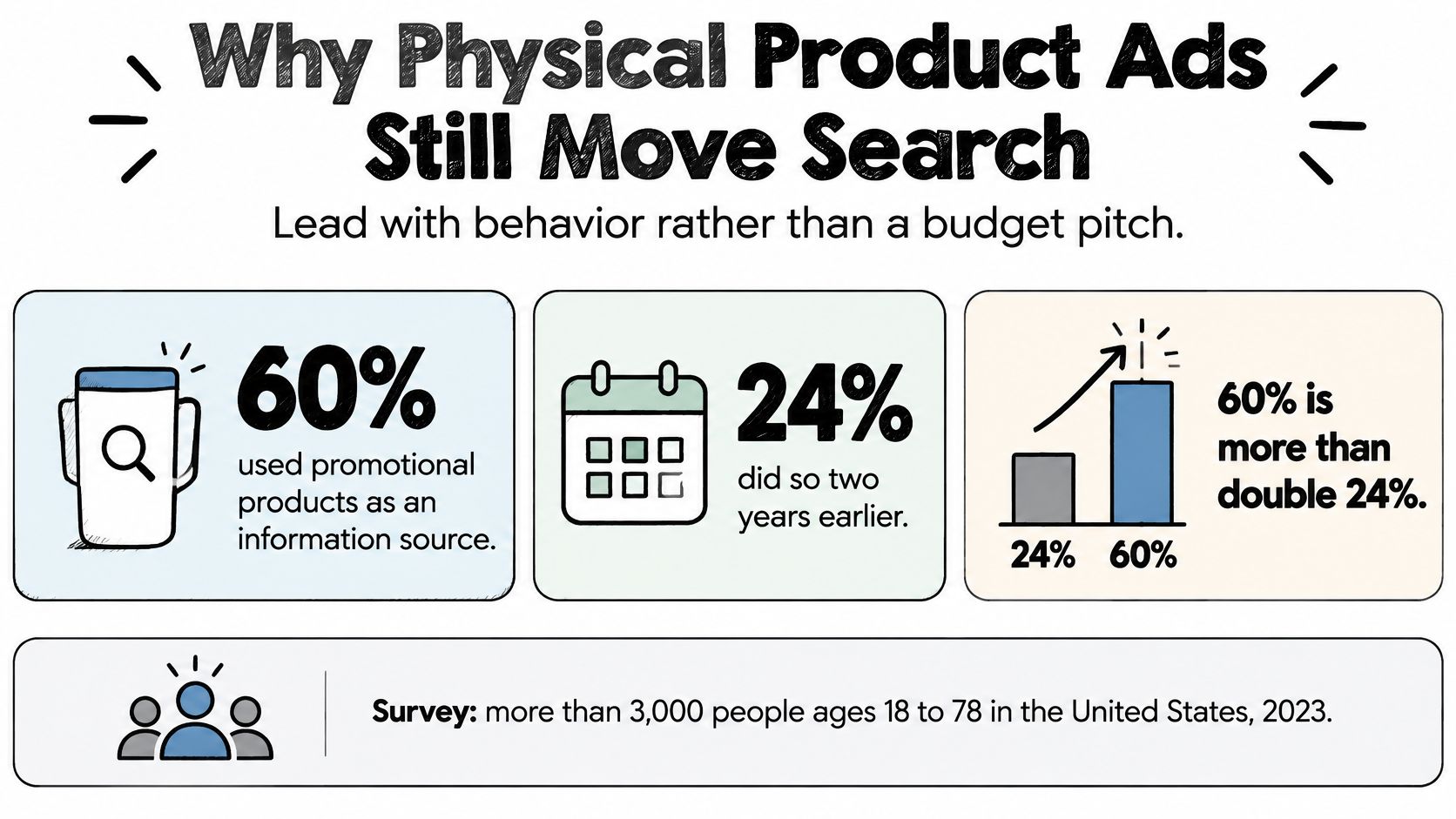
That search response is where bedding should pay attention. A delivery gift, a manufacturer leave-behind at a buying group, or an RSA shirt that shows up in a showroom photo can start a branded search, and the product page it lands on has to finish the job. The item earns the query. The page earns the sale.
Recall Gets You Found, Not Chosen
Recall and spillover ran strong in the same survey. Most respondents could still name the advertiser on a logoed product they had received during the previous year, and close to half had posted on social media about a promotional product. A physical item can leave the one-to-one handoff and surface again in a customer's room reveal or a retailer's event post.
Acceptance was high as well: respondents said they enjoy free items from brands they already like and would welcome them more often. People aren't rejecting useful branded items. They're ignoring forgettable ones, which is why a sturdy measuring tape sized for a bedroom fits a mattress retailer better than a generic novelty that lands in a drawer.
A remembered logo still isn't a sale. A mattress is part searchable spec and part credence good, so the item should carry what a shopper can check and hand the rest to proof they can inspect. If the search lands on a page that can't show the quilt pattern, gusset height, coil unit, and foam stack the shopper expected, recall just speeds up disappointment. The item opened the door and the page closed it.
Measure the entrance: Track branded search and direct visits after an event or delivery drop, not just units handed out.
Measure the landing: Check whether those visits reach layer diagrams, size guides, and trial terms.
Measure the handoff: Ask RSAs whether shoppers mention the item by name on the floor.
Treat merch and on-pack lines as entrances to proof. Their job is to make the right mattress easy to find again, then let checkable specs and an honest lie-down do the closing.
Claims That Survive a Quick Look
In the United States, a promotional line on a carton, hangtag, law label area, point of sale card, or brochure is advertising. The Federal Trade Commission's remarks on safety related marketing state that FTC advertising oversight covers product labeling, packaging, point of sale displays, and brochure statements. So cooling, orthopedic, chemical-free, made in the USA, and reduces back pain get evaluated as ad claims even when they never appear in a paid campaign.
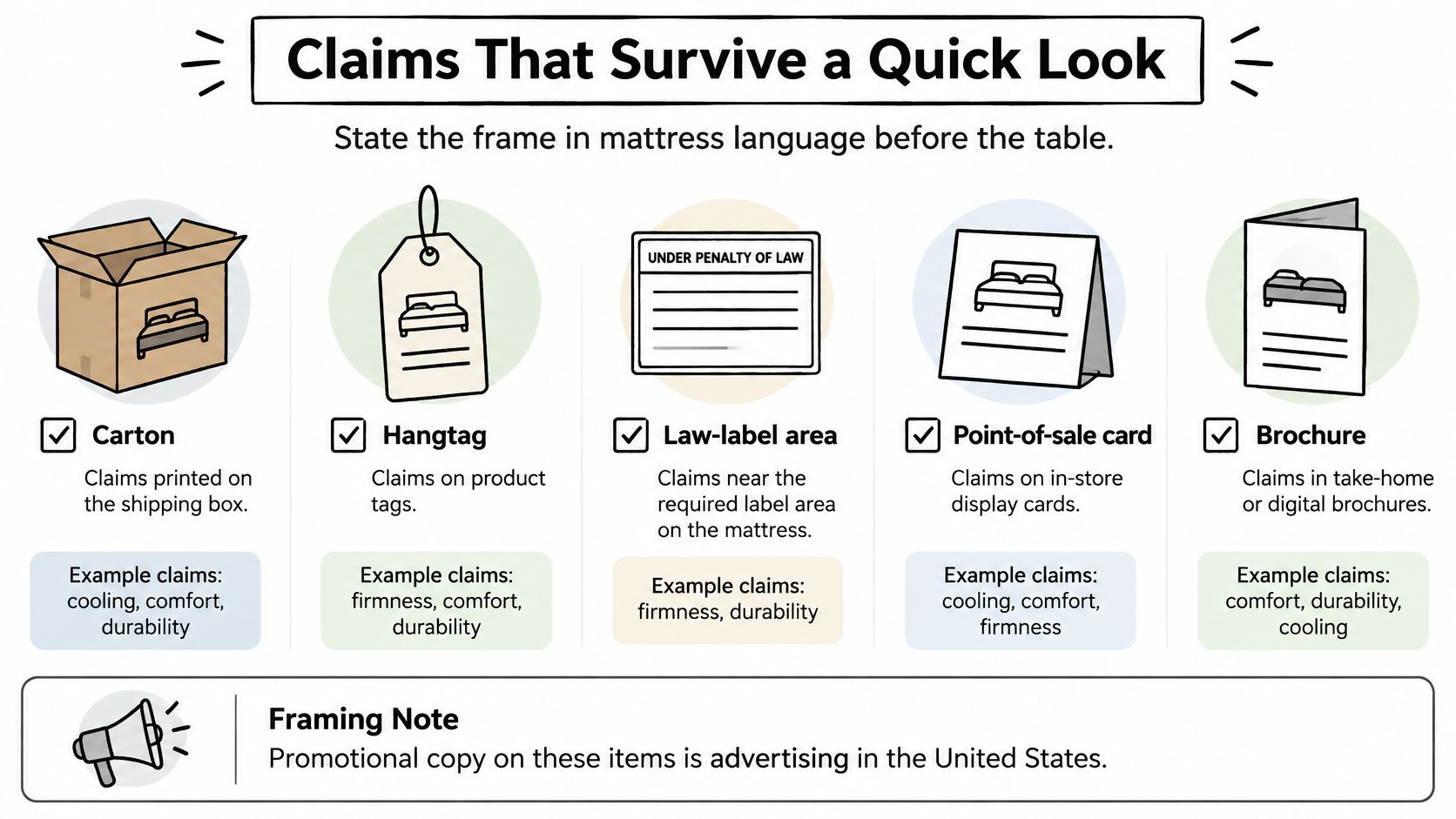
Objective claims need a reasonable evidentiary basis before dissemination, and a material omission can make the overall message deceptive. The implication from an icon, photo, or layout counts too, not only the literal words. A snowflake over a full bed implies whole bed cooling even if your test only covered the cover fabric at first touch.
The Net Impression Is the Claim
Shoppers don't read a carton like a contract. They take the headline, the image, and the icons together in a few seconds, often while an RSA is talking. If the front panel shouts a benefit and a side panel whispers the limit in low contrast type, the quiet text doesn't cure the loud promise.
Put qualifying information next to the claim it limits, in a size and contrast a person can read at the actual viewing distance. Test hangtags at pillow height and cartons from the aisle, not on a designer's monitor. If a result depends on room temperature, body weight, foundation type, or a specific build, that condition belongs beside the headline, not on another panel.
Environmental wording needs the same scoping. Words like eco-friendly, green, non-toxic, biodegradable, and recyclable should name whether they cover the ticking, one foam layer, the cover, the whole mattress, or only the packaging. Shoppers who learn to compare furniture descriptions with confidence look for exactly that kind of scope, and mattress shoppers ask the same question when a badge doesn't say which component earned it.
Channel choice follows claim type. In a 2025 study covering three experiments and 1,153 participants, sustainability messaging increased trust for search and experience goods but had limited or negative effects for credence goods, and digital media worked better for low complexity search goods. Mattresses sit in both camps, since dimensions and certifications are checkable while comfort, support, durability, and health effects aren't verifiable before purchase.
Claim type | Short ad or package front | Richer proof | Bedding example |
|---|---|---|---|
Size, price, trial, warranty | Yes, if the feed and page match | Spec block on the PDP | Queen, trial nights, warranty years stated identically |
Named certification with scope | Yes, if the certified part is named | Certificate or standards page | CertiPUR-US on the foam, not the whole bed |
Cooling or pressure relief | Only with a tested, qualified component | Layer diagram, video, RSA script | Phase-change ticking, not all-night cooling |
Health or pain relief | Do not use unless clinical evidence exists | Clinical support or remove the line | Reduces back pain, remove unless supported |
Broad eco language | No, unless scope and percent are stated | Material share and disposal note | Cover yarn share stated, foam not curbside recyclable |
Origin | Only when the statement matches that build | Component origin breakdown | Assembled in the U.S., foam imported |
End the review with a one page claim evidence matrix for every live line. List the exact wording, the component and build tested, the test method, sample conditions, units, and where the proof lives for shoppers and RSAs. If a row has no evidence owner, the claim comes off the carton and out of the feed until it does.
Mattress Ad Examples by Business Type
Manufacturer With a Cooling Hybrid
Say a manufacturer's hybrid carton says all-night cooling beside a callout for phase change ticking. The foam layers below that cover are standard foams that warm with body heat, so the carton promises an outcome the build can't deliver for eight hours. Retailers hear about it first, in comfort exchanges that get coded as feel when the underlying problem is expectation.
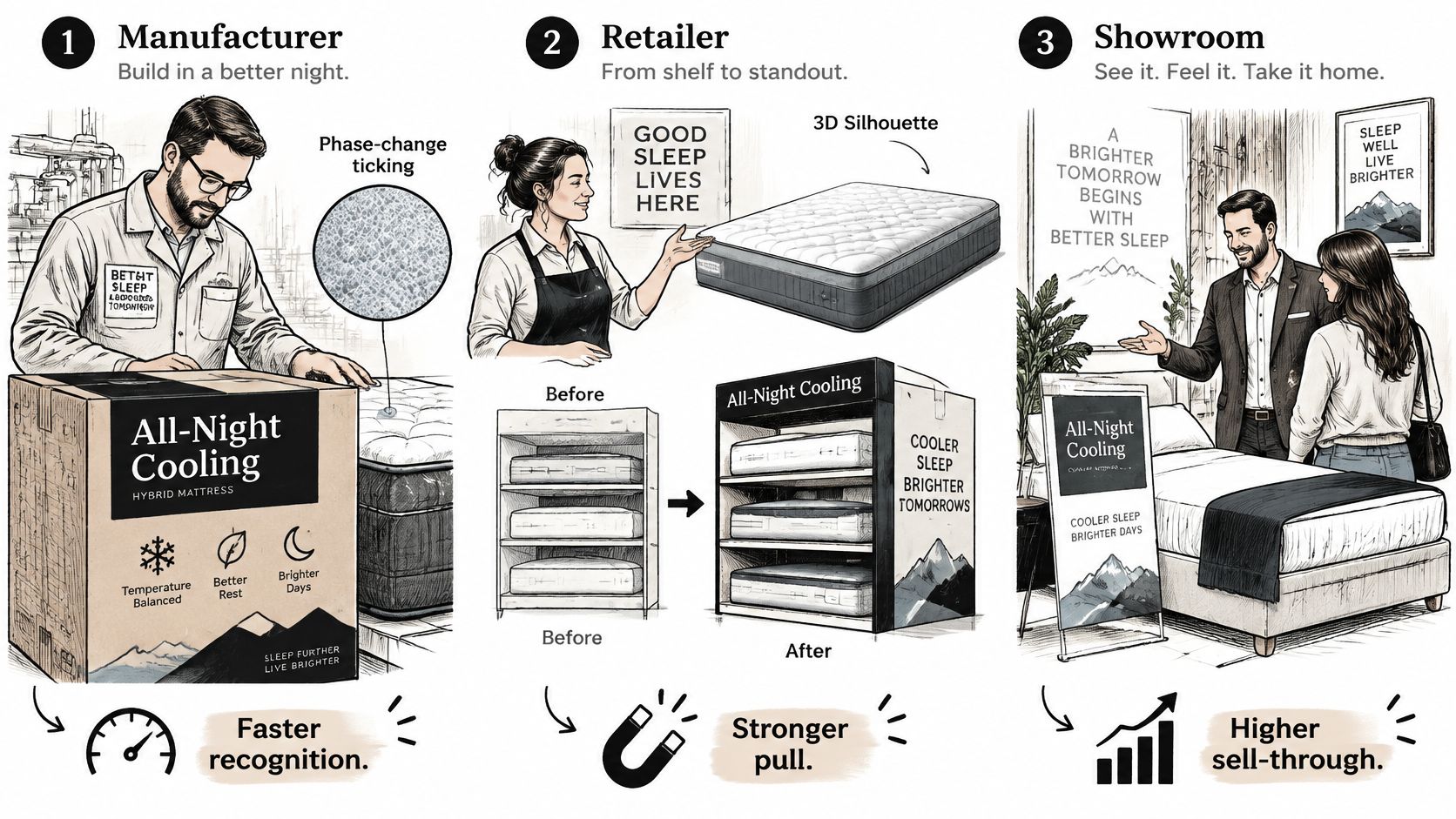
The fix names the component and drops the whole bed promise. The carton says the cover is cool to the touch, a layer diagram shows where that ticking sits above the quilt and comfort foams, and the RSA script explains that bedding, room temperature, and a protector change the result. I'd measure that manufacturer on claim related returns and exchanges, not on click rate for the louder headline.
The same discipline applies to eco badges, because trust is thin. A survey summarized by Blue Yonder's 2025 sustainability survey report found that only 20% of consumers believed brands accurately represented their sustainability efforts, while 30% cited insufficient sustainability information and 26% cited unclear or misleading claims as barriers. An eco hybrid badge should become a component fact with a disposal note, or it should come off the bed.
Retailer Running a Holiday Floor Set
Say an independent retailer builds a Memorial Day set around three hybrid price points. The product cards use the same three proof points as the ads running that week, in the same order, so a shopper who saw the ad finds the matching card without help. Strong point of sale marketing that matches the live campaign keeps that handoff tight, and it keeps the floor from inventing a stronger claim under pressure.
The RSA shirts carry the store logo only, with no medical line across the chest. When a shopper asks how two brands differ, the RSA walks the layer diagrams instead of trading slogans, much like a buyer using a Gorins Furniture & Mattress comparison guide to compare builds side by side before visiting. Measure this retailer on assisted close rate and attachment of bases and protectors, because a clearer comparison usually shows up there before it shows up in traffic.
DTC Startup With One Bed
Say a startup sells one boxed bed and leads its Shopping title with size, trial, and a firmness label. That's enough to earn a qualified click. The page then carries gusset height, the full foam stack, edge support construction, foundation requirements, and warranty terms where a skeptical shopper expects them.
Room scenes show the bed's scale in a real bedroom rather than a staged clinical result. A silhouette gives marketplaces a clean, accurate product shot, and a layer breakdown visual answers the what's inside question without a paragraph of foam names. Measure the startup on time spent in proof modules and return reasons, since a short ad only works if the proof behind it holds attention and sets the right expectation.
Build the Channel Plan and Audit It
Bring the people who can change a line into the same room: the marketing director, whoever owns the feed, a retail or factory partner who sees the physical product, and one RSA who hears the objections. A mattress sits between searchable spec and credence good, so the audit should decide which lines can stand alone in a title and which need inspection before they are believed. A claim review without the floor produces copy the floor will not repeat.
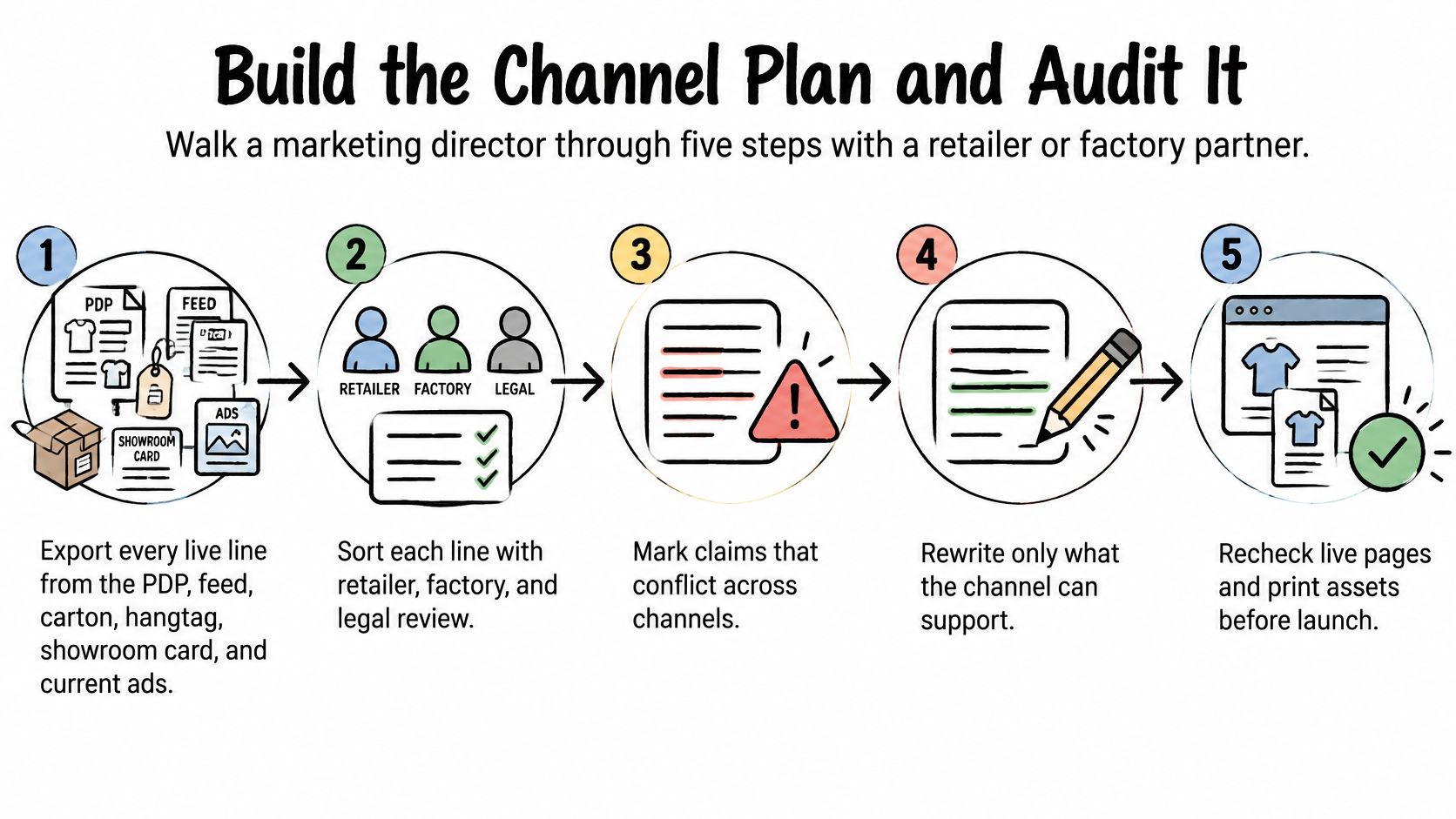
Export every live line. Pull the PDP, product feed, carton panels, hangtags, showroom cards, inserts, current Google and Meta ads, and marketplace titles into one document. Photograph the physical pieces at reading distance so contrast and type size are judged as shoppers see them.
Sort each line by claim type. Send size, price, trial days, a named certification, and one layer's material to Shopping titles, Meta primary text, and carton fronts. Move feel, durability, pain relief, and whole bed eco promises to the proof layer, where conditions and evidence can sit beside them.
Build the proof layer before you buy more traffic. Add comparison blocks, FAQs, foundation guidance, and disposal notes to the page. Use layer breakdown visuals for the foam stack, silhouettes for clean product shots, and room scenes that show scale without inventing a clinical outcome, then give RSAs the same diagrams in a floor friendly format.
Add merchandise only where exposure repeats. Choose useful pieces for the sales floor, trade shows, and delivery teams, such as floor notebooks or delivery cards, over generic drinkware nobody keeps. The channel is large enough to plan deliberately, since PPAI's industry sales summary reports that U.S. promotional products generated an estimated $26.78 billion in distributor sales in 2024, representing 2.63% growth from $26.09 billion in 2023.
Freeze the claim list, then read the right results. Lock approved wording before the next flight or carton print, and give any change an owner and a date. After launch, review return reasons and qualified product page engagement instead of clicks alone, using a consistent method like the one in this guide to measuring marketing attribution.
What the Audit Can and Cannot Promise
An audit removes contradictions you control. It cannot set your offer, your market, a competitor's promotion, or whether a shopper's foundation sags. BEDHEAD does not guarantee specific results from using its services, and marketing outcomes can vary based on numerous factors beyond its control, so judge the work on cleaner claims, fewer expectation returns, and better qualified engagement over time.
Where the gap is claim safe pages and visuals, our digital marketing, ecommerce strategy, creative asset creation, product storytelling, and high-end visual content fit the work described here. Keep floor language inside the same claim list as the page: if a script says more than the carton or PDP can support, rewrite the script before the next delivery run.
Print the shortest true claim. Prove the rest where a shopper can inspect it.
If your carton, feed, and floor cards are telling three versions of the same bed, BEDHEAD can help you sort which claims belong in a short ad and which need layered visuals, page proof, and RSA language behind them. Bring us one hybrid that's generating expectation returns and we'll map its live lines against the build, the ticking, and the trial terms. Start with that single bed, fix its chain, then roll the same claim discipline across the rest of your line.