What Is Brand Messaging? a Guide for 2026
A shopper stands in a showroom comparing two hybrid mattresses. Both offer pocketed coils, cooling foam, and a 100-night trial. Online, the product pages look equally polished. After studying the spec sheets and watching product videos, the shopper still can't explain why one bed deserves the higher price. They leave without buying, or choose the mattress with the clearer story.
That gap is the practical answer to what is brand messaging. It isn't a slogan placed above a product photo. It's the structured system of words, promises, proof points, and tone that helps buyers understand why your mattress exists, who it's for, and why it deserves consideration. For mattress manufacturers, retailers, private label brands, and sleep product startups, messaging often has to do the work a shopper can't do by lying on every bed in the category.
Why Mattress Buyers Cannot Tell Your Brand Apart
The problem usually isn't product quality. A mattress may have carefully selected foam layers, a durable ticking, a well-built quilt, and a thoughtfully engineered gusset. But shoppers don't experience those decisions as engineering documents. They experience them through product names, headlines, salesperson explanations, comparison charts, imagery, reviews, and checkout copy.
When every brand says “better sleep,” “premium comfort,” or “engineered for rest,” the category becomes difficult to understand. A side sleeper who overheats may see the same cooling language on a luxury hybrid, a value bed, and a private label model. The features differ, but the buyer can't tell which difference matters to their night.
The showroom problem
A retail associate can translate a specification into a useful recommendation. “This quilt feels softer” is a feature observation. “This surface gives a side sleeper pressure relief without making the bed feel enveloping” is a customer-facing benefit. Without an agreed message, every associate creates a different explanation.
That inconsistency affects the showroom experience, floor models, and margin conversations. If the shopper hears only a list of materials, the discussion often moves toward price. If the retailer can connect the mattress to a specific sleep tension, the conversation has a reason to continue.
The product page problem
Online, the buyer has even less context. They can't press the mattress, compare edge support in person, or ask why one hybrid uses a particular foam configuration. They scan the hero section, product visuals, layer breakdown, shipping terms, trial details, and reviews to predict whether the bed will suit them.
Practical rule: If a shopper has to build your differentiation from separate spec sheets, your messaging is making the buyer do the marketing.
Clear brand messaging makes a mattress feel distinct before the shopper lies down. It gives the homepage, PDP, paid ad, retail script, email, and customer support team one useful narrative to repeat. That narrative doesn't replace product quality. It makes the quality easier to understand.
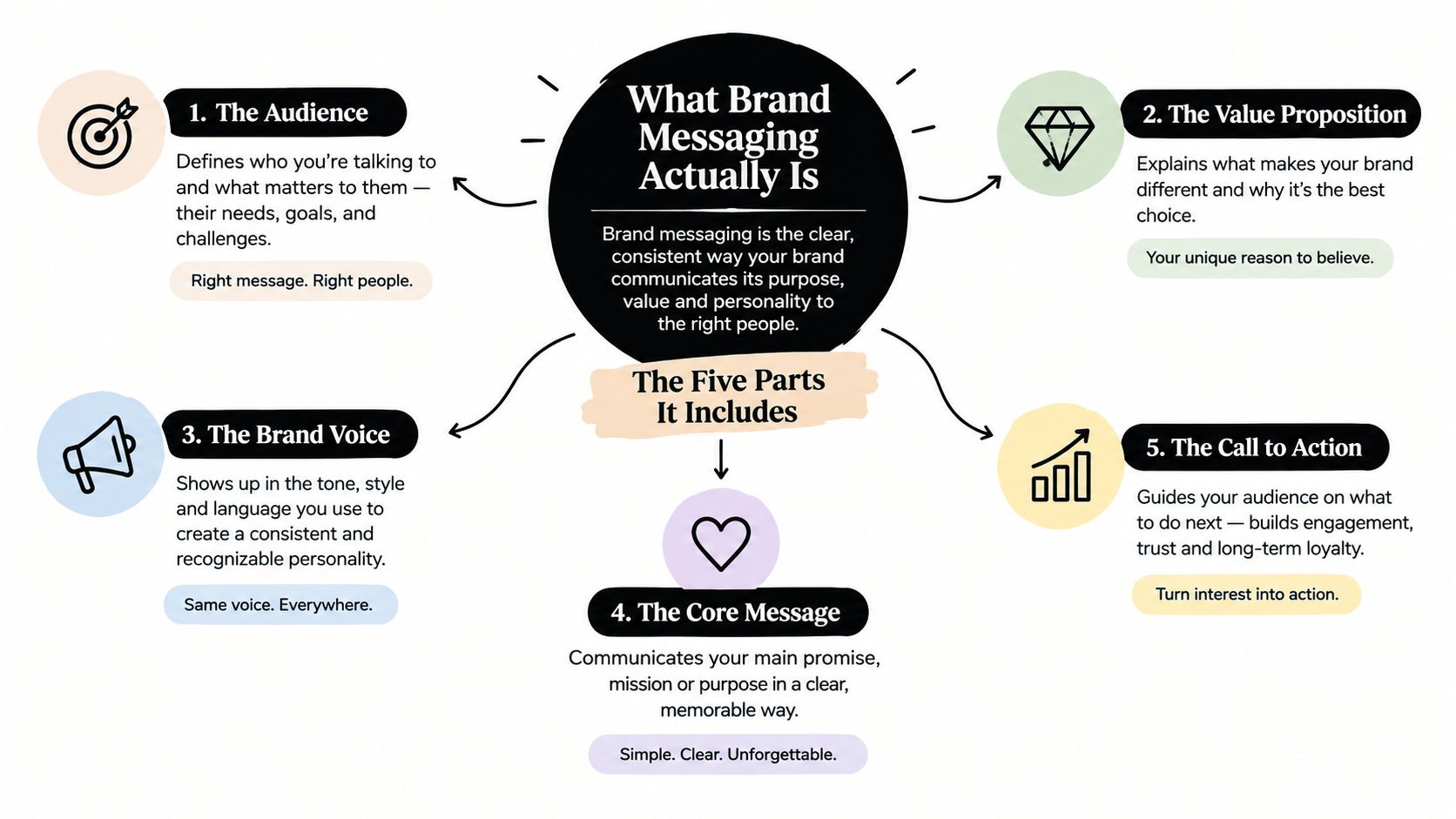
What Brand Messaging Actually Is and the Five Parts It Includes
Brand messaging is the structured set of words, claims, and proof points a company uses to explain its value across customer-facing and internal channels. It includes the verbal counterpart to visual branding, so it governs more than a tagline. It shapes website copy, advertising, product education, sales conversations, retail training, and the language used to describe a mattress inside the business.
A practical framework needs five parts.
Value proposition
The value proposition states what the mattress does, who benefits, and why the offer is worth choosing over alternatives. For example:
“The hybrid built for plus-size sleepers who overheat.”
That sentence is deliberately narrow. It identifies an audience, a tension, and a product direction. The product team would still need to substantiate the claim, but the message gives the buyer a reason to pay attention.
Tone
Tone describes how the brand sounds. A performance-led mattress may use precise, calm language about support zones, airflow, and materials. A lifestyle-led brand may sound warmer and more sensory, focusing on bedrooms, rituals, and the feeling of waking refreshed.
Tone isn't permission to change personality on every channel. The language can adapt for a showroom script, Google ad, or warranty email while still sounding like the same company.
Positioning
Positioning is the place a brand chooses to occupy in the buyer's mind. It might be the chiropractor-recommended mattress under $1,500, a recovery-focused hybrid for active sleepers, or a straightforward value bed for first-time buyers.
Positioning helps executives make decisions about what not to lead with. A brand can't own every audience and every benefit in one hero message.
Proof points
Proof points support the promise. They can include foam density, certifications, coil construction, trial terms, testing information, founder experience, or transparent manufacturing details. A claim about cooling should connect to verifiable construction and appropriate evidence, not just a blue product render.
Proof points also protect sales teams. Associates don't need to improvise when the framework tells them which material, certification, or policy supports the main claim.
Messaging hierarchy
Messaging hierarchy determines what appears first, second, and third. The most differentiating idea should usually lead, followed by the product benefit and then the proof.
For a fictional brand called HarborSleep, the hierarchy might look like this:
Hero message: A cooler hybrid for couples who can't agree on firmness.
Primary benefit: Responsive support for two different sleep positions.
Proof: Zoned coils, breathable foam construction, and a clearly stated trial policy.
Action: Compare the feel and choose a comfort option.
The same logic should appear in the PDP, retail presentation, paid social creative, and email. A useful explanation of how to connect product features to customer benefits appears in these product messaging frameworks explained. For a mattress team, the next step is documenting that translation in a value proposition messaging framework, then applying it to every place buyers encounter the product.
Why Brand Messaging Matters for Mattress Brands
A shopper stands in a showroom, presses two mattresses, and still cannot explain why one deserves a higher price. Online, the problem is sharper. The buyer cannot test the feel, judge partner disturbance, or predict whether the bed will suit their body after the first few nights. Brand messaging gives that uncertain experience a clear explanation before the mattress reaches the bedroom.
Vague language leaves shoppers with easy substitutes. They may ask for more help, compare specifications and prices, wait for a promotion, or postpone the decision. A precise message answers the question behind the question: Why should this mattress be the one? For a mattress brand, that means translating construction into a buyer-relevant reason to choose, such as pressure relief for side sleepers, cooler support for couples, or a responsive feel for people who change positions.
Trust makes clear messaging more valuable. This brand messaging research summary reports that 81% of consumers need to trust a brand before considering a purchase, 88% say authenticity affects which brands they like and support, and 77% buy from brands that share their values. These findings do not make messaging a substitute for product performance. They show why unsupported, inconsistent, or inflated claims create doubt before shoppers reach the specifications, reviews, or trial terms.
Consistency protects the promise
Hootsuite cites research indicating that brand consistency can increase revenue by 10–20% (Hootsuite's guide to brand messaging). For a bedding company, consistency means more than repeating a logo or color palette. The hero claim on the website, retail associate's explanation, Amazon listing, retail media creative, and Google ad should all support the same central promise.
That alignment reduces translation work. A salesperson does not have to reinterpret a spec sheet from scratch, and creative teams have a defined basis for product photography, 3D mattress renderings, Digibuns layer visuals, silhouettes, room scenes, and comparison graphics. The customer encounters one explanation across channels, even when the format changes.
Messaging is operating infrastructure
The same research summary reports that 15% of companies do not have brand messaging guidelines, while nearly half publish off-brand content a few times a year or more. In bedding, the gap may look like a premium homepage paired with discount-heavy ads, a technical product page paired with vague showroom language, or a cooling claim that product education never explains.
A messaging framework connects product engineering with buyer understanding. It gives the mattress a coherent story before the customer tests edge support, feels the quilt, or decides whether the hybrid's foam layers justify the price. Teams can then use this guide to improve brand awareness to strengthen recognition around the same promise, rather than adding disconnected campaigns.
Three Messaging Styles You See Across the Bedding Category
The same mattress feature can feel entirely different depending on the message wrapped around it. Consider a 38-year-old side sleeper shopping online because she wakes hot and wants pressure relief. The construction may be similar across three brands, but the promise changes the perceived value.
Messaging Style | Core Promise | Typical Language | Buyer Profile |
|---|---|---|---|
Commodity | Reliable sleep at a sensible price | “Comfort for every night,” “Quality without the markup,” “A better value” | Price-conscious shoppers comparing specifications and promotions |
Premium-lifestyle | A more elevated sleep experience | “Transform your bedroom,” “Rest in luxury,” “Crafted for your nightly ritual” | Buyers drawn to design, aspiration, materials, and an emotional purchase |
Performance-led | A specific sleep problem solved through construction | “Pressure relief for side sleepers,” “Responsive support for changing positions,” “Designed to manage heat” | Buyers seeking a clear functional answer to a defined concern |
Commodity messaging can remove purchase anxiety, but it often makes the mattress easier to compare on price. Premium-lifestyle messaging can create desire, especially when room scenes, tactile visuals, and refined copy work together. It can become vague if the product story never explains what the shopper is buying.
Performance-led messaging gives the side sleeper a more direct path. It can connect a sleep tension to the quilt, comfort layers, coil response, or breathable construction, provided the brand can prove the claim and avoid unsupported medical promises.
The right choice depends on the product, channel, margin strategy, and audience. A private label retailer may need value clarity, while a premium direct-to-consumer brand may need a stronger emotional world. The mistake is allowing the default style to emerge accidentally from competitor language.
How to Build or Audit a Mattress Brand Messaging Framework
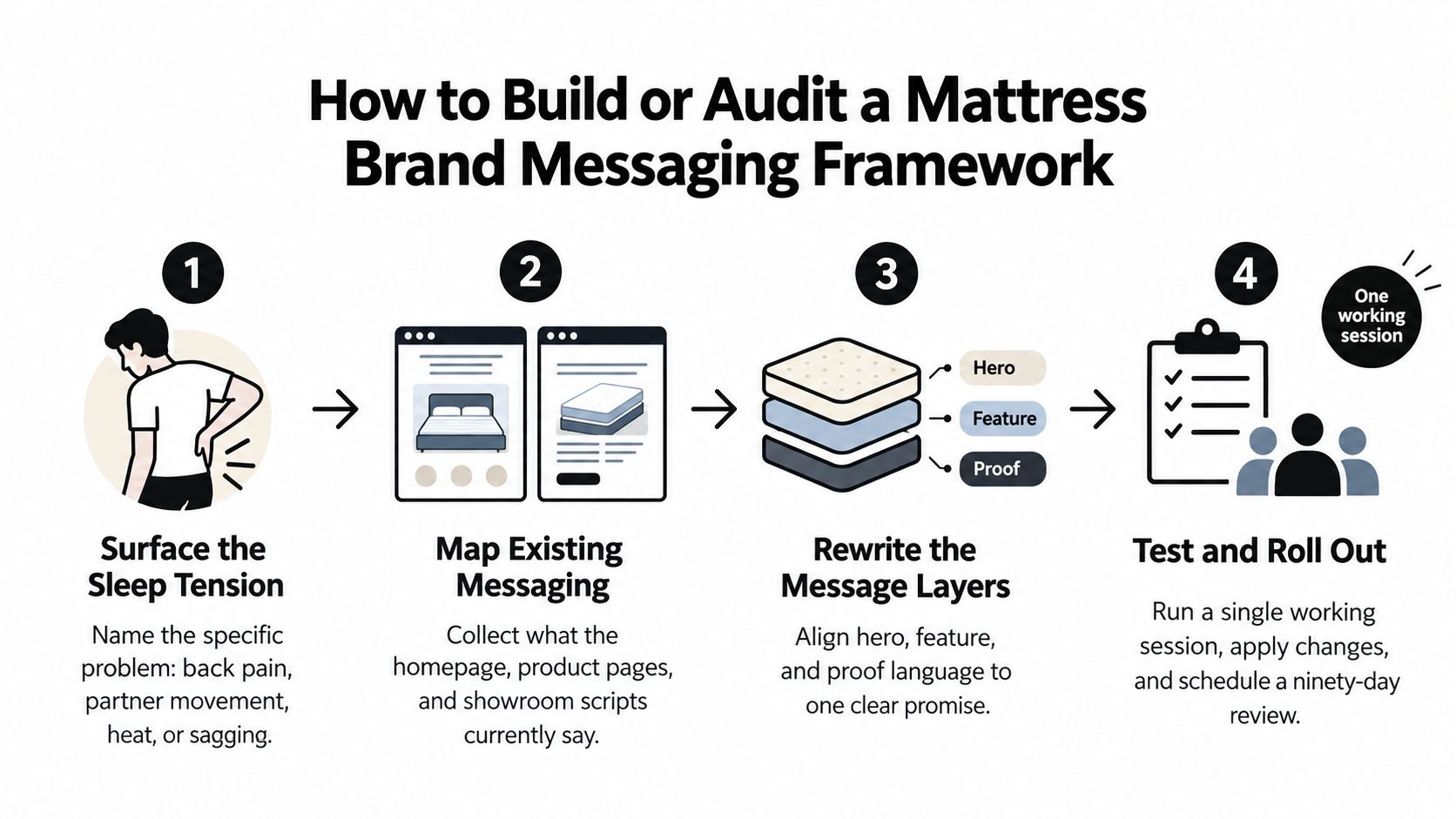
A mattress team can build or audit its framework in one focused working session. Bring product, marketing, sales, merchandising, customer support, and eCommerce into the same conversation. The point isn't to produce more copy. It's to decide which promise every team should protect.
Start with the sleep tension
Name the concrete problem the buyer is trying to solve. Avoid broad statements such as “wants better sleep.”
Use a fill-in prompt:
“Our target buyer is struggling with ______, especially when ______.”
Possible answers include overheating beside a partner, pressure at the shoulder and hip, fear of sagging, partner movement, or uncertainty about value. Customer reviews, support tickets, showroom questions, search queries, and return reasons can help reveal the language buyers already use.
Turn the tension into one promise
Translate the problem into a sentence that connects audience, outcome, and distinction:
“For [audience] who [tension], [brand or mattress] provides [specific outcome] through [credible difference].”
A hybrid mattress brand might write: “For side sleepers who wake with pressure at the shoulder, HarborSleep provides responsive cushioning through a layered foam and coil design.” The sentence isn't final advertising copy. It's a decision filter.
Select evidence
Choose proof points that support the promise without drifting into medical claims. Rank them rather than presenting every available specification.
Construction proof: Explain the relevant foam layers, coil system, edge support, ticking, quilt, or gusset.
Trust proof: Add certifications, testing, transparent policies, or manufacturing information that the brand can verify.
Experience proof: Use reviews and customer language carefully, without turning isolated experiences into universal guarantees.
Build the hierarchy and roll it out
Set the order for the homepage, PDP, Google responsive search ad, email, retail script, marketplace listing, and support response. Define the general audience, the priority target audience, and the voice customers should hear in every channel.
A simple audit asks:
Does the hero state one recognizable promise?
Does each feature explain why it matters?
Do the showroom script and PDP use the same core language?
Can a salesperson prove the main claim?
Does the visual system support the message?
Document the decisions in brand guidelines rather than leaving them in a meeting recording. A useful companion is how to create brand guidelines.
A Worked Example of a Mattress Messaging Audit
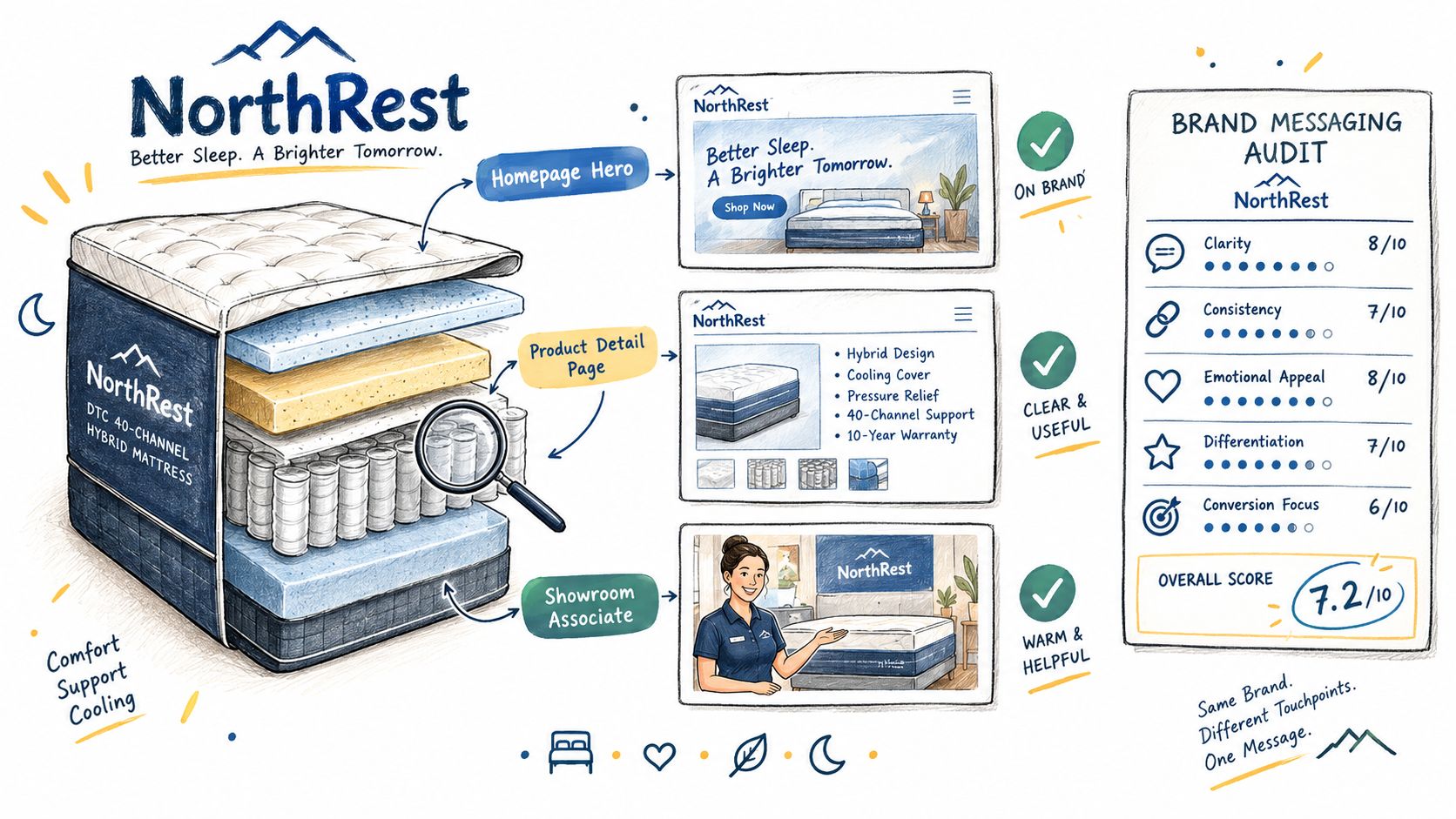
Consider fictional DTC hybrid brand NorthRest, which sells a 40-channel product range through its website, retail partners, marketplace listings, and showroom materials. Its homepage says “Premium comfort for better sleep.” The PDP lists cooling foam, individually wrapped coils, a quilted cover, and a generous trial. The showroom script says, “This is one of our most popular premium hybrids.”
Nothing is inaccurate. Nothing is memorable.
The current layer
Touchpoint | Current message | Audit finding |
|---|---|---|
Homepage hero | Premium comfort for better sleep | Interchangeable with almost any mattress brand |
PDP | Cooling foam, pocketed coils, quilted cover | Features appear without a clear buyer problem |
Showroom script | One of our most popular premium hybrids | Popularity replaces useful product guidance |
NorthRest's product team knows the mattress has a specific construction. The shopper doesn't know which part matters for their sleep.
The revised layer
The audit identifies a priority audience of couples with different comfort preferences, especially shoppers concerned about heat and movement. The revised framework becomes:
Hook: “A responsive hybrid for couples who sleep differently.”
Value proposition: “NorthRest helps partners find balanced support and cooler comfort in one adaptable hybrid.”
Ranked proof: Responsive coil system, breathable comfort construction, and clearly explained comfort options.
Tone: Calm, practical, and reassuring. No exaggerated performance language.
Showroom translation: “If one of you sleeps on your side and the other changes position, this hybrid is designed to balance cushioning with responsive support. Let's compare the feel on each side.”
The revised homepage can lead with the tension. The PDP can show a Digibuns-style layer breakdown that connects each layer to the promise. The showroom associate can use the same language while still adapting the conversation to the shopper.
That work is different from changing a headline in isolation. It aligns the claim, visual explanation, product education, and sales behavior. For teams that need to express complex mattress construction clearly, 3D assets such as layered product visuals, clean silhouettes, and room scenes can give the message a physical form.
Common Messaging Pitfalls and How to Avoid Them
Mattress teams often assume more product detail creates more confidence. It can do the opposite when the shopper can't see which detail answers their concern.
Five recurring failures
Interchangeable language: “Sleep better and wake refreshed” doesn't tell the shopper who the bed is for. Replace it with a specific sleep tension and a defensible promise.
Feature dumping: A long list of foam densities, coil counts, and fabric treatments leaves the shopper to interpret relevance. Explain what each feature changes in the sleep experience.
Borrowed premium language: A rival's lifestyle tone may sound attractive, but copying it creates a surface-level imitation. Choose a voice that matches your actual product, proof, and customer.
Channel disconnect: A polished PDP can't compensate for a showroom script that calls the mattress “a good value” when the website presents it as a specialized performance bed. Align the language.
Audience overload: One hero message can't lead equally with cooling, back support, pressure relief, partner movement, value, and luxury. Choose the audience tension that matters most for the offer.
Pitfall | Weak Phrasing | Why It Fails | Sharper Rewrite |
|---|---|---|---|
Generic benefit | “Better sleep starts here” | Every competitor can use it | “Responsive support for side sleepers who change position” |
Untranslated feature | “Advanced foam layers” | The buyer can't infer the benefit | “Layered cushioning that reduces the hard transition into the coil system” |
Unsupported premium claim | “The ultimate luxury hybrid” | It offers no testable distinction | “A refined hybrid with a quilted surface and clearly documented materials” |
Conflicting channels | “Affordable comfort” beside “engineered performance” | The shopper receives competing value signals | Select one lead promise, then use price and performance as supporting messages |
Multiple audiences | “Cooling relief for every body and every sleep style” | The message tries to serve everyone | “Cooling comfort for hot sleepers who share a bed” |
The sharper rewrite still needs product validation. Good messaging doesn't make a weak product sound stronger than it is. It makes a real difference easier to recognize.
Measuring Whether Your Messaging Is Working
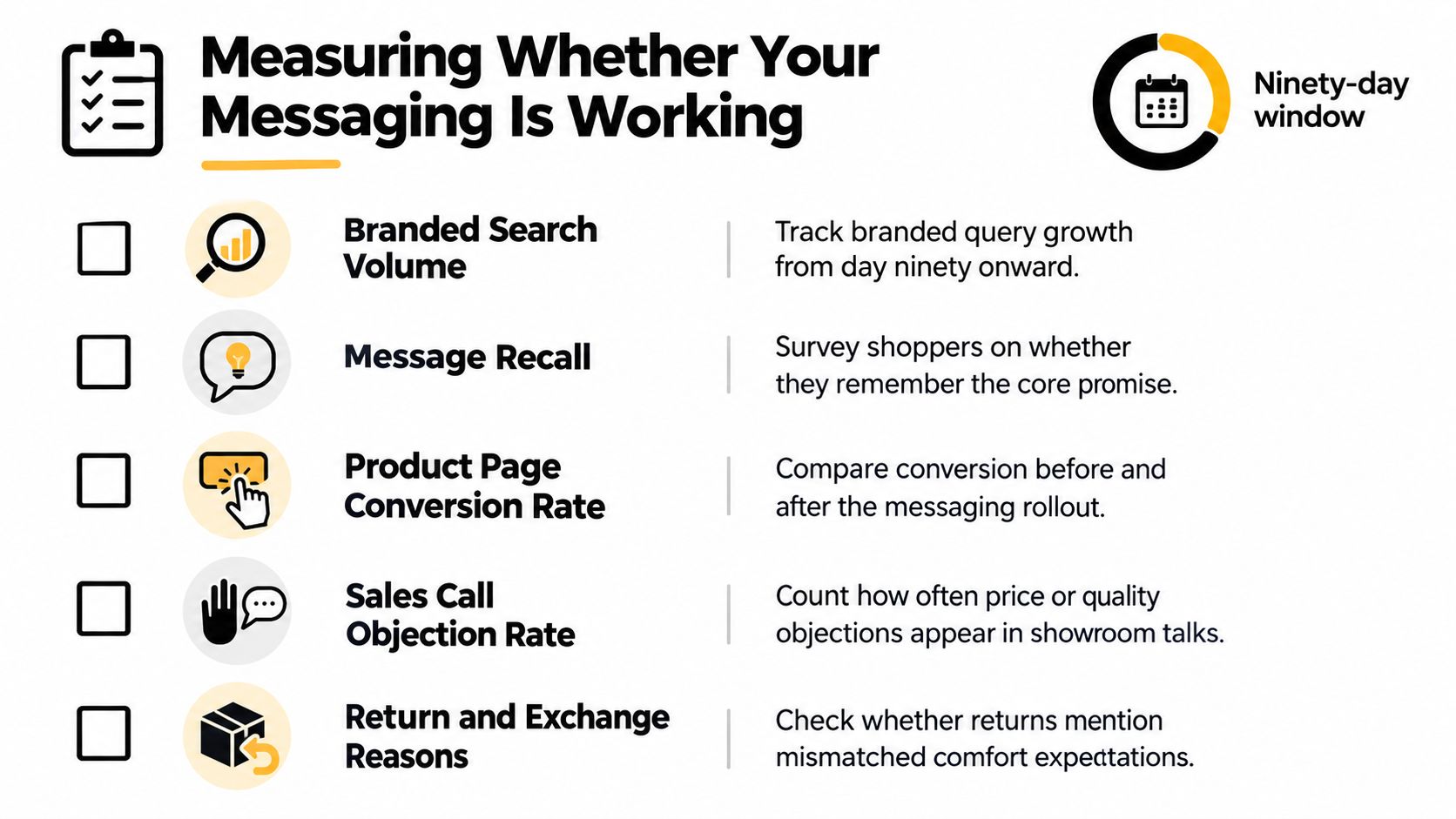
Messaging should connect to observable behavior, not only internal approval. Start with a baseline, roll out the revised framework, and review the same measures after a consistent evaluation period. The important question is whether buyers understand the offer more readily at the moment they compare, ask, click, test, or return.
Track five signals:
Assisted conversion rate: Review category and comparison pages to see whether clearer education contributes to more completed journeys.
PDP add-to-cart rate: Compare product pages before and after the message change, while recording major changes in price, media spend, inventory, and offer.
Showroom script-to-sale conversion: Ask store teams to use the approved language and record whether conversations progress to purchase.
RSA performance and Quality Score movement: Compare message variants in Google Ads and review whether the language aligns more closely with search intent.
Return rate and review sentiment: Look for signs that buyers received the experience the message described. Pay particular attention to comfort expectations and perceived differences.
A brand's measurement plan can include more than the five operational measures above. The supplied visual also highlights branded search volume, message recall, product page conversion rate, sales call objection rate, and return and exchange reasons as useful indicators. Treat those as diagnostic signals, not automatic proof of causation.
Run a quarterly message check
Use a short review with merchandising, creative, paid media, eCommerce, retail, and customer support:
Compare the hero promise: Check the PDP, ad copy, retail script, marketplace listing, and email.
Review search language: Compare top queries and customer questions with the proof points in the framework.
Inspect objections: Note whether shoppers still ask the same unresolved questions about quality, comfort, heat, or price.
Test one message shift: Change one meaningful promise or proof arrangement at a time so the team can interpret the result.
Update visual support: Confirm that product photography, 3D renders, Digibuns, silhouettes, and room scenes explain the same idea as the copy.
Teams can use this analytics implementation guide to make the reporting setup more reliable. For ongoing collaboration between manufacturers, retailers, marketers, and sales teams, Bedhead Network is a free hub for mattress industry professionals with marketing insights, news updates, networking, training resources, an industry directory, and business tools.
Bedhead helps mattress manufacturers, retailers, private label brands, and sleep product startups turn product engineering into clear brand messaging through brand development, USP development, SEO, paid media, product page optimization, 3D mattress visuals, and mattress sales training. If your current PDPs, showroom scripts, or campaigns make shoppers work too hard to understand the difference, visit BEDHEAD to discuss a practical messaging and activation plan.