Social Media Marketing for Mattress Brands: What Works
A shopper walks into your showroom, phone in hand, and asks for a hybrid by name. She has already seen its foam layers in a short video. Your floor model looks nothing like that video, and your RSA has thirty seconds to close the gap. That moment is where social media marketing either helps the sale or exposes weak product storytelling.
Why Social Media Marketing Reaches Most Mattress Shoppers
Say that shopper watched a layer breakdown on Tuesday night. By Saturday she's comparing ticking and quilt patterns in person. She doesn't remember your ad copy. She remembers whether the gusset, coils, and comfort layers made sense.
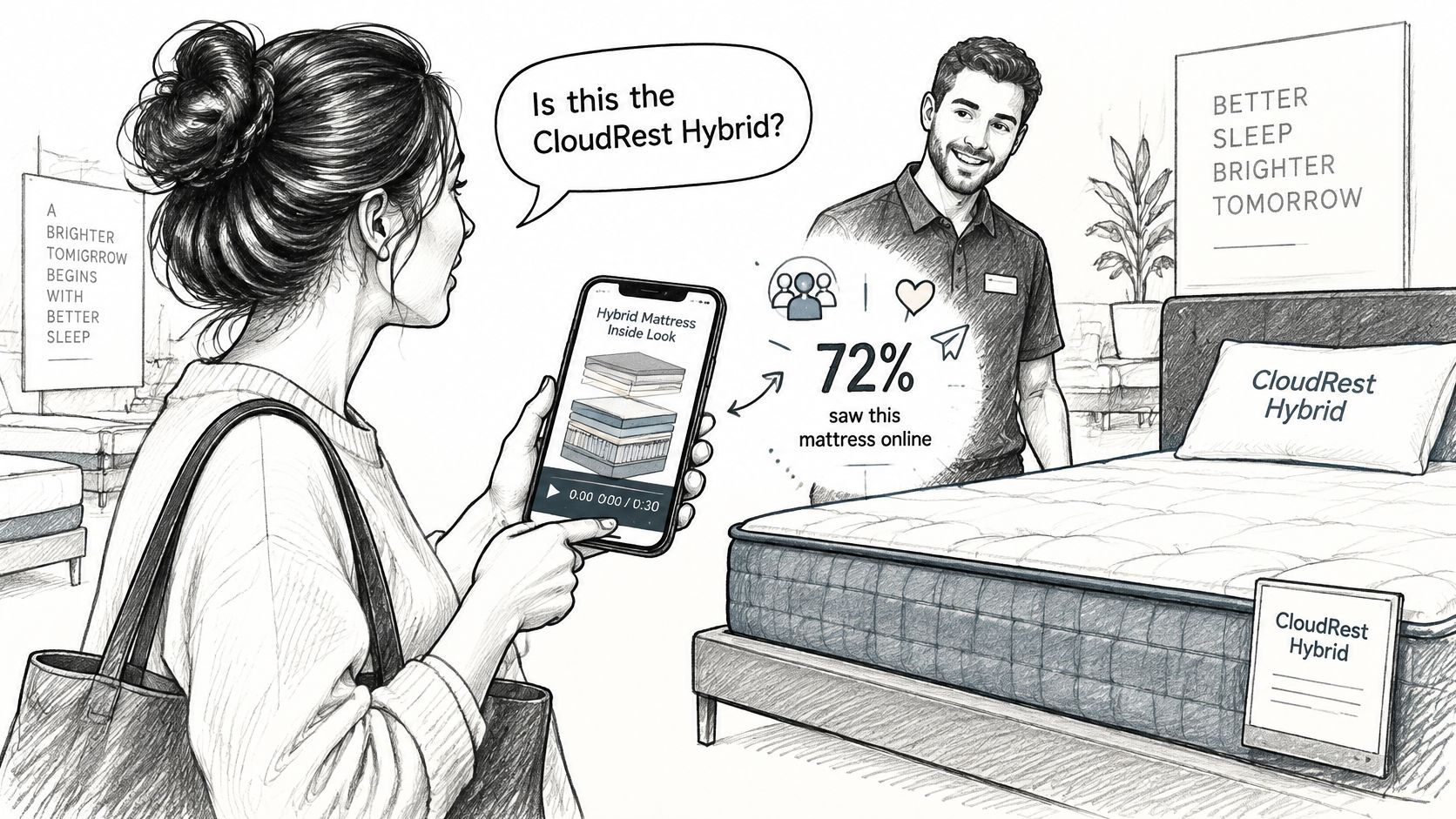
That behavior is normal because social is where attention already sits. The Pew Research Center social media use chart shows 72% of U.S. adults used social media by February 2019, up from 5% in March 2005.
Executives usually describe the same three problems. Showroom traffic doesn't convert. Product photos hide construction. Sales staff can't explain foam layers quickly when a shopper is standing at the foot of the bed.
What a useful plan has to answer
You need a platform choice, content matched to the buying journey, posts people can find through search, and measurement that works when the sale happens offline. Manufacturers, retailers, and eCommerce brands won't use those pieces the same way, and that's fine.
You'll leave with a platform choice, a measurement method, and one next step to take this quarter.
Which Platforms Mattress Brands Should Prioritize
Don't start by asking where your competitor posts. Start with where U.S. adults are, then give each platform one job. Posting the same cut-down video everywhere wastes the differences that matter.
The Pew Research Center 2025 survey of 5,022 U.S. adults found 84% had ever used YouTube, 71% had used Facebook, and 50% had used Instagram, while TikTok reached 37% and WhatsApp 32%. About half of U.S. adults visited Facebook and YouTube at least daily, including 37% visiting Facebook several times a day and 33% visiting YouTube several times a day.
Platform | U.S. adults who have ever used it | Creative job for mattress brands |
|---|---|---|
YouTube | 84% | Demonstrations, layered construction explainers, room scenes, showroom education |
71% | Local retailer reach, store events, broad mature-household audiences | |
50% | Visual product storytelling, bedroom styling, retailer collaborations | |
TikTok | 37% | Short comfort-test demonstrations, creator-led product moments |
32% | Inquiry handling, sample requests, retailer follow-up |
Assign one job per platform
YouTube earns the long explanation. A hybrid needs time. Show coil unit, transition foam, quilt, and ticking in order. That video can also train RSAs and support a retailer product page.
Facebook earns local intent. Store events, floor-model sales, delivery areas, and mature households replacing a guest bed fit here. Keep the retailer name and city in the creative, not buried in the caption.
Instagram earns visual comparison. A clean Silhouette next to a styled room scene helps a shopper judge height, profile, and finish. Retailer collaboration posts work when both accounts show the same model that's on the floor.
TikTok earns the quick proof. A hand pressing into the quilt, a side sleeper test, or a cutaway that opens fast. If you use creators, vet them for product clarity, not just personality. A specialist such as a TikTok influencer agency can be a useful reference point for how creator campaigns are structured, but I'd still require the mattress to appear in the opening seconds.
WhatsApp earns follow-up. It's not your discovery engine. Use it for sample requests, delivery questions, and retailer replies after someone has shown intent.
Selection rule: A single-showroom retailer often needs only Facebook and Instagram. A manufacturer with national distribution should usually add YouTube first.
Pick two platforms, assign each one creative job, and give each a deliberate share of budget. A third platform only makes sense when you have distinct creative for it, not leftovers from the other two.
Matching Social Content to the Mattress Buying Journey
A mattress isn't bought like a candle. A shopper discovers a model in a feed, researches specifications days later, tests it in a showroom, then buys from a retailer or online. If your content treats every post as a final sales pitch, you'll push hard at the wrong moment and go quiet when she needs detail.
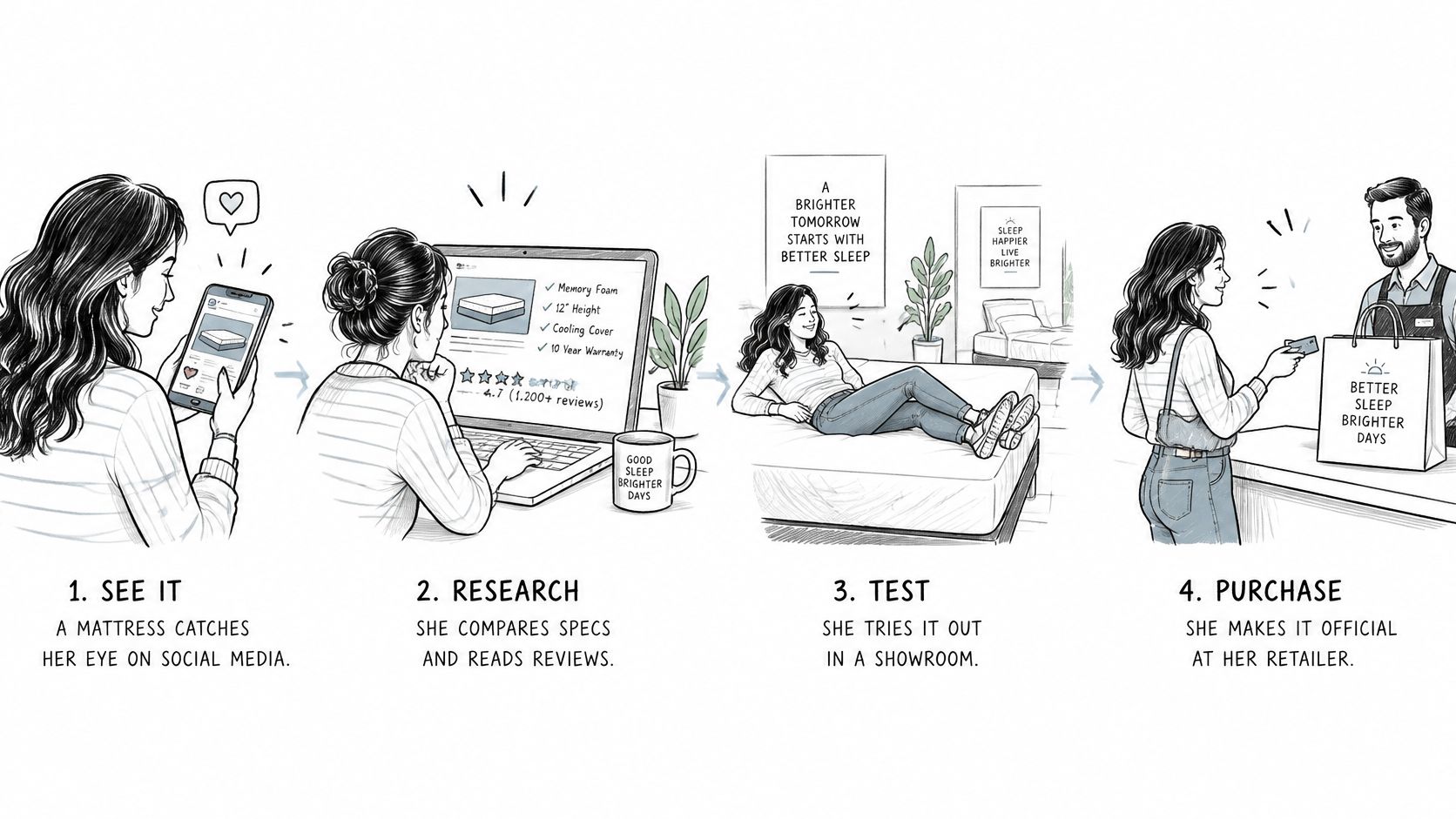
Think of the feed as the storefront window and the product page as the showroom floor. The window earns attention. The floor is where firmness, height, warranty, and price get tested.
Stage | Content type | Metric to watch |
|---|---|---|
Discovery | 3D layer breakdown or room scene that stops the scroll | Video holds and profile visits |
Research | Firmness, sleep-position and warranty explainers | Clicks to specification pages |
Comparison | Hybrid vs all-foam construction clips covering ticking, quilt and gusset | Product page visits |
Testing | Showroom QR codes to layer breakdowns and floor-model walk-throughs | QR scans and appointment requests |
Purchase | Retailer availability, delivery windows and return policy | Retailer sell-through and return rate |
Discovery and research need different creative
At discovery, a Digibun works because it separates the layers a shopper can't see on a made bed. Don't lead with pillows and throws. Show the build, then put it in a room.
At research, answer one question per post. How firm is firm for a back sleeper? What weight limit applies? How long does the adjustment period run? What does the warranty cover? Shoppers remember a clear answer and forget a general comfort claim.
Comparison is where plain language matters most. A side-by-side clip of a hybrid and an all-foam model should explain what changes, not just list layers. Say what the ticking does for surface feel, what the quilt adds, and why the gusset matters for edge appearance. That's also where staff-led explanations connect naturally to social selling in a mattress retail context, because the RSA continues the same explanation the shopper started online.
Testing and purchase close the loop
In the showroom, put a QR code at the foot of the floor model that opens the same layer breakdown from social. The shopper shouldn't have to reconcile two different stories. Your RSA can point to the layer on screen, then to the feel under hand.
At purchase, remove friction. Name the retailer, delivery window, and return policy in the post or linked page. Vague availability kills momentum after a good showroom test.
Try this exercise this week. Take your five most recent posts, assign each to one stage, and rewrite the call to action for that stage. Discovery asks for a save or profile visit. Testing asks for a store visit. Purchase asks for a retailer check. Most accounts discover they're asking everyone to buy and almost no one to compare or test.
Making Social Posts Findable in Search
Search inside social apps now competes with the browser for early mattress research. The Sprout Social research on Gen Z search behavior found 41% of Gen Z respondents in the United States, United Kingdom, and Australia said they use social platforms first when looking for information, compared with 32% for traditional search engines, and 37% of consumers prefer social first for product reviews and recommendations. Shoppers run the same searches for brand names and nearby retailers, so a caption that matches real phrasing can surface twice: once in the feed, once in the search results.
That changes how you write captions. Build each post around one question a shopper would type, such as how hybrid layers handle pressure relief for side sleepers. Use the words she uses, including firmness, hybrid, ticking, quilt, and trial period, without stuffing every term into every caption. A post phrased like the question earns the click. A post phrased like a campaign slogan does not.
Good keyword research for mattress content starts from showroom questions, not a generic list. Ask RSAs what shoppers ask at the rail, then turn those exact phrases into searchable posts. The phrasing that moves a shopper toward a store visit is rarely the phrasing on the sell sheet.
Connect the post to a page that can finish the job
Every post about cooling foam, an adjustable base, or a new collection should link to a specific, crawlable page that explains the claim and offers a next step. The Google Search Central documentation defines search engine optimization as the process of increasing a webpage's visibility in search engines to attract more relevant traffic. If the linked page uses different language than the post, shoppers hesitate and search engines see a weaker match.
Confirm the click leads somewhere worth the visit: a specification page that carries a retailer or lead event the shopper can act on.
A caption that reads like a spec sheet loses the entertainment value that earns the view. Answer the question clearly, then let the product page carry the depth.
Measuring Social Beyond Likes, Views and Last-Click Sales
Likes mislead mattress brands because the purchase rarely happens where discovery happens. A shopper sees a post, researches specifications later, tests the bed in a showroom, and buys through a retailer. Last-click reporting gives the credit to whatever she touched last, even if social created the shortlist.
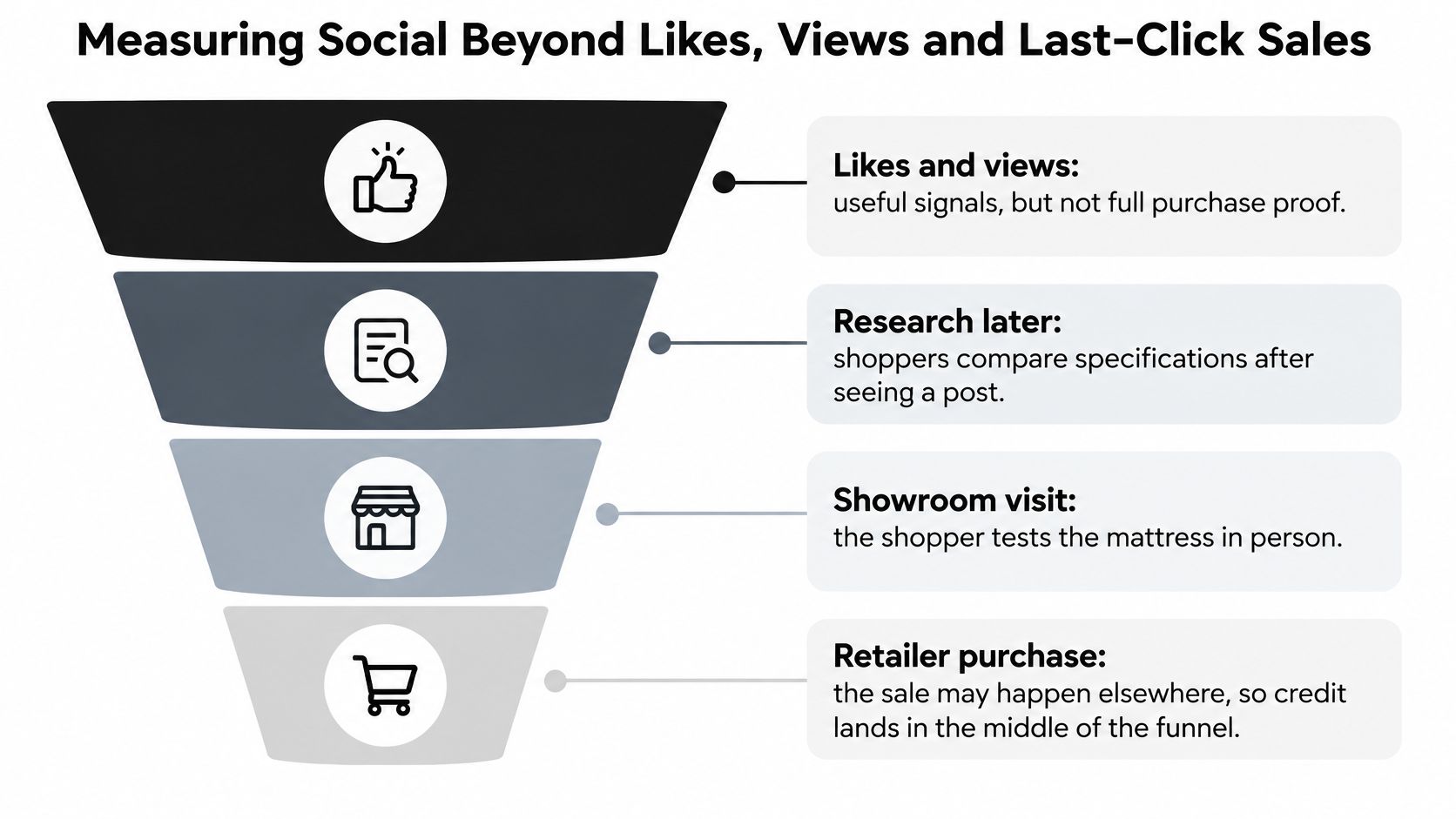
The Sprout Social 2025 survey of 1,200 marketing leaders found teams commonly use engagement and conversion rates to define social ROI, while more advanced teams connect leads, UTM-tagged content, and multiple touchpoints across the customer journey. That same report found 76% of surveyed consumers said social content influenced a purchase during the prior six months, rising to 90% among Gen Z and 84% among Millennials.
Metric | What it tells you | Use it for |
|---|---|---|
Platform engagement rate | Attention relative to reach | Early creative testing only, a weak signal alone |
Product-engagement score | Whether viewers look at the mattress when it appears on screen | Choosing which video cut to scale |
Store-locator visits | Intent to visit a showroom | Tracking retailer-level campaigns |
Branded search lift | Whether social raises searches for the brand name | Judging awareness spend |
Incremental lift from holdout test | Conversions the ads caused, not just claimed | Budget allocation between channels |
Cost per incremental conversion | What each caused conversion costs | Comparing channels and campaigns |
Separate diagnostic signals from budget signals
Engagement tells you whether creative held attention. It doesn't tell you whether to move budget from search to social. Store-locator visits, QR scans, retailer referral codes, and call-center questions sit closer to revenue because they reflect a shopper trying to test or buy.
Creator content needs the same discipline. If you're sourcing customer or creator clips, the UGC recruitment advice from JoinBrands is a practical starting point for briefing and hiring, but I'd judge the output by store-locator clicks and qualified traffic, not by how warm the comments feel. A structured view of how to measure marketing attribution helps you decide which touchpoints to connect before you spend more.
Run a holdout test before you reallocate budget
Suppress paid social for a matched geographic or audience control group while keeping retail availability and other media the same. Then compare store visits, branded searches, lead submissions, and sales. The Northwestern Kellogg comparison of observational and randomized advertising measurement found a test-group conversion rate of 0.045% versus 0.033% for the control group, an incremental lift of 0.012 percentage points, or 38% relative lift, which shows why platform attribution alone can overstate causal impact when delivery algorithms choose who sees ads.
Use platform data to optimize creative. Use incremental lift and cost per incremental conversion to decide where budget goes. We don't guarantee specific results from our services, and marketing outcomes can vary based on numerous factors beyond our control, so treat every test result as evidence for the next decision, not as a promise.
Creative That Shows the Product, Not Just the Bedroom
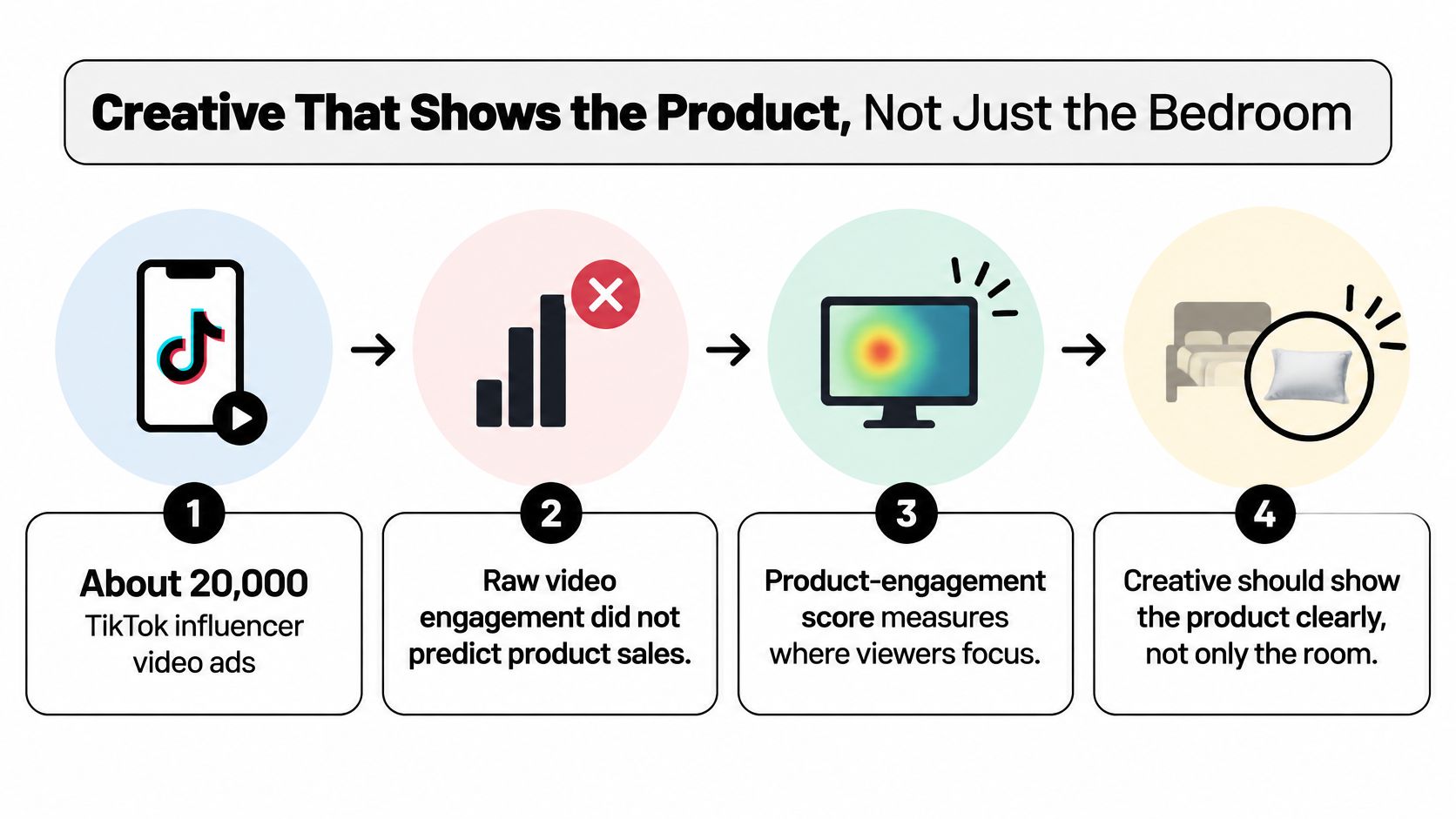
A beautiful bedroom can earn a like and still sell nothing. If viewers remember the headboard, the throw, or the creator, but not the mattress, your creative did the wrong job.
The Wharton study analyzing approximately 20,000 TikTok influencer video advertisements found raw video engagement was not predictive of product sales. Its researchers developed a product-engagement score by comparing where viewers concentrate attention with when and where the product appears on screen, which is more commercially meaningful because it tests whether attention is directed toward the advertised product.
Run a five step frame level audit
Log product frames. Watch one video slowly and note every moment the mattress is clearly visible. Mark the first appearance. If the bed is covered or out of frame early, flag it.
Tag the selling moments. Mark product visibility, logo exposure, feature demonstrations, and calls to action. A hand pressing the quilt counts. A wide bedroom pan doesn't.
Compare with behavior. Line those moments up against retention, clicks, store-locator visits, and retailer inquiries. Look for drop-offs right before the product appears.
Keep the product-led cuts. Retain clips that hold attention while the mattress, layers, or comfort test are on screen. Cut lifestyle footage that delays the product without adding proof.
Reuse winners on product pages. Feed the strongest clips into the product page near specifications and retailer options, so social proof supports the decision instead of living only in the feed.
Compare two openings for the same hybrid
Version A opens on lifestyle. Morning light, a styled bedroom, someone stretching. The mattress is under bedding for the opening seconds. Viewers may enjoy it, but they can't tell a hybrid from an all-foam model.
Version B opens on construction. The ticking lifts, the quilt separates, foam layers and coils appear in order, then the finished bed appears in a room. The shopper learns what she's buying before she judges how it looks.
I'd scale Version B and keep Version A only if it drives profile visits that later convert. That judgment is exactly what product-engagement thinking forces you to make.
Asset type matters. Digibuns show layered construction that photography can't reveal without cutting a bed open. Silhouettes give you clean product images that stay legible in a feed, a listing, and a retailer deck. Room Scenes add lifestyle context after the product has been shown, which is the right order.
Customer clips can work too, if you brief them tightly. The approach in how to create user-generated content is most useful when you require an unmade-bed shot, a close view of the quilt, and one specific comfort claim the creator can demonstrate.
Before you publish, confirm the mattress is on screen before the story begins. If a viewer paused in the first seconds, could she name the product type? If not, recut it.
Social Media Marketing Playbooks for Mattress Brands
Copying a competitor's posting schedule is a weak strategy. Distribution, staffing, margin structure, and showroom count change what you should publish and what leadership should review each month.
Manufacturer launching a new foam layer
Publish a YouTube construction explainer that shows where the new layer sits and what it changes for pressure relief or temperature. Give retail partners a co-branded short clip they can post without editing. Leadership should review retailer sell-through and inquiry volume, not national view counts alone.
Brick and mortar retailer running a floor model sale
Use Facebook event posts tied to the specific store, with the actual floor models named. Put a QR code on each bed that opens its layer breakdown. Review appointment requests and store visits weekly during the event. A simple social media scheduler can help a small team keep store posts consistent without turning scheduling into a daily scramble.
eCommerce brand selling on trial and returns confidence
Use Instagram and TikTok to explain the trial period, return pickup, and what happens if firmness feels wrong after the adjustment period. Show the mattress in a room scene, but keep construction clips pinned for comparison shoppers. Review qualified product-page traffic and conversion rate, and watch return reasons for language your content failed to explain.
Private label or startup brand building a first audience
Lead on Instagram with a founder explaining materials, certifications, and why you chose a hybrid build over all-foam. Keep claims narrow and demonstrable. Review waitlist sign-ups and first-order rate rather than follower growth.
Each playbook names one primary platform, one content priority, and one monthly metric. Find the scenario closest to your business and check whether your current reporting measures what that scenario needs. If it doesn't, your calendar may be busy while your decision-making stays blind.
Confirm Your Social Plan Before the Next Budget Cycle
Finish these five steps before your next budget review. They don't require a new platform. They require honest sorting.
List current channels. Check each one against the platform table and cut any channel with no distinct creative job.
Map your best posts. Assign your five best-performing posts to buying-journey stages and note the missing stages.
Audit one video. Run the frame-level audit and cut frames that hide the mattress.
Set up one measurement method. Choose a retailer referral code, a showroom QR code, or a holdout test.
Agree the budget metric. Set a review date and name the metric that will decide budget changes.
If you're evaluating product imagery or product pages, review your Digibuns, Silhouettes, and Room Scenes against the buying-journey map to see where social and product content disagree. We help mattress brands, bedding manufacturers, and retailers grow through digital marketing, eCommerce strategy, creative asset creation, product storytelling, and high-end visual content, and results depend on many factors outside any agency's control.
For deeper training, use Bedhead University. You can also join Bedhead Network, which is free for mattress industry professionals and offers marketing insights, news, networking, training resources, an industry directory, and business tools. Questions about our Terms and Conditions can be sent to info@bedheadmarketing.com or through the contact form at bedheadmarketing.com/contact.
If your social content shows bedrooms more clearly than mattresses, or your reporting can't connect a post to a showroom visit, we can help you rebuild that chain with product-led creative and measurement that fits a retailer-mediated sale. Visit BEDHEAD to talk through your platforms, imagery, and next budget cycle.