New Products Advertising for Mattress Launches: A Guide
A new mattress gets one chance to look right in an ad, feel right on a floor model, and read right on a product page. If those three stories don't match, new products advertising creates returns and confused sales associates instead of repeat demand. Treat the launch as retail support work first, and awareness work second.
Why Launch Ads Must Earn Repeat Demand
A peer-reviewed study of consumer packaged goods found that 25% of newly introduced stock-keeping units were no longer purchased one year after launch, rising to approximately 40% after two years. Failure meant permanent cessation of sales. That's the risk. Your ads don't just need first orders, they need trial, repeat purchase, and a retailer who still wants the bed on the floor next season.
Mattresses make that harder than most products. A shopper can't judge firmness, foam layers, pressure relief, ticking, quilt feel, or gusset construction from a flat photo. She'll compare your new hybrid mattress against the proven model two slots down, ask why the transition layer changed, and check whether the ad matches what she feels in 90 seconds on the showroom floor.
Where Launches Break Down
Mismatched floor models: The ad shows a plush quilt and cooling cover, but the floor sample uses older ticking or a firmer build.
Thin talk tracks: Sales associates get a sell sheet, not a 20-second story they can repeat under pressure.
Inflated eCommerce expectations: Lifestyle imagery promises hotel softness, then the bed arrives firmer and comes back as a return.
Write down the one thing a shopper must believe after seeing the ad. If your creative, retailer talk track, and product page don't say the same thing, you aren't ready to spend.
That single belief might be cooler sleep from a specific cover, quieter motion from wrapped coils, or stronger edge support for couples. Pick one, prove it visually, and let every channel repeat it. Product imagery, demos, and retailer enablement aren't creative extras. They're how you protect sell-through after curiosity fades.
Channel Roles and Starting Budget Shares
Give each channel one job before you approve creative. Search should catch shoppers already comparing firmness and construction. Paid social should show texture and use. Retailer support should help a sales associate close the gap between the ad and the floor model.
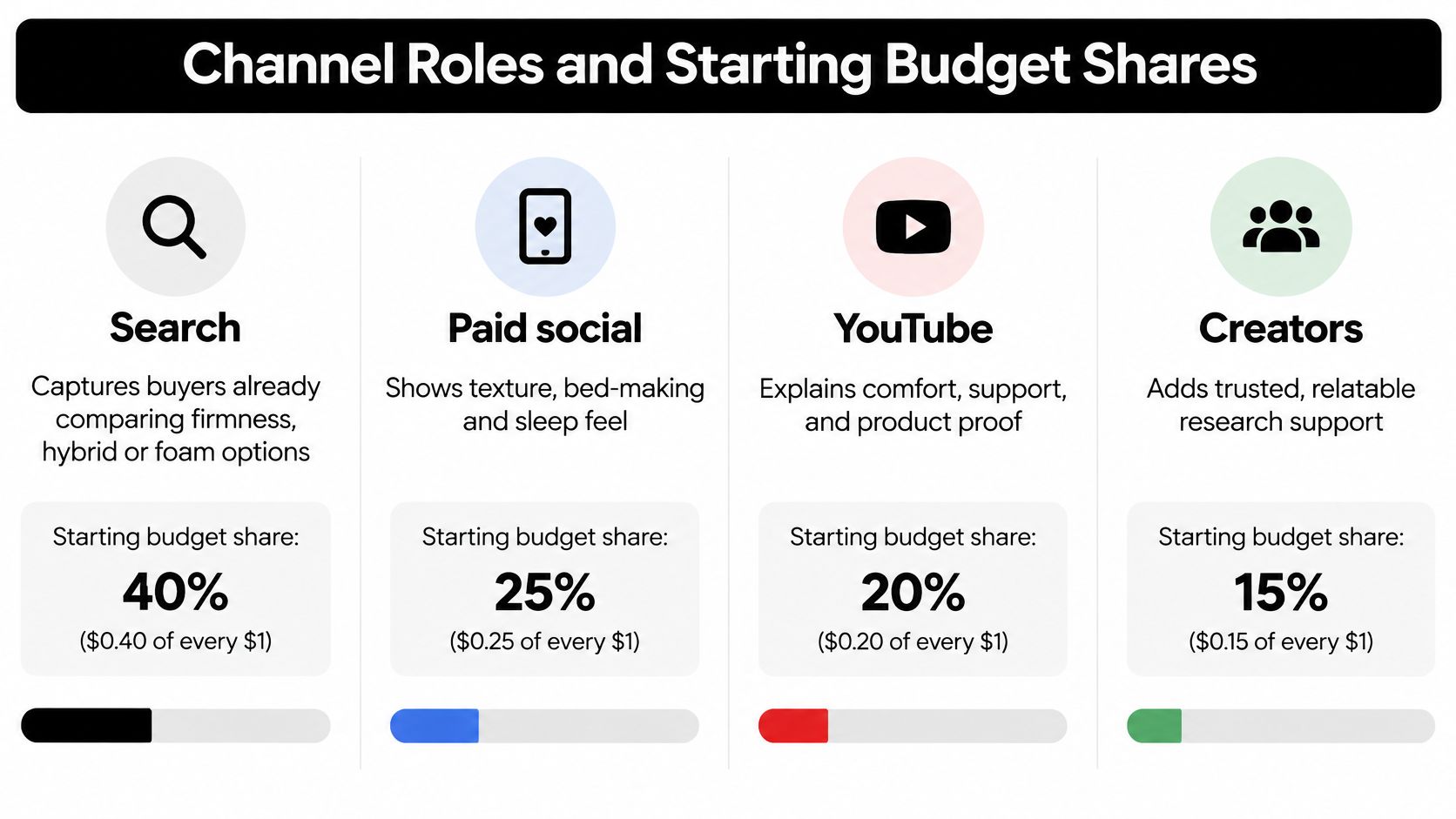
Before splitting money, size the pool from unit economics. Decide what acquisition cost your margin can carry, multiply it by the units the launch must sell in 90 days, and hold 10 to 15% in reserve for creative cuts in days 8 to 30. If the pool can't produce enough qualified visits to read a test, narrow the geography instead of spreading thin. For a broader view of how these placements fit together, see these examples of marketing channels.
Channel | Launch job | Starting share | Lead creative |
|---|---|---|---|
Search (Google Ads) | Capture buyers comparing firmness, hybrid or foam | 25-30% | Spec comparison and FAQ landing page |
Paid social (Meta, TikTok) | Show texture, bed-making and sleep feel | 25-30% | Product-in-use video and layer carousel |
YouTube and display | Explain construction to research-stage shoppers | 10-15% | Layer breakdown explainer and comparison video |
Convert waitlist and past buyers into first orders | 5-10% | Launch offer and early reviews | |
Retailer and in-store | Support floor models and sales associates | 15-20% | Showroom talk track, shelf card, QR to spec page |
Creators and reviews | Build third-party proof | 5-10% | Overnight trial and unboxing |
Total at midpoints | 100% |
Shift toward retailer support when most volume will close in showrooms. Shift toward search when shoppers already search your brand or model type. Don't let paid social carry the whole explanation, because a thumb-stopping clip can't teach coil count, foam density, and return terms at once.
Watch targeting limits early. The Google Ads personalized advertising policy restricts advertiser-curated audiences built around sensitive categories including personal health information and health conditions. Don't build lists around insomnia, chronic pain, or sleep apnea. Use contextual placements, permitted predefined audiences, and broad geographic or demographic targeting instead.
The Day 14 Rule
Review the split at day 14 against cost per qualified visit, not cost per click alone. A cheap click that bounces from the spec page teaches you nothing. A pricier visit that watches the layer video, checks firmness, and finds a retailer is launch progress.
Creative That Makes a New Mattress Easy to Verify
Shoppers verify before they commit. A 2025 Levanta survey of 1,000 U.S. online shoppers who use AI for product research found that fewer than 10% clicked AI-recommended links, while 87% discovered products through trusted creators, blogs, and communities. Your ad often starts research. It rarely finishes it.
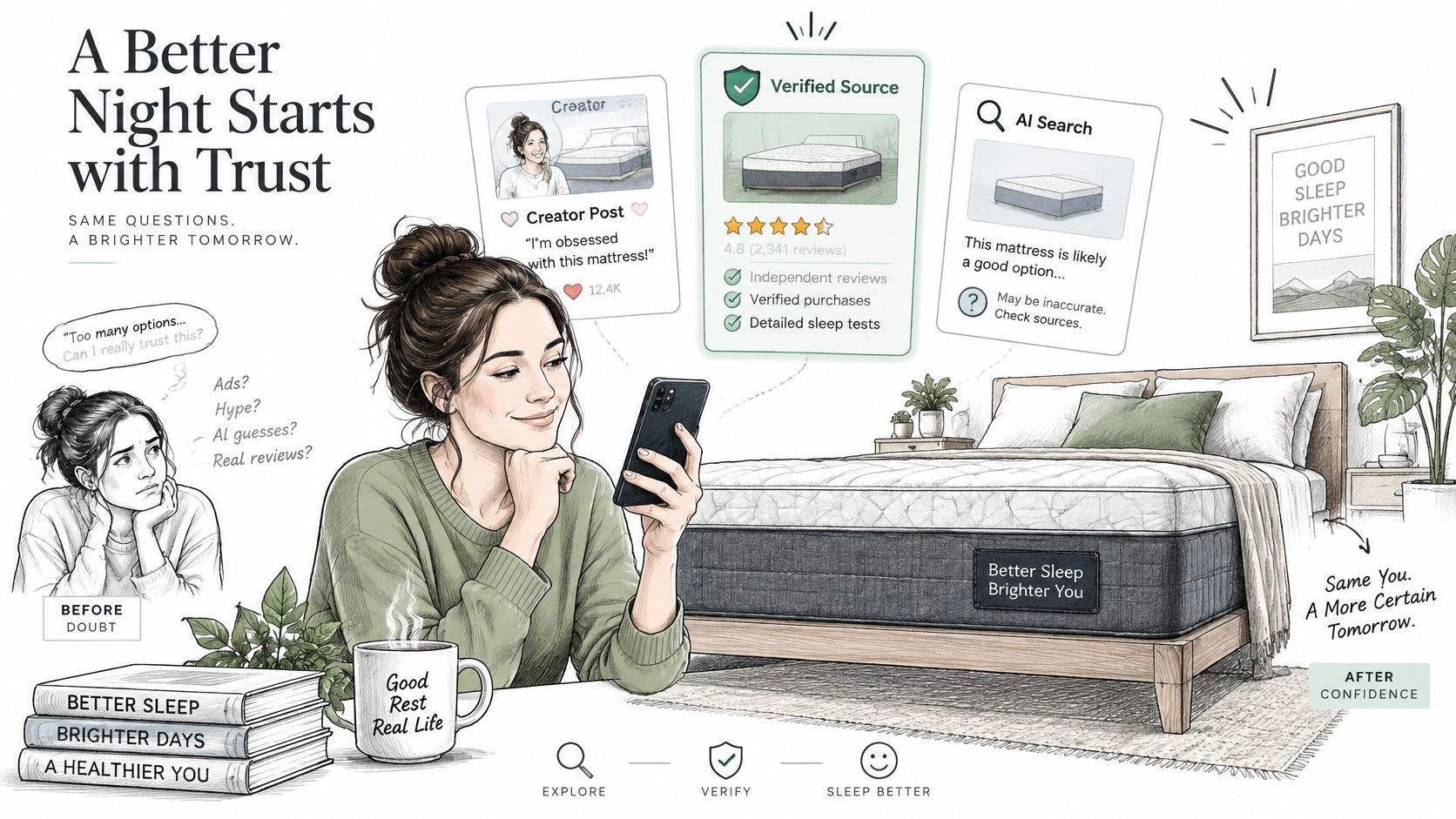
So build creative for the next step. Every major claim needs visual proof, plain language, and a place to confirm it. That's the practical lesson in how to use imagery on a product page, and it matters even more in an ad where you have seconds.
One Proof Format Per Claim
Digibuns: Use layer breakdown visuals to show comfort foam, transition foam, coils or base foam, and total height. A shopper can see why a hybrid feels different from an all-foam build.
Silhouettes: Put the new model on a clean backdrop beside your current bestseller. Keep angle and scale consistent so ticking, quilt pattern, handles, and gusset height compare fairly.
Room Scenes: Show the bed made, at proper scale, in a primary bedroom or guest room. Shoppers judge height, bedding drape, and whether the profile suits their frame.
Add a short demo for what stills can't prove. Sit on the edge, roll across the surface, or place a glass of water near a moving partner. If you need quick variations for hooks, captions, and formats, a ShortGenius AI ad creative tool can help you produce testable cuts, but the proof still has to come from the actual construction.
Use spec callouts a non-expert can repeat. Say a 12-inch hybrid with individually wrapped coils, a 2-inch gel foam comfort layer, and a 3-inch transition foam. Don't say advanced responsive support system and expect a retailer or spouse to pass that along accurately.
Practical rule: Pick three claims, attach one visual to each, and use the same wording in the ad, FAQ, shelf card, and sales associate talk track.
Answer comparison questions on the landing page itself. Put firmness scale, sleeper type, trial, warranty, and return handling near the proof visuals. If shoppers have to leave to verify basics, a competitor's clearer page will finish the job for them.
Compliance Checks Before Assets Go Live
Most launch teams treat claims as copy. Compliance treats them as evidence. The Federal Trade Commission health products compliance guidance requires health claims to be truthful, not misleading, and supported by competent and reliable scientific evidence. Testimonials and broad assurances don't replace that evidence.
That distinction matters in bedding, where marketing slips easily from comfort into medical promise. Our overview of health and wellness marketing covers the category context, but each claim still needs its own file. If you say a mattress reduces pain or improves a condition, keep studies that test that exact benefit. If you say clinically proven or doctor recommended, you need support for that assertion itself, not just a pleasant quote.
Claim or asset | What to keep on file | Wording to check or avoid |
|---|---|---|
Sleep quality or pain relief | Studies testing the same benefit, reviewed by experts | Pain-free sleep with no supporting data |
Clinically proven or doctor recommended | Evidence for the exact assertion and the endorsement | Unsupported clinical language |
Quantified benefit | Test method, sample size and results | Unverified percentages |
Manufacture label | Month and year, plant location on the permanent label | Headquarters city in place of plant location |
Crib or play yard compatibility | Tested model list matching packaging and listings | Generic fits any crib |
Labels need the same discipline. The Consumer Product Safety Commission mattress guidance explains that where 16 C.F.R. Part 1632 applies, the permanent label must show month and year of manufacture and the individual plant or factory location. Don't crop it out of photography, hide it under packaging graphics, or swap in headquarters.
Crib mattresses carry a sharper risk. The Consumer Product Safety Commission crib mattress guidance states that testing must be conducted with each intended compatible crib or play yard, and marketing can be considered when determining intended use. A generic fits any crib line can create a compliance problem, not just a copy problem. Keep a tested model list and match it across ads, packaging, labels, retailer feeds, and instructions.
Put claim review and label artwork at the week minus 6 gate. Keep one file per claim, name one reviewer, and confirm final details with counsel. Fixing a claim before renders, shelf cards, and retailer feeds ship is annoying. Fixing it after is expensive.
Build a Launch Timeline Backward From Day One
Work backward from launch day because compliance, retailer training, and asset production take longer than media setup. Ads can be built in days. A floor team that understands a new hybrid build can't.
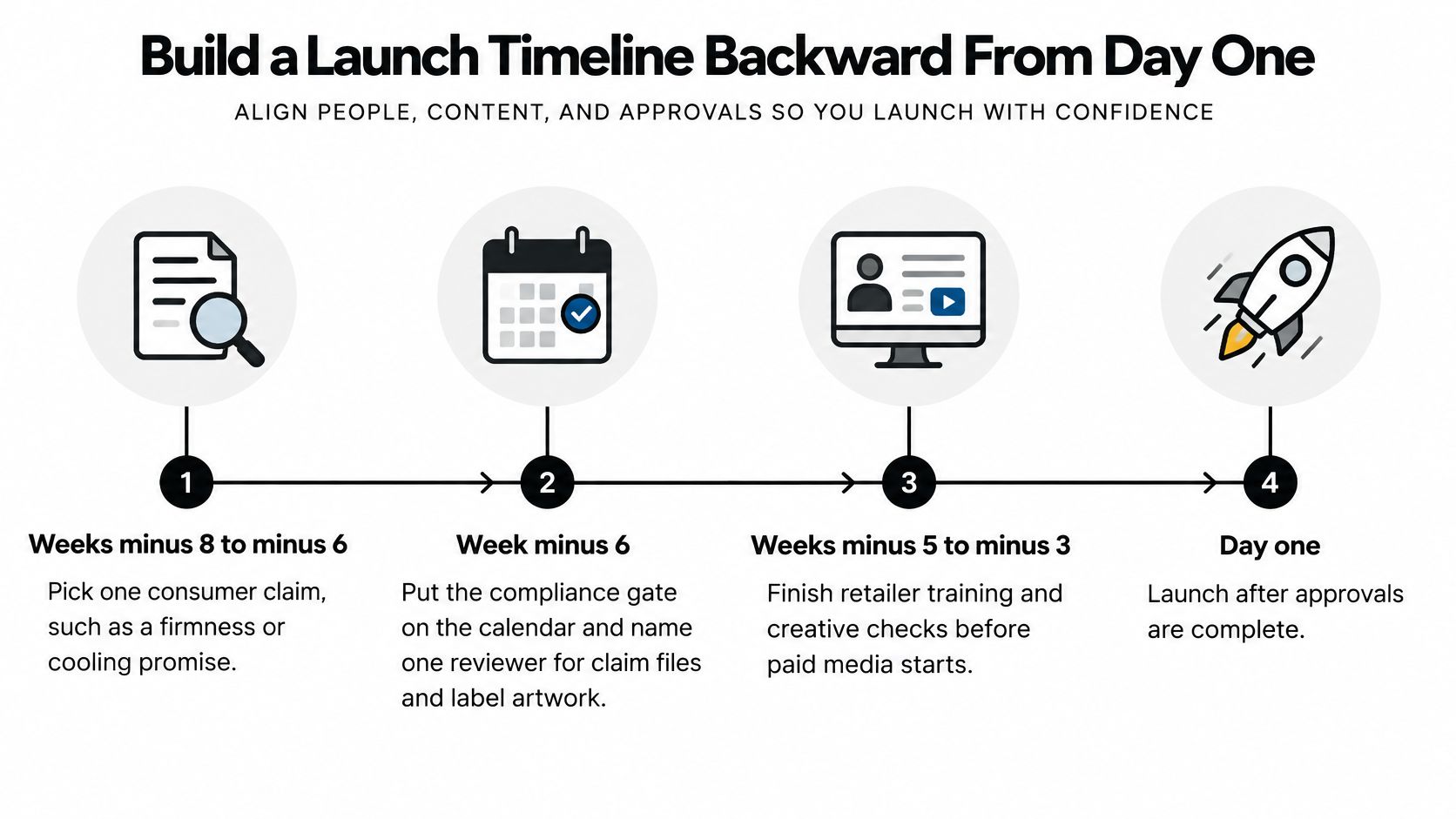
Weeks Minus 8 to Minus 6
Pick one consumer claim, such as a cooler-feeling cover, firmer edge, or quieter coil unit. Then produce the assets that prove it: Digibun layer breakdowns, Silhouettes for clean comparison, and Room Scenes for scale. I would lock construction facts here, including layer order, heights, coil type, ticking, and firmness language, before anyone writes ad copy.
Weeks Minus 6 to Minus 3
Confirm labels, plant location, and claim support with compliance. Build the floor-model talk track while that review runs. Give sales associates a short opening line, two proof points they can show on the bed, and one honest comparison against the model it replaces.
Shelf cards: Match the ad claim and QR code destination exactly.
Spec sheets: Use the same layer names as the Digibun, not factory shorthand.
Training demo: Show associates where to press, sit, or unzip, if the design allows it, so they can demonstrate instead of reciting.
Weeks Minus 3 to Minus 1
Open the waitlist, build search and social audiences without health-condition targeting, and brief showroom staff. Check retailer listings against final photography and pricing. A launch loses trust fast when the ad shows charcoal ticking, the website shows white, and the floor model has a third border treatment.
Launch Week Through Day 90
Run search, paid social, and retailer video at full weight during launch week. Check links, inventory, pricing, and retailer pages daily. In days 8 to 30, change one creative variable at a time and cut placements that don't hold attention through the proof moment.
From days 31 to 90, shift toward reviews, reorders, and post-purchase email to first buyers. Ask what matched expectations and what didn't. Those answers should feed the next creative cut and the next retailer training session.
Copy this sequence into a shared calendar, assign an owner to each milestone, and make compliance sign-off the gate that controls paid spend. If that gate slips, move spend. Don't launch ads for assets you may have to pull.
Measuring Lift Without Trusting Platform Numbers
Platform dashboards are useful for delivery. They aren't proof that advertising caused a sale. Separate creative optimization from incrementality measurement, or you'll mistake a better thumbnail for business lift.
Start creative testing with one hypothesis. For example, a product-in-use image will beat a studio-only Silhouette for qualified product-page conversion. Change only that element while holding audience, budget, placement, and schedule constant.
Set the Test Before Launch
Primary outcome: Choose qualified product-page conversion or revenue per visitor in advance.
Fixed duration: Set the end date before launch so the team doesn't stop when early results look good.
One variable: Don't change the headline, layer graphic, offer, and audience in the same test.
An A/B test tells you which variant performed better. It doesn't prove the ad caused incremental sales. For that, withhold advertising from randomly selected users or matched geographic markets and compare exposed versus held-out results. Resources on measuring true Meta ad lift are useful for planning that holdout, and our guide to how to measure marketing attribution helps separate attribution from causation.
Measure incremental conversions, incremental revenue, and incremental return on ad spend. Platform-attributed conversions alone will usually flatter the launch.
Plan sample size before you promise an answer. An incrementality testing guide notes that detecting a 10% relative difference may require approximately 1,600 conversions per arm. Many mattress launches can't reach that in one region because ticket prices are high and consideration is long. Pool several comparable markets, extend the window, or accept that you can only detect a larger effect.
The common errors are predictable. Teams move budget toward the early winner, judge success by click-through rate, or call a winning variant proof of causal impact. Clicks are especially weak for mattresses because curiosity about a new ticking pattern isn't the same as intent to replace a bed.
Be straight about limits with leadership and retail partners. Results depend on price, inventory, floor placement, competitor promotions, seasonality, and associate confidence. BEDHEAD does not guarantee specific results from using its services, and marketing outcomes can vary based on numerous factors beyond its control. A clean holdout won't remove those variables, but it will stop you from crediting every sale to the last ad clicked.
Three Decisions Before Spend Goes Live
Make these decisions in the week before launch, while you can still change the plan cheaply. Don't wait for the first dashboard to force them.
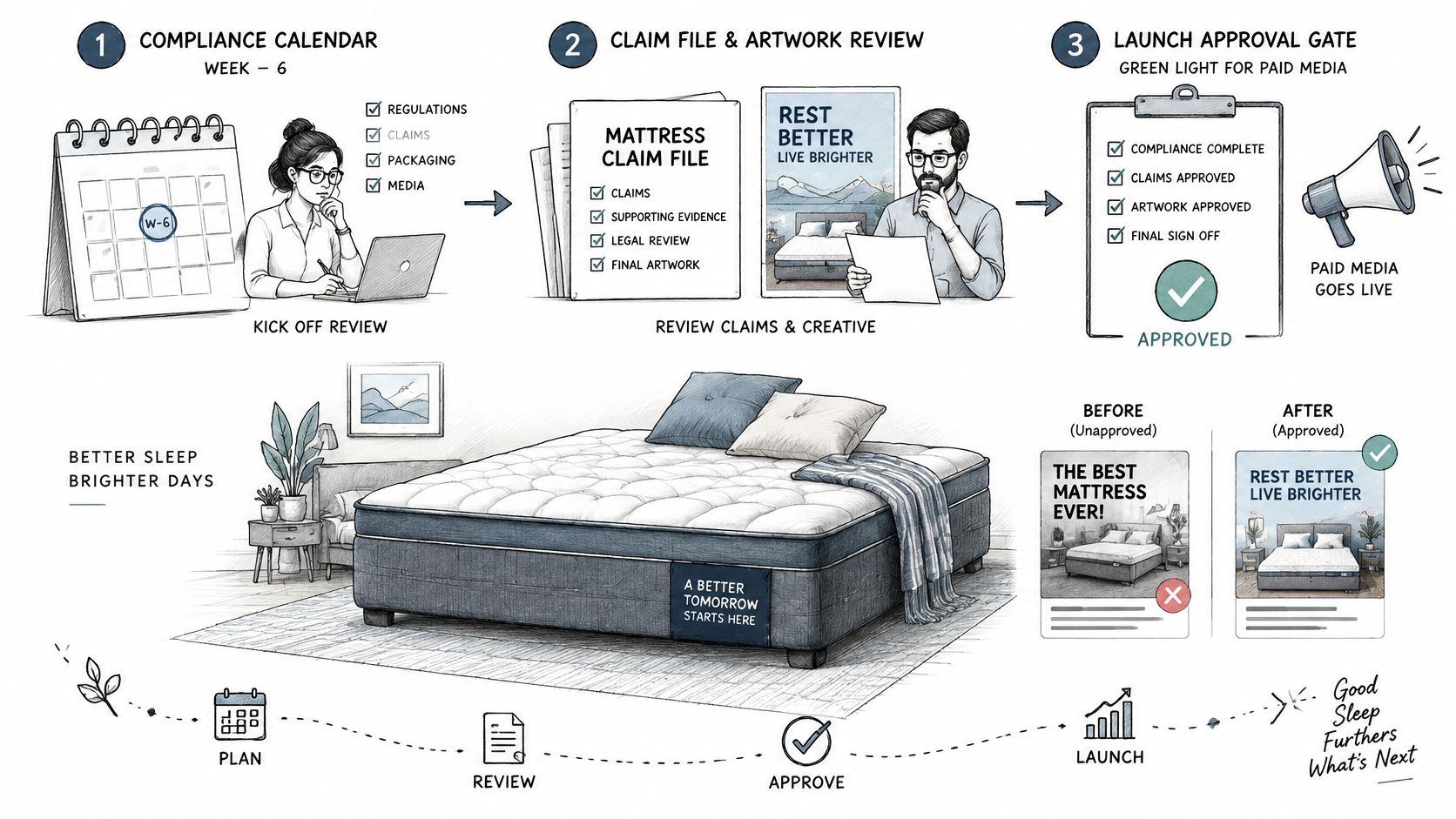
Lock the compliance gate: Put the week minus 6 review on the calendar, name one reviewer for claim files and label artwork, and don't start paid spend until sign-off is recorded.
Book retailer training: Schedule it before launch so floor staff can repeat the talk track before the first shopper arrives. Decide then whether your first creative test can use a random or geographic holdout, because that choice affects how many markets you need.
Set the review rule: Enter the channel split as the starting plan and book the day 14 review against cost per qualified visit.
Each of these protects repeat demand, not just launch week. A floor associate who can explain the build and repeat the talk track turns a first visit into a second one. A recorded sign-off keeps a flagged claim from pulling your strongest creative mid-flight. And a review rule set in advance stops the day 14 meeting from becoming an argument about which number counts.
If your current imagery doesn't show foam layers, ticking, quilt detail, or the bed at scale in a real room, start smaller than a full media push. A focused set of Digibun and Room Scene assets is usually the cheapest first test because it improves the ad, the product page, and the showroom conversation at the same time. Weak visuals push the whole explanation onto a sales associate, and that is the worst place for a new product's story to live.
We work with mattress manufacturers, retailers, and emerging bedding brands on digital marketing, ecommerce strategy, creative asset creation, product storytelling, and high-end visual content, including website design and 3D visualization. Questions can go through bedheadmarketing.com/contact.
If you're preparing a mattress launch and your ads, product page, and floor story still sound like three different beds, we can help you tighten the claim, build the layer visuals, and plan the channel test around proof. Visit BEDHEAD to talk through the launch assets and advertising support your next product needs.