Email Marketing Strategy for Mattress Brands
A strong email marketing strategy starts with a hard commercial fact. In 2025, 35% of marketing leaders reported receiving a return of $10 to $36 for every $1 spent on email marketing, according to Litmus's State of Email report. Mattress brands rarely get that return from blasts. They get it when email teaches construction, supports the showroom close, and proves its effect weeks after the first click.
Email Marketing Strategy That Earns Its Place in Mattress Sales
The return is real, but it isn't automatic. The Data & Marketing Association's 2019 Marketer Email Tracker surveyed 197 UK marketers in January 2019 and found 91% considered email an important strategic channel. Those marketers estimated £42.24 for every £1 spent, and 41% could calculate the lifetime value of an individual email address, estimated at £37.32 in 2018. Treat those self-reported UK figures as a benchmark, not a promise for your market.
The measurement gap is the warning. In 2025, 21% of surveyed marketers said they were unsure of their email marketing program's return on investment, according to Litmus's State of Email research. If you can't tie a send to product-page visits, quote requests, dealer leads, or orders, you're running a promotional outlet, not a revenue channel.
Why Mattress Email Is Different
A mattress shopper doesn't buy like an apparel shopper. She researches for weeks, compares hybrid construction, foam layers, ticking, quilt feel, and firmness, then often lies down on a floor model before she pays. One inbox offer seldom closes that sale alone.
Email earns its place by doing three jobs well:
Teach construction: Explain what's inside the mattress and why each layer changes pressure, motion, and temperature.
Equip the floor: Give retailers and RSAs the same story the shopper read at home, so the showroom conversation continues instead of restarting.
Keep owners engaged: Cover setup, break-in, care, and accessories after delivery, when reviews and returns are decided.
Practical rule: If a campaign can't name the shopper question it answers and the next step it should produce, don't send it.
For teams building urgency-based campaigns around launches or limited floor events, it helps to drive email sales with Quikly as one reference for pairing timed incentives with email, then judge the result on orders and store leads, not clicks alone.
Start with a baseline. Pull the last twelve months of email revenue, delivered volume, unique clicks, and dealer or store leads. That's the number your new plan has to beat.
Map Campaigns to the Mattress Buying Cycle
Build campaigns around the question the buyer is asking, not around your calendar. This map pairs each stage with the email that fits it.
Buying stage | Email type | Trigger | Primary goal |
|---|---|---|---|
Research | Explainer series on ticking, foam layers and hybrid construction | New subscriber sign-up | Trust and product education |
Consideration | Side-by-side guide, hybrid vs memory foam | Two or more product pages viewed | Product-page visits |
Purchase | Trial period, return policy and financing options | Cart or quote started | Completed orders |
Post-purchase | Setup and break-in guide, warranty registration | Order delivered | Warranty registrations and reviews |
Replenishment | Pillow, protector and topper reminders | 12 to 18 months after original order | Repeat orders |
Research and Consideration
At research stage, the question is simple. What's inside this mattress, and why should I care? Your explainer series should show the gusset, quilt, comfort layers, transition foam, and coil unit in plain language. Layer visuals do heavy work here because shoppers can't unzip a floor model. Link the series to your mattress buying guide so the education lives in one place your RSAs can also share.
Consideration is where fit replaces features. The shopper now asks which build suits her body and sleep position. A side-by-side hybrid versus memory foam guide should cover bounce, edge support, motion transfer, and heat. For shoppers narrowing by pain and support, a useful external reference on choosing foam mattress firmness for back pain can reinforce why firmness advice must match sleep position, not just a soft, medium, or firm label.
Purchase, Post-Purchase, and Replenishment
At purchase stage, risk is the blocker. What happens if I'm wrong? Lead with the sleep trial, return process, delivery timing, old mattress removal, and financing terms. Don't bury those answers under a discount banner. A shopper who's afraid of being stuck with the wrong bed won't be saved by another percentage off.
Post-purchase email protects margin. Send setup steps on delivery day, explain normal break-in and initial odor, and tell owners when to rotate the mattress and when not to. Ask for warranty registration while the law tag and receipt are still easy to find. That sequence reduces avoidable returns and gives unhappy owners a service path before they write a review.
Replenishment is smaller, steadier revenue. Pillows flatten, protectors wear, and toppers become relevant when comfort needs change. Time those reminders to the original order, suppress recent accessory buyers, and keep the message useful.
Every campaign must pass one test. It answers one buyer question at that stage and links to one measurable next step.
Segment Your List Within Consent Rules
Segmentation fails when it starts with demographics you happen to have. Start with differences that change what a person should receive.
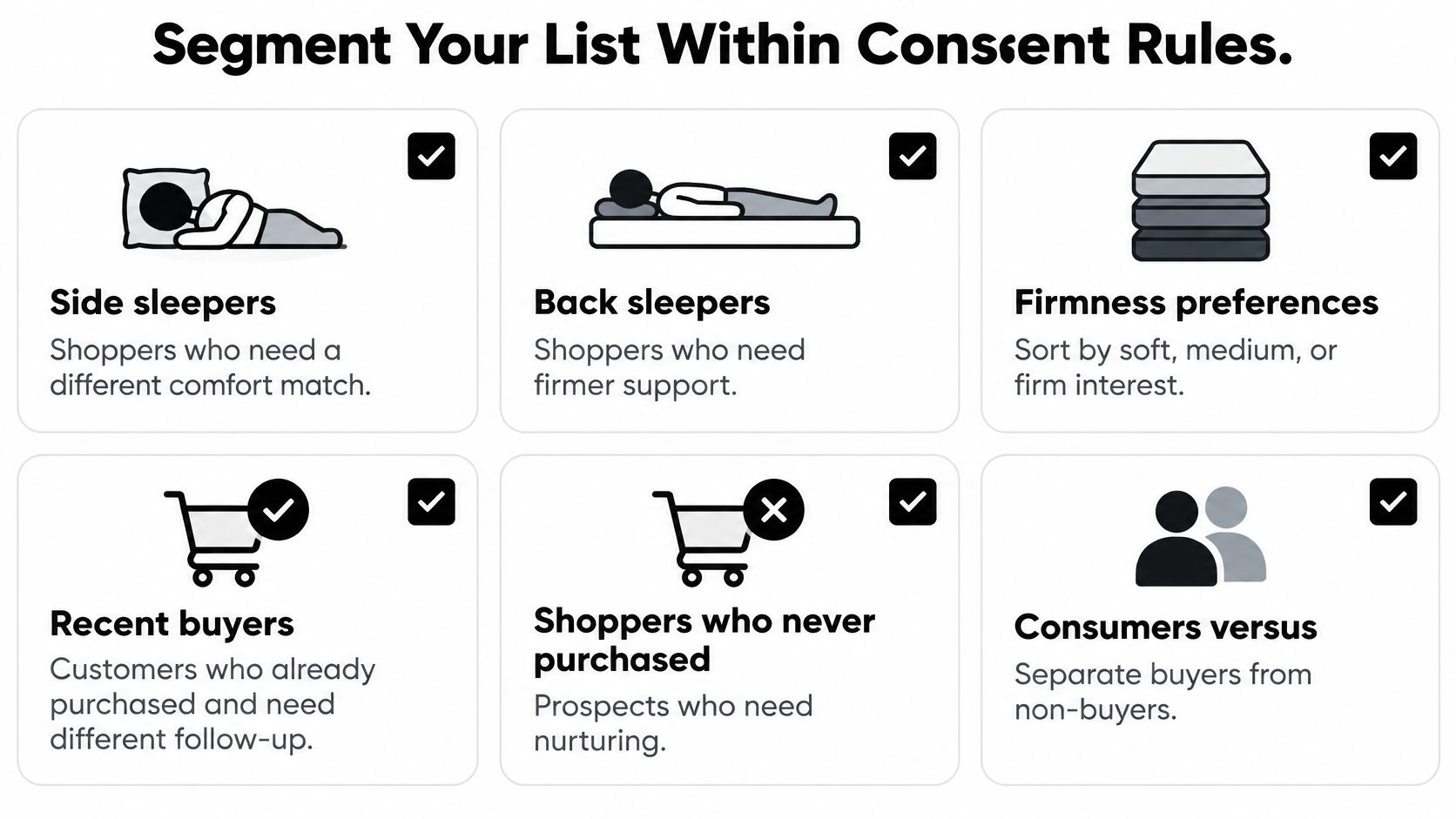
Segments That Change the Message
Side sleepers: Lead with shoulder and hip pressure relief, softer comfort layers, and pillow height.
Back sleepers: Lead with lumbar support, coil zoning, and firmer transition layers.
Firmness preferences: Separate soft, medium, and firm interest so a plush hybrid campaign doesn't land with firm-bed shoppers.
Recent buyers: Send setup, care, and accessory education. Suppress them from mattress promotions.
Shoppers who never purchased: Keep teaching fit, trial, and financing. Don't treat them like owners.
Consumers versus retailer staff: Shoppers need buying help. RSAs and dealers need launch dates, floor talking points, and lead follow-up material.
Dealers by region: Route store events, inventory, and delivery promises only where they're true.
Collect those signals directly through quizzes, preference centers, and product-page behavior. Our explainer on zero-party data covers how to ask for sleep position and firmness preference without turning signup into an interrogation.
Consent Is a Design Decision
For individuals in the United Kingdom, the ICO guide to PECR electronic marketing states that the Privacy and Electronic Communications Regulations generally require specific, informed, freely given consent before unsolicited promotional messages are sent. Consent must cover the sender and the communication type, shown by a clear affirmative action such as an unchecked box the subscriber actively selects. Pre-ticked boxes do not qualify.
The soft opt-in is narrower than many teams assume. It can apply when an existing customer bought or negotiated to buy a similar product or service, got a clear chance to opt out when details were collected, and gets an opt-out in every message. A general website inquiry or a business card from market doesn't create permission for ongoing promotions.
B2B needs the same care. Under PECR, ICO guidance on marketing and data protection explains that limited companies and certain corporate subscribers generally do not require prior consent, while sole traders and some partnerships are treated as individual subscribers. A corporate purchasing inbox and a named independent retailer owner aren't the same legal case. Every message still needs sender identification and a straightforward opt-out.
In the United States, the FTC CAN-SPAM Act compliance guide requires a clear way to stop future marketing messages, an unsubscribe mechanism capable of processing requests for at least 30 days after sending, and honoring each request within 10 business days. Subject lines and headers can't be deceptive, either.
Consent source recorded, segment rules documented, suppression list synced. If any one of those three is missing, pause the send and fix it.
Teams that want the underlying frameworks in one place can use Bedhead University for training material. Document who owns consent records before volume grows, because rebuilding permission history after a complaint is painful and sometimes impossible.
Set Up Deliverability Before You Scale
Deliverability isn't a creative review at the end. It's the gate every flow must clear before launch.
The Prerequisite Checklist
Send from a custom company domain: Publish SPF and DKIM so receiving systems can verify you.
Add DMARC: Start with at least a monitoring policy of p=none and confirm the authenticated domain aligns with the visible From domain.
Support one-click unsubscribe: Use RFC 8058 for promotional mail and process opt-outs promptly.
Monitor before you grow: Watch Google Postmaster Tools and investigate authentication failures before raising volume.
Verify the setup: Run your records through an SPF and DKIM checker before a launch so a broken record doesn't sink the campaign.
Our detailed walkthrough on how to improve email deliverability covers the operational checks behind this list.
For mattress brands, list discipline matters as much as authentication. Don't mail the whole database every week because a promotion is on. Start with high-intent groups, recent buyers for owner content, active shoppers for product education, and retailer leads for dealer material. Widen only when delivered rate, clicks, and complaints say the segment is healthy.
Inactive subscribers need a separate path. Give them a clear re-engagement choice, then suppress non-responders from regular sends. Protecting sender reputation is cheaper than rebuilding it during your biggest sale weekend.
Automate the Four Flows That Carry the Most Revenue
Build in this order. Each flow needs an owner, a suppression rule, and a reporting view before it goes live.
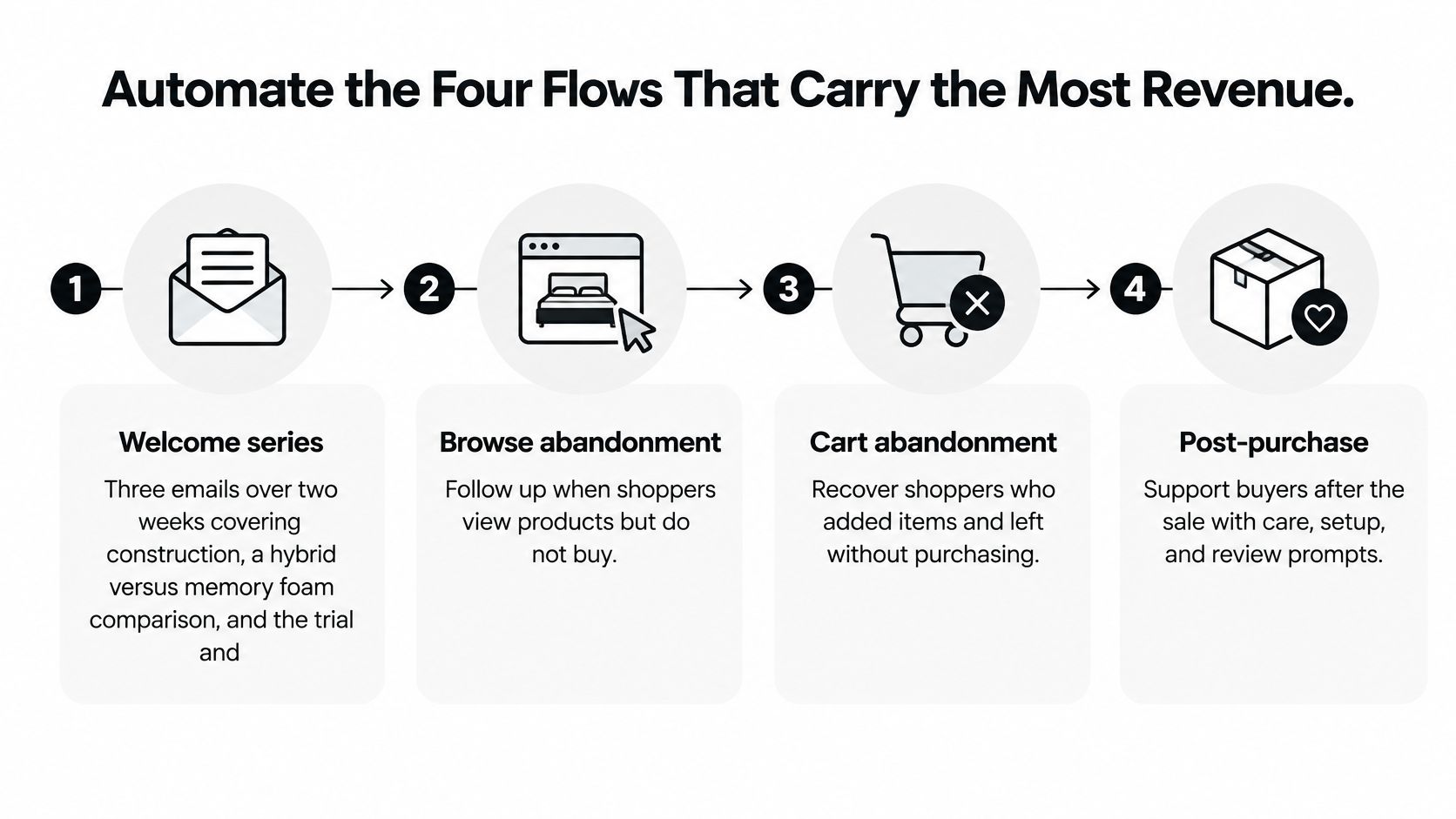
1. Welcome Series
Send three emails over two weeks. First, explain construction with a layer breakdown. Second, compare hybrid and memory foam by sleep position and temperature. Third, explain the trial, returns, and delivery. Buyers need product literacy before a price cut.
The common slip is opening with a discount. You'll train new subscribers to wait for promotions and you'll attract coupon seekers who never learn why your bed costs more than a commodity import.
2. Browse or Quote Abandonment
Trigger this within a few hours while intent is still live. Show the exact model viewed, one fit reason tied to the pages visited, and the trial terms. For dealer models, include the nearest store and a quote request path instead of forcing an online cart that doesn't exist.
Suppress anyone who has purchased, booked an appointment, or entered a service case. The fastest way to look careless is sending a reminder after the RSA has already closed the sale on the floor.
3. Post-Purchase Series
Start on delivery. Cover foundation checks, setup, break-in expectations, protector use, and warranty registration. Then ask for a review after the owner has had enough nights to judge comfort fairly.
Don't swap setup help for a sales pitch. The first weeks shape comfort exchanges, returns, and review scores. A useful owner email protects more margin than an early topper offer creates.
4. Replenishment Reminders
Time pillow, protector, sheet, and topper reminders to the original purchase and the accessory's replacement cycle. Keep mattress owners, pillow-only buyers, and guest-room purchasers in separate paths. Sending a flagship mattress promotion to someone who bought two pillows last month tells her you aren't paying attention.
The Technical Floor Under Every Flow
Scale changes the rules. Google's bulk sender guidance sets the threshold at 5,000 or more messages per day to personal Gmail accounts, and qualifying senders must use SPF, DKIM, and DMARC. Noncompliance can lead to temporary or permanent delivery failures. Google also warns that third-party open-rate measurements are not fully reliable, so judge flows on delivered messages, unique clicks, quote requests, store-locator visits, and revenue per recipient.
Build rule: No flow launches without a named owner, an exit condition, and a suppression rule. Automation without exits becomes noise on a schedule.
Test one variable at a time. Change the welcome order, the abandonment delay, or the post-purchase review timing, then read the result against orders and registrations, not subject-line curiosity.
Measure What Matters When Open Rates Mislead
Open rates can't carry a mattress program. Privacy protections and mailbox changes make opens ambiguous, and the purchase often happens weeks later in a showroom. An email can influence the shortlist, the store visit, and the RSA conversation without recording the final transaction online.
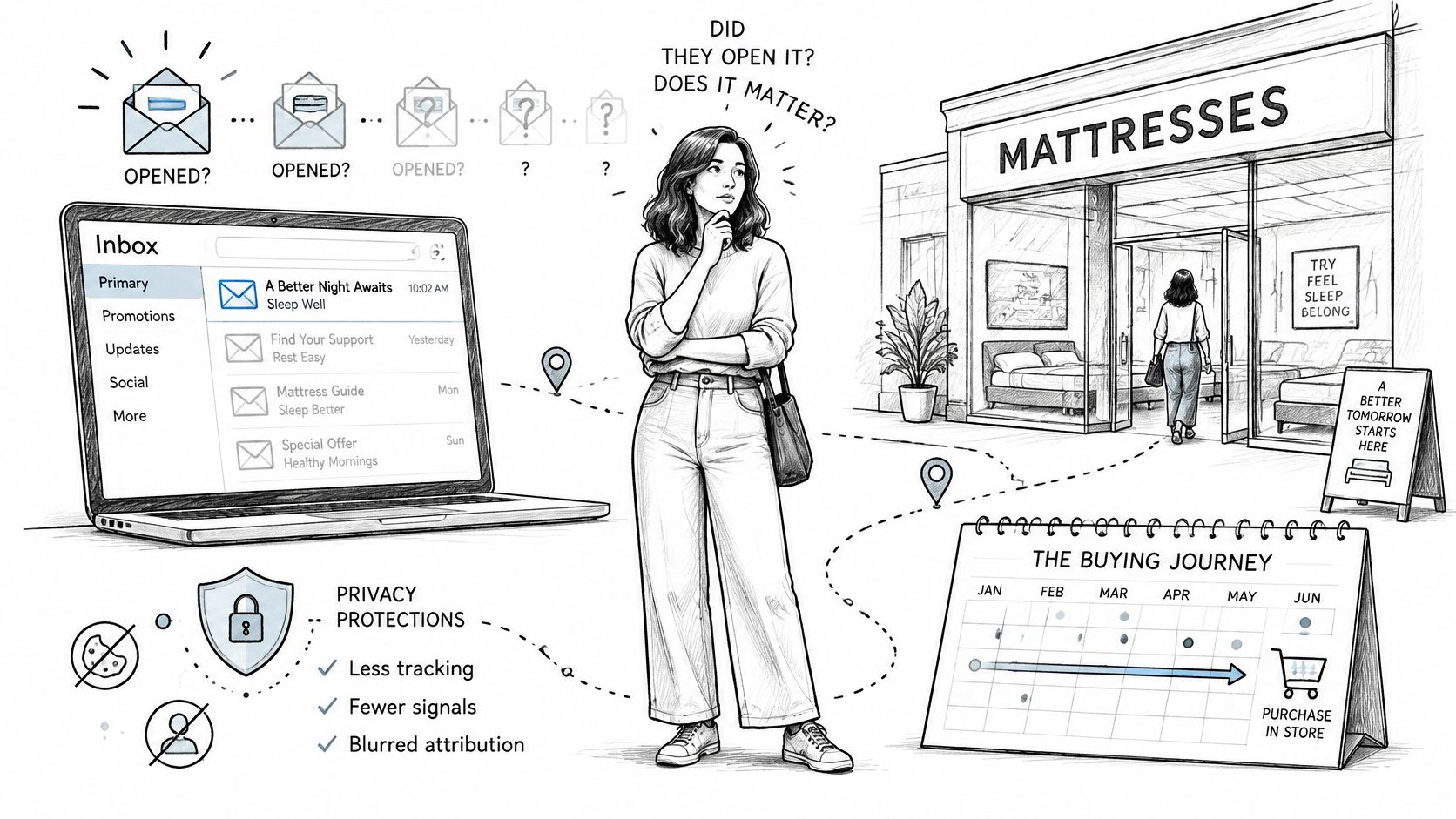
The discipline gap is operational, not creative. Forrester's 2025 report on how marketers feel about email marketing reported that fewer than half of marketers regularly personalize emails despite substantial internal or vendor support. More personalization won't help if event tracking, dealer attribution, and holdout testing are weak.
Metric | What it tells you | Decision it drives |
|---|---|---|
Delivered rate | Whether mailbox providers accept the send | Fix authentication before scaling volume |
Unique click rate | Engagement with education or product content | Keep or retire a content module |
Product-page engagement | Whether email drives visits to the mattress page | Adjust creative and links |
Quote requests and store-locator visits | Offline and dealer intent | Route leads to the right retailer |
Revenue per delivered email | Economic value of each send | Compare campaigns fairly |
Unsubscribe and complaint rate | Trust and list health | Reduce frequency or tighten segments |
Read the set together. Strong clicks with weak product-page engagement point to a landing-page mismatch. Strong store-locator visits with weak online revenue may still be a winning dealer campaign. Our reference on email marketing benchmarks helps teams set internal comparisons without chasing generic retail averages.
Prove Lift With a Holdout
Keep a random five to ten percent of a segment unmailed, then compare purchase, quote, financing inquiry, and warranty registration rates against the mailed group. Use a window long enough for mattress research and store visits. A short online attribution window will undercount the showroom close.
That's the answer to the common question. What should a bedding brand optimize when the customer may buy weeks later through another channel? Optimize revenue per delivered email and holdout lift. A simpler program with trustworthy incrementality measurement can outperform a highly personalized program judged mainly by inflated opens.
Confirm Your First 30-Day Email Plan
A useful first month answers one question: which sends change quotes, product-page visits, and dealer leads, and which only collect clicks. Four weeks is enough to stand up the system. It is not enough to rebuild every campaign.
Start from the baseline you already have. Add one flow at a time.
Week one. Pull the twelve-month baseline, confirm authentication and consent records, and choose three segments that change the message. Segments that only rename the same offer waste the month.
Week two. Build the welcome and post-purchase flows. Use 3D visualization and product storytelling where construction and scale are clearer than a flat product shot. A cutaway of foam layers or edge support belongs in the email only if the same explanation is easy to find on the product page.
Week three. Launch browse or quote abandonment and set the holdout group before the first send. Once mail goes out, you cannot recreate a clean unmailed group.
Week four. Review delivered rate, product-page engagement, quote requests, and dealer leads. Expand the campaign with proven lift. Retire the one with clicks and no downstream action.
Email and the product page have to tell the same story. If the email explains ticking and edge support clearly, and the product page buries those details under financing copy, paid traffic stalls. Creative assets, website design, and showroom-ready product storytelling belong in the same pass. Fixing one surface usually shows the gap on the other.
BEDHEAD helps mattress brands, bedding manufacturers, and retailers grow, and the work stays in this category. That focus matters when a useful email has to explain ticking, edge support, and floor follow-up, not a generic home-goods offer. Marketing outcomes vary with factors beyond any one send, so the month is for learning what moved, not for promising a revenue number.
Questions can go to info@bedheadmarketing.com or through the contact form at bedheadmarketing.com/contact.
If your program needs mattress-specific flows, clearer product storytelling, and measurement that accounts for the showroom close, visit BEDHEAD for digital marketing, ecommerce strategy, creative asset creation, and 3D visualization. Bring your baseline numbers and your current flows.