Mattress Buying Guide: How to Choose the Right Bed
Most mattress buying advice starts in the wrong place. It tells you to compare coil counts, foam densities, ticking fabrics, and firmness scores as if more specifications automatically produce a better decision. They don't. A mattress purchase is a fit problem, and the industry often makes that fit harder to judge through inconsistent labels, opaque pricing, showroom pressure, and product pages that explain construction without showing how the bed will feel.
This mattress buying guide takes a different route. It focuses on how shoppers make decisions, where those decisions commonly fail, and how to connect construction, body needs, support, trial terms, and price before committing. For mattress manufacturers, retailers, private-label brands, and sleep-product startups, that same framework matters on the selling side because clearer product storytelling reduces confusion across both the showroom and the eCommerce product page.
Why Most Mattress Purchases Go Wrong
More research doesn't guarantee a better mattress purchase. It can create a false sense of confidence when the information being compared isn't consistent.
A “medium” mattress from one brand may feel noticeably different from a “medium” mattress from another. A reviewer's experience may also have little relevance to a shopper with a different body shape, sleeping position, partner preference, or pain concern. The popular soft-to-firm scale is useful as a starting point, but it can't account for how intensely a person's shoulders, hips, or pelvis load the comfort layers.
The result is predictable. Shoppers collect reviews, open browser tabs, and memorize product features, then make a decision based on a label that doesn't describe their actual experience. A useful mattress buying guide can help organize the process, but the buyer still has to interpret the information against their own body and sleep habits.

The real sources of buyer regret
A 2026 U.S. shopper study reported that 58% of buyers experienced at least one regret. The leading complaints were inadequate pain relief at 19% and choosing the wrong firmness or comfort level at 18%, while 12% said they bought too quickly and 12% wished they'd tried the mattress in person first, according to Amerisleep's mattress buying study.
Those findings point to a more useful question than “What's the best mattress?” Ask instead:
What problem am I trying to solve? Pressure at the shoulder, pelvic sink, heat retention, partner movement, and difficult edge access require different construction decisions.
How will I test the decision? A showroom lie-down and an online sleep trial answer different questions, and both require a deliberate test method.
What would make me return it? Define failure before purchase, not after weeks of rationalizing an uncomfortable bed.
Practical rule: A mattress isn't successful because it has impressive specifications. It's successful when it supports your body, suits your sleep behavior, and remains acceptable after the excitement of purchase wears off.
The industry also creates pressure through urgency. A showroom associate may move you rapidly from one model to another, while an online store may present a temporary discount, a bundle, and a long warranty before you've understood the mattress itself. Resist the urge to solve every variable at once. First identify the sleep problem, then evaluate the construction that addresses it.
For mattress brands, product communication often breaks down at this point. A quilted cover, gusset, foam layers, and coil unit may be accurately described, yet the buyer still can't tell how those parts change pressure relief or movement. Clear Silhouettes, Room Scenes, and Digibuns, layered visuals that reveal the inside of the product, can make that explanation more concrete than a dense specification block.
Understanding Mattress Types and Construction
Every mattress is a stack of layers, and each layer makes a separate decision for you. The support core carries the load, transition layers control how weight moves into the bed, comfort layers shape pressure relief, and the cover system, including the ticking and quilt, determines first contact with the surface. Construction affects feel, heat, movement, edge behavior, and how support changes over time. The specifications matter only when you can connect them to those practical outcomes.
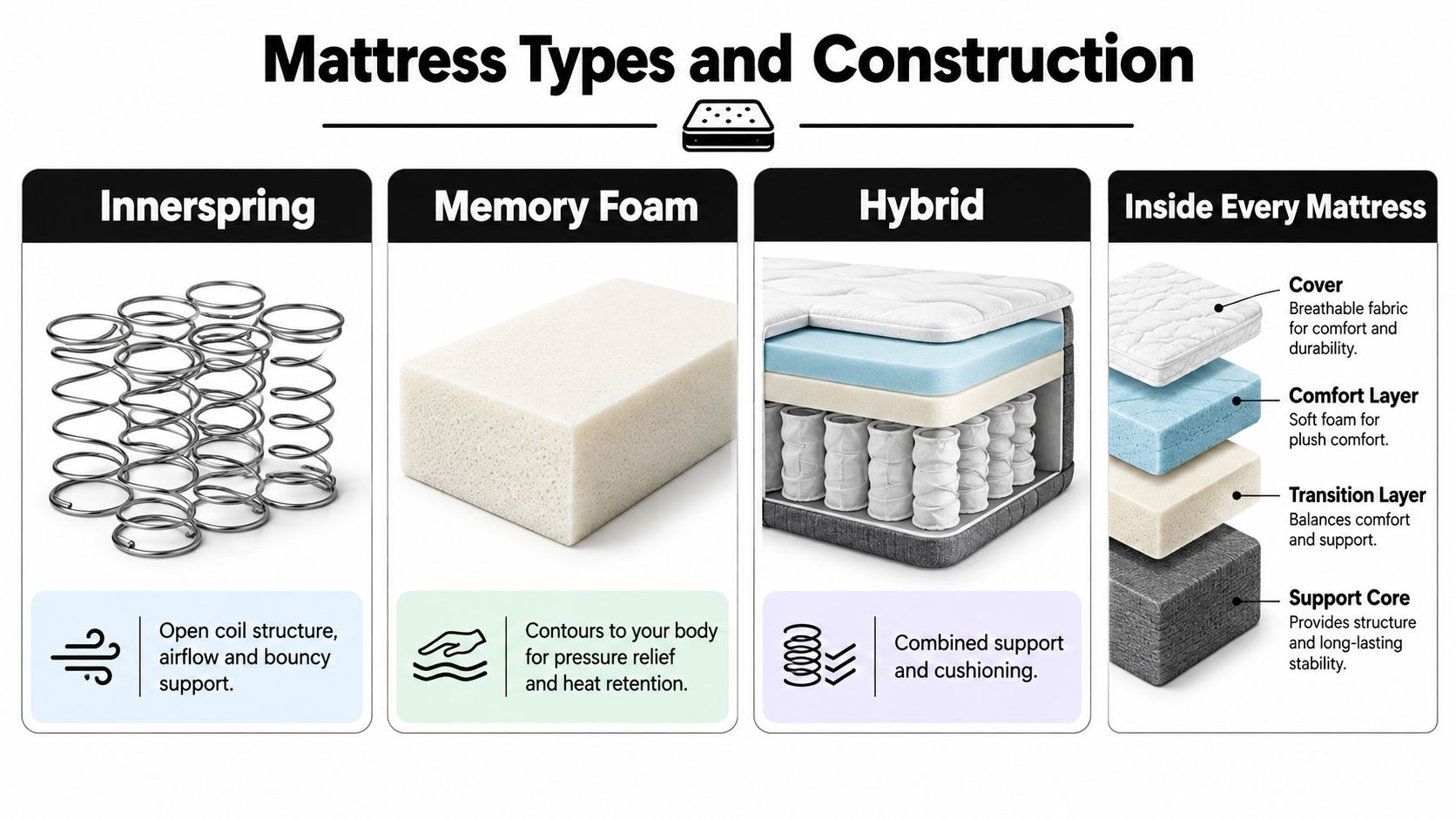
Use the comparison below to narrow the field, then inspect the actual layer arrangement. For a fuller breakdown of each build, see Bedhead's guide to the different mattress types.
Innerspring mattresses
Traditional innerspring models place upholstery over a coil support system. They usually offer responsive support, stronger airflow, and easier movement than highly contouring all-foam beds. Perimeter construction varies, so the presence of coils alone says little about how stable the edge will feel.
Check whether the coils remain steady in your usual sleeping position, whether the comfort materials protect your shoulders and hips from pressure, and whether the edge supports you when sitting down or sleeping near the side. A simpler coil build can feel lively and breathable. It may still leave a side sleeper wanting more cushioning.
Memory foam mattresses
Memory foam conforms closely to the body and can reduce the sensation of partner movement. That contouring suits sleepers seeking pressure relief, while dense foam may retain more heat and make position changes harder.
The first minute on a memory foam bed can mislead you. Stay long enough to assess whether your hips sink farther than your shoulders, whether movement requires effort, and whether the edge leaves enough usable surface. Product pages that list foam layers without showing their order force the buyer to interpret too much. Bedhead's plain-language explanation of what memory foam is provides useful context before you compare models.
Latex mattresses
Latex usually feels resilient, buoyant, and responsive, rather than slow and enveloping. It can distribute pressure while allowing easier position changes, and durability is its strongest practical argument. Consumer Reports simulates 8 to 10 years of use with a roller weighing more than 300 pounds, cycled 30,000 times. Sleep Foundation estimates average durability of 7.5 to 8.5 years for latex, compared with 5.5 to 6.5 years for innerspring and 6 to 7 years for foam, in its mattress durability methodology.
Those figures describe construction categories, not a guarantee for every product. The cover, firmness, zoning, and layer design still determine whether a latex mattress suits your body and sleeping habits.
Hybrid mattresses
Hybrid mattresses combine coils with foam or latex comfort layers. They attract shoppers who want buoyancy from the support core and cushioning from the upper layers, although the balance differs substantially between models.
A hybrid can suit couples with different preferences, combination sleepers, and hot sleepers who want less contouring than a fully foam surface provides. The category can also hide weak product communication. A retailer that lists “hybrid” without showing the coil unit, transition layer, comfort stack, and cover has not given the buyer enough information to judge the bed.
The most useful comparison is both visual and physical. You should be able to see the layer order, understand each layer's job, and connect that structure to likely pressure relief, cooling, motion response, and edge support. That clarity makes it easier to resist a persuasive label and judge the mattress on how it is built.
Finding Your Ideal Firmness Level
Firmness is not a universal property. It's the interaction between the mattress and the sleeper.
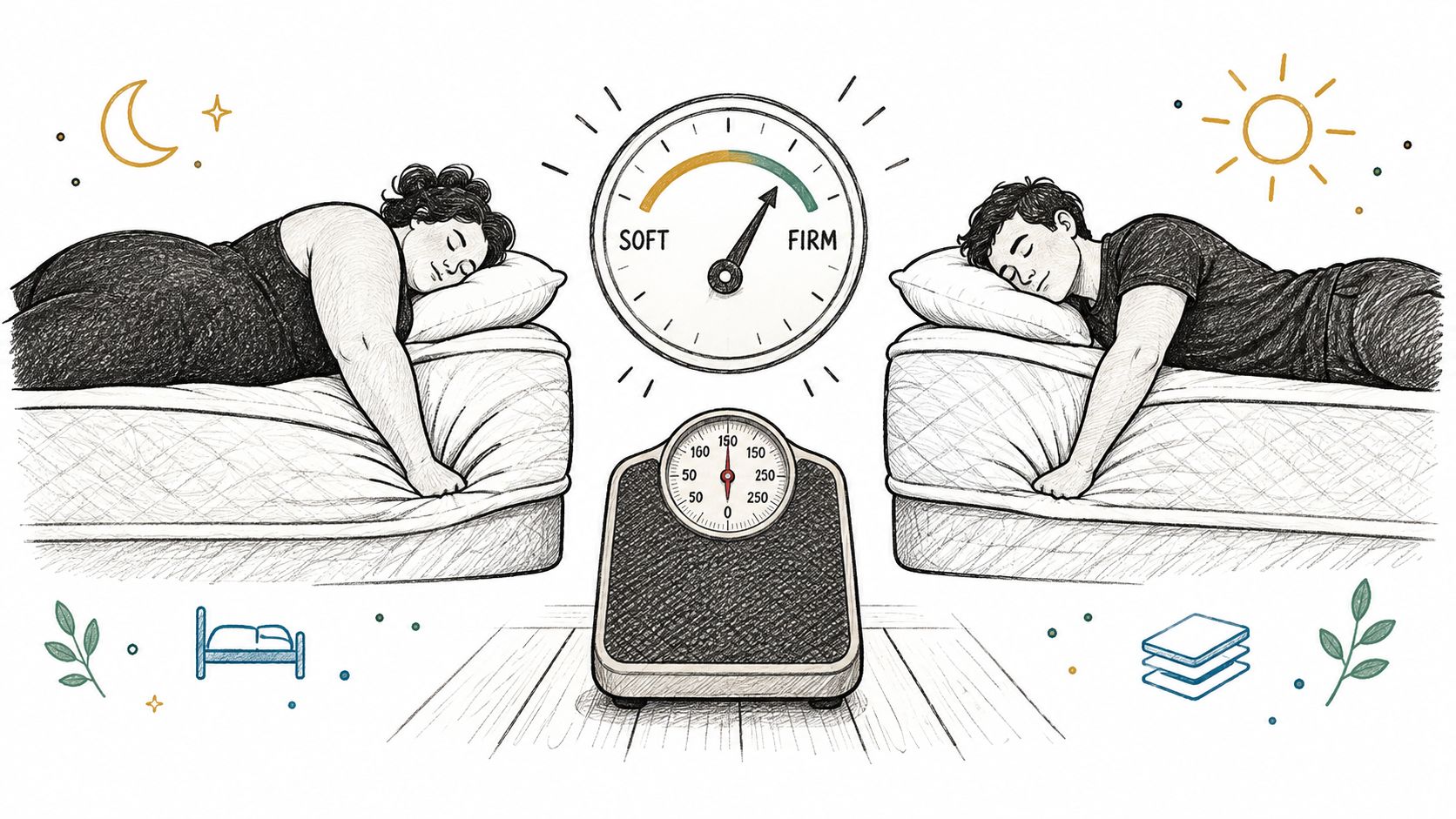
A lighter side sleeper may experience a mattress as firm because the shoulders and hips don't compress the comfort layers very far. A heavier stomach sleeper may experience the same model as softer because the pelvis loads the mattress more. This is why a firmness chart can guide a conversation but shouldn't make the decision by itself.
Mattress firmness is commonly described on a 1-to-10 scale, with 10 as the firmest, and many sleep guides treat 100 nights as a standard online sleep-trial length, according to Healthline's mattress selection guidance. Treat both figures as reference points, not guarantees.
A practical firmness process
Start with your primary position. Side sleepers generally need enough surface cushioning for the shoulders and hips to settle without creating sharp pressure. Back sleepers need a balance that supports the lumbar area without allowing the pelvis to drop. Stomach sleepers usually need stronger resistance beneath the midsection to reduce excessive sink.
Add body shape to the decision. Weight distribution matters more than a generic label. Someone with broader shoulders may need a different comfort response from someone with a straighter profile, even if both sleep on their sides. If two partners share a bed, assess each person separately before deciding whether one compromise surface is realistic.
Check alignment, not just softness. Lie in your normal position and ask whether your spine feels neutral. A mattress can feel wonderfully plush for a few minutes and still let the hips sink too far. Conversely, a firm surface may feel stable but create pressure at the shoulder or hip.
Account for movement and pain. If you change positions often, excessive sink can become irritating. If pain is part of the buying decision, describe the location and pattern to a qualified healthcare professional rather than treating a salesperson's firmness recommendation as medical advice.
A regional reference such as this mattress firmness guide for Indiana can help shoppers frame the basics, but the final test remains personal. Manufacturers and retailers can reduce uncertainty by showing firmness comparisons with consistent photography, cross-sections, body-position diagrams, and guided quizzes instead of relying on adjectives such as “cloud-like” or “luxury firm.”
Pressure distribution is the better test
A clinical study available through PMC's mattress research found that participants on a latex mattress had significantly lower mean peak body contact pressures in several torso and buttock regions than on a polyurethane foam mattress across front, side, and back positions. That doesn't establish a universal winner. It demonstrates why material and zoning can matter more than the firmness word printed on the label.
Use the firmness rating to create a shortlist. Use alignment, pressure response, movement, and your likely trial experience to choose from it.
Mattress Sizing, Support, and Trials
A good mattress can fail because the rest of the purchase was handled casually. The foundation, frame, room, delivery route, and return process all affect the result.
Start with the physical space. Measure the bedroom, stairways, doorways, and the route from the delivery point to the bed. A larger mattress may improve sleeping space but leave little room for movement, bedside furniture, or opening drawers. The right size serves the room and the sleepers, not just the showroom impression.
Bed dimensions, partner needs, and frame requirements deserve their own comparison rather than a quick assumption. Bedhead's mattress size comparison resource provides a useful way to organize those trade-offs before you begin comparing models.
The foundation is part of the mattress system
The Better Sleep Council reported that the mean mattress replacement cycle fell from 9 years in 2020 to 8.3 years in 2022, while consumers' expected replacement horizon stayed at 9.4 years in 2016 and 2022, with a 9.5-year peak in 2020, according to its replacement-cycle research. If you're buying for a useful service life measured in years, the support underneath the mattress can't be an afterthought.
That research also found that 54% of consumers sleep on a flat box spring or foundation, 24% use a stationary base that isn't a box spring or foundation, and 15% use an adjustable foundation, from the same source. Check the mattress warranty for required slat spacing, center support, foundation construction, and adjustable-base compatibility. A worn foundation can change the feel of a new mattress and may create a warranty problem.
Trials are policies, not promises
Online sleep trials typically range from 60 nights to 180 nights or more, and return policies commonly allow a mattress to be sent back for a refund during the eligible window, as explained by Sleep Foundation's online mattress guidance. The headline trial length isn't enough.
Read the operational details:
Adjustment requirements: Check whether the retailer expects you to keep the mattress for a minimum period before arranging a return.
Return logistics: Confirm who schedules pickup, whether you must package the mattress, and whether return shipping is covered.
Condition rules: Ask how stains, damage, or missing packaging affect eligibility.
Foundation rules: Verify that the base you intend to use meets the warranty requirements.
Refund timing: Find out whether the refund begins at pickup or after the retailer receives the mattress.
In a showroom, the return policy may be narrower than the online offer. Get the terms in writing before you treat a sale as reversible.
Price Ranges and Value Assessment
Mattress price does not rise in direct proportion to sleep quality. A higher price can reflect better materials, but it can also cover retail overhead, advertising, showroom costs, elaborate ticking, accessories, financing expense, or brand positioning. Judge the construction and service terms, not the ticket alone. Ask which parts of the price should improve your sleep or extend the bed's useful life.
Better Sleep Council research reported in 2021 found that consumers paid a mean of $915 for a queen-size mattress or set, were willing to pay $980, and expected to pay $1,061, as summarized in the reported sleep-products research. The same survey summary found that only 47% of consumers believed mattresses were fairly priced for the value provided, while 40% said they were too expensive. Willingness to pay also varied by age and household income, showing why a single “normal mattress price” is a poor buying rule.
Build a value matrix
What you're evaluating | Evidence worth checking | Common mistake |
|---|---|---|
Support materials | Coil design, foam quality, latex content, zoning, and edge construction | Paying for a label without understanding the layer stack |
Comfort materials | Pressure response, surface quilting, foam behavior, and temperature feel | Assuming a thick quilt or plush top guarantees comfort |
Protection | Trial terms, warranty coverage, foundation rules, and return logistics | Treating a long warranty as a comfort guarantee |
Selling overhead | Delivery, setup, accessories, retail service, and financing terms | Comparing advertised prices that include different bundles |
Long-term value | Expected durability and whether the construction suits your body | Choosing the lowest price and replacing the bed sooner |
The fairness split also explains why promotions and financing have such influence in mattress retail. A discount can reduce the bill, but it cannot correct poor support, pressure points, heat retention, or an unsuitable feel.
Financing may make a suitable purchase manageable, while a monthly payment can conceal the total commitment. Review consumer retail financing considerations beside the cash price, repayment term, fees, and return obligations. Compare the full transaction, not just the advertised monthly figure.
Spend more where construction affects support, pressure distribution, cooling, or durability. Question add-ons that improve the sales story more than the sleep experience. The right value is the lowest total cost for a mattress that fits your body, lasts as expected, and comes with terms you can accept.
The Smart Buyer's Pre-Purchase Checklist
The final decision should feel boring. Boring means you've answered the practical questions before a salesperson, promotion, or attractive product page can rush you.
In-store, Consumer Reports recommends spending at least 10 minutes on each candidate bed and checking back support, side support, stomach support, edge support, and motion isolation, as described in its mattress buying guide. Lie in the position you typically use. Sit on the edge. Turn over. If you share the bed, test movement while your partner gets in and out.
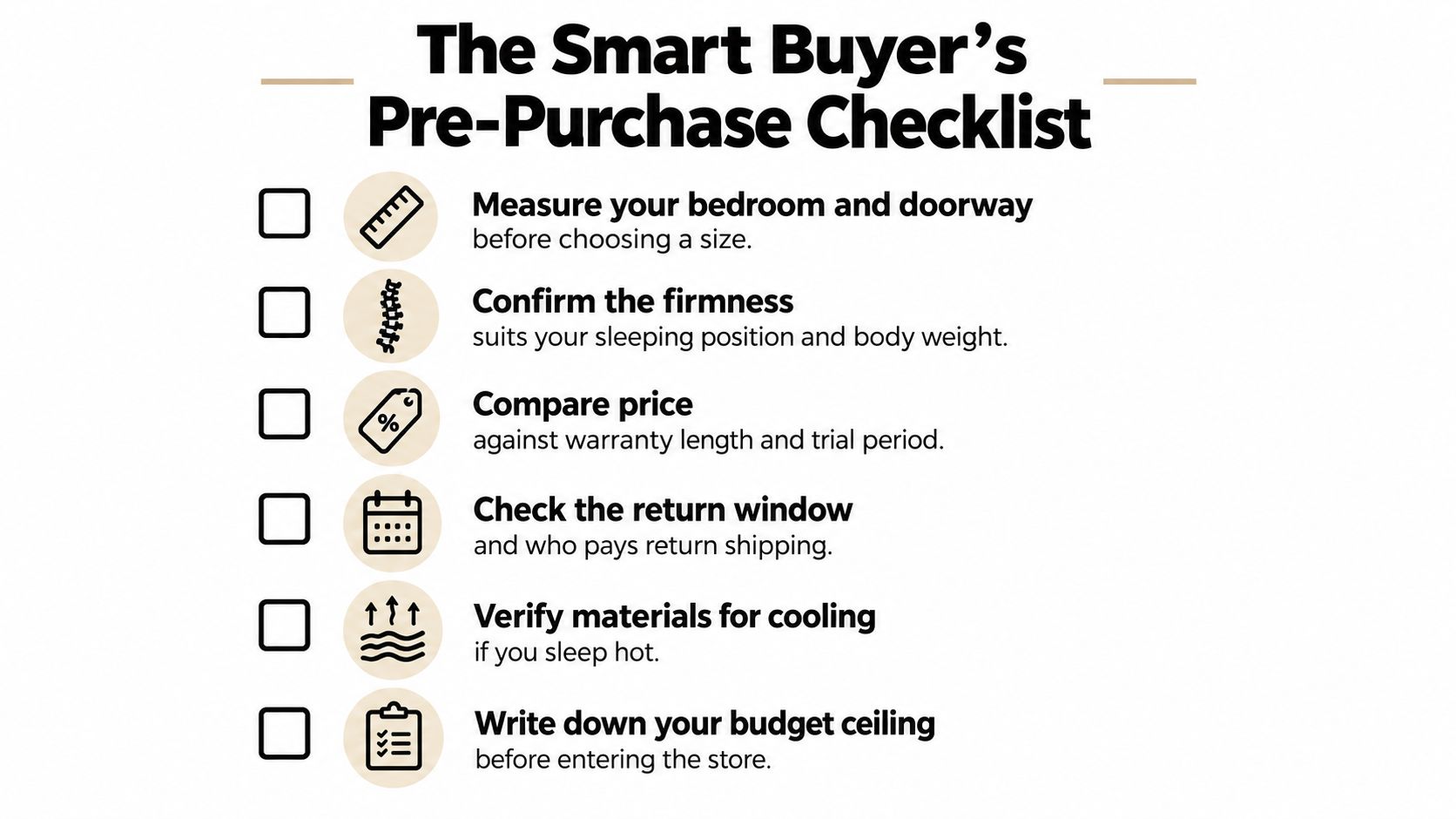
Six checks before payment
Measure the route: Confirm the bedroom, doorway, stairway, frame, and delivery path can accommodate the chosen size.
Describe the sleep problem: Tell the associate whether you need shoulder pressure relief, stronger pelvic support, less motion transfer, cooler materials, or easier movement.
Test the construction: Ask to see the foam layers, coil system, zoning, gusset, quilt, and ticking specifications that affect the feel.
Compare total cost: Put the mattress, foundation, delivery, setup, protection, financing, and accessories into one figure.
Read the exit terms: Verify the sleep trial, return window, pickup process, fees, refund timing, and warranty exclusions.
Set a decision boundary: Write down your budget ceiling and the conditions that would make you walk away.
A knowledgeable showroom team should answer these questions without creating artificial urgency. If the associate won't explain the return process, pushes a model unrelated to your stated needs, or uses a limited-time offer to prevent comparison, pause the purchase.
Online shoppers need a different form of discipline. Product pages should show the complete construction, explain firmness in a consistent way, display the foundation requirements, and make trial terms easy to find. Brands that use Digibuns, Silhouettes, Room Scenes, interactive product pages, or guided quizzes can help shoppers understand a mattress before delivery. BEDHEAD offers these types of mattress-specific 3D assets, along with SEO, paid media, product-page optimization, and sales training that connect manufacturer messaging with showroom execution.
For an additional retailer perspective, you can ask Indian River Furniture about mattresses when you want another practical set of questions for the buying conversation.
Write down your answers before you buy. If the mattress still seems right after you compare fit, construction, cost, support, and the actual return process, you're making a decision based on evidence rather than sales momentum.
Visit BEDHEAD to review mattress-focused SEO, 3D rendering, interactive product storytelling, and sales training for manufacturers, retailers, private-label brands, and sleep-product startups. You can also explore Bedhead University for education that helps teams communicate mattress construction and buying decisions more clearly. BEDHEAD services are built around the category's real showroom and eCommerce problems, from confusing layer stories to product pages that leave shoppers uncertain.