What Is Social Selling? How Mattress Brands Use It
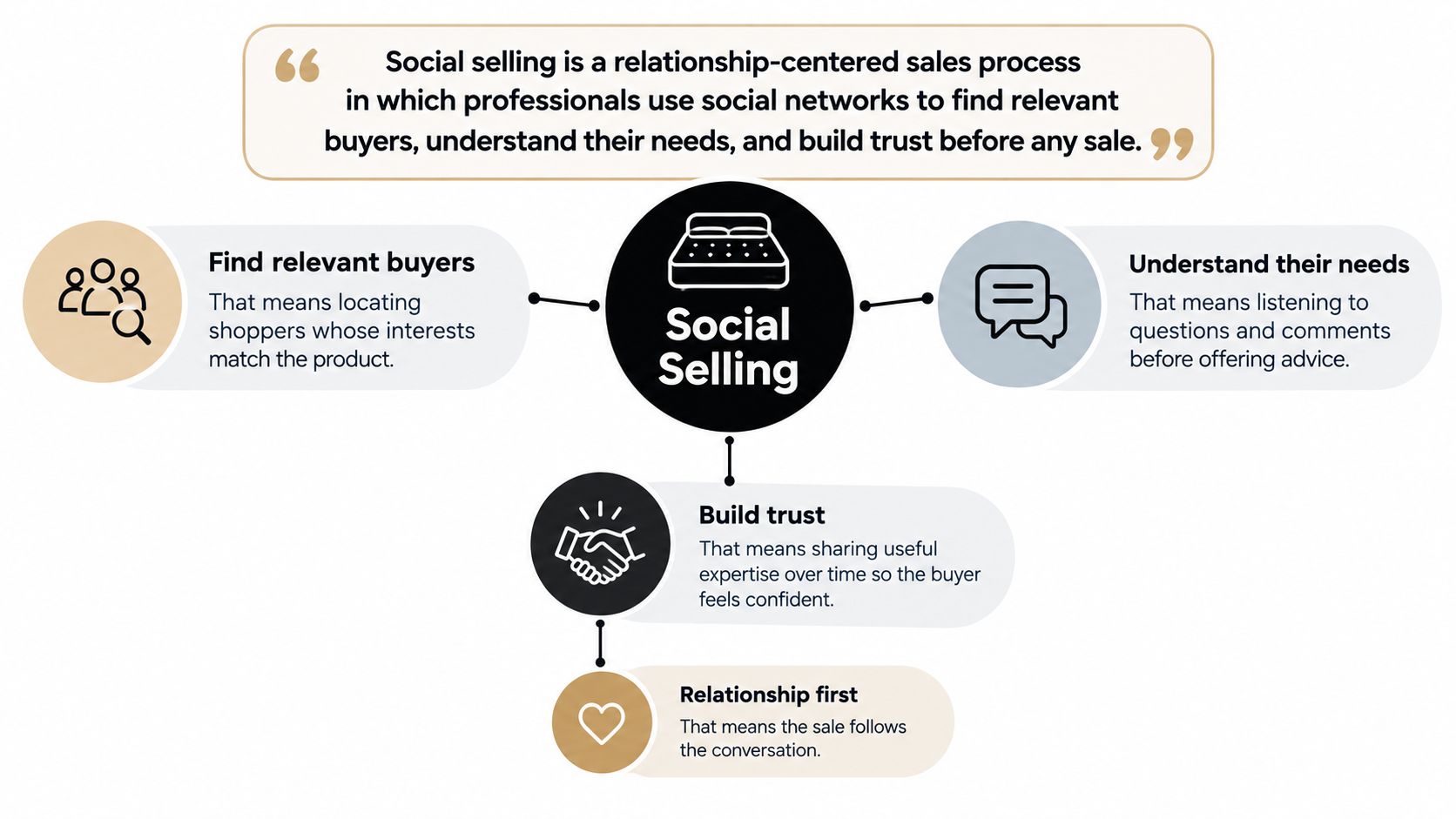
Social selling is a relationship-centered sales process in which professionals use social networks to find relevant buyers, understand their needs, share useful insight and build conversations over time.
Your store has posted a new hybrid mattress, but the useful question is sitting unanswered underneath it: would this model suit a side sleeper whose partner prefers a firmer surface? Meanwhile, a manufacturer's rep has shared a launch announcement without following up with the retail buyer who asked about the construction.
What is social selling in practical mattress terms? It's the showroom skill of listening, explaining and following through, applied before the buyer reaches your floor or opens your line sheet.
What Social Selling Means for Mattress Businesses
Social selling is a relationship-centered sales process in which professionals use social networks to find relevant buyers, understand their needs, share useful insight and build conversations over time.
A good retail sales associate remembers that a shopper mentioned back discomfort and follows up with relevant product information, without promising a medical outcome. On LinkedIn, Instagram or Facebook, that same associate can answer a question, remember the context and suggest an appropriate next step.
The Wikipedia overview of social selling describes its relationship-oriented foundation and identifies the practical dimensions of insight generation, connecting and engagement. For mattress businesses, those dimensions translate into familiar sales work:
Insight generation: Read the question before recommending the product. Is the buyer concerned about surface feel, partner disturbance, delivery access or margin?
Connecting: Identify the appropriate shopper, retailer, purchasing manager or product developer rather than collecting unrelated followers.
Engagement: Offer an explanation that helps that person evaluate a real choice, then continue the conversation when invited.
Product knowledge makes the interaction useful
A component supplier's rep might explain how the placement of a bonded foam layer affects a proposed edge-support construction. The useful answer includes the assembly context and limitations, not a blanket claim that bonded foam always improves support.
At retail, an associate might answer a side sleeper's firmness question publicly, then offer a private fitting appointment. Neither interaction starts with a discount code.
Scattered posts, paid ads and cold direct messages without buyer research aren't substitutes for this work. A manageable publishing schedule helps, and Revid's resource on social media planning for small businesses can support that organizational side. The selling still requires someone who understands the product and buyer.
Start by listing who already does this informally: territory reps, sales associates, product managers and store owners. Give those people a repeatable process rather than asking marketing to impersonate them.
Social Selling vs Social Media Marketing
Both use the same platforms, but they're run by different people, aimed at different audiences and judged by different results.
Social selling and social media marketing compared
Dimension | Social Media Marketing | Social Selling |
|---|---|---|
Primary goal | Build awareness and brand reach | Move named buyers toward a sales conversation |
Who acts | Marketing team and agency | Sales reps, sales associates, store owners and buyers |
Audience | Broad public and followers | Defined accounts, retail partners and prospective buyers |
Typical content | Campaigns, lifestyle posts and launch announcements | Product education, tailored answers and rep-led follow-up |
Main outputs | Impressions, engagement and follower growth | Qualified conversations, appointments and opportunities |
Success measure | Reach, likes and follower count | Response time, qualified conversations and assisted sales |
Time horizon | Campaign bursts | Ongoing relationships over months |
Those marketing measures describe distribution, not a complete marketing ROI report. Marketing should also connect campaigns to commercial outcomes, but a rep's relationship-building work needs its own accountability.
Social selling isn't social commerce
Social selling influences the decision; social commerce completes a transaction inside the platform. A buyer can discover your mattress socially and still choose your website or showroom to purchase.
That distinction has practical support: DHL's social commerce trends report notes that 63% of retailers sell through social platforms, while 45% of shoppers buy through them. Don't design every interaction around an immediate platform checkout.
Mattress shoppers may need specifications, firmness guidance, delivery details and human reassurance. Build the transition around their uncertainty:
Education for awareness: A layer-breakdown post explains what separates a hybrid from an all-foam model.
Proof for comparison: A construction comparison shows materials and positioning without treating firmness descriptions as universal measurements.
Conversation for qualification: An associate asks about sleep position, current mattress complaints and, privately and sensitively, relevant partner-size differences.
Transition to purchase: Send the exact retailer product page, dealer location or fitting appointment option that matches the discussion.
Preserve context in the handoff. The receiving associate should know which model the shopper discussed and what remains unresolved, with the shopper's permission.
A campaign announcing a hybrid line is social media marketing. A rep sending a hotel purchasing manager a relevant construction comparison after discussing replacement requirements is social selling.
Most bedding brands need both. Staff the relationship layer with named people and clear response rules, rather than assuming a content calendar covers it.
Where Social Selling Pays Off for Bedding Brands
A buyer who researches before contacting your business can arrive with useful questions or unresolved assumptions. Your opportunity is to help shape that understanding before the showroom visit or line review.
In LinkedIn's 2021 State of Sales report, 82% of buyers were more likely to consider a brand when the salesperson had an informative LinkedIn profile, while 76% were more likely to consider a brand when the salesperson reached out through LinkedIn. These findings associate credibility and channel choice with buyer consideration. They don't prove that social activity alone causes sales.
Match the benefit to the business role
Manufacturers: Equip reps to discuss assortment gaps, explain launches and prepare retail partners for product activation.
Retailers: Establish the shopper's shortlist before arrival, so the associate can select relevant floor models instead of restarting discovery.
Sales associates: Stay useful after a shopper leaves by answering the specific question that prevented a decision.
Component suppliers: Help brand product teams understand a material's application, manufacturing constraints and construction trade-offs.
For each role, define whom you're trying to help. A regional dealer evaluating a premium hybrid needs different information from a consumer comparing trial terms. Building buyer personas for mattress marketing helps keep those conversations distinct.
Broader seller sentiment supports testing the approach: HubSpot reports that in 2024, 87% of sellers said social selling was effective for their business, and 59% reported making more sales through social media than in the previous year. That's self-reported seller sentiment, not independent proof of results for mattress brands.
The practical payoff to test is a better-prepared sales conversation, not a viral post.
Look for fewer irrelevant demonstrations, clearer product questions and less time spent reconstructing what the buyer already learned online. Those are operational improvements worth measuring against staff time and selling costs.
Mattress Social Selling KPIs That Prove Results
Measure the progression from social activity to target-account engagement, qualified conversations, CRM-recorded opportunities, assisted revenue and post-sale outcomes. Audience size alone can't tell a retail operator whether associates are helping suitable buyers move forward.
Social selling KPIs for mattress manufacturers and retailers
KPI | What It Shows | Mattress Example |
|---|---|---|
Response time to comments and direct messages | Speed of buyer contact | Firmness, delivery or trial-period questions answered the same business day |
Qualified conversations | Buyers with a real product question | A shopper asks how a hybrid's coil count changes support for a heavier partner |
Consultation or fitting appointments booked | Movement toward purchase | Fitting booked after a side-sleeper firmness question |
Showroom visits linked to a social conversation | In-store follow-through | Shopper arrives with a saved layer breakdown and asks for the display model |
Tracked referrals through unique links or codes | Assisted online sales | Rep-specific or store-specific referral links reviewed monthly |
Opportunities recorded in the CRM with a social source | Pipeline contribution | Source tag applied to each social-originated lead |
Retailer or dealer engagement with product content | Manufacturer-side engagement with partners | Regional retailer shares a hybrid comparison with floor staff |
Follower count and impressions | Warning sign if treated as sales success | Track for context, never as the sales target |
A coil-count question qualifies as buyer interest, not proof that coil count determines support. Train associates to explain the full construction rather than validate an oversimplified comparison.
Record the interaction and its outcome
Create CRM fields for original source, platform, responsible associate, product interest, next action and outcome. Separate a lead first acquired socially from an existing customer who later asked a question there.
For a showroom handoff, attach a brief factual note rather than copying unnecessary personal information. Apply consistent tagging to walk-ins and phone leads too, so your comparison has meaning.
The Total Retail discussion of social buying trends reports that 73% of consumers expect a brand response within 24 hours. Speed belongs in sales reporting because an unanswered product question can interrupt an active purchase decision.
Set a proposed 90-day baseline before assigning brand-specific targets. That's a starting measurement window, not an industry benchmark.
For dashboard design, Sift AI's overview of essential social media KPIs for enterprises offers broader context. Keep the mattress scorecard focused on sales progression, and use marketing attribution methods to distinguish social-assisted revenue from sales social originated.
Finally, review cancellations, returns and gross margin alongside attributed sales. A discounted order that produces an avoidable comfort return shouldn't count as an unqualified success.
Platform Tactics for LinkedIn, Instagram and Facebook
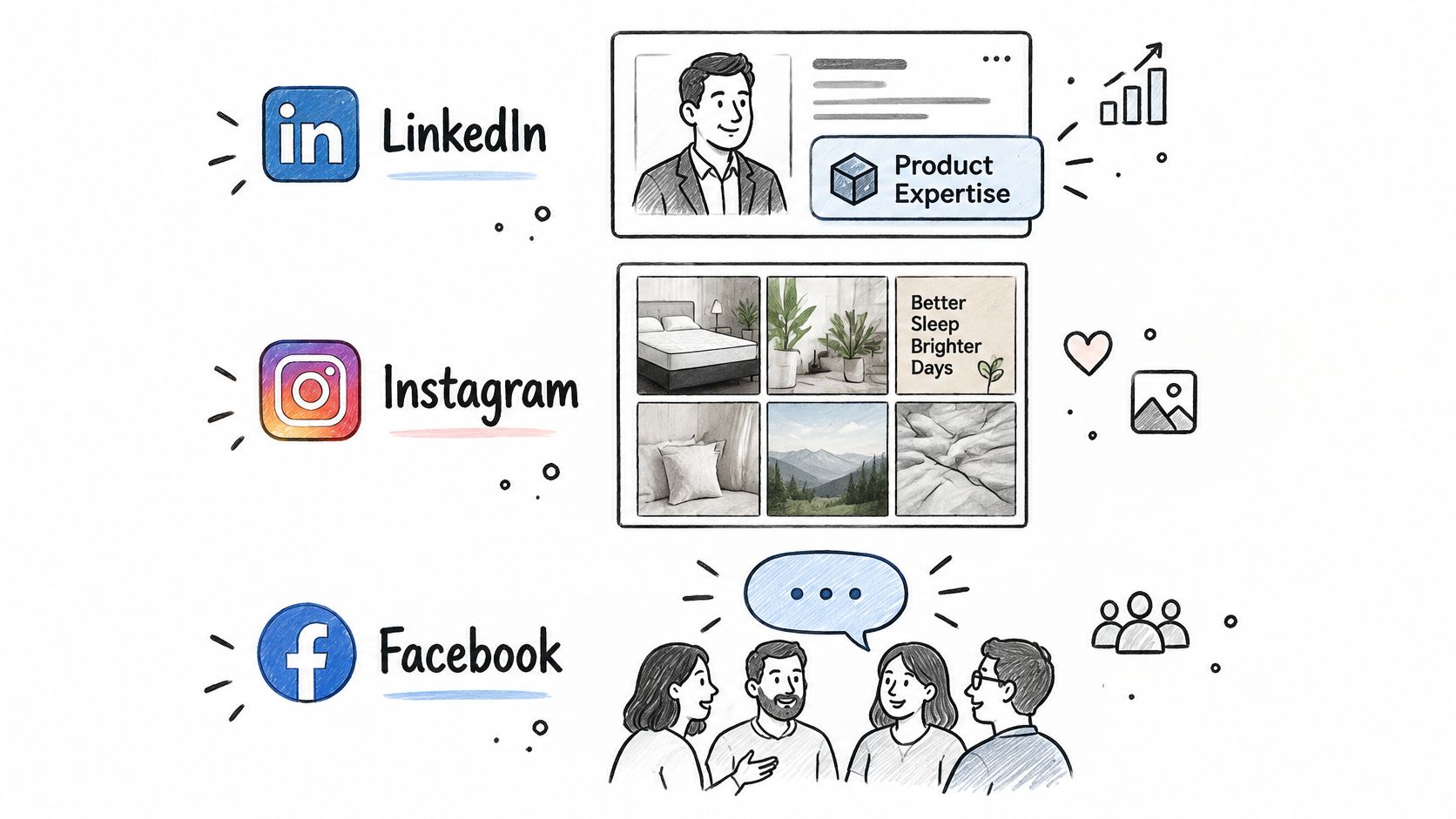
Assign each platform a job based on the buyer and the information they need. Don't duplicate the same launch caption everywhere and call it a sales program.
LinkedIn for professional buyer conversations
Use LinkedIn for manufacturer, component-supplier and retail-buyer relationships. A rep's profile should name the products, the territory they cover and the decisions they can help with. "Passionate about sleep" tells a category buyer nothing.
Put each rep on a steady posting rhythm built around construction questions. A post about foam density should distinguish density from firmness and explain the material's intended role. A ticking post can address composition and finish without inventing cooling claims.
When a buyer comments, answer the point publicly. Ask permission before sending a specification sheet or requesting a meeting; the public thread is where you earn the private conversation.
If you're comparing workflow tools, Linkboost's guide to LinkedIn engagement platforms can inform that evaluation. Keep technical replies and account-specific outreach under the rep's control. Automated praise on a buyer's post demonstrates nothing about product expertise, and buyers notice.
Instagram for product detail and comparison
Use Instagram to make construction easier to understand. A Digibun, a layered rendering of the product interior, can show the support core, transition layers and comfort materials that an exterior photograph can't.
Pair that view with a short firmness-comparison demonstration. Explain the models' relative positioning within your range, then close with a route to action: a link to find a retailer or a prompt to book a consultation.
Keep assets consistent with production specifications. A beautifully rendered quilt, gusset or foam layer creates problems if it differs from the mattress shoppers receive.
Hold creator content to the same standard. Creator recommendations can shape purchase decisions, so treat them like any other sales claim. Use trackable referral links, disclose gifted or paid relationships, and avoid scripts that imply every sleeper will have the same experience.
Facebook for local retail questions
Use Facebook for store-level conversations and existing-customer support. Keep delivery coverage, contact information and current product information accessible, with a named staff member responsible for messages.
Give that person approved answers about trials, warranties and adjustable-base compatibility. They should verify model-specific terms before replying, not paste a general policy into every conversation. When an exchange narrows to a specific model and budget, invite the shopper to visit the showroom or book a time.
Local groups require restraint. Follow community rules and answer relevant questions without turning every exchange into a promotion; this guide to Facebook marketing groups can help plan participation.
Give replies an owner
Every message needs a name attached to it. Sprout Social's customer-service guidance reinforces that buyers use social channels for conversations, not just content consumption. Assign monitoring to specific people, cover absences and holidays, and measure the work against the response standard in your scorecard.
Operating rule: Publish only what your team can support with accurate answers and a useful next step.
A Hybrid Mattress Sale Traced Through Social Selling
The following sequence is illustrative, not a customer case study or a promised sales result. A regional mattress retailer is helping a shopper compare a hybrid with a memory-foam model.
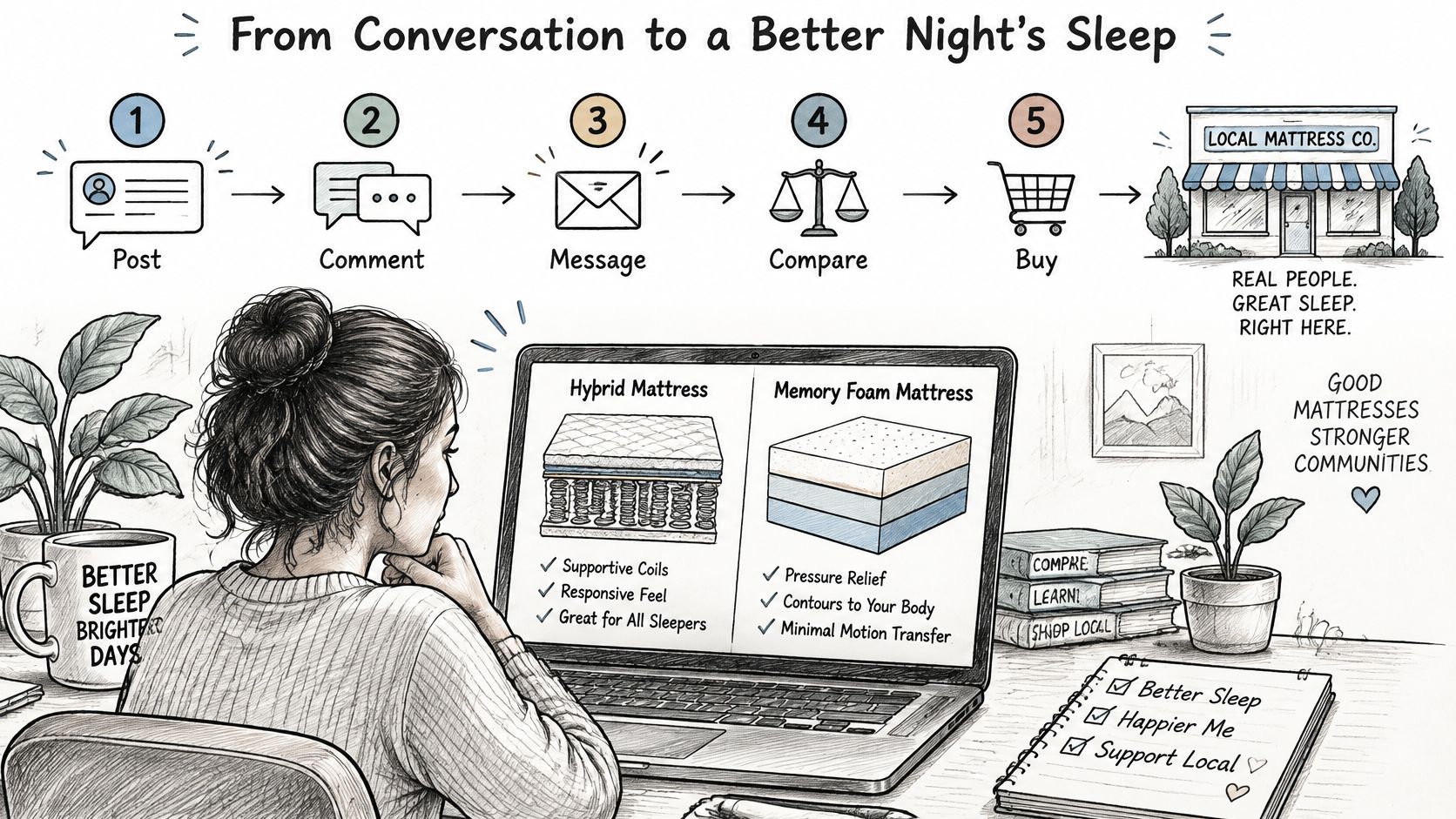
A public question starts the exchange. A Facebook commenter asks whether the hybrid suits a back sleeper who overheats. In this scenario, the manager replies within the hour, confirms whether the shopper stays on their back or also sleeps on their side, and asks what feels uncomfortable about the current mattress.
A private message explains the construction. With permission, an associate sends a Digibun showing the coil support core, foam comfort layers and cover ticking. The associate explains what each component does without suggesting that a visible coil unit proves the mattress will sleep cool.
A room view answers a presentation question. The shopper asks how the model would look in a compact bedroom. A Room Scene render shows its proportions and appearance, while the associate supplies actual mattress dimensions and asks the shopper to measure the room. The image helps visualization; it doesn't establish clearance.
An appointment preserves the context. The shopper books a fitting, and the associate records the social-originated source, shortlisted models and unresolved questions in the CRM. The floor team prepares the relevant display models instead of repeating the entire message exchange.
The shopper evaluates the feel in person. In this hypothetical example, the sale closes after a 15-minute comparison on the floor models. The associate confirms comfort preferences, delivery arrangements and applicable trial terms before completing the order.
What the visuals contributed
The layer view answered what's inside. The Room Scene answered how it looks in a setting, while measurements addressed fit. Neither replaced the shopper's comfort test.
The online steps made this illustrative visit more focused because the associate had already handled construction and presentation questions. The source tag made the journey traceable without pretending the final showroom interaction didn't matter.
Build Your Social Selling Starter Checklist
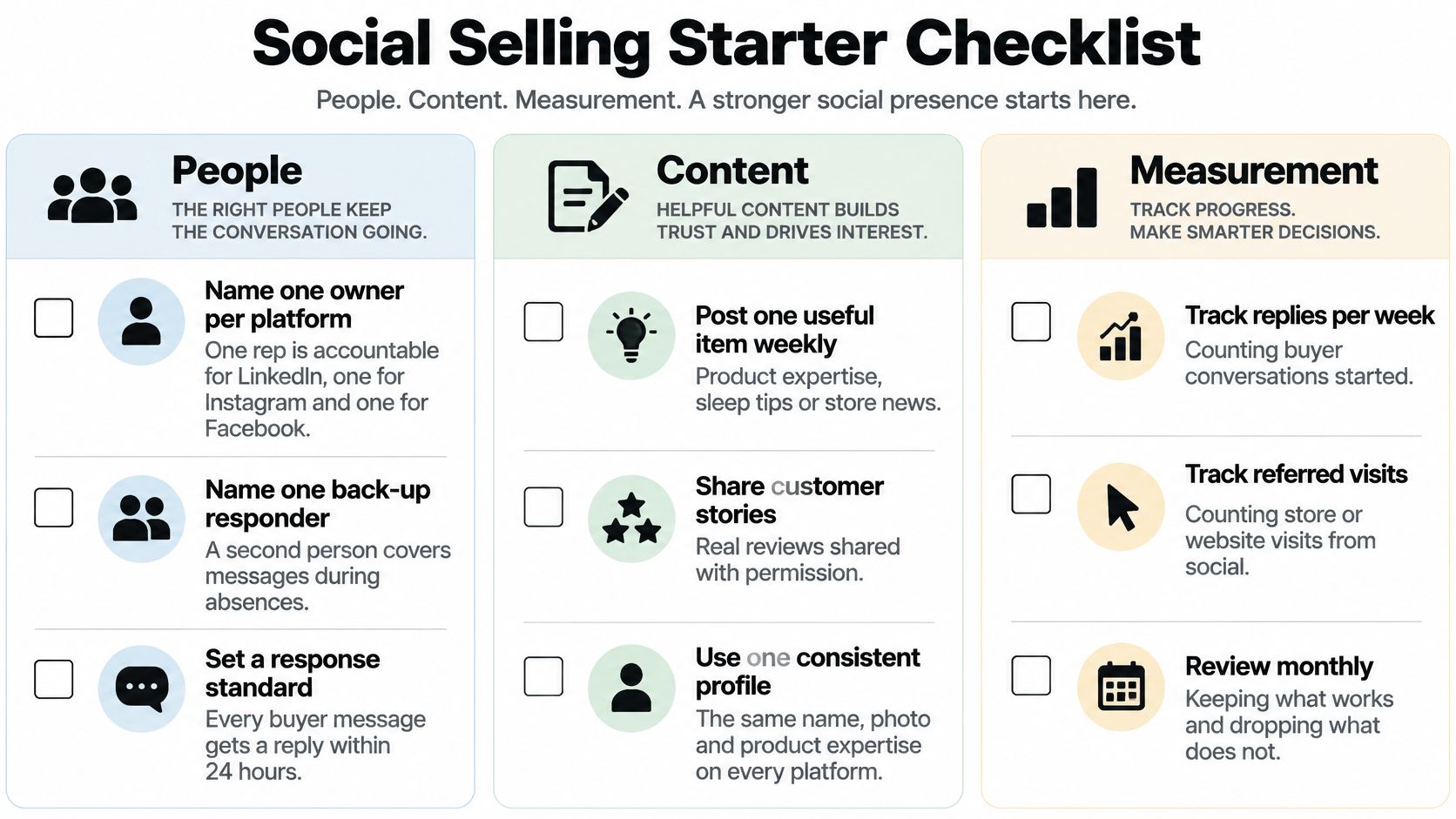
Start with a manageable product line and the staff who know it well. Build the process around accurate answers, not a larger posting quota.
People
Assign ownership: Name a platform owner and a backup responder so no buyer question sits unanswered through a shift change.
Set coverage: Define a first-reply standard and a handover process between whoever answers online and whoever greets the shopper on the floor.
Escalate correctly: Route technical questions, health claims and disputed warranty issues to qualified staff. An associate improvising an answer about trial terms costs more than a slow reply.
Content
Approve product information: Document firmness language, ticking, quilt, gusset construction, foam layers and trial terms so every associate describes the same build.
Prepare useful visuals: Create Digibun layer views for construction questions, Silhouettes for clean product identification and Room Scenes for context.
Support the associate: Organize sales enablement content by buyer question, not file format, so a rep can pull the right asset mid-conversation.
Disclose relationships: Follow the FTC's endorsement guidance for employee, paid, gifted and affiliate connections; don't describe personal product experiences you haven't had or make unsupported claims.
Measurement
Tag contacts: Record social-originated leads in the CRM and track what happens to them after the first reply.
Establish a baseline: Use the proposed review window to assess conversation quality, appointments, margin and post-sale issues before expanding to a second product line.
If your product pages rely on a single lifestyle photograph, consider layer views and room renders built from factory specifications. They give associates concrete material to share when shoppers ask construction and presentation questions, the same questions that stall a reply thread without them.
For sales-team education on this process, Bedhead University covers the mattress-specific ground your associates need.
BEDHEAD combines mattress-exclusive digital marketing, a 3D design studio, brand and USP development, expert consultation, presentation decks and retail sales training for manufacturers, brick-and-mortar and eCommerce retailers, private-label brands and sleep product startups. Its team connects product visualization with SEO, Google and Meta advertising, product-page optimization and manufacturer-to-retailer activation. Bring your current product assets and unanswered buyer questions to a consultation to identify what your associates need for more useful social sales conversations.