Social Media Management for Mattress Brands: A Guide
A mattress buyer comments, “Is this firm, or does it just look firm in the photo?” Someone else asks when a damaged delivery will be replaced. Meanwhile, a local retailer is waiting for a promotional post to go live before the weekend floor-model event. If your social plan only covers what to publish, these everyday conversations can fall through the cracks.
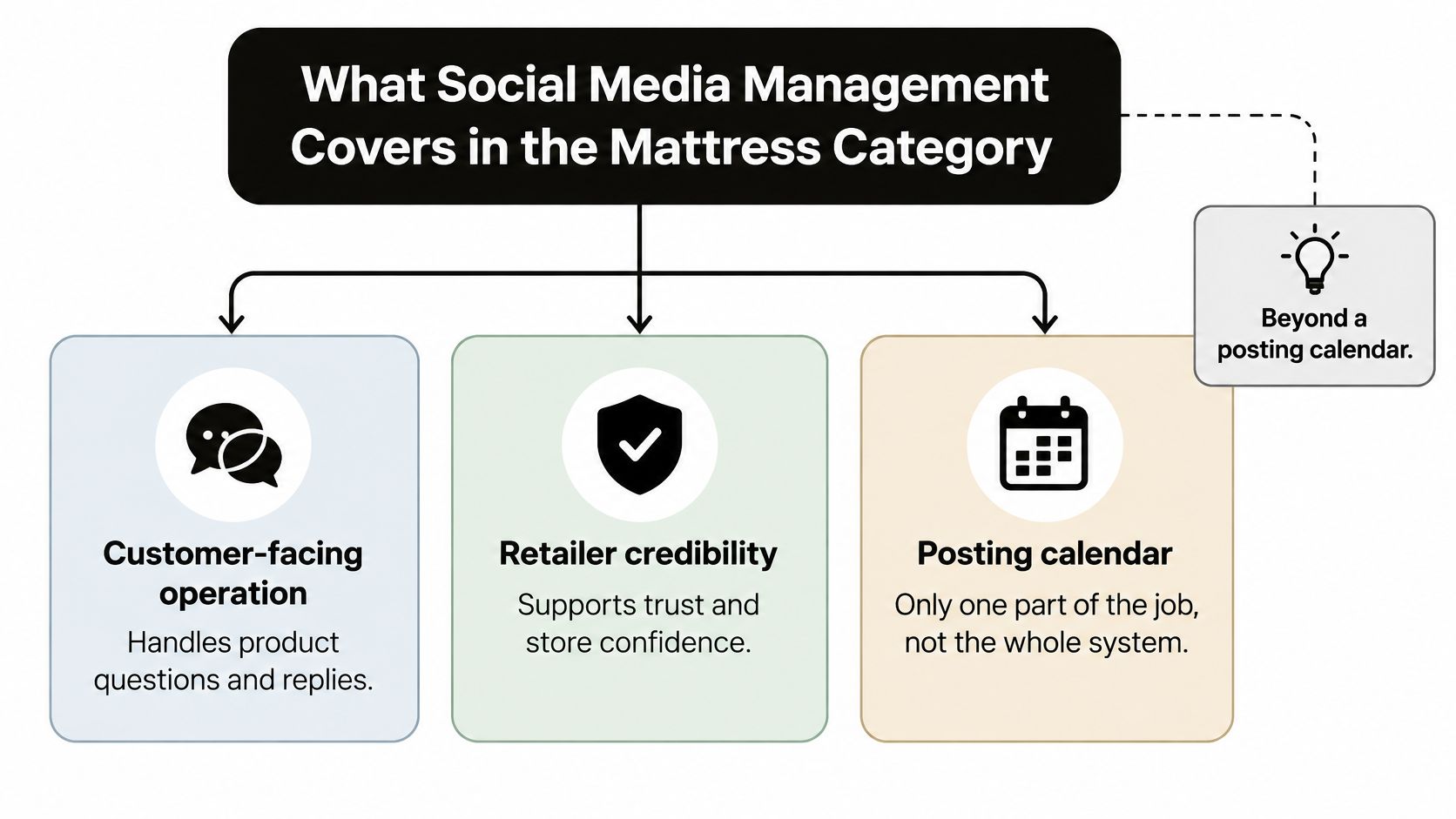
Social media management for mattress brands is a customer-facing operation as much as a content calendar. It needs to connect product information, showroom and retailer support, customer care, paid campaigns and reporting, with clear owners for each job.
What Social Media Management Covers in the Mattress Category
A scheduled post is one small part of the work. Mattress manufacturers, retailers and DTC teams also need a reliable way to answer questions about foam layers, ticking, firmness, delivery and warranties, while keeping product claims and imagery consistent across channels. DataReportal's Digital 2025 Global Overview counted 5.24 billion active social media user identities worldwide and found that the typical internet user spent 2 hours and 21 minutes a day on social media in 2025. For bedding businesses, that scale makes social an ongoing communications and service responsibility, not an occasional promotional task.
The day-to-day operation spans the full route from planning to measurement:
Content planning: Build a launch sequence for a new hybrid line. Owner: marketing director.
Creative production: Make a clear breakdown of a foam core's layers. Owner: content lead or agency.
Publishing: Format a Room Scene carousel for each channel. Owner: social manager.
Community management: Answer firmness questions beneath a product post. Owner: community rep.
Customer-service routing: Move a warranty claim to customer care. Owner: customer care lead.
Paid amplification: Retarget visitors who viewed a product detail page, or PDP. Owner: paid media manager.
Reputation monitoring: Spot and route a complaint about delivery damage before it spreads. Owner: social manager.
Reporting: Track product-page visits from social in a monthly scorecard. Owner: analytics owner.
For distribution, the useful principle is to adapt assets to each channel rather than publish every post identically. This guide to streamlining content distribution with Narrareach offers a practical reference for organizing that work.
At minimum, a mattress team needs a strategist, a creator and a responder. In a smaller business, one person may cover more than one role. Larger teams usually divide responsibilities across marketing, customer care and retail partnerships, so the person answering a warranty question isn't also expected to approve every product claim.
Function | What It Covers | Mattress Example | Typical Owner |
|---|---|---|---|
Content planning | Themes, pillars and calendar | Launch sequence for a new hybrid line | Marketing director |
Creative production | Photo, video, 3D and graphics | Layer breakdown of a foam core | Content lead or agency |
Publishing | Scheduling and platform formatting | Room Scene carousel for a bedroom set | Social manager |
Community management | Comments, DMs and tags | Answering firmness questions under a product post | Community rep |
Customer-service routing | Escalating support issues | Warranty claim moved to customer care | Customer care lead |
Paid amplification | Boosted and campaign ads | Retargeting visitors who viewed a PDP | Paid media manager |
Reputation monitoring | Brand mentions and reviews | Spotting a complaint about delivery damage | Social manager |
Reporting | Scorecards and insights | Monthly view of product-page visits from social | Analytics owner |
Choosing Platforms by Audience and Job
Choose platforms by where your buyers spend time and what each channel can do well, not because a “post everywhere” habit sounds thorough. Pew Research Center's 2025 survey of 5,022 U.S. adults found that YouTube, Facebook and Instagram had broader reach than TikTok or WhatsApp. Daily use also differs by platform, which matters when you're deciding where to put response coverage and production effort. The Pew Research Center survey gives a useful national starting point:
Platform | U.S. Adults Who Use It | Daily Use | Best Job for a Mattress Brand |
|---|---|---|---|
YouTube | 84% | 33% several times a day | Explainers on construction, foam layers and setup |
71% | 37% several times a day | Showroom events, local promotions and community | |
50% | Not listed in this survey | Visual product storytelling, Room Scenes and Silhouettes | |
TikTok | 37% | 24% daily | Short demonstrations of feel, bounce and motion isolation |
32% | Not listed in this survey | Direct retailer and customer messaging where a sales team already uses it |
Give every active channel a distinct job. YouTube can hold explainers on coil systems, foam construction, unpacking and setup. Facebook suits local showroom events and retailer updates, especially when a store needs to make floor-model availability clear. Instagram and TikTok are natural places to show product details, a quilt texture, or a short demonstration of how a hybrid mattress responds to movement. WhatsApp is useful when retailer or customer messaging already runs through it. Don't add it just to fill out a platform list.
Your sales model should shape the mix. A DTC brand with strong product-page traffic may prioritize visual demonstrations that send shoppers to a PDP. A showroom chain with three locations may get more value from store-level events and answers about local stock. Use buyer and dealer information to sharpen that decision. This guide to creating buyer personas can help teams distinguish the information a shopper needs from what a retail partner needs to sell confidently.
Content Strategy and Posting Cadence That Hold Up
Start with three content pillars, then set a cadence your team can sustain. Product education explains construction, materials, firmness and support systems. Sleep and lifestyle shows bedroom styling, bedding and the mattress in context. Trust and retail covers retailer stories, warranty explanations and staff picks.

Use these volumes as starting points, not targets to hit at the expense of accurate product information or service coverage.
Channel | Starting Weekly Volume | Dominant Content | Pillar Fit |
|---|---|---|---|
4 to 5 posts | Silhouettes, Room Scenes and carousels | Sleep and lifestyle, product education | |
3 to 4 posts | Showroom events and local retailer news | Trust and retail | |
TikTok | 3 to 5 short videos | Feel tests and layer reveals | Product education |
YouTube | 1 long-form video every 2 weeks plus Shorts | Construction and setup explainers | Product education |
Batching makes this practical. One planned photo or 3D session can generate a clean Silhouette, a Digibun layer reveal, a Room Scene and short clips for multiple channels. The goal isn't to dress every asset in a different visual style. It's to create useful versions of the same accurate product story.
A regional retailer's week might look like this: Monday, a short explainer on how a hybrid's comfort layers work; Wednesday, a bedroom Room Scene; Friday, a showroom spotlight that says whether a floor model is available. That sequence gives shoppers both product context and a reason to visit, without turning the feed into a repeating sale announcement.
Practical rule: Use a cultural moment only when it connects naturally to the product. A conversation about warm nights may suit a cooling construction, but a trend unrelated to sleep or bedding will usually feel like borrowed attention.
For more ideas grounded in customers' own experiences, use this guide to creating user-generated content. Get permission before reusing a customer's post, and make sure the feature shown matches the model being sold.
Community Management and Response Standards
A slow reply can cost more than a missed interaction. In a multi-country consumer-service study, slightly more than half of consumers considered a response time of up to five minutes acceptable, but only 15.6% reported receiving a reply within that window, according to the RingCentral consumer-service study. Treat response time as an operational measure. Assign each message type an owner, a target and a clear escalation point.
Message Type | First-Response Target | Owner | Escalation Trigger |
|---|---|---|---|
Pre-purchase question on firmness, size or materials | Within 1 business hour | Social rep using approved FAQ | Custom sizing or bulk order request |
Order or delivery status | Within 4 business hours | Customer care | Damaged delivery or missed delivery window |
Warranty, health or safety claim | Acknowledge same day, human answer only | Product or quality lead | Any mention of injury, allergy or medical condition |
Public complaint | Public reply within 1 hour, then move to private | Community lead | Repeated complaint or press mention |
Retailer or dealer inquiry | Within 4 business hours | Retail partnerships | Pricing, co-op or MAP question |
An automated acknowledgment can confirm that the team received a message and ask for an order number or product size. It shouldn't decide whether a warranty applies or respond on its own to a health, safety or reputational issue. Keep a human responsible for claims about injury, allergies or medical conditions, and route retailer questions to the store or retail-partnership lead rather than leaving them in a general inbox.
Set expectations for after-hours coverage, too. If the team can't investigate a delivery complaint at night, say when the customer can expect a meaningful follow-up. Then watch median and 90th-percentile first-response time, resolution time, unanswered-message rate and handoff rate separately. An average can hide the handful of messages that sat unattended.
Recurring questions should change the content, not just the inbox. If shoppers repeatedly ask whether a particular SKU feels firm or plush, add a clear answer to the PDP and FAQ, then make the next product post consistent with both. For a practical view of how social interactions connect to sales conversations, see this guide to what social selling is.
Paid and Organic Work That Earns Its Place
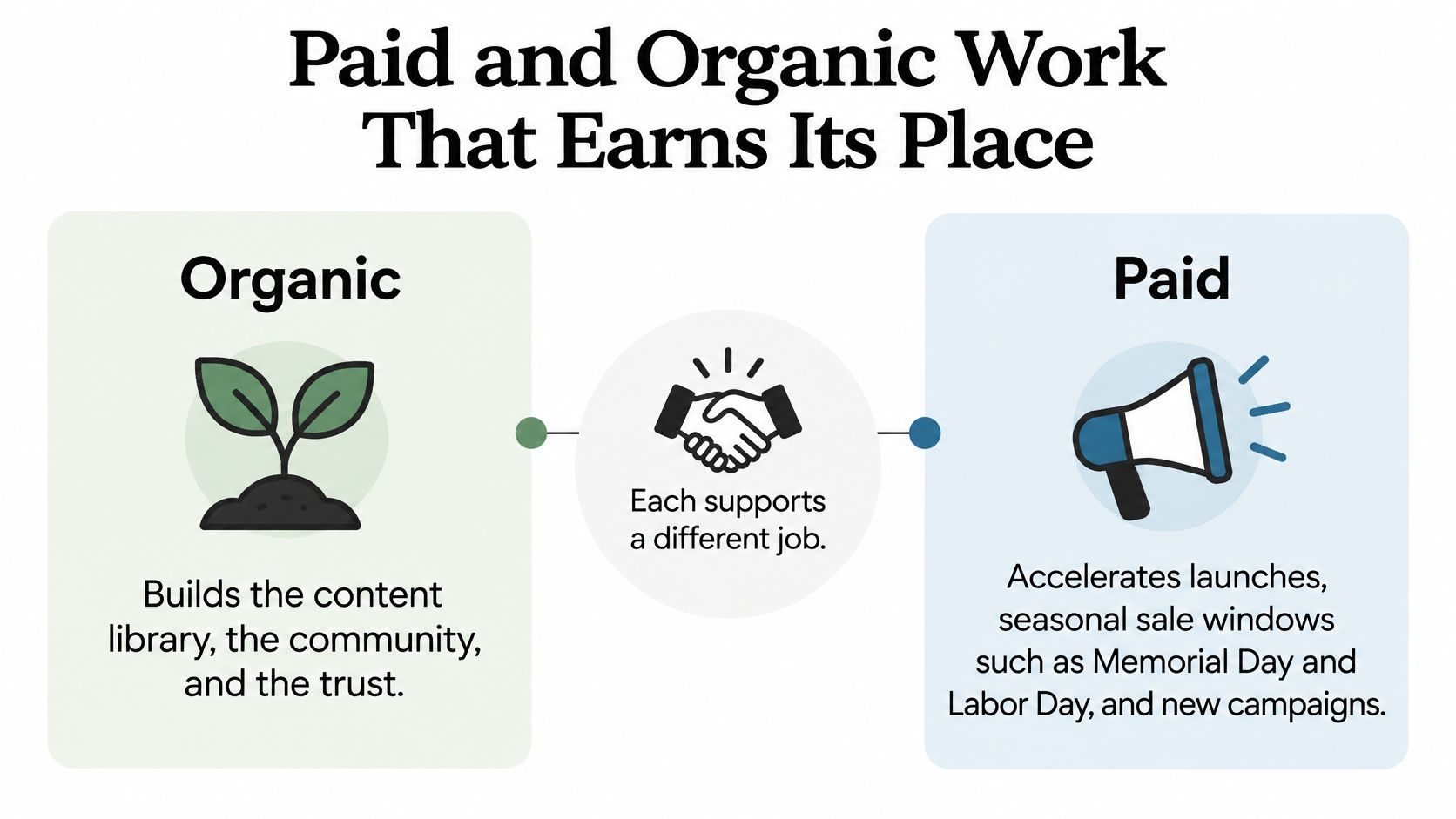
Organic builds the content library, the community and trust. Paid media accelerates a launch, a seasonal sale window such as Memorial Day or Labor Day, a new SKU or a retargeting campaign. They solve different problems, so don't use paid spend to compensate for an account that hasn't established what its products are or how it answers buyers.
Approach | Best Use | Trade-Off | Mattress Example |
|---|---|---|---|
Organic | Build a reusable library and maintain customer and retailer relationships | Reach depends on audience and sharing; results take time to develop | Explain a foam-layer design and answer questions in comments |
Paid | Add reach or focus delivery around a defined campaign | Spend can amplify waste as quickly as useful results | Retarget PDP visitors who haven't purchased |
Combined | Carry consistent creative from discovery through follow-up | Requires coordinated creative, targeting and tracking | Support a hybrid launch with an explainer and a product-page campaign |
Boost a post only after it earns strong saves and shares organically. That's a useful filter because paid amplification can extend a product demonstration that's already helping people understand the mattress. It can't fix inaccurate imagery, a confusing claim or a PDP that doesn't answer basic questions. Organic reach generally takes time; paid campaigns can begin showing results sooner, but poor targeting or weak creative can waste budget just as quickly.
Review creator, retailer and employee content before it goes live. The Federal Trade Commission's social-media disclosure guidance says a material connection can include payment, employment, family or personal relationships, or receiving free or discounted products or services. A gifted mattress, retailer incentive, affiliate link or employee endorsement may require disclosure that's obvious and included with the endorsement itself, not hidden on another page.
Put sponsored and gifted content through a compliance check, and keep a record of creator and employee arrangements. A simple approval process protects clarity without turning every caption into a legal document.
KPIs and Reporting Mattress Leaders Can Act On
A channel's engagement rate is meaningful only if you know how it was calculated. A 2025 benchmark covering accounts with at least 1,000 followers reported average engagement of 5.0% on TikTok, 3.6% on Instagram and 3.4% on YouTube, but its formulas differed: TikTok and Instagram used reach as the denominator, while YouTube used video views. The 2025 Dash Social benchmark is a reminder to keep separate scorecards and compare like with like, such as short product demos against other short videos.
KPI | Definition | Why It Matters | Check |
|---|---|---|---|
Engagement rate per reach | Likes, comments and shares divided by reach | Compares creative on the same platform | Compare with your own 90-day average |
Saves and shares | Count of saves and shares per post | Signals product-education value | Review first on explainer content |
Product-page visits from social | Sessions landing on mattress PDPs from social | Links content to purchase intent | Confirm UTM tags on every link |
Retailer inquiries | Leads from social passed to a store or dealer | Shows value to showroom partners | Log the source at intake |
Median and 90th-percentile first response | Time to first reply | Shows service health | The 90th percentile reveals the slow tail |
Qualified website traffic | Visits from target markets | Filters out empty reach | Compare with sales by region |
Cost per qualified visit | Paid spend divided by qualified visits | Judges paid media | Compare with cost per product-page order |
Pair engagement with an outcome. Saves on an explainer may indicate that shoppers want to revisit the information, but product-page visits show whether the post moved them toward a purchase. Retailer inquiries need source tracking at intake, or a useful lead may be credited to the wrong channel. For website traffic, UTM tags are the small labels added to links that let analytics identify where a visit came from; check that every campaign link is tagged consistently.
Review operations weekly, including message response performance. Then produce a monthly business view with qualified visits, retailer inquiries and paid-media outcomes. This analytics implementation guide can help teams make sure the reporting setup supports those decisions.
Workflows, Tools and How Agencies Scale Execution
A fixed weekly rhythm keeps content moving without making every post a last-minute scramble. It also gives product, retail and customer-care teams time to review the things they're qualified to check.
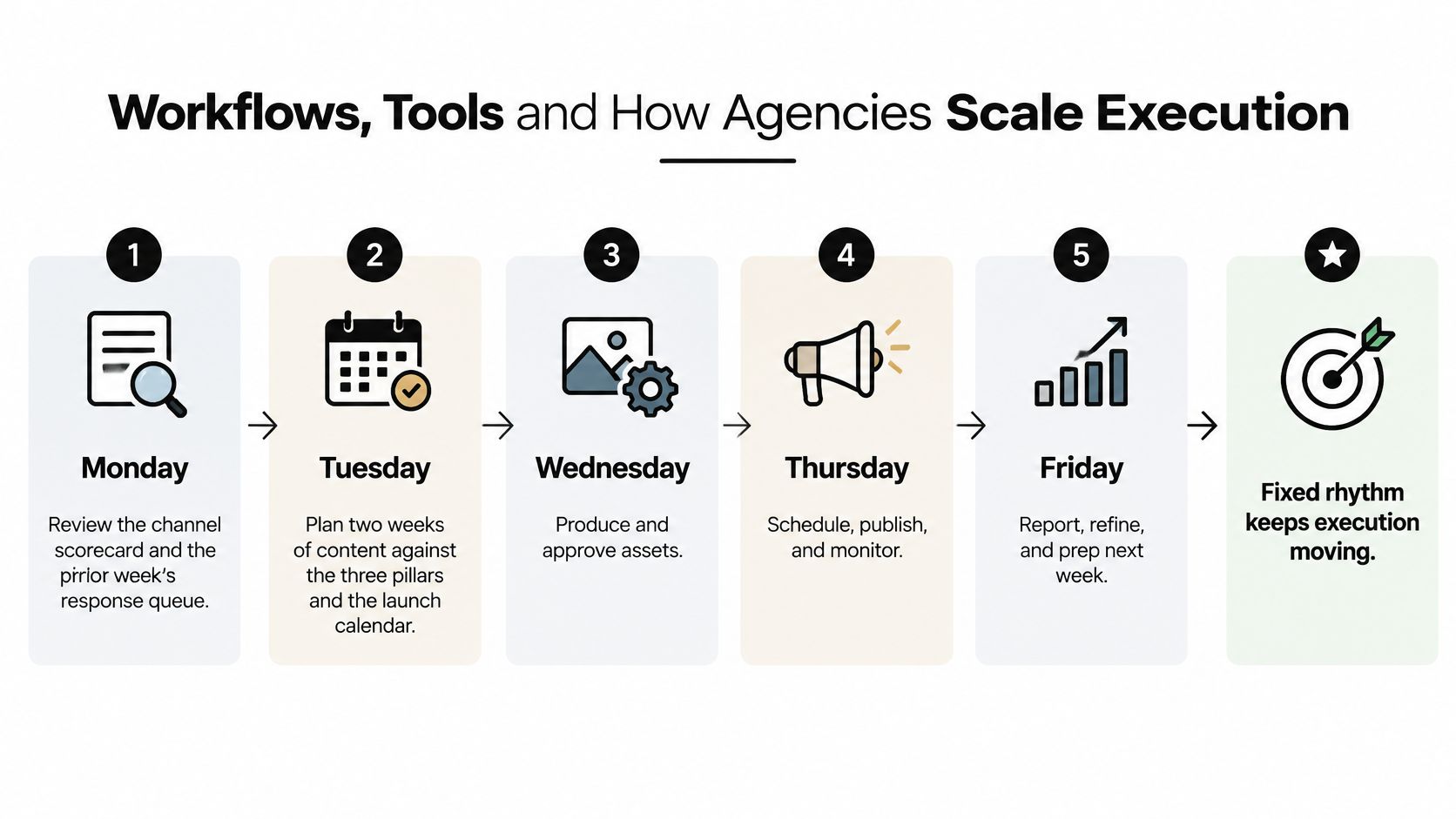
Monday: Review the channel scorecard and the previous week's response queue. Flag any unanswered warranty, delivery or retailer messages.
Tuesday: Plan the next two weeks against the content pillars, product calendar and store activity.
Wednesday: Batch production. Turn a photo or 3D session into clips, carousels and stills, then check that each asset shows the right mattress details.
Thursday: Run approvals. Compare product claims against the spec sheet, get retailer sign-off on local posts and check disclosures for sponsored content.
Friday: Schedule posts and confirm weekend response coverage. Make sure the person on duty knows how to route urgent issues.
Month end: Publish the outcome report and adjust the next cycle based on business and service results.
Keep the tool stack practical. Your team needs a way to schedule posts, share an inbox, organize approved digital assets and review performance. Before adding another subscription, decide which of those jobs it will handle and who will own it. This overview of social media tools for 2026 can help with comparing options.
AI can help draft captions or accessibility text, but a human should review product details and customer-sensitive responses. Ipsos' AI Monitor 2025 found that 79% of people believe companies using AI should disclose it. Make disclosure part of your policy, and don't use synthetic visuals that change a product's dimensions or imply construction the mattress doesn't have.
The goal is not more posts. It's a dependable system that turns each accurate asset into useful content and each customer question into a better answer.
Teams can keep execution in-house, outsource production or work in a hybrid model. A hybrid arrangement often makes sense when internal staff know the products and retailer relationships, but lack time or specialist creative capacity. Bedhead Marketing works with mattress businesses on social media, 3D Digibuns, Silhouettes and Room Scenes, alongside SEO, paid media, product-page work and sales training. Reusing accurate product assets across social, eCommerce and showroom training helps the same construction story reach both shoppers and sales associates.
Confirm Your Social Operation Before the Next Quarter
A quarter-end review works best as a short audit. Run these five checks in order:
Audit every account. Record its owner, last post date and response backlog. A warranty question sitting unanswered in a Facebook inbox for a week tells you more about the operation than reach numbers do.
Test the platform mix. Compare audience reach with your own sales, dealer and web analytics. A channel that drives showroom visits deserves different treatment than one that only collects likes.
Set response tiers. Name an owner for each message type and agree on an escalation path, so a comfort complaint reaches someone who can resolve it.
Build separate scorecards. Track channel-specific engagement alongside product-page visits, retailer inquiries and service measures.
Write a disclosure and AI-use policy. Make sure employees and retail partners understand and sign off on it.
If product imagery, sleep claims and store messaging don't match across channels, a focused review can identify where the differences occur and whether 3D assets, Digibuns or Room Scenes would close the gap. Teams building internal capability can use Bedhead University for mattress-specific marketing and selling education.
If your social channels need clearer product stories, more consistent 3D imagery or better connections between paid media and product pages, BEDHEAD can help assess the work and plan practical next steps. To discuss a social media review, a mattress-specific content program or sales training that supports the questions your channels surface, contact BEDHEAD at bedheadmarketing.com.