Product Video Production Company: A Mattress Buyer's Guide
You've just paid for a beautiful lifestyle film, soft light, a couple laughing on a dressed bed, slow pans across a tidy bedroom. Views look healthy. Then the returns team calls. Customers say the mattress feels firmer than expected, looks thinner than the footage suggested, and doesn't match what they thought they bought.
That gap is why choosing a product video production company matters for a mattress brand. A video that misstates construction or firmness doesn't just underperform. It sends product back to you.
Why Generalist Video Crews Miss the Details That Sell Mattresses
A mattress video can look polished and still leave buyers unsure what will arrive. If the footage hides construction, firmness guidance or dimensions, it creates atmosphere without answering the questions that affect the purchase.
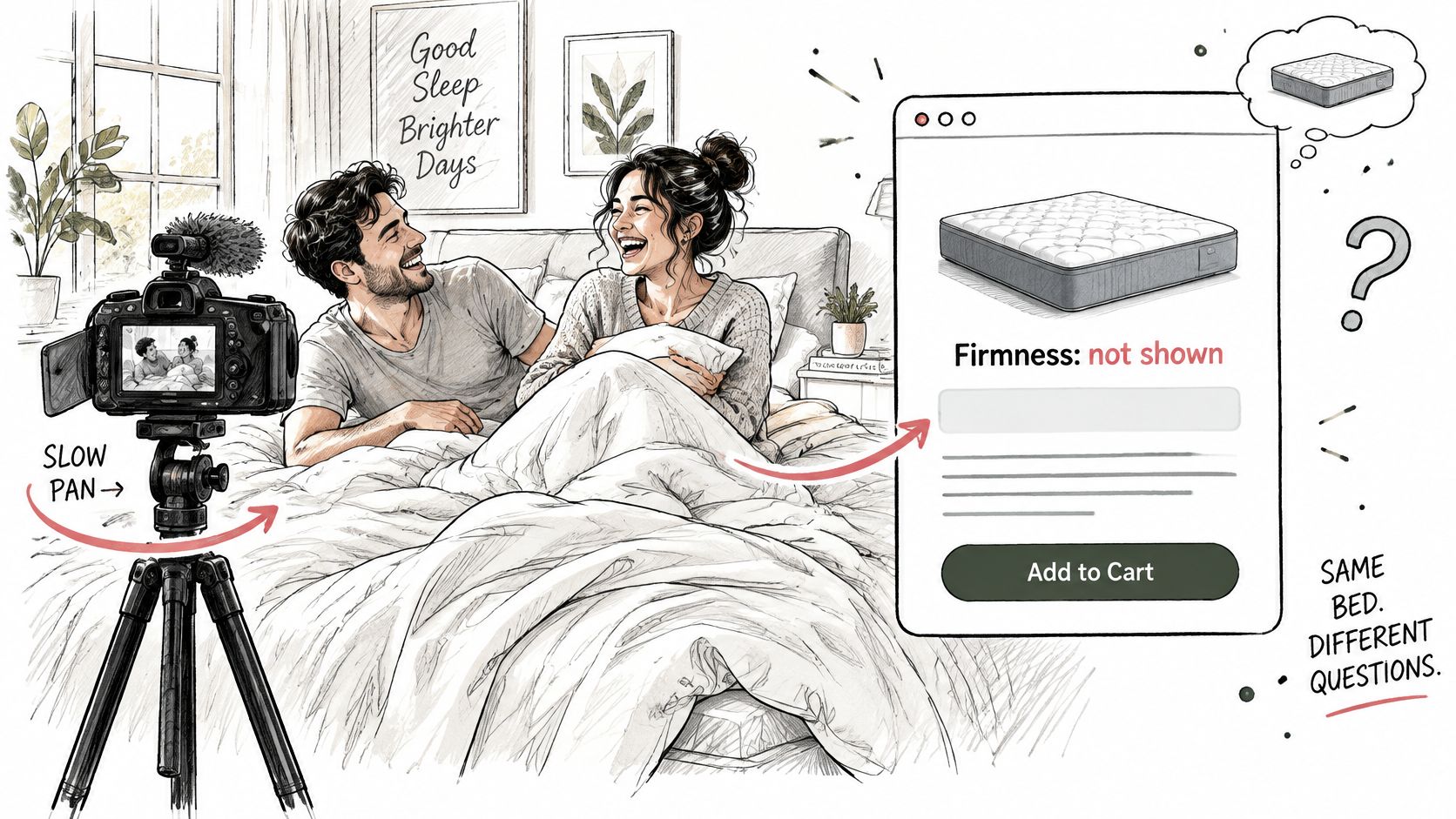
That gap can show up in returns. In research cited by Akeneo, 62% of surveyed consumers said more accurate product information would reduce their likelihood of returning an item, while 59% said they had returned a product because its online description was misleading or inaccurate, according to Akeneo research on consumer behavior and product returns. For a mattress brand, the production decision should turn on whether a video makes product details easier to judge, not whether it looks cinematic.
What a Non-Specialist Crew Typically Misses
Mattress details need deliberate lighting and framing. Poor light can make ticking patterns look like grey mush. Bedding can hide gusset height, while shallow angles flatten quilt depth and keep foam-layer transitions out of view. Those omissions leave buyers guessing about materials and construction.
A crew unfamiliar with mattress shoots may also film a showroom floor model without checking for compression marks or requesting a fresh unit. A worn edge may be ordinary on the showroom floor, but on a product page it can suggest poor quality.
Judge a production partner by the confusion its videos prevent on product pages, not by views or cinematic polish.
Before signing, ask which product claims and physical details the crew will show clearly. Confirm how it will represent measurements, materials, setup steps and comfort differences, so buyers can compare what they see with what arrives.
Services and Deliverables to Expect in a Proper Package
A product page can show a mattress clearly and still leave shoppers unsure about what they are buying. A useful production package gives the brand assets that answer different questions across product pages, paid placements, showroom screens and sales conversations. Judge each deliverable by whether it clarifies the product and reduces avoidable confusion, not by how polished it looks on its own.
Core deliverables in a mattress video package
Deliverable | What it covers | Where it gets used |
|---|---|---|
Master hero film (16:9) | Brand story, factory or sleep lab footage, mattress in a real bedroom | Homepage, YouTube, brand site |
Short cutdowns (6, 15 and 30 seconds) | One benefit per clip, such as edge support or cooling | Paid social, Meta, Google video |
Vertical and square versions (9:16, 1:1) | Reframed cutdowns for mobile feeds | Instagram, TikTok, Facebook feeds |
Silent-first edits with burned-in captions | Demonstration readable without sound | Social feeds, retailer screens, showroom loops |
Caption files and transcripts | Synced text for narration and meaningful audio | Website players, accessibility compliance |
Digibun and layer breakdown renders | Cutaway of ticking, quilt, foam layers and gusset | Product pages, spec sheets, sales decks |
Silhouettes and room scenes | Clean product frames and lifestyle context | Retailer listings, email, paid placements |
Request a line-by-line quote for each item. A lower total may leave out versions your team will later need to commission again. Confirm that the listed work includes the product details and formats required for each placement.
Three Deliverables Buyers Forget to Request
Silent-first edits come first. Social placements and retailer screens may play without sound. The demonstration should still make sense with captions and visuals alone. If a motion-isolation test needs narration to explain what viewers are seeing, it will not work well on a muted screen.
Caption files are not the same as burned-in text. Under WCAG 2.1 Success Criterion 1.2.2, Level A, prerecorded video with meaningful audio needs captions for spoken words and important non-speech audio. W3C guidance on planning accessible audio and video media explains how to plan accessible media. Ask for caption files that can be switched on or off, as well as transcripts, so the material can be used across website players, retailer screens and social platforms.
Digibun layer breakdowns show construction in a frame. A cutaway can display ticking, quilt, foam layers and gusset together, giving retail sales associates and product-page shoppers a view they can pause and inspect. Add silhouettes for clean listings and room scenes for context. These still assets keep product presentation consistent across placements, including email marketing with video content.
Confirm the Details in Writing
Before signing, specify aspect ratios of 16:9, 9:16 and 1:1, cut lengths, revision rounds and file specifications for each retailer. Export requirements vary between retail partners. Finding out after delivery may mean paying to re-export or revise files, so list the requirements in the scope.
Aspect ratios and lengths: Confirm every version, not only the master.
Revision rounds: State how many are included and who consolidates feedback.
Retailer specs: List each partner's format, naming and caption requirements.
Source files: Agree who retains project files, models and raw footage.
Many mattress brands split production between internal editors and specialist crews. Cutdowns, resizes and caption revisions often suit an in-house editor who knows the SKU and can make routine updates. The hero film and 3D construction models call for specialist production skills. A useful vendor decision is therefore about scope: keep repeatable edits close to the brand, and outsource work where product depiction, filming or modeling demands dedicated expertise.
Ask the production company to identify which deliverables can be revised internally and which changes require its team. That distinction affects how quickly the brand can correct a caption or resize a clip, and what happens when the product itself changes. HubSpot's video marketing statistics on production approaches provides context on in-house and outsourced production approaches, but the right division of work depends on your team's editing capacity and the complexity of the assets.
Choosing Between Live-Action, 3D and Hybrid Video
Live-action proves how a mattress feels and moves with a sleeper, while 3D shows what the eye cannot see inside the product. Most mattress briefs need some of both.
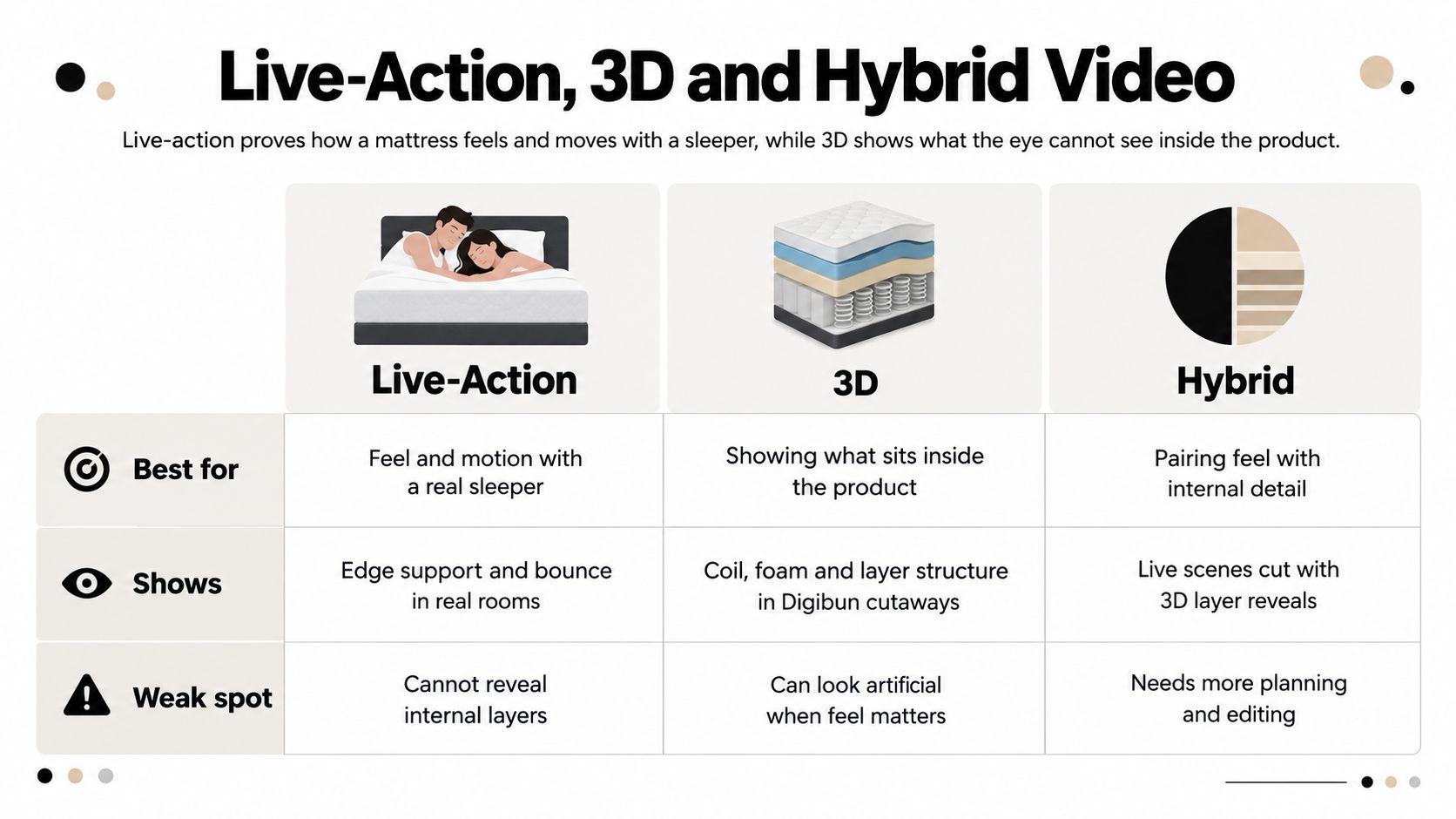
Live-action, 3D and hybrid compared for mattress video
Criterion | Live-action | 3D animation | Hybrid |
|---|---|---|---|
Best use | Brand story, sleep context, feel and motion | Construction, layers, cutaways | Hero film plus technical sequences |
Shows real motion transfer and feel | Yes, with a real sleeper | No, simulated | Yes, in the live segments |
Revising after a foam or ticking change | Reshoot required | Update the model and re-render | Re-render only the 3D segments |
Ticking and quilt accuracy | Depends on lighting and camera | Depends on material specs supplied | Both, depending on the segment |
Typical lead time | 4-8 weeks from brief to final | 3-6 weeks for a full set of views | 6-10 weeks combined |
Main cost driver | Crew, location, talent, shoot days | Modeling detail, texture, revision rounds | Combined production and modeling |
Three Situations, Three Answers
A brand launching a new hybrid mattress with a pocketed coil and a latex comfort layer needs both formats. Use 3D cutaways for the layer build and live-action for the motion transfer demo, since neither format proves the other claim.
A retailer with a steady catalog and frequent ticking or foam changes benefits most from 3D. Revisions become model updates instead of reshoots, which protects floor model consistency across seasons. That logic also applies to product video animation for mattress construction visuals.
A DTC brand with one flagship bed and a strong founder story can lead with live-action. Use 3D only for the construction explainer, where a camera can't go.
The governing trade-off: 3D is only as accurate as the specifications you supply, so spec sheets, swatches and layer thicknesses must come before modeling begins.
BEDHEAD is one option for that technical work, producing 3D renders, Digibuns, silhouettes and room scenes specifically for mattress brands. Whichever partner you choose, the test is the same. Ask what they need from your product team before they build anything.
How a Mattress Shoot Is Planned, Lit and Staged
A strong partner runs a platform-specific, action-oriented workflow, not a generic shoot day. The sequence below reflects what's worked on mattress sets specifically.
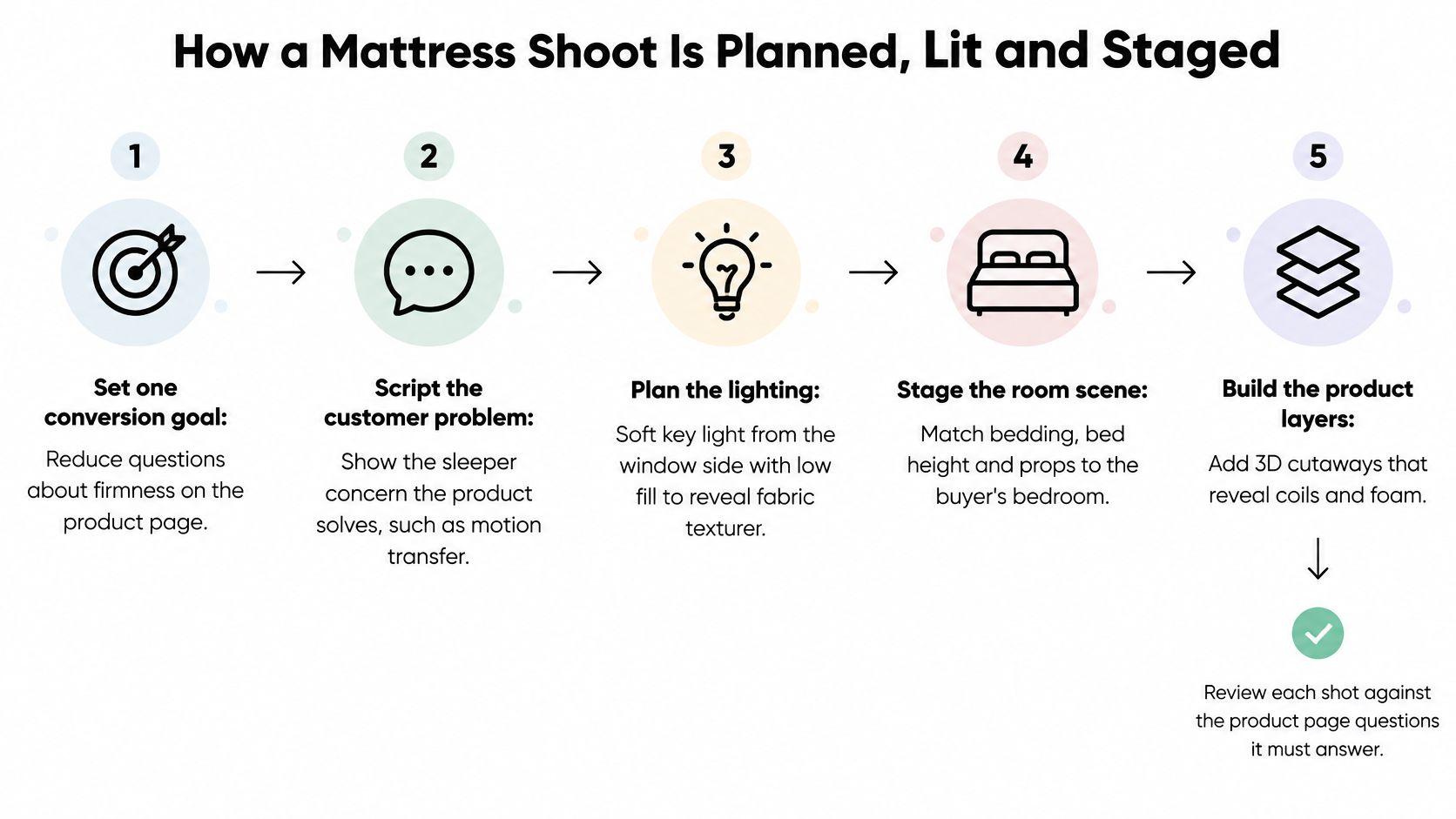
Define one conversion objective: Pick a single goal, such as reducing firmness questions on the product page.
Script the problem and benefit: Build the script around the sleeper concern the product solves.
Storyboard the first five seconds: Show the product and brand early, not after a lifestyle intro.
Show the mattress in use: Place it in a realistic bedroom at a believable bed height.
Capture an audible brand mention: Don't rely on an end card to do the branding.
Demonstrate the intended action: Show the next step, such as trying the bed at a retailer.
Deliver alternate cuts for testing: Shoot enough coverage for different openings and claims.
That order aligns with Google's YouTube ad production guidance on featuring the product in use, which recommends integrating the brand within the first five seconds and showing talent completing the desired action. Google also advises encouraging engagement rather than making the piece only a hard sales pitch.
Staging Details That Make or Break Accuracy
Remove covers only after confirming the ticking is clean and unwrinkled. Shoot at a height that shows the quilt and gusset, and use a fresh unit rather than a worn floor model unless the video is deliberately about the showroom experience.
Lighting knit and jacquard ticking takes care. Hard light can flatten quilt depth or make patterns shimmer, so soft key light with low fill usually reveals texture more faithfully. Run a color check against the brand's physical swatch before you commit to a full day.
A definition of a close-up shot and when to use it matters here, because tight frames carry the proof. Get close on stitching, edge compression and layer edges where a wide bedroom shot tells the shopper nothing.
Shooting Demonstrations a Buyer Can Trust
Run motion transfer as a controlled test with a consistent load, not an actor flopping onto the bed. Build a shot list for edge support, side sleeping pressure points and compression to recovery, and repeat each one the same way so comparisons hold up.
If a demonstration can't be repeated on the retail floor by an RSA, it won't hold up as product page proof either.
Avoid the three common failures. Don't delay product exposure, don't rely only on abstract lifestyle footage, and don't produce one edit for every placement. A showroom loop, a paid social cut and a product page demo ask different things of the same footage.
Measure view-through rate, click-through rate, product page engagement, add-to-cart rate and completed purchases separately. High view counts can conceal weak commercial performance.
Pricing Models and Realistic Timelines to Budget For
Quotes look incomparable until you know the billing model. Two proposals for the same brief can differ mainly because one includes cutdowns, captions and retailer exports and the other doesn't.
Pricing models for product video partners
Pricing model | How it is billed | Main cost driver | Best fit |
|---|---|---|---|
Per-project fixed fee | Fixed price for defined deliverables | Shoot days, cast, number of final cuts | One hero film with a clear scope |
Day rate plus post | Per shoot day, then edit separately | Crew size, locations, set build, edit hours | Brands shooting many SKUs in one session |
Per-asset 3D pricing | Per SKU or per rendered view | Model complexity, number of angles, revisions | Large catalogs needing consistent construction visuals |
Monthly retainer | Fixed monthly fee for a set output | Volume of cutdowns, edits, channel management | Retailers and DTC brands with ongoing content needs |
Hybrid program | Project fee plus retainer or licensing | Combination of the above | Product launches with long-tail content needs |
A Realistic Launch Timeline
When specs are ready, script and storyboard approval usually takes one to two weeks. A hero film with a single bed typically shoots in one to two days. Editing with two revision rounds then runs two to three weeks.
Add time for every extra aspect ratio, caption file and retailer-specific export. For 3D, the schedule depends on the number of views and how quickly material specs arrive, which is worth comparing against typical 3D rendering cost drivers before you commit to a launch date.
Waiting on samples: Ticking or foam swatches that arrive late stall modeling and color checks.
Late claim approvals: Legal review after the shoot forces edits or reshoots.
Open-ended revisions: Uncapped rounds blur the budget and the delivery date.
Ask every vendor to price the full deliverables list line by line. That way a quote without silent-first edits or captions shows up as a gap, not a bargain.
Questions to Ask a Product Video Production Company Before You Sign
A mattress video can look polished and still leave shoppers unsure about firmness, materials, or construction. Ask vendors how their work addresses those questions on the product page, and what evidence they use to judge whether the video is helping.
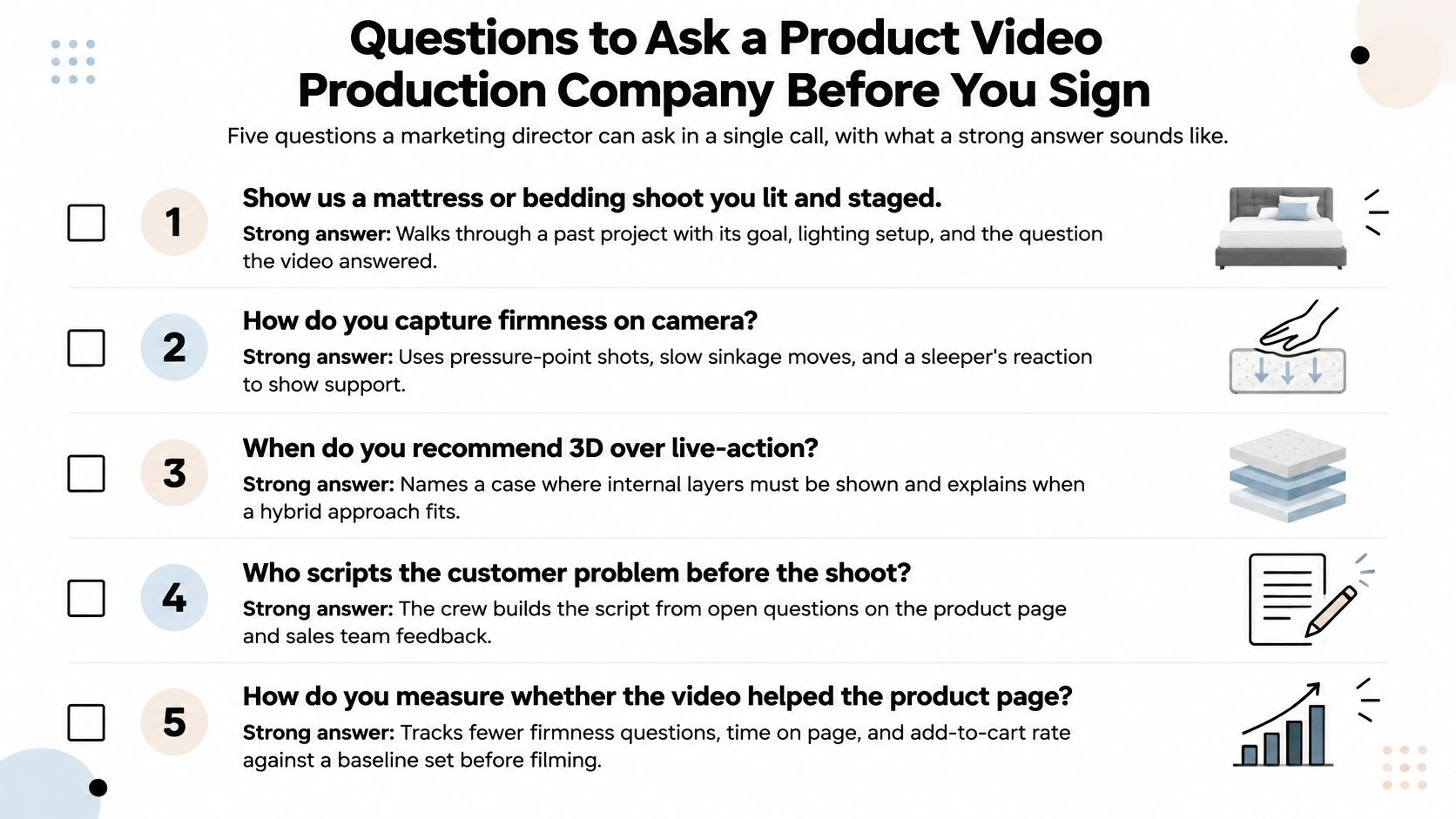
Show us a mattress project and the product page it supported: Ask which SKU the video covered and what shopper confusion, product-page questions, or return reasons it was meant to address. Look for a clear connection between the asset and the product-page need.
Who checks construction claims before filming: Ask for a written approval step, and confirm the team will review your spec sheets, swatches, and layer thicknesses before production.
How do you handle a ticking or foam change after the shoot: Find out whether the vendor can update a model or re-render only the affected segment, rather than requiring a full reshoot.
Which captions and transcripts do you deliver: Confirm that every master and cutdown includes caption files, and ask who checks them for accuracy.
How would you test two openings or two benefit claims: Ask the vendor to define what changes, how the audience is split, and which outcomes are tracked.
For this test, engagement is directional evidence, not proof of sales. Track the measures from question 5 against returns, product-page questions, and completed orders to see whether the video reduces confusion and supports purchases.
Red Flags Worth Walking Away From
No mattress work in the reel: Generic product footage does not show whether the team understands ticking, quilting, or firmness.
No written claim approval step: Unchecked construction or performance claims can create compliance problems and shopper disappointment.
One aspect ratio only: A single format may not fit product pages, feeds, and showroom screens.
No caption files: Without captions, sound-off placements and accessibility needs may be missed.
Measurement limited to views: Views alone cannot show whether product questions or returns have fallen.
Promised guaranteed sales lift: Treat a guaranteed result as a warning. A vendor can explain its testing process, but cannot control every factor behind a sale.
A strong partner asks about your returns data and product-page gaps before discussing cameras. Their answers should show how they will reduce shopper uncertainty, not just how they will make a polished video.
Run a Single-SKU Pilot Before You Commit
A mattress can draw firmness complaints because shoppers cannot judge its feel from the product page. Start with one SKU where confusion or returns are already a concern, rather than commissioning a full catalog.
Set a tight scope: one hero film in 16:9, two captioned cutdowns in 9:16 and 1:1, and one construction breakdown for the product page. Record at least four weeks of baseline performance before the video goes live.
Choose the measures before filming. Track returns, product page questions, add-to-cart rate and completed orders separately from views. Compare the finished assets with the agreed scope, and check whether shoppers have clearer information, not just whether the video looks polished.
A pilot also shows how the company handles revisions, claim approvals and spec sheets under real production conditions. For your own team, Bedhead University mattress marketing and sales training covers the selling side of putting those assets to work.
If you're reviewing current product imagery or video, start with a short review of gaps on the product detail page. Bedhead Network (BEDNET) is a resource for mattress industry professionals.
If your next launch needs video that shows construction clearly and holds up on the product page, on the retail floor and in paid feeds, BEDHEAD builds mattress-specific live-action demonstrations, Digibuns, silhouettes and room scenes for manufacturers, retailers and private label brands. Start with a single SKU and a clear returns or question problem, and we'll help you scope a pilot you can measure.