Email Marketing Video for Mattress Brands That Converts
You've got the hero video ready. The hybrid cutaway looks clean, the foam layers separate on cue, and the RSA demo is tight. Then the email marketing video sends, and almost nobody plays it. That isn't a creative problem. It's the inbox refusing to do what your ESP preview promised, and it's fixable with a different system.
The Compatibility Problem Behind Email Marketing Video
A mattress marketing director we know lived this exact morning. The launch email for a new hybrid went out with a polished construction video embedded in the template. Opens looked fine, clicks were thin, and video starts were close to zero. The team assumed the video wasn't compelling enough. In reality, most recipients never saw a player at all.
That's because email clients don't reliably support inline video playback. Guidance on the cross-client pattern is clear that a clickable thumbnail with a play button that links to a browser video works in major environments like Gmail and Outlook because the email contains an image link, not a player the inbox must render. When you try to force playback inside the message, you're betting on the riskiest part of the stack.
Why This Matters More for Mattresses
Bedding education depends on showing what a shopper can't feel online. Motion isolation, adjustable base positions, ticking and quilt detail, unboxing and setup, these need demonstration. If autoplay fails, sound is off, or images are blocked, the benefit still has to land through the subject line, thumbnail alt text, benefit-led copy, and a non-video CTA.
This is why email video is a compatibility and accessibility problem first, not an embedding trick. A 2025 consumer study cited in guidance on embedding video in email found that 78% of consumers want brands to use video more, yet 44% said they'd never received video content from brands they do business with. The demand is there. The delivery layer is where brands lose it.
A clickable thumbnail that links to a fast landing page outperforms any clever embed, and it works in Gmail, Outlook, and Apple Mail.
Other categories are learning the same lesson about meeting customers where they already are on mobile. Teams looking at adjacent retention tactics can find loyalty tools for restaurants as an example of building for the phone first rather than hoping desktop behavior carries over. For mattress brands, the equivalent discipline is simple. Don't ask the inbox to be a video player. Ask it to earn one clear click to a page you control, where the video, specs, and next step all work.
Building the Thumbnail and Landing Page System
Hand your designer this sequence and you'll avoid most rebuilds. It's six moves, in order, and each one removes a specific failure point we've seen in bedding sends.
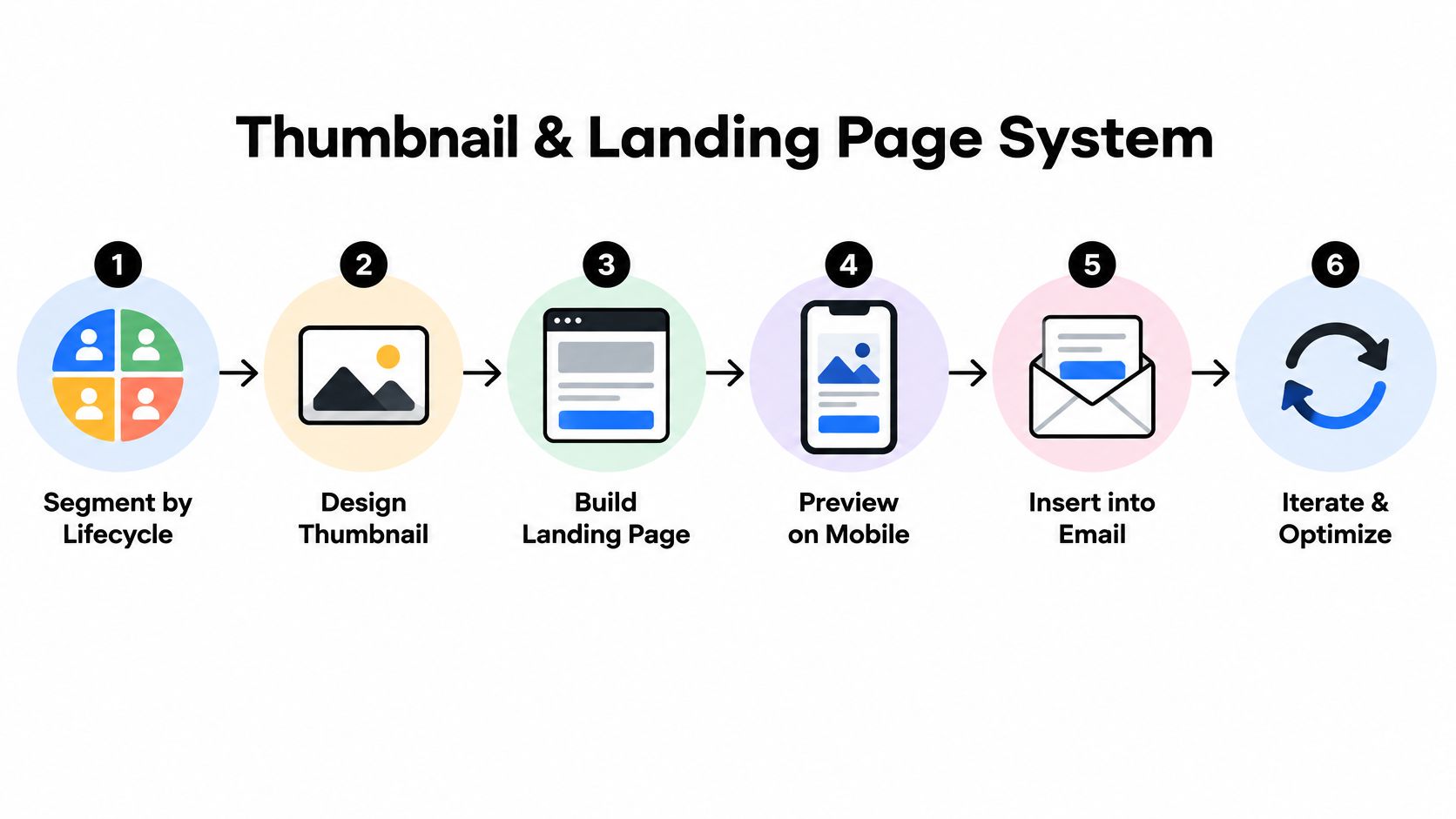
The Six Moves in Order
Segment by lifecycle and interest: Send unboxing and setup to recent DTC buyers, construction education to shoppers who viewed a hybrid PDP, and retailer event video to showroom prospects near that store.
Signal video in the subject line: Keep it short and benefit-led, so the recipient knows there's something to watch and why it matters.
Put the thumbnail above the fold: Use a compressed image with a clear play-button overlay and a large tap target, not a small text link buried under copy.
Link to a fast landing page: The page should be mobile-optimized, load quickly, and play the video without extra hunting.
Provide a fallback: A static image or short animated GIF keeps the message intact when a client blocks or strips richer media.
Test each element separately: Subject line, thumbnail, CTA, and landing page get isolated tests, which the next testing section covers in detail.
That workflow is the practical pattern described in SendSpark's video email marketing guide, which also notes general benchmarks of approximately 21.5% open rate and 2.3% click-through rate. Treat reported lifts like a 19% open-rate increase or 65% click-through increase from that same guidance as test hypotheses, not guarantees, because wording, thumbnail design, and audience selection drive much of the result.
Thumbnail choice should match the job. A comfort-layer cutaway works for a hybrid launch because it previews what's inside the quilt and gusset before the click. An adjustable-base demo frame works for a feature email because the position change is visible at a glance. An unboxing frame works in a welcome series because it sets setup expectations and can reduce early buyer's remorse.
Shoppers judge bedding the same way they judge other big home purchases, by reading visual cues quickly. Advice on how to judge furniture from photos is a useful reminder that people infer quality, scale, and construction from a single image. Your thumbnail does that job in the inbox. If you need the underlying foam education to script these videos well, the Foam Playbook for mattress construction education is a solid starting reference for layer language your RSAs already use on the floor.
Build the landing page as part of the email, not an afterthought. The headline should match the thumbnail promise, the video should sit at the top, and one persistent CTA should stay visible. If the email promises layer education, don't drop the clicker on a generic collection page and make them search.
Choosing the Right Embedding Option for Bedding Campaigns
Four options show up in almost every bedding campaign discussion. Only one of them survives the actual client mix without caveats, and the trade-offs become obvious once you compare support, tracking, and file weight side by side.
Email Video Deployment Options Compared
Option | Cross-client support | Tracking | File weight | Best mattress use case |
|---|---|---|---|---|
Linked still thumbnail | Broad, it's an image link | Clicks, page views, video quartiles on the landing page | Low if compressed | Hybrid launches, spec education, retailer demos |
Animated GIF preview | Broad, with some client limits on animation | Clicks only until the landing page | Moderate, must stay lightweight | Motion isolation tease, base position loop |
Native HTML5 embed | Inconsistent across Gmail, Outlook, and Apple Mail | Unreliable when playback fails | High risk if the file travels with the email | Controlled internal lists only, rarely consumer sends |
YouTube or Vimeo link | Broad as a link, playback happens off your page | Platform views, weaker tie to your CTA and lead flow | Low in the email itself | Broad education content where on-page conversion is secondary |
The linked thumbnail wins for most manufacturer, retailer, and DTC sends because you keep control of what happens after the click. You can measure video starts, completion, and CTA clicks on your own page, and you can pair the video with financing, trial, warranty, and store locator information. On a third-party video page, the next recommended video is rarely yours.
GIFs have a narrower role. A short loop showing a base rising or foam recovering can earn the click, but it shouldn't try to teach the full story. If the loop needs captions to make sense, it's trying to do the landing page's job inside the inbox. Keep it as a preview, then let the full demonstration run where it can be measured.
Matching Thumbnail Creative to the Campaign Goal
Pair each thumbnail with a landing page built for that intent:
Foam layer cutaway: Link to a construction page where shoppers can compare firmness, height, and material composition.
RSA demonstrating a base: Link to a retailer demo booking page or a base compatibility guide.
Dressed room scene: Link to the collection or lifestyle landing page for a seasonal drop, where ticking and quilt styling carry the story.
Clean silhouette on white: Link to the PDP for a price or promotion send, where clarity beats atmosphere.
Sleep education can also anchor a send when a product claim needs context. Content on temperature and sleep for bedding shoppers gives cooling foam and cover stories a credible landing destination instead of leaving the claim stranded in a 30-second clip. The pattern stays the same. The email creates curiosity, the page delivers proof, and the CTA captures the next step.
Production Specs, Captions, and File Weight That Actually Deliver
Give your editor or 3D team fixed specs before production starts. Retrofitting heavy assets after the edit is where timelines slip and deliverability suffers.
Start with a 16:9 master in 720p at roughly 2 Mbps, then derive a lightweight thumbnail and a short animated preview only when file-size limits permit, keeping GIFs under 1 MB to reduce mobile loading friction, as outlined in Firework's guidance on video emails and conversion rates. That same guidance notes mobile devices account for about 46% of email opens, so mobile-first compression and a prominent tap target aren't preferences. They're baseline requirements.
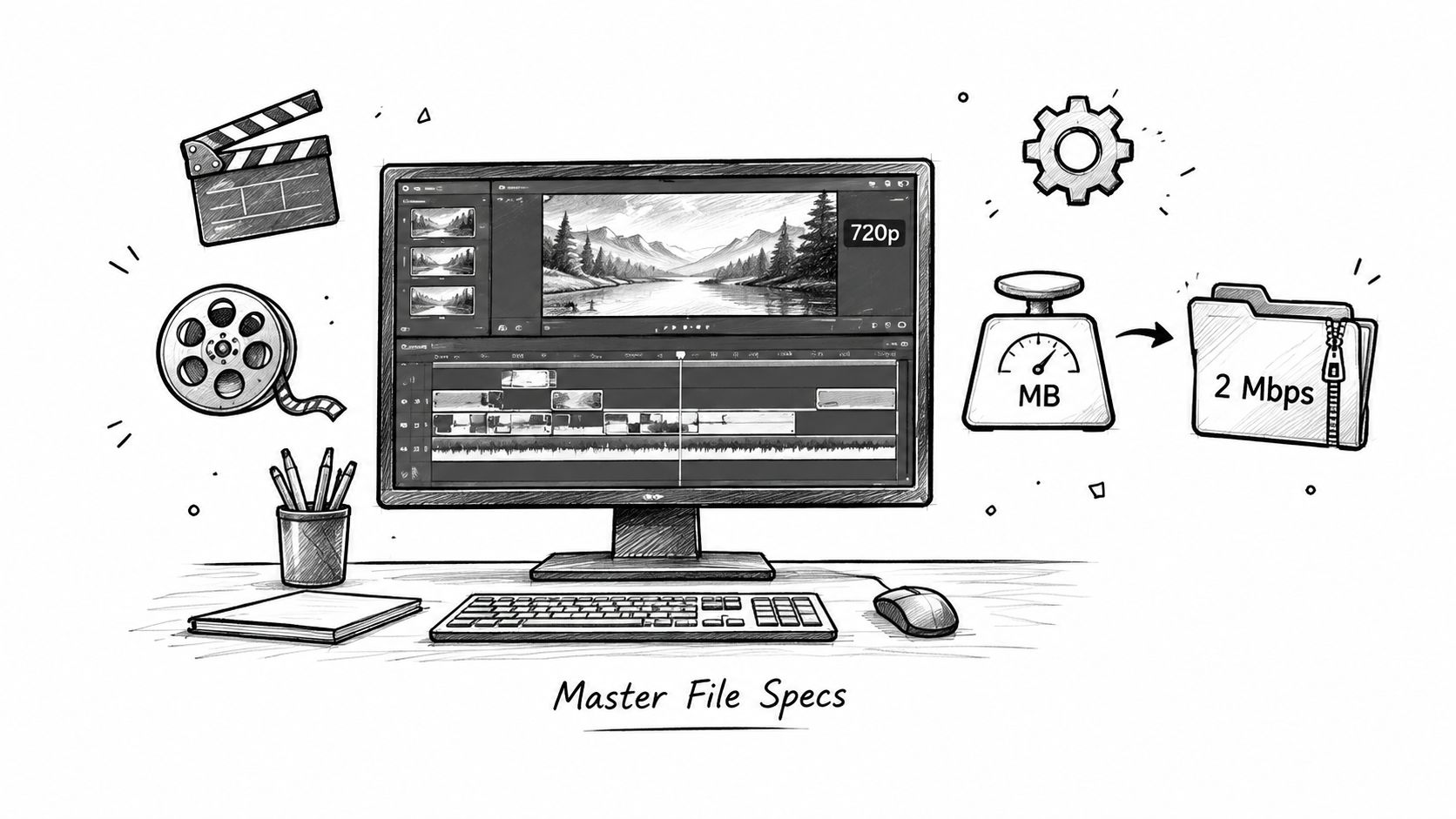
Keep the Email Light, Keep the Page Rich
File weight is a deliverability issue, not just a loading annoyance. Vidyard, citing Litmus guidance in its overview of video in email marketing, reports that well-optimized emails typically contain no more than 2.7 MB of images and warns that large files from unknown senders can trigger spam filters. Detailed 3D renders, layered cutaways, and room scenes are exactly the assets that blow past that limit if you drop in full-resolution files.
The fix is straightforward. Compress the thumbnail for the inbox and stream the full demonstration on the landing page. The shopper still sees the quilt detail and foam transitions in full quality, just one click later, where page speed and playback are under your control.
Production planning for other visual industries follows a similar discipline of shooting for the destination format first. The thinking behind a photography videography strategy for developers is a useful parallel, because it treats capture, edit, and placement as one plan rather than separate handoffs. Mattress teams should do the same with Digibun layer visuals, silhouettes, and room scenes, exporting email-weight and page-weight versions from the same master.
Captions and Alt Text Are Part of the Build
Captions aren't polish. Arizona State University's digital accessibility guidance for email says videos should be captioned, recommends avoiding text smaller than 14 pixels, and says content should remain usable when enlarged to 200%. Many recipients open email at work, in public, or on a phone with sound off, so your caption track has to carry the product claim on its own.
Write captions that name the specifics a shopper needs, material composition, firmness, height, warranty detail, or setup step. Add descriptive alt text to the thumbnail, concise benefit-led copy around it, and a transcript on the destination page. Then render-test Gmail, Outlook, Apple Mail, and major mobile clients before launch. Confirm the fallback image links correctly and the landing page loads fast on a real phone, not just office WiFi.
Production rule: If the email doesn't communicate the benefit with sound off, images blocked, and playback unavailable, it isn't finished.
Running A/B Tests That Actually Tell You Something
Most bedding teams don't have a testing problem. They have an attribution problem. They change the subject line, swap the thumbnail, rewrite the CTA, and then argue about which change caused the lift. Nobody knows, so the next send starts from opinion again.
Run the sequence one variable at a time. It takes a few more sends, but you'll build a playbook your team can reuse across launches, promotions, and retail events.
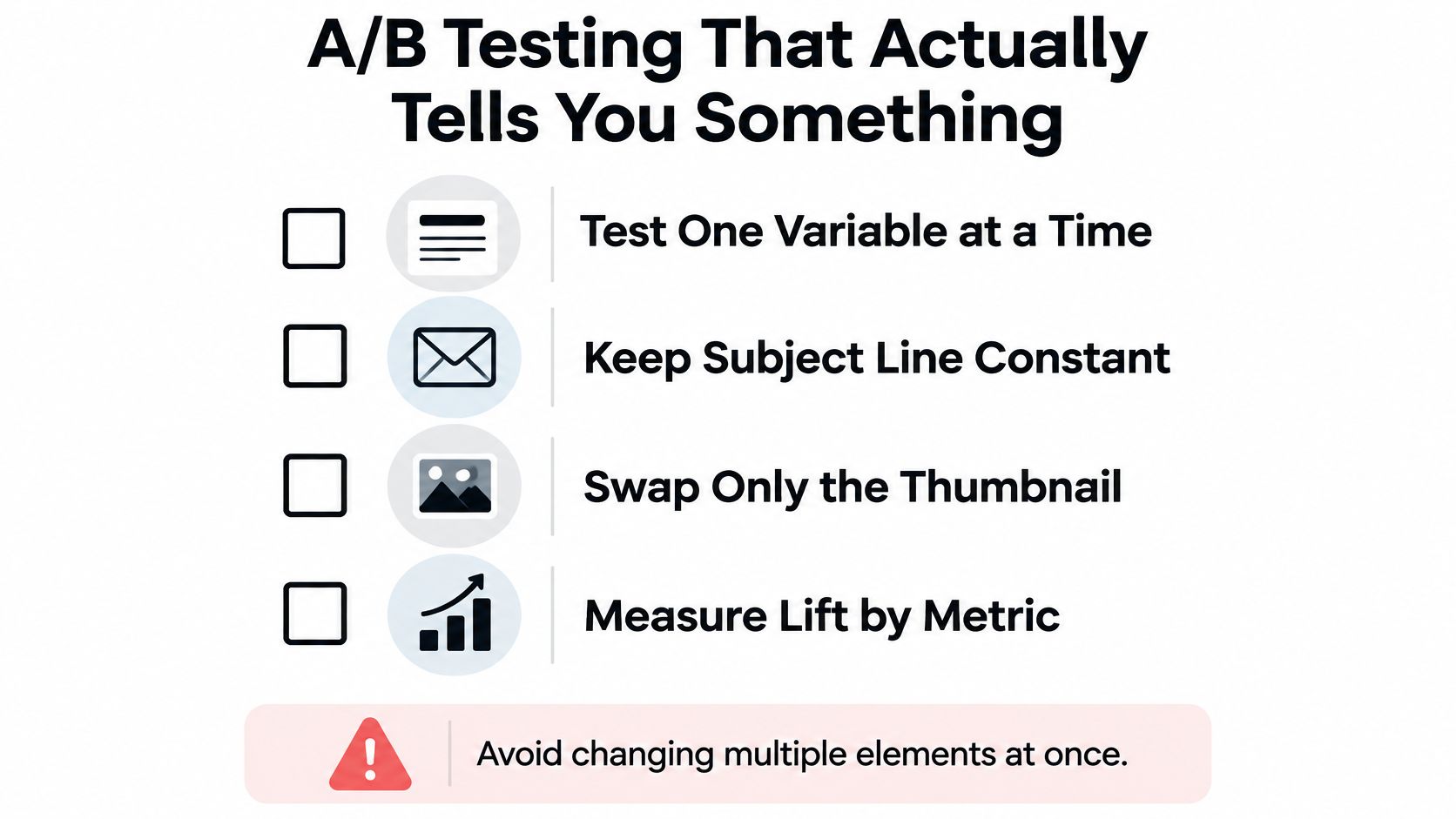
A Clean Four-Step Sequence
Subject line first: Test a video-signalling line like a gusset durability watch prompt against your feature-led control. Keep everything else identical and judge it on opens plus clicks, since a curiosity open that doesn't click isn't progress.
Thumbnail second: Pit a comfort-layer cutaway against a lifestyle room scene for the same hybrid. This tells you whether your segment wants proof or aspiration first.
CTA third: Try a construction-focused CTA against a demo-booking CTA. For wholesale and retail lists, that distinction often separates education seekers from buyers ready to talk margins and floor placement.
Landing page last: Test video position, headline match, and whether a persistent CTA stays on screen during playback.
Segment matters while you test. A thumbnail that wins with DTC cart abandoners may lose with retail prospects who've already tried the floor model. Run each test on a segment large enough to produce a meaningful sample, and don't declare a winner on open rate alone. Clicks, video starts, and downstream actions are where the money shows up.
Keep a simple test log with the hypothesis, the single variable, the segment, and the result. Over a quarter, that log becomes more valuable than any individual send because new hires and agency partners can see what your list responds to. Examples of structured campaign work in mattress marketing case studies show how documented tests compound into repeatable programs instead of one-off wins.
One caution from the floor. Don't test creative that your RSAs can't support in store. If the winning video makes a motion isolation claim, the showroom demo should recreate it, or shoppers will feel the gap the moment they lie down.
Metrics That Matter Beyond Open Rate
Open rate tells you the envelope worked. It tells you almost nothing about whether the video educated anyone or moved a sale forward. Mattress brands that judge Email Marketing Video on opens alone routinely keep winning subject lines attached to losing landing pages.
Build your reporting around the full chain instead:
Delivered rate: Confirms the send survived filtering and list hygiene issues.
Unique opens and clicks: Show whether the subject line and thumbnail earned attention.
Video starts: The first honest sign the landing page kept its promise.
25%, 50%, and 75% completion: Reveal where viewers drop off, which is gold for editing the next cut.
CTA clicks: Connect viewing to a concrete next step.
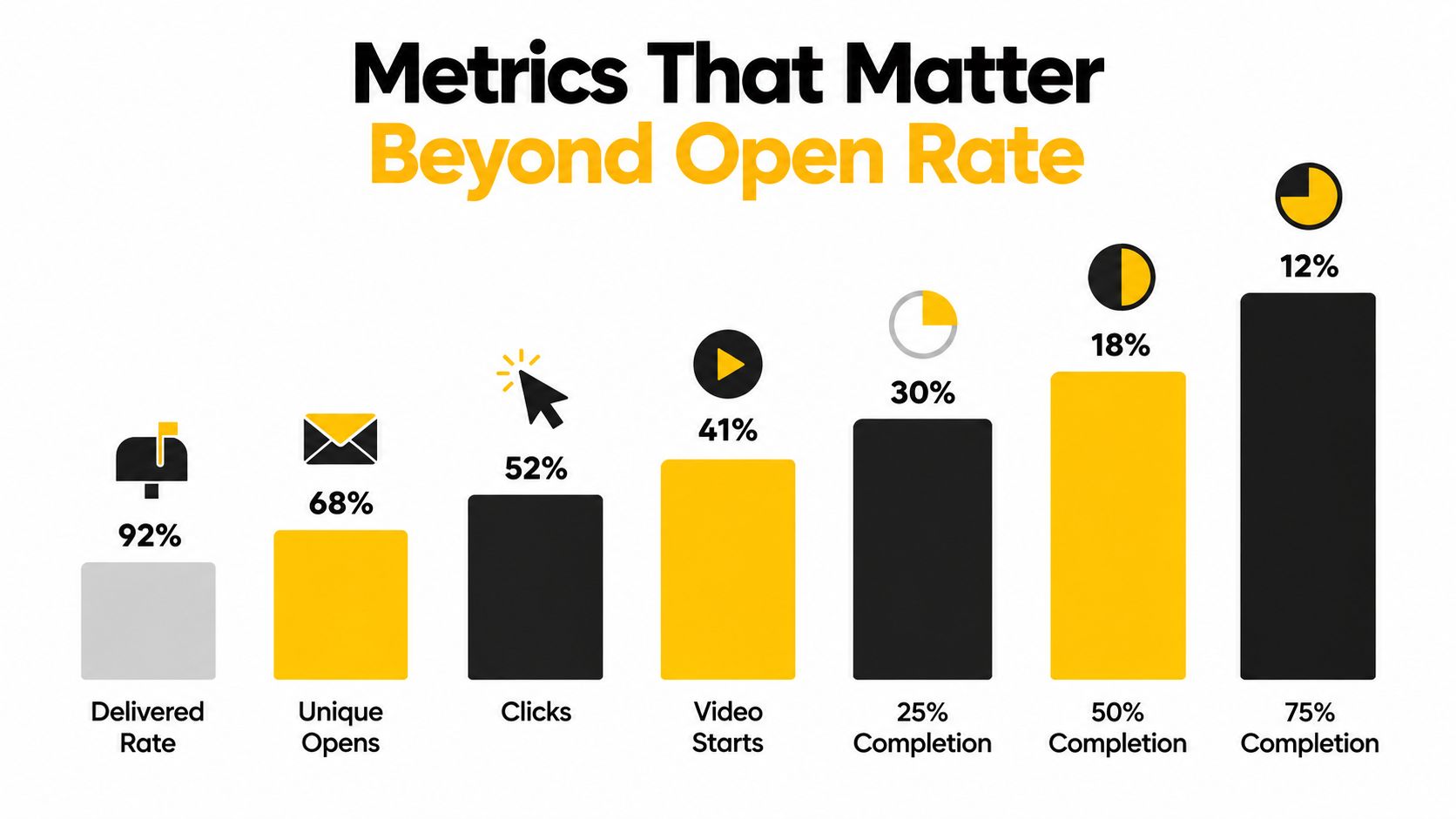
What a Real Comparison Shows
A ClickZ case study of email campaigns linking to video landing pages found the video campaign's click-through rate was six times higher than the first send and its click-to-open rate was four times higher. That's the headline many teams would celebrate. The more useful finding came after the click. The house list generated leads from 5% of clicks, compared with 2% for the third-party list, and adding a persistent call to action increased the share of leads from the video landing page, which produced 20% of leads on the house list versus 10% on the third-party list.
Read that as a bedding operator. Video can multiply clicks, but list quality and page design decide whether those clicks become retailer demo bookings, spec requests, or sales. A warm list of showroom visitors and past buyers will outperform a rented list even with identical creative. That's not a video insight. That's a list and landing page insight that video exposes faster.
Use the email to create interest, but judge the campaign on what happens after the click.
Set quartile drop-off reviews after every send. If viewers leave before the layer explanation finishes, your video is front-loading branding and back-loading proof. Move the construction payoff earlier, tighten the intro, and keep the CTA visible throughout so an convinced viewer doesn't have to wait for the end screen to act.
Your 30-Day Deployment Plan and Next Step
You don't need a platform migration to ship this. You need one campaign, one landing page, and four focused weeks.
Week one, audit and pick. Review your last several sends for heavy images, unsupported embeds, and CTAs below the fold. Choose one campaign type to rebuild first, a hybrid launch, a feature education send, a DTC welcome step, or a retail event invitation.
Week two, produce the system. Build the captioned video, compressed thumbnail, fallback image, alt text, transcript, and matching landing page as one package. Reusable 3D assets pay off here, since a Digibun layer breakdown can supply the thumbnail, the landing page visuals, and RSA training material from the same render set.
Week three, run the test sequence. Start with the subject line on a clean segment, then thumbnail, then CTA. Resist bundling changes even if a launch date is pressing, because a contaminated test costs you the whole quarter's learning.
Week four, review and lock the playbook. Read the full metric stack from delivered rate through downstream conversion, document what won by segment, and templatize the winning structure for the next launch or promotion. If you're mapping where outside help fits, the overview of mattress marketing services and 3D production support shows how strategy, rendering, and campaign execution connect under one roof.
Keep Learning With Other Bedding Operators
BEDHEAD built its accessible video email approach around mattress-specific assets, Digibuns, silhouettes, and room scenes, because bedding education fails when the visuals are generic. That focus on one category is the difference between a thumbnail that shows actual foam layers and one that shows a stock bedroom.
For ongoing peer learning, join the free Bedhead Network at BEDNET for mattress industry professionals. It's a hub for marketing insights, news updates, networking, training resources, an industry directory, and business tools, and it's free for mattress industry professionals who want to compare notes with manufacturers, retailers, and RSAs facing the same inbox problems.
Start with one send rebuilt the right way. A thumbnail that survives every client, a page that plays fast on mobile, captions that carry the claim with sound off, and metrics that go past opens will teach you more in a month than a year of embedded video experiments.
If you're evaluating how your current email creative holds up across Gmail, Outlook, and mobile, BEDHEAD can build the thumbnail, landing page, and captioned video system around your actual foam layers, ticking, and room scenes. Visit BEDHEAD to talk through your next launch, retail event, or welcome series and get a practical plan your team can ship this quarter.