Product Activation Marketing for Mattress Brands
A new mattress line is shipping in 90 days. Your sales reps have seen the renderings, three retail partners want floor-ready assets, and paid media is already consuming launch budget. Yet nobody can explain how a shopper will move from an ad impression to lying on the mattress, understanding the foam layers, trusting the ticking and gusset story, and choosing that SKU over the model beside it.
That gap is where product activation marketing earns its place. For mattress brands, activation isn't generic event promotion. It's the coordinated work that turns product interest into trial, qualified consideration, showroom conversion, and a more confident DTC purchase.
Why Mattress Brands Need a Real Activation Strategy
A mattress launch can look healthy in a marketing report while failing commercially. Search impressions rise, social posts collect attention, and retail partners receive polished launch materials. On the showroom floor, however, the associate may not know how to explain the new quilt, the floor model may be positioned poorly, and the shopper may leave without ever understanding why the hybrid mattress feels different.
Mattress buying has a physical problem that most product categories don't share. Shoppers want to lie down, change positions, compare firmness, inspect the cover, and understand how the construction relates to their sleep problem. A product page can explain the foam layers, but it can't fully replace the confidence created by a guided trial. A showroom can provide that trial, but only if the brand gives the retailer a usable story and a conversion path. Experiential retail works best when the physical interaction has a clear commercial purpose.
The showroom and DTC split
Retail and DTC also create different activation demands. A showroom needs associate confidence, floor model placement, signage, comparison logic, and a reason to capture shopper information before the customer reaches the register. A DTC page needs strong visualization, clear construction education, useful comparison tools, unboxing expectations, and reassurance around delivery and returns.
Poor activation creates expensive mismatches. A shopper may expect a lofty, soft surface from lifestyle photography and receive a more supportive feel in the home. That disconnect can contribute to returns, negative reviews, and additional handling costs. On the retail side, an impressive floor display that doesn't help an RSA identify the customer's need is decoration, not activation.
Practical rule: Every launch asset should answer one question, what should the shopper do next?
Activation provides the bridge between awareness and the first meaningful trial moment. It connects paid media to a showroom visit, a room scene to a product comparison, and a floor model conversation to an order. The ANA and PQ Media reporting from 2016 marked how brand activation expanded into relationship, influencer, promotional, content, experiential, and retailer marketing. The report described U.S. spending exceeding $560 billion in 2015, representing 59.8% of overall marketing expenditures, with projected growth to nearly $600 billion in 2016 and more than $740 billion by 2020. The lesson for bedding is straightforward. Activation is a commercial motion, not an optional event layer to add after the media plan is complete.
What Product Activation Marketing Means for Bedding
For a mattress team, product activation marketing is the deliberate set of physical experiences, digital content, and retail enablement activities that move an interested prospect toward first-hand product trial and purchase confidence.
That definition separates activation from awareness advertising. A paid social ad can introduce a new hybrid mattress. A product activation experience helps the shopper understand its construction, compare it with an alternative, lie on it, ask questions, and take a measurable next step.
Three activation environments
Physical experience includes floor model tryouts, guided in-store demonstrations, sleep consultations, pop-ups, mobile tours, and unboxing or sleep-trial moments. The physical experience matters because mattress value often depends on pressure relief, support, surface feel, motion response, and perceived temperature.
Digital experience carries the same story to the product page. A DTC shopper can explore a configurator, compare foam layers, watch an unboxing, inspect a silhouette render, or use a sleep quiz that recommends a construction. Photorealistic 3D assets can show a room scene for context, while Digibuns, layered images of the inside of a product, make hidden construction easier to understand.
Community experience equips the people who influence the purchase. That includes retail partner training, associate decks, sales scripts, sleep-coach content, review programs, and lifecycle messaging for shoppers who need more time before ordering.
The distinction becomes especially useful when reviewing results. Launch PR may create coverage. Paid media may create visits. A retailer event may create foot traffic. None of those outcomes proves that the shopper understood the mattress or moved closer to purchase.
A definition teams can use
Put this in the launch brief:
Product activation is responsible for creating and measuring the first meaningful product interaction that helps a qualified shopper understand, try, compare, or purchase the mattress. Awareness activity creates interest, while activation turns that interest into an observable commercial action.
For digital teams, the first meaningful action may be completing a sleep quiz or comparing two constructions. For retailers, it may be a guided lie-down test followed by a quote or lead capture. The important point is alignment. Creative, media, sales, and retail partners need the same definition of what “activated” means. Interactive product demos can help translate a complex mattress build into an experience shoppers can explore.
Planning an Activation Campaign From Pre-Launch to Post-Launch
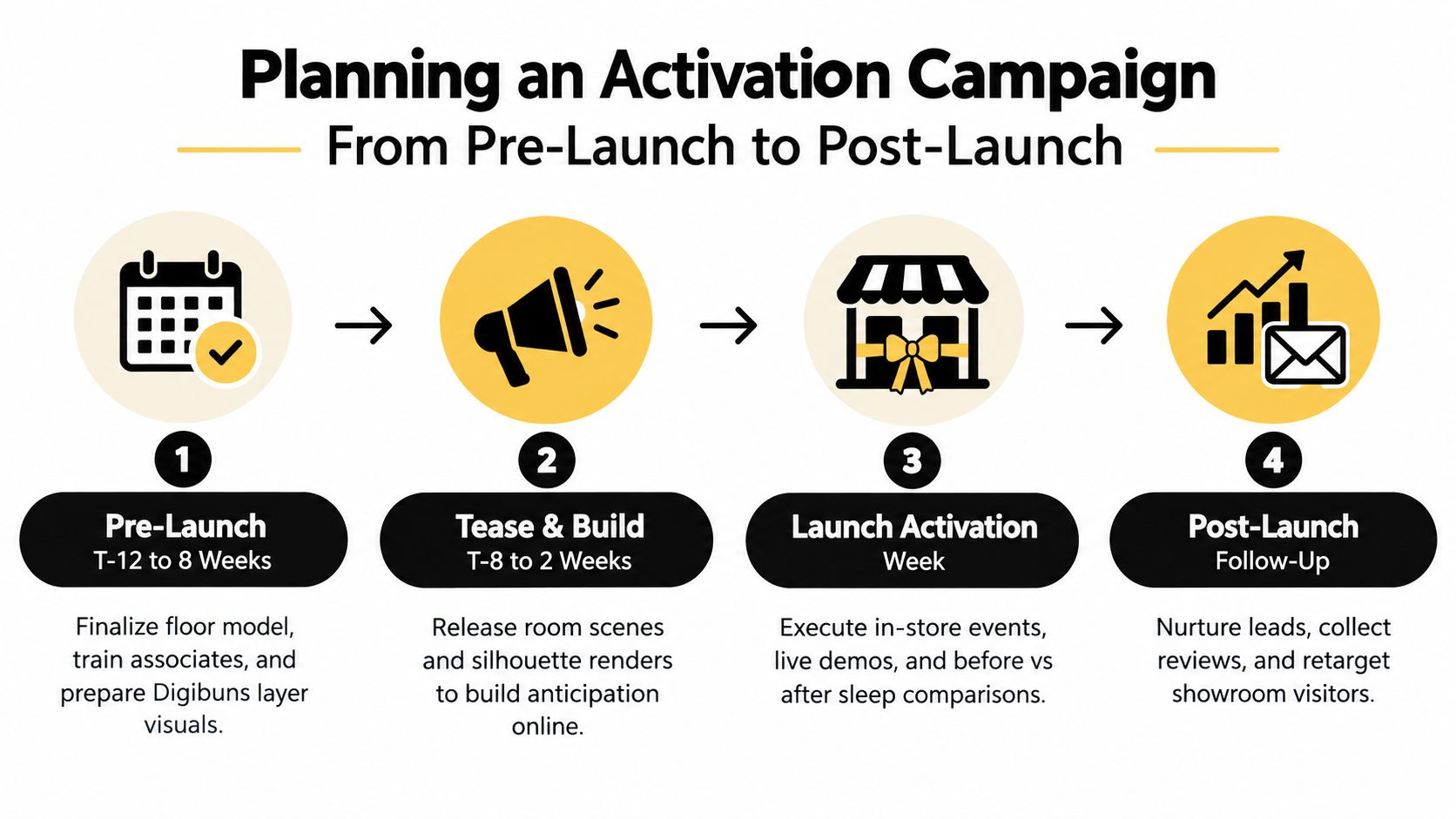
Mattress activation planning should follow the product calendar, not the event calendar. The floor model, associate knowledge, creative assets, media, and follow-up sequence need to arrive as one system.
Pre-launch from T-minus 12 to 8 weeks
Start by locking the physical product story.
Confirm the floor model: Finalize the mattress specification, ticking, quilt, gusset, height, foundation pairing, and retail placement.
Secure retail commitments: Identify which partners will host the model, support demonstrations, provide secondary placement, or participate in co-marketing.
Brief the tactile story: Give creative a clear explanation of what shoppers should notice when they touch, sit on, and lie on the mattress.
Build the training deck: Prepare the associate presentation and selling framework before samples ship.
Prepare the asset system: Create Digibuns for construction, silhouettes for clean commerce use, and room scenes for lifestyle context.
The usual failure happens here. The floor model arrives late, so training gets postponed. On launch day, the mattress is physically present but the associate can't connect the cover story to the customer's sleep concern.
Tease and build from T-minus 8 to 2 weeks
Use this window to make the product legible before the shopper sees it in person. Release room scenes, silhouette renders, short construction videos, comparison content, and retailer-ready email assets. The DTC product page should be usable before paid traffic scales, not assembled while the campaign is live.
A pre-launch email can introduce the sleep problem and the construction answer. A retail partner can receive a concise product card, associate talking points, signage, and a QR path to a deeper product explanation.
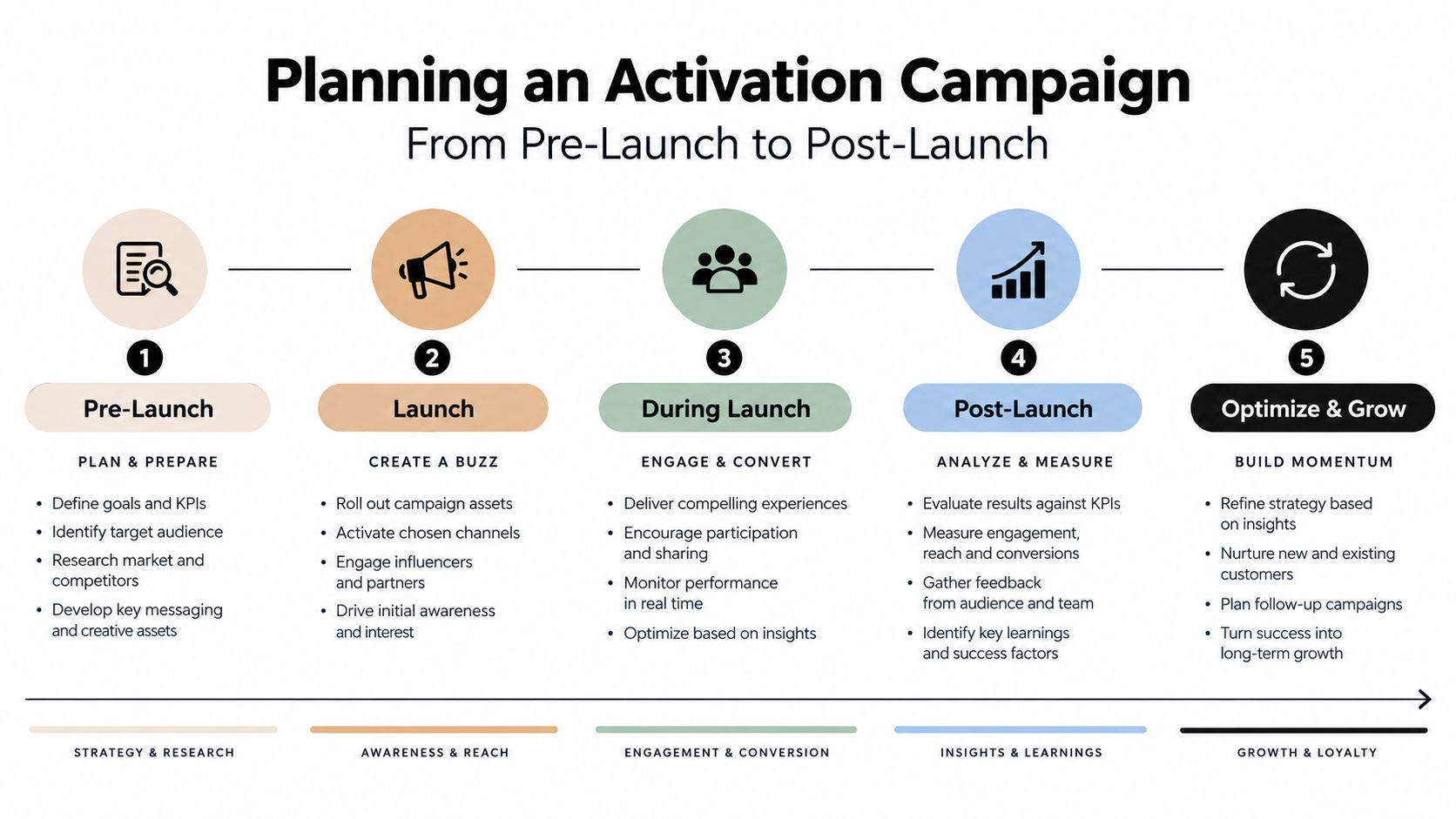
Launch window from T-minus 2 to launch plus 2 weeks
Run the in-store experience, DTC unboxing push, and retail co-marketing together. Review daily signals such as lead quality, quote activity, floor-model interaction, product-page engagement, and attach opportunities for pillows or bases.
The objective isn't to create the busiest event. It's to remove the friction between interest and a purchase decision.
Post-launch sustain from weeks 3 to 12
Keep the floor model refreshed and the digital story active. Publish comparison content against the prior generation, retarget shoppers who viewed the product or completed a sleep quiz, route qualified leads to the right retailer, and document which questions associates hear most often.
That learning should influence the next SKU. Product introductions benefit from a disciplined new product introduction process, especially when manufacturing, retail, and DTC teams need to communicate the same value proposition.
Activation Formats That Work for Mattress Brands
The right format depends on the sales channel, the product's proof requirement, and the action you need from the audience. A premium mattress may need guided comparison and associate advocacy. A DTC launch may need strong unboxing content, a timed offer, and a product page that makes construction understandable without a salesperson.
Activation Format | Best Use Case | Cost Band | Primary KPI | Common Failure |
|---|---|---|---|---|
Pre-launch seed unboxings | Building credible product understanding with editors, sleep coaches, or creators | Lean to mid-range | Qualified content and branded consideration | Sending product without a briefing, tracking, or follow-up |
Sample-drop DTC kits | Giving shoppers a low-friction way to explore materials or comfort elements | Lean to mid-range | Sample redemption and SKU-assisted orders | A discount code with no useful product education |
Retail floor-model takeover | Improving sell-through at a partner showroom | Mid-range | Floor-model conversion and lead quality | Attractive displays without associate training |
Pop-up sleep lab | Creating guided trial in a high-foot-traffic market | Mid-range to flagship | Qualified leads and assisted orders | Optimizing for attendance rather than purchase intent |
Livestreamed factory tour | Explaining materials, workmanship, and construction | Lean to mid-range | Engaged viewers and product-page actions | Production value that never connects to a SKU |
ISPA EXPO or Las Vegas Market activation | Supporting trade relationships and wholesale demand | Mid-range to flagship | Qualified buyer meetings and commitments | Treating the booth as a static showroom |
A product demo doesn't need to be complicated. Teams developing digital or retail demonstrations can browse product demo templates for ways to structure guided product education, then adapt the format to show a mattress's layers, feel, and use case.
Match the format to the commercial job
Sampling can create trial, but it won't fix a weak product page. A pop-up can generate leads, but it won't compensate for poor retail routing. A trade show activation can help secure buyer attention, yet its value depends on follow-up quality and the retailer's ability to turn interest into floor presence.
The strongest programs combine formats. A seed unboxing creates content, a DTC landing page captures demand, and a showroom activation gives shoppers the physical proof they still want. Augmented product education can support that connection, particularly for retailers exploring augmented reality in retail stores.
Running an In-Store or Showroom Activation That Converts
A showroom activation succeeds when the associate can move a shopper through a simple sequence without making the conversation feel scripted. The bed needs to be easy to find, easy to compare, and easy to understand.
Before the event
Train associates on the new ticking, quilt, gusset, foam layers, edge support, and intended sleeper profile. Don't give them a specification sheet and expect a sales story to emerge. Convert each construction detail into a customer-relevant explanation, such as how the surface feel relates to pressure relief or why a hybrid design may suit a shopper who wants both contouring and support.
Use a clear physical setup:
Place a value anchor nearby: A premium model becomes easier to evaluate beside a relevant alternative, not hidden in isolation.
Create a signage hierarchy: Lead with the sleep problem, follow with the construction answer, then show the next action.
Add a scan-to-save path: Let shoppers save the product, request a quote, or receive follow-up without walking to the register.
Put the tablet beside the bed: A sleep diagnostic quiz works better at the moment of comparison than at a remote kiosk.
During the interaction
The first conversation should identify the sleeper's problem before presenting the product. Move from greeting to sleep history, then to a guided lie-down test, side-by-side comparison, construction explanation, and a specific next step.
A useful 60-second pitch connects the cover story to the stated need. If the shopper mentions heat, the associate can explain the relevant surface materials and construction without making unsupported performance promises. If the shopper wants a firmer edge, the associate can point to the design elements that address support and invite a comparison.
Capture the email and sleep profile at the bed, not at the register. The information is most useful when it is tied to the model and the shopper's stated concern. For QR-based retail engagement, teams can also find BonusQR retail solutions as one option for connecting scans with follow-up actions.
After the event
Route leads the next day, record offer or sample redemption, and align associate incentives with qualified activity and completed sales rather than raw scans. Review which questions stalled the conversation and revise the training deck while the experience is still fresh.
Measuring Activation ROI Beyond Foot Traffic
Foot traffic is an input. It isn't a business result. A CFO needs to see whether the activation produced qualified demand, incremental sales, profitable attachments, and acceptable return behavior.
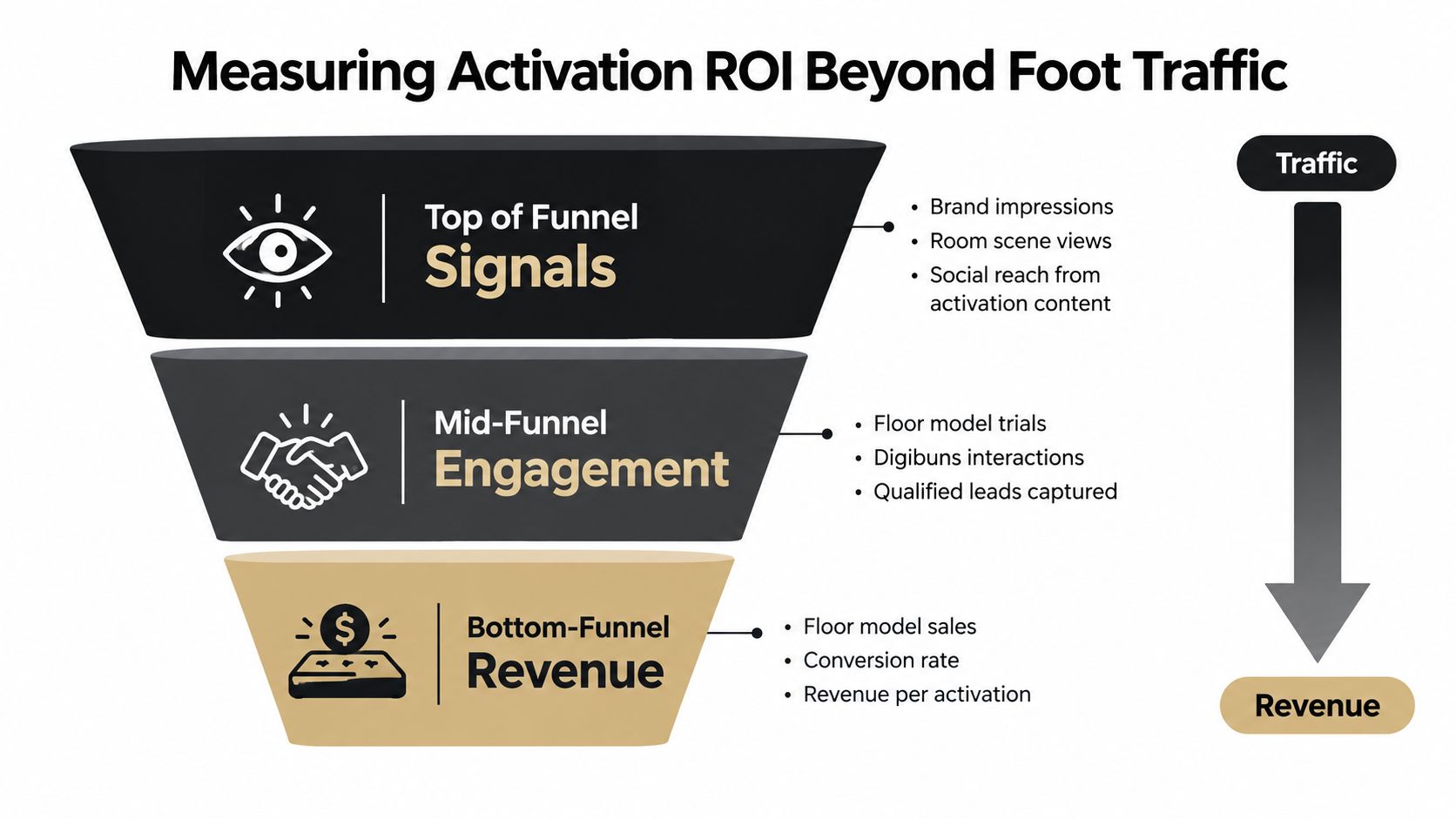
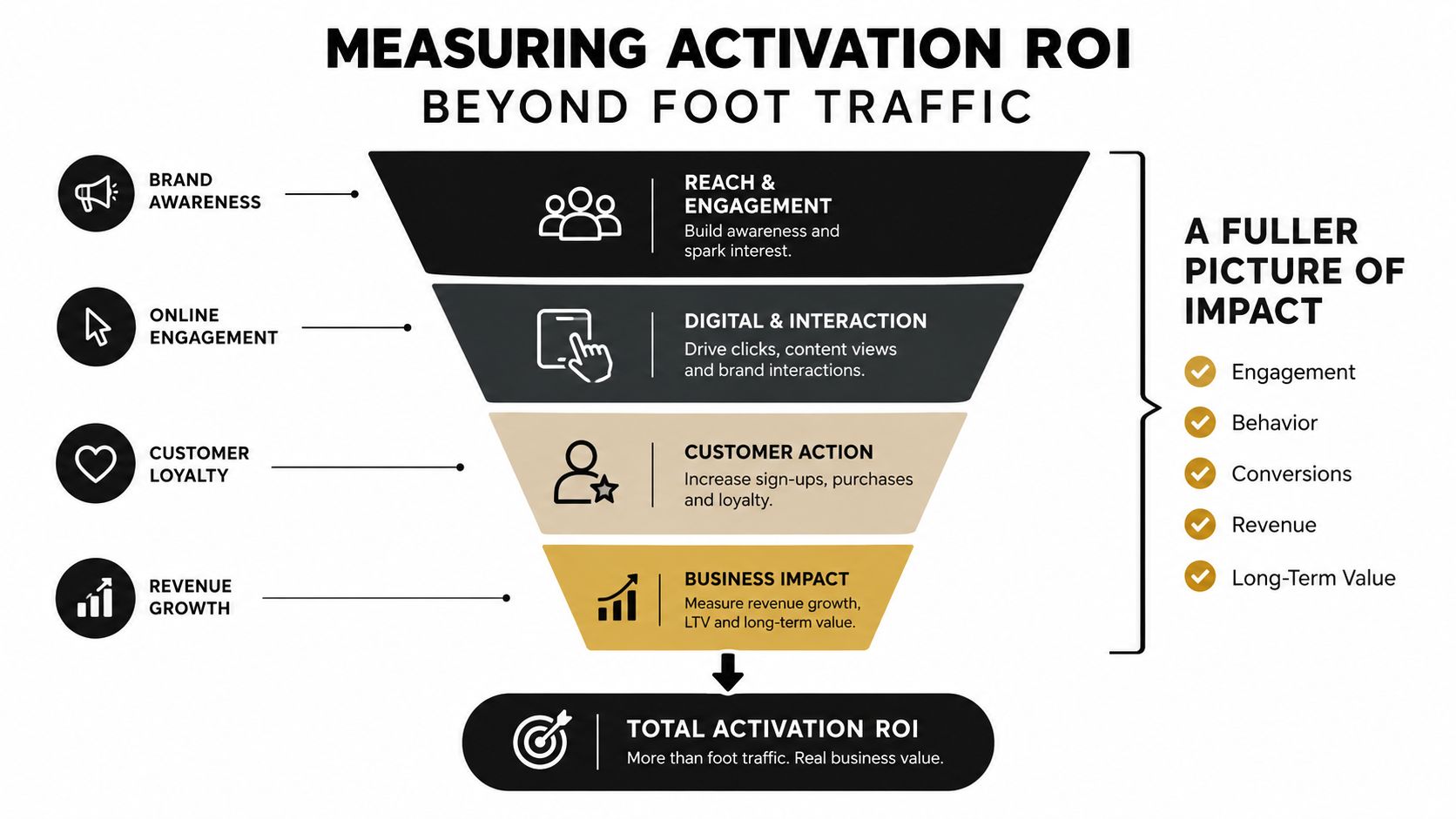
Build a three-level measurement model
Top-of-funnel signals show whether the activation created attention that can be tracked. Use brand search activity, direct visits, branded mention volume, room scene views, and content engagement. These signals help explain reach, but they shouldn't carry the revenue claim.
Mid-funnel signals show whether shoppers interacted with the product. Track sleep quiz completion, time on the floor model, Digibuns interactions, sample redemption, lead-to-quote rate, and the percentage of captured leads that meet the target shopper profile.
Bottom-funnel signals connect the experience to commercial performance. Track units sold per activation day, floor-model conversion, pillow and base attach rate, net revenue after discounts, and returns over the relevant trial periods. Compare participating stores with a sensible baseline or control group where possible, while accounting for shared promotions and overlapping media.
The Umbrex guidance on in-store sampling and shopper activation emphasizes collecting sales data before, during, and after the event, then calculating conversion and ROI against a baseline. That approach matters for mattresses because a busy Saturday may reflect existing store demand rather than incremental activation impact.
Use a margin-aware formula
A practical calculation is:
Activation ROI = (incremental net revenue minus activation cost, discount cost, fulfillment cost, and expected return cost) divided by activation cost.
The formula is only useful if the inputs are consistent. Separate organic store demand from activation-generated demand, tag shared promotions, and assign leads to the correct retailer or DTC path. Don't count a full-price order as purely incremental if the shopper would likely have purchased without the event.
For digital trials, cohort measurement prevents teams from mixing shoppers with different signup dates or trial lengths. In product-led measurement, the activation rate is calculated as activated users divided by trial signups, while median time-to-activation helps identify whether the experience is reaching value quickly. Monetizely's activation methodology describes why cohort reporting and a product-specific “aha” action are stronger than simple login activity. The mattress equivalent is a defined action such as completing a guided comparison, booking a showroom appointment, or placing an order after a qualified product interaction.
Budget and Timeline Templates You Can Actually Use
Activation budgets should start with the sales motion, not the desired spectacle. A showroom-led brand needs trained associates, floor execution, lead routing, and retail support. A DTC brand may place more weight on product education, creator seeding, landing pages, paid media, and lifecycle follow-up.
The tiers below are planning ranges, not promises. Actual costs vary by geography, retailer requirements, production scope, staffing model, delivery needs, and the number of markets involved.
Tier | Total Budget | Top Line Items | Timeline (Weeks) | Best For |
|---|---|---|---|---|
Scrappy pilot | Under $10K | Focused paid media, limited showroom staffing, essential creative, small sampling or trial units, basic nurture | 10 to 14 | Testing one SKU, one market, or one retail partner |
Mid-market program | $25K to $75K | Geofenced media, retail staffing, 3D and video production, sampling, partner support, lead nurture, reporting | 10 to 14 | Coordinated showroom and DTC activation |
Flagship launch | $100K+ | Multi-market media, pop-up or sleep lab, extensive production, creator or influencer seeding, delivery logistics, staffing, remarketing | 10 to 14 | Major line launch or broad retail rollout |
What belongs in every tier
The scrappy pilot still needs a defined KPI, trained staff, a usable product page, tagged lead capture, and a follow-up sequence. Cutting measurement doesn't make the activation lean. It makes the spend harder to defend.
A mid-market program can add paid search, Meta campaigns, retail co-marketing, Digibuns, silhouettes, room scenes, comparison videos, and a structured email or SMS nurture path. A flagship program may support pop-up sleep labs, livestreamed factory content, white-glove delivery for influencer seeding, and multiple retail markets.
Some line items flex:
Media geography: Geofenced spend can expand or contract around participating stores.
Creator fees: Influencer participation can be replaced with editorial seeding or owned content.
Production depth: A focused 3D asset package may be more useful than a large event film.
Some line items don't disappear:
Compliance review: Product and offer claims still need review.
Returns handling: Trial mattresses require a defined process for pickup, inspection, and disposition.
Floor model depreciation: Retail partners need clarity on how display wear and replacement are handled.
Saturday staffing: Showroom programs may require premium staffing coverage when weekend traffic is highest.
De-installation: Pop-ups and temporary displays need a removal plan, not just an installation budget.
A workable calendar
Weeks 1 through 4, pre-launch: Lock the floor model, retail commitments, product claims, creative brief, associate training, landing page, tracking plan, and lead-routing rules.
Weeks 5 through 8, tease and build: Release room scenes, silhouettes, construction visuals, product education, creator kits, retailer emails, and paid campaigns designed to drive a specific activation action.
Weeks 9 through 10, launch window: Run the showroom experience, DTC activation, partner promotion, daily reporting, offer tracking, and associate feedback loop.
Weeks 11 through 14, sustain and decide: Complete de-installation where needed, run remarketing, route remaining leads, review returns and attachments, and compare results with the original KPI.
Pick the launch-week KPI before you approve the budget. Then choose one activation format that matches your channel mix. Showroom-led brands should pilot the in-store conversion checklist first. DTC brands should pilot a digital activation tied to a specific SKU and discount ladder. Set a 30-day decision point to scale the winning format or cut it.
Bedhead Marketing combines mattress-specific product activation with 3D assets, SEO, paid media, product-page optimization, brand development, and sales training. For ongoing industry resources, BEDNET, the free Bedhead Network, connects mattress professionals with marketing insights, news updates, networking, training resources, an industry directory, and business tools.
If your next mattress launch needs a clearer path from ticking and foam-layer education to floor-model conversion or DTC purchase confidence, BEDHEAD can help build the activation strategy, visual assets, product-page experience, and sales training around that path. Visit BEDHEAD to discuss the SKU, channel mix, and KPI you need to defend before launch.