How to Optimize Title Tags for Mattress Product Pages
Google displayed a title different from the supplied HTML title tag for 33.4% of 953,276 top-ranking pages in an Ahrefs title-tag study. If you're deciding how to optimize title tags for a mattress catalog, that changes the assignment. You're not writing a guaranteed search headline. You're creating a clear product description that needs to work even when Google changes its wording.
For mattress marketers, the key question is whether a searcher can distinguish your medium-firm hybrid from the next listing before clicking. Treat each title as a test variable, not a permanent label, and judge it by qualified visits rather than whether you've filled an SEO field.
Title Tag Rules at a Glance
Say your queen hybrid product page has strong photography, detailed specifications, and competitive pricing, but attracts fewer clicks than a competing listing. Before replacing the imagery, inspect the search result. A title built around an unfamiliar model code may tell shoppers nothing about construction, firmness, or fit.
The title tag is the HTML element, not a guarantee of the clickable headline Google will display. Google's title-link guidance recommends a specified title for every page, with wording that's unique, clear, concise, and accurate.
Title tag rules and mattress examples
Element | Guideline | Mattress example |
|---|---|---|
Length | Aim for a tested range of about 50-60 characters as a starting point; Google truncates by display width | Queen Hybrid Mattress with Cooling Foam |
Primary topic | Put the product or category name first | Hybrid Mattresses for Side Sleepers |
Differentiator | Use one concrete attribute, such as firmness, materials, or use case | Medium-Firm Hybrid with Pocketed Coils |
Brand | Place at the end and test before making it default | Hybrid Mattresses for Side Sleepers - Brand |
H1 match | The visible H1 covers the same subject as the title | H1 reads Queen Hybrid Mattress with Cooling Foam |
Uniqueness | No two distinct pages share a title | Twin XL Memory Foam vs Full Memory Foam |
Language | Match the language and script of the page | English title on an English product page |
Avoid | Remove generic labels, boilerplate, and exaggerated claims | Home, Profile, Best Mattress Ever |
Treat the length range as an editing starting point, not a Google requirement. Display width and the search environment affect what fits, so a character counter can't promise that every word will appear.
Practical rule: Keep the words a shopper needs to identify the mattress. Remove the words your team added because the field had room.
Language consistency deserves the same attention as product accuracy. Google's localization guidance recommends matching the title's language and writing system to the page's main content.
Use the table as a checklist, not a formula. A title can satisfy every row and still disappoint if the landing page describes a different product or makes the promised attribute difficult to verify.
Write and Audit Title Tags Step by Step
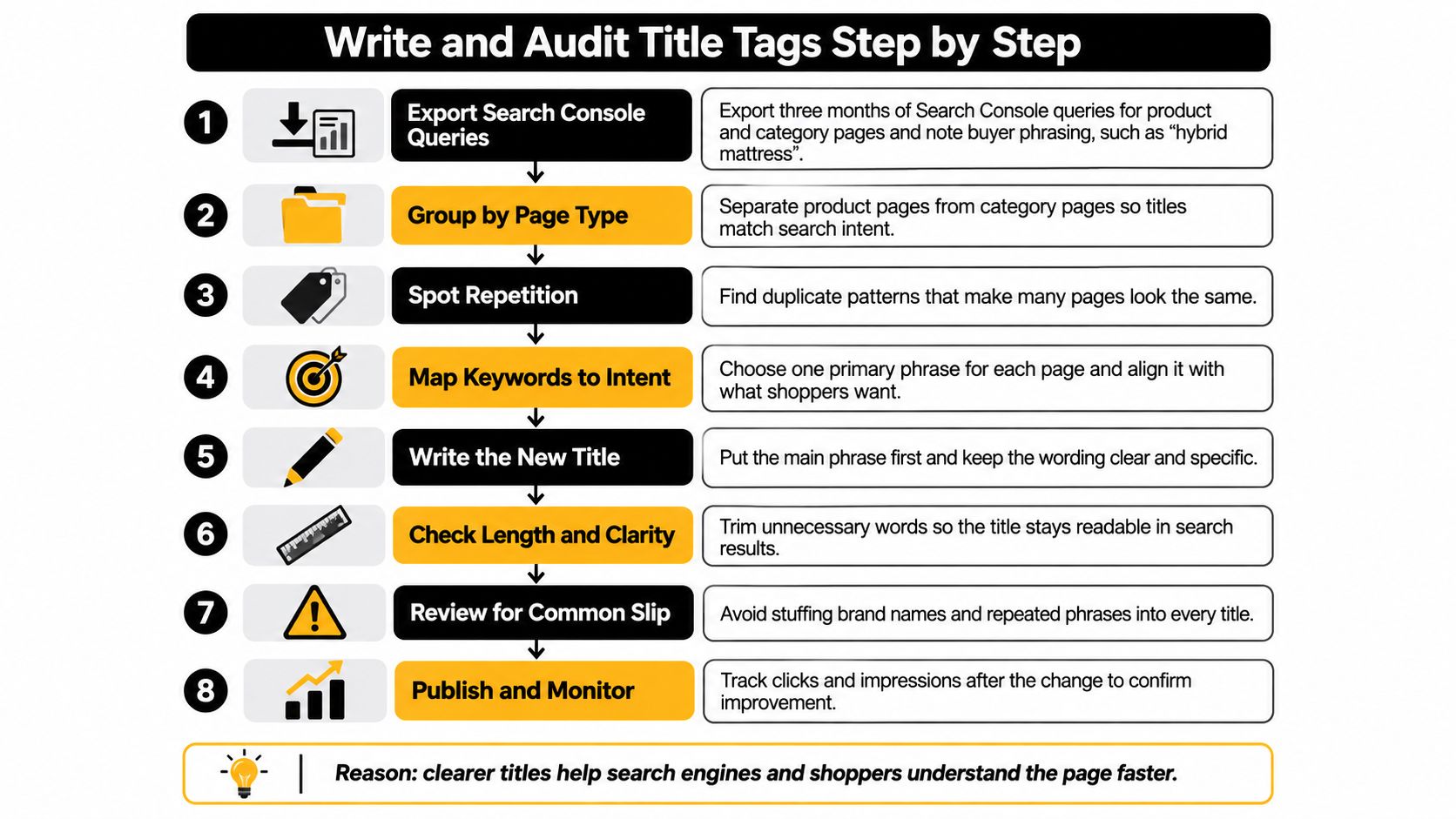
Start with an export, not a blank title field. You need to know which pages appear in search, how shoppers describe their needs, and whether the page answers those needs.
Keep product pages separate from category, firmness, and component pages while working. A shopper comparing hybrid mattresses needs a different destination from a purchasing manager sourcing pocketed coil units.
Build the audit around buyer language
Export three months of Search Console queries. Filter for product and category URLs, then record phrases such as hybrid mattress for side sleepers, rather than relying on internal merchandising names. The common slip is copying model codes into titles even when shoppers don't search for them.
Sort for high impressions and weak click-through rate, then choose ten commercially important pages. Include a hybrid, a foam mattress, and a component page so the audit doesn't become an exercise in polishing only the top seller. Use margin, inventory, and lead value to decide which opportunities deserve attention.
Inspect the visible H1 and opening copy. Google's SEO Starter Guide explains that title links can come from the title element, headings, and other prominent page text, so conflicting descriptions leave Google alternative wording to use. A vague H1 built around a collection name is the common slip, especially when the SEO title promises a specific construction.
Lead with the product or category, followed by its strongest supported distinction. For example, Medium-Firm Hybrid Mattress with Pocketed Coils communicates more than Discover Your Perfect Night. Avoid putting introductory sales language ahead of the product.
For help separating buyer vocabulary from factory terminology, use BEDHEAD's explanation of what keyword research involves. A query about foam layers may indicate product comparison, while a query about foam supply belongs with a manufacturing audience.
Write, verify, and record
Add the brand selectively. Start with a trailing brand on brand-destination pages, and flag its placement for testing rather than appending it everywhere. The slip is allowing a long brand suffix to crowd out the feature that separates neighboring models.
Count characters and inspect a pixel-based search preview, using about 50-60 characters as a starting target, not a hard cap. Read the proposed title aloud and check what remains if the ending disappears. Don't delete an essential material or firmness detail just to make a preview indicator turn green.
Compare the draft against adjacent catalog records. Separate different pages by meaningful fields such as size, construction, or firmness, rather than adding random adjectives. Identical model titles across distinct SKUs are the common slip.
Log the old title, publication date, hypothesis, and displayed search title. Change one variable per page and schedule an initial review after three to four weeks, extending the observation window when traffic is sparse. Changing several elements together makes the result difficult to interpret.
For Shopify catalogs, Yassine Malti's Shopify metadata guide is a useful companion when organizing metadata work at scale. Keep a separate exception list for products whose records don't contain enough information to generate a useful title.
BEDHEAD's website design and 3D visualization services for mattress and bedding brands connect these decisions to the actual page. The title, visible product name, and displayed construction should describe the same mattress.
Title Templates for Mattress Product and Category Pages
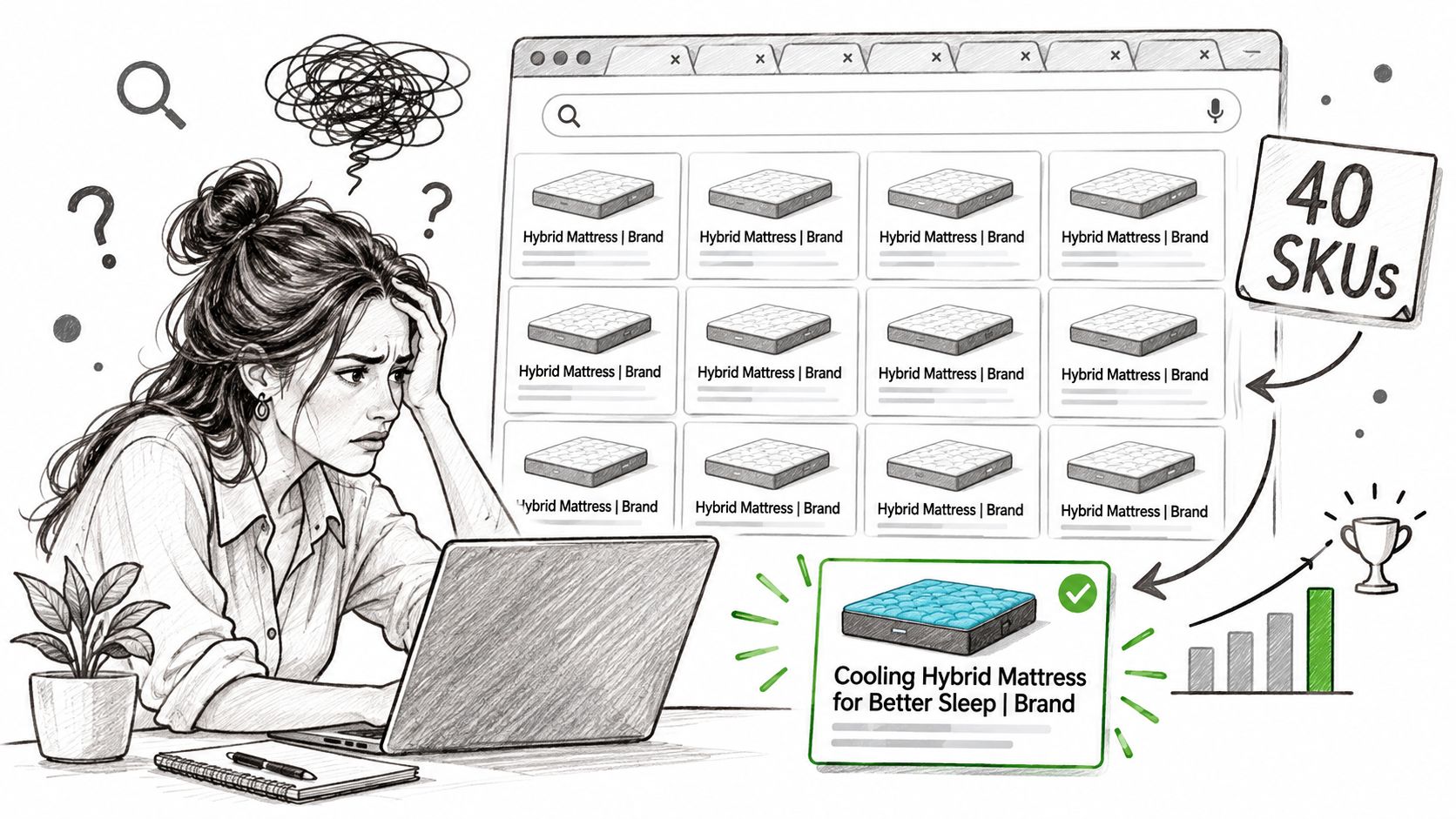
Consider a manufacturer with 40 hybrid SKUs, all carrying the hypothetical title Hybrid Mattress | Brand. The titles don't explain which model uses a plush quilt, which has a firmer comfort package, or which belongs in a retailer's opening price tier.
The problem isn't a missing synonym. It's a missing merchandising distinction. Write templates around the information buyers need to separate products, not around how many keywords fit.
Title templates by mattress page type
Page type | Template | Example |
|---|---|---|
Product page | Model + key attribute + material | Queen Hybrid Mattress with Cooling Foam |
Category page | Category + sleeper or need | Hybrid Mattresses for Side Sleepers |
Firmness tier page | Firmness + construction | Medium-Firm Hybrid Mattresses |
Component supplier page | Component + buyer | Pocketed Coil Units for Mattress Manufacturers |
Choose the distinction that helps the buyer
A named product can retain its model identity without becoming unreadable. A hypothetical Harbor Medium-Firm Pocketed Coil Mattress gives a model name context; an unexplained alphanumeric code doesn't.
For category pages, use audience or need only when the assortment supports it. A side-sleeper category should offer an intentional selection, not every hybrid in the warehouse. Firmness-tier pages need the same discipline: don't label a mixed assortment medium-firm just because the phrase attracts relevant searches.
Component titles require a different vocabulary. A buyer sourcing ticking, quilt panels, gusset materials, or pocketed coil units needs to recognize the component and its intended application, not a consumer sleep promise.
For a retailer's showroom listing, keep the product and distinction first. Add local context when the page supports a store visit, with availability, floor-model details, and a clear location. Don't imply that shoppers can try a model that isn't on the floor.
A useful template preserves the difference a salesperson would explain when a shopper asks why these mattresses aren't interchangeable.
Scale through product records, not copy-and-paste
Build the title template from CMS fields such as model, key attribute, and material. Give missing fields a clean fallback so a new SKU doesn't publish with empty separators or repeated words.
Reserve manual overrides for priority traffic pages or products whose positioning doesn't fit the standard pattern. Then inspect the rendered in the page source and verify that the H1 template uses compatible product fields.
For mattress-specific design context, Operosus web design for Purple is a relevant reference to review alongside your catalog decisions. Use design examples to assess presentation, not as a reason to copy another brand's metadata.
The final check belongs on the destination page. BEDHEAD's guide to product detail page optimization helps frame that review: if cooling foam is the reason to click, shoppers should be able to locate and understand that foam layer after arriving.
Why Google Rewrites Titles and How to Respond
A 2022 Zyppy analysis examined 80,959 title tags across 2,370 websites worldwide and reported that Google rewrote 61.6% of desktop search titles, while the separate study noted earlier found a 33.4% rewrite rate across 953,276 pages. Those aren't interchangeable benchmarks. Dataset, date, query environment, and methodology can change the measured rate.
The practical response isn't to chase a supposedly rewrite-proof character count. Write a title whose essential meaning survives editing, then inspect the headline shoppers see.
Rewritten title symptoms, causes and fixes
Symptom | Likely cause | Fix |
|---|---|---|
Google shows the H1 instead of the title | Title and H1 describe different subjects | Rewrite the title to match the H1 subject |
Title is cut off in results | Title is too long for the pixel width | Lead with the product and drop filler words |
Google shows body text or anchor text | Title is vague or generic | Replace generic labels with a specific product description |
High impressions, low clicks, title shown as written | Title does not state a differentiator | Test one differentiator such as firmness, material, or sleep position |
Diagnose the result, not just the SEO field
Treat these causes as working hypotheses, not proof. A rewritten title doesn't automatically mean your original was poor, and an unchanged title doesn't mean it's effective.
Also distinguish truncation from rewriting. If Google displays the beginning of your title and cuts off the ending, the immediate task is prioritization. If it substitutes a collection heading, inspect the page's competing descriptions.
For a mattress category, an acceptable rewrite may preserve construction and audience while dropping repetitive branding. A concerning rewrite might substitute a promotional banner that describes a temporary sale instead of the category.
Judge the displayed title by whether the right buyer can identify the right destination, not by whether Google preserved every word.
When clicks are weak, inspect the whole search listing before blaming the headline. Review the surrounding message using these meta description best practices, but keep description changes separate from a title-only experiment.
Check priority pages monthly and record the displayed title beside the submitted version. Include the query and device context so your team doesn't mistake different search conditions for a response to its latest edit.
Testing Title Changes Without Losing Rankings
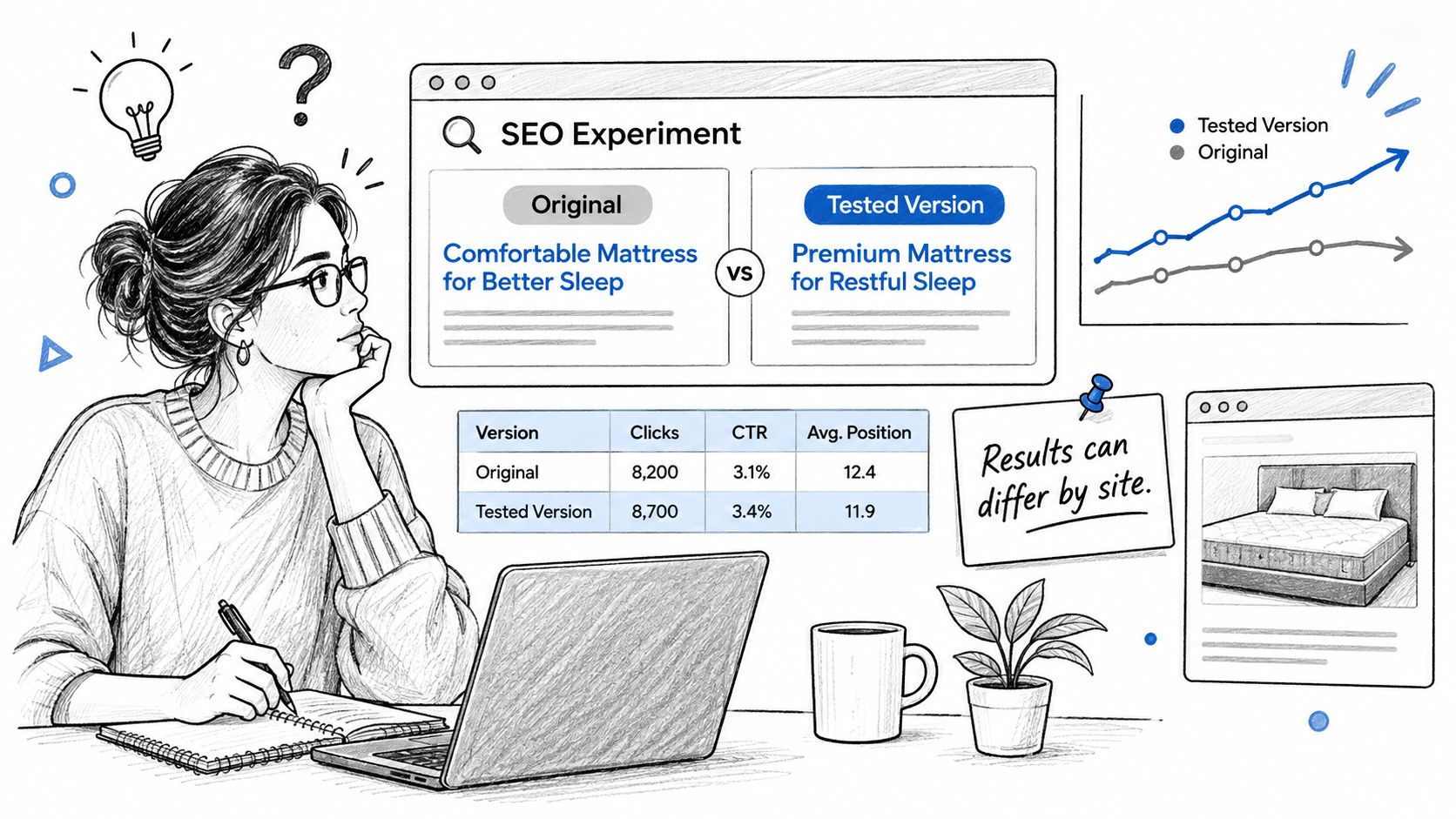
Putting the brand first isn't automatically safer or stronger. A Semrush experiment reported a statistically significant negative traffic effect after moving the brand name to the front of listing-page titles; its published title-tag testing discussion also describes the contrasting improvements below.
These are site-specific findings, not forecasts for your mattress business. They justify testing low-information wording before redesigning an entire title system.
Published title tag tests and what they show
Test | Reported result | What to take from it |
|---|---|---|
Remove unnecessary numbers from titles | 7.3% more organic clicks over three weeks | Strip arbitrary years and counts unless they match a real search term |
Remove call to action from product-page titles | Estimated 6.6% more clicks | Keep the product and differentiator instead |
Move brand name to front of listing-page titles | Statistically significant negative traffic effect | Test brand placement; don't default to Brand | Keyword |
Protect the comparison
Establish a baseline for impressions, clicks, click-through rate, and ranking position on high-impression pages with weak clicks. Record the query mix as well, because a page that starts appearing for broader searches may gain clicks while its overall CTR falls.
Use a narrowly stated hypothesis: Removing Shop Now will leave more room for firmness information. Hold the H1, product copy, imagery, and offer constant while testing the title.
Where your catalog supports it, compare a changed group with similar unchanged pages. A before-and-after comparison alone can't reliably separate the title's effect from promotions, seasonal demand, or broader search changes.
Keep commercial outcomes in view
Retain a change only when clicks improve without a material decline in qualified traffic, rankings, or conversion rate. For direct-to-consumer pages, inspect product engagement and purchases; for component suppliers, inspect relevant inquiries rather than raw visit counts.
Position matters: Don't compare CTR across substantially different ranking positions and attribute the difference entirely to copy.
Merchandising matters: A sale, stockout, or changed delivery promise can affect buyer behavior during the test.
Expectation matters: Adding side sleeper may attract clicks, but the product must support that positioning.
A title test can reduce avoidable uncertainty, but it can't guarantee unchanged rankings. BEDHEAD's guide to improving click-through rates provides additional context for evaluating clicks without treating them as the only business outcome.
Next Steps and Free Bedhead Resources
For the coming month, keep the assignment small enough to finish and document. A focused audit is more useful than rewriting the entire catalog without a way to judge the outcome.
Run the ten-page audit: Include product, category, firmness, and component destinations rather than selecting only familiar bestsellers.
Set one hypothesis per test: State which buyer-facing distinction you're changing and why it should attract a more relevant visitor.
Maintain a dated search-title log: Record what Google displays, not just what your CMS contains.
Connect the search promise to the mattress
Evaluate titles and imagery together during planning, then separate their implementation when you need a clean test. A title describing a pocketed coil hybrid shouldn't lead to imagery that obscures the support unit or shows a different quilt pattern.
Digibuns, the layered inside-product visuals, can explain foam layers and construction. Silhouettes provide clean product views, while Room Scenes establish lifestyle context. Use each where it answers a buyer's question rather than treating every asset as decoration.
For showroom teams, carry the same product distinctions into sales conversations. Clear terminology helps staff connect the online promise with the floor model without introducing unsupported comfort claims that can create disappointment and returns.
Bedhead University offers free training resources for the sleep category. For ongoing professional resources, join Bedhead Network (BEDNET), free for mattress industry professionals, with marketing insights, news updates, networking, training resources, an industry directory, and business tools.
BEDHEAD combines mattress-focused SEO, product page optimization, website design, and 3D visualization to connect search titles with accurate product storytelling. If your catalog titles blur meaningful differences between models, visit BEDHEAD to discuss a focused metadata and product-page audit.