How to Improve Click Through Rates for Mattress Brands
Most mattress marketers start with the easiest advice: change the subject line, add a discount, and chase a higher click-through rate. That approach misses the harder question. Which click is leaking, in which channel, and does that click represent real buying intent?
For a bedding brand, a searcher comparing hybrid mattresses behaves differently from a past customer reading delivery guidance. A shopper scrolling Meta behaves differently from someone who has already viewed a cooling mattress product page. Improving click through rates requires a channel-specific diagnosis, stronger creative, and lifecycle timing that matches the buyer's next decision.
The practical definition is simple: click-through rate measures clicks divided by impressions, as documented in research covering 32,488 headline A/B tests run between January 24, 2013 and April 14, 2015 (headline experiment research). The difficult part is deciding which impressions, clicks, and destinations deserve attention.
Why Most Mattress Brands Chase the Wrong CTR
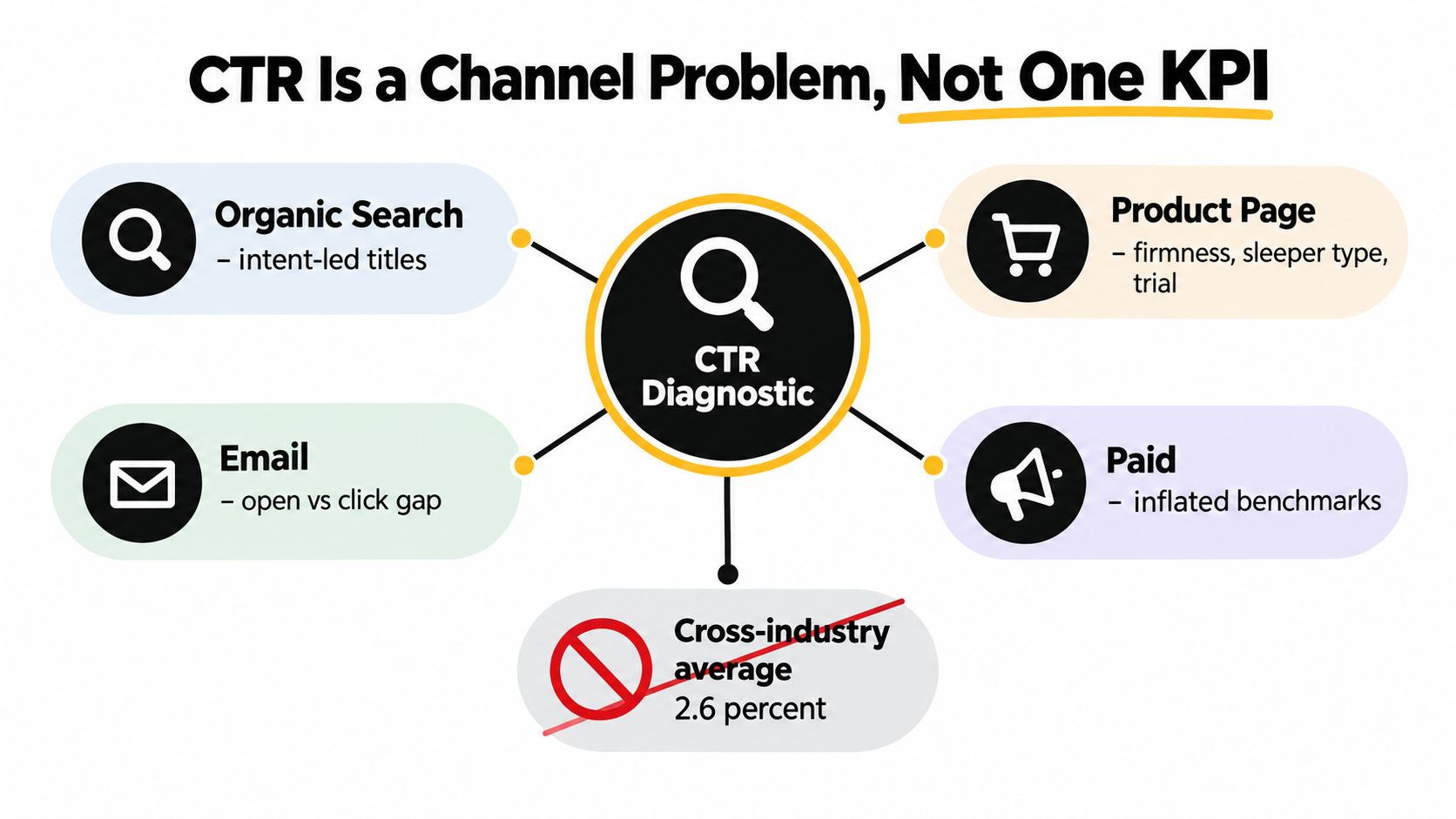
A single blended CTR can make a mattress marketing dashboard look precise while hiding the actual problem. Organic search, paid search, paid social, display, email, and product-page interactions each have different intent levels, auction conditions, creative controls, and definitions of success.
That's why a paid search CTR and an organic meta description CTR shouldn't sit in the same benchmark column. Search ads compete directly for an active query. Organic listings compete with retailers, review sites, shopping aggregators, and other manufacturers. Display impressions often reach people who aren't actively shopping at all.
Channel differences are substantial. Email benchmarks range from roughly 0.88% to 2.62% CTR, search ads from about 3.17% to 6.42%, and display can fall below 1%, depending on source and segment (channel-specific CTR statistics). Those ranges aren't interchangeable targets. They're diagnostic clues.
The easy optimization trap
Subject lines and price-led headlines receive attention because marketers can change them quickly. They also produce visible movement in opens or clicks without requiring a product-page redesign, feed cleanup, new mattress renders, or better retail messaging.
That doesn't make them irrelevant. Subject-line quality matters. A benchmark dataset reports that 64% of recipients decide whether to open an email based on the subject line, while the average email CTR across industries is about 2.00%, with sector benchmarks ranging from 0.77% to 4.36% (subject-line benchmark data). But a higher open rate isn't the same as a stronger product-page visit, add-to-cart rate, or completed purchase.
The bigger opportunity often sits in the promise after the click. If the ad highlights cooling performance but the landing page leads with a vague brand story, the campaign may generate curiosity without producing qualified sessions. If the organic listing says “premium sleep technology” while the shopper wants firmness, sleeper type, financing, or a trial policy, the result is the same.
Practical rule: Optimize CTR only after you define the commercial action that follows it.
For a mattress business, that action might be a visit to a hybrid comparison module, interaction with a firmness selector, a showroom appointment, or a product-page view from a high-intent query. Strong topical structure also helps search visibility and relevance. Bedhead's guidance on building topical authority is useful when your content needs to support product discovery rather than attract broad traffic.
Diagnose Where Your CTR Is Leaking
A mattress brand can diagnose CTR within a working week, but only if each channel is evaluated on its own terms. A blended average hides whether the problem is weak creative, poor audience fit, or a broken handoff after the click.
Start with the measurement layer
Pull trailing 90-day CTR by source, campaign, audience, landing page, and device. This operating window gives the team enough history to spot recurring issues while keeping the analysis relevant to current offers, inventory, and creative.
Separate at least these areas:
Organic search: impressions and clicks by query, title, landing page, and position.
Paid search: brand, non-brand, Shopping, financing, firmness, cooling, and sleeper-intent campaigns.
Paid social: prospecting, retargeting, creative concept, and audience.
Display: placement, audience layer, frequency, and destination.
Email: broadcast, welcome, browse abandonment, cart abandonment, and post-purchase.
Product pages: clicks on selectors, comparison tools, financing details, reviews, and primary purchase actions.
Interpret the click according to its job. A product-page click on “view layer details” can indicate useful engagement even without an immediate transaction. A search click is the first handoff from shopper intent to the brand's owned experience. Those actions should not share one performance label.
Map each leak to a cause
Classify the likely failure before changing copy or bids:
Intent mismatch: the creative attracts shoppers seeking a different mattress type, price tier, or benefit.
Creative fatigue: the same room scene, quilt detail, or offer has run long enough to lose attention.
Weak information hierarchy: firmness, foam layers, gusset construction, trial terms, delivery, or financing is difficult to find.
Audience saturation: retargeting reaches the same visitors without offering a new reason to return.
Landing-page mismatch: the ad promises white-glove delivery or a cooling feel, while the destination buries that information.
For mattress brands, creative quality often deserves priority before another subject-line tweak. A fresh demonstration of construction, feel, or use case can repair attention at scale, while lifecycle automation can give returning shoppers a more relevant reason to click than a repeated broadcast.
Rank by commercial impact
Raw click volume should not set the work order. A low-volume campaign targeting “best hybrid mattress for side sleepers” may matter more than a high-volume display placement if its visitors are closer to purchase. Check event definitions and destination behavior before drawing conclusions. Bedhead's conversion tracking setup guidance helps teams verify that GA4 events represent meaningful product-page behavior.
Channel | Low CTR | Healthy CTR | Top Quartile |
|---|---|---|---|
0.88% | 2.00% | 2.62% | |
Search ads | 3.17% | 4.80% | 6.42% |
Display | Below 1% | Channel-dependent | Channel-dependent |
These ranges are directional, not mattress-specific guarantees, and are summarized in the channel benchmark source. Use them to frame questions, then compare CTR with conversion rate, revenue per click, and downstream product engagement.
SERP and Product Page Tactics That Earn the Click
Searchers don't click mattress listings because a brand describes itself as “innovative.” They click when the result appears to answer the buying question in front of them.
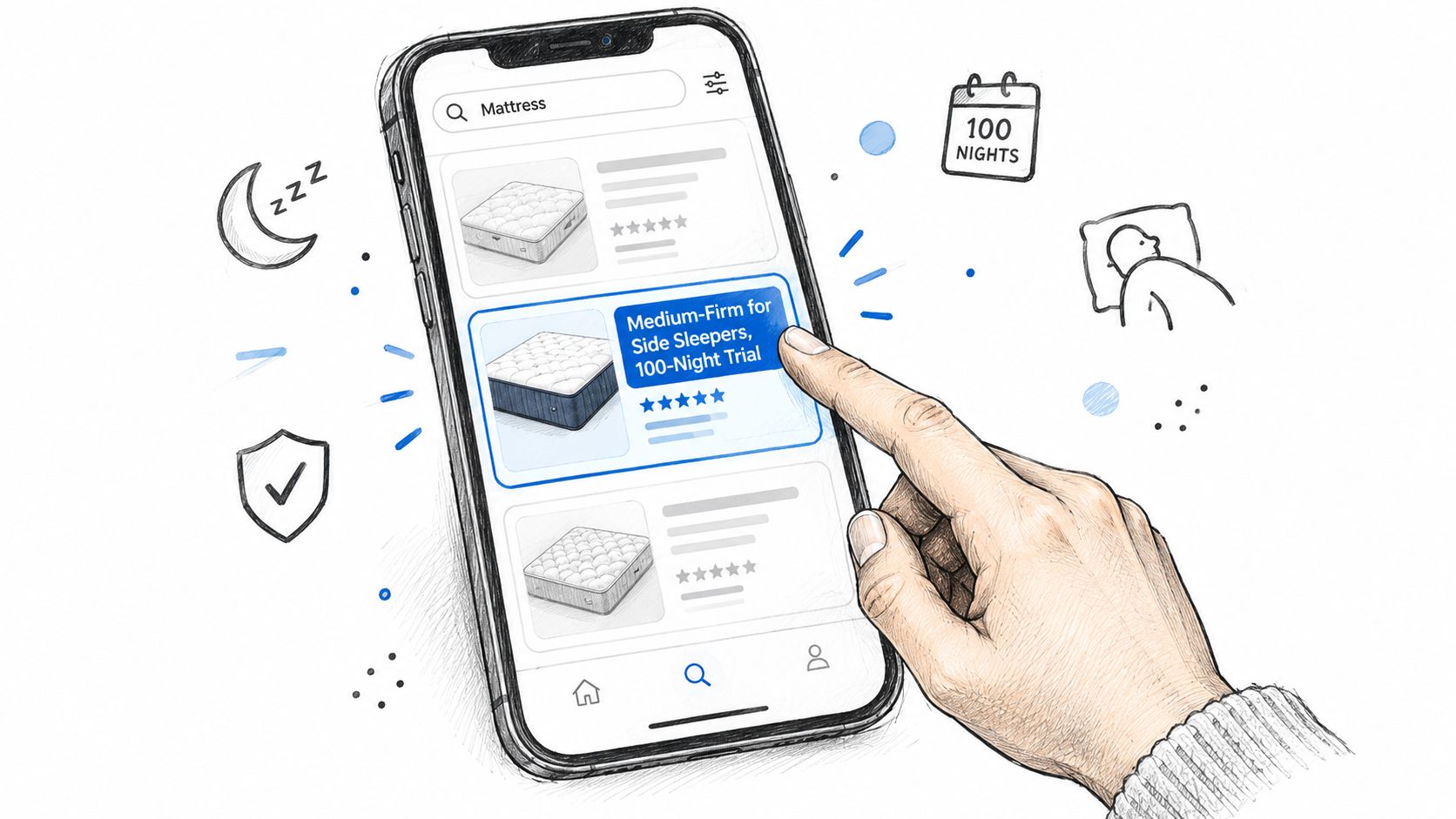
Make the result match the query
Rewrite title tags around the shopper's language. “Brand Name Luxury Mattress” gives little context. “Medium-Firm Hybrid Mattress for Side Sleepers” signals product type, feel, and audience. A large analysis of 4 million Google search results found that title tags between 40 and 60 characters had the highest organic CTR, with 8.9% better average CTR than titles outside that range (Google CTR analysis).
The character range is a testing guide, not a reason to remove useful detail. Put the strongest relevance signal early, then use the remaining space for a differentiator such as cooling construction, trial terms, or delivery.
Meta descriptions should complete the promise. Explain what the shopper gets, then give a reason to continue, such as free shipping, a sleep trial, comparison help, or a clear financing path. Bedhead's meta description best practices can support a systematic rewrite across collection and product templates.
Improve the page after the click
A strong SERP listing won't rescue a confusing PDP. Keep the first screen focused on the product decision:
Lead with the product: Show the mattress in a credible bedroom setting, not only a cutout on white.
Clarify feel: Place firmness, sleeper suitability, height, and construction near the primary product information.
Surface trust: Put reviews, trial terms, delivery details, and financing where shoppers can see them without hunting.
Support comparison: Help visitors distinguish innerspring, memory foam, and hybrid mattresses without sending them back to search.
Show construction clearly: Use layered Digibun visuals to explain foam layers, support cores, ticking, quilt, and gusset details.
Structured data can earn richer search results. Google's documentation cites a Rotten Tomatoes test in which structured data was added to 100,000 unique pages, producing a 25% higher CTR than pages without it (Google structured data documentation). Implement Product, Review, and FAQ markup only when the page content supports it.
For broader merchandising detail, Reddog Consulting Group's product listing optimization guide offers a useful reference for improving the information shoppers see before choosing a listing.
Paid Search and Display Plays for Bedding Brands
Paid search and display require separate CTR decisions. Search meets an expressed need. Display earns attention earlier, often before a shopper has chosen a mattress or identified a specific objection.
Give searchers a concrete reason to click
Vague luxury language makes shoppers do more comparison work. Offer-led copy gives the click a clear reason:
“Free White Glove Delivery”
“$200 Off + Old Mattress Removal”
“Queen Mattress Starting at $899”
These are message structures, not universal offers. Use only claims the brand can fulfill, and keep the landing page aligned with the ad. Someone responding to old-mattress removal should reach delivery and removal details quickly, rather than a generic homepage.
Query intent should shape the copy and destination. A side-sleeper query needs relevant language. A cooling query should lead to breathable materials or construction details. A financing query should reach financing information. Responsive search ads can test headline combinations, but the useful test connects search terms with revenue outcomes, not internal preferences.
Feed quality affects Shopping CTR before a shopper reaches the product page. Broken titles, incomplete images, or mismatched prices weaken traffic quality and reduce confidence. Bedhead's product listing ads guidance covers the feed and merchandising work behind those listings.
Treat display as an attention channel
Display CTR can look healthy while producing little commercial value. Track engaged sessions, product interaction, add-to-cart behavior, and revenue per click alongside the click rate. A broad audience may generate clicks that disappear when the landing page cannot support the creative promise.
Separate prospecting creative from retargeting. Prospecting can introduce the mattress category or explain a distinctive construction. Retargeting should address the objection that remains unresolved, such as feel, delivery, trial, returns, or financing.
Channel | Audience | Typical CTR | Strong CTR | Watch For |
|---|---|---|---|---|
Paid search | High-intent query | 3.17% | 6.42% | Query and landing-page mismatch |
Broad or lifecycle audience | 0.88% | 2.62% | Opens masking weak clicks | |
Display | Prospecting or retargeting | Below 1% | Channel-dependent | Low-intent curiosity traffic |
The benchmark ranges are directional, not mattress-specific guarantees. Use them to spot an unusual result, then judge performance by audience quality and downstream behavior. Creative that attracts curiosity without product interaction is not a CTR win.
Rotate the offer and message, not only the image. A new bedroom render paired with the same generic claim may look different to the team while feeling identical to a saturated audience. Relevance, promise accuracy, and audience fit usually matter more than another minor visual variation.
Email Subject Lines and Lifecycle Flows That Outperform Broadcasts
Opens don't pay for floor models, fulfillment, or paid media. Clicks do, and lifecycle context usually gives email a stronger reason to earn them than a weekly broadcast.
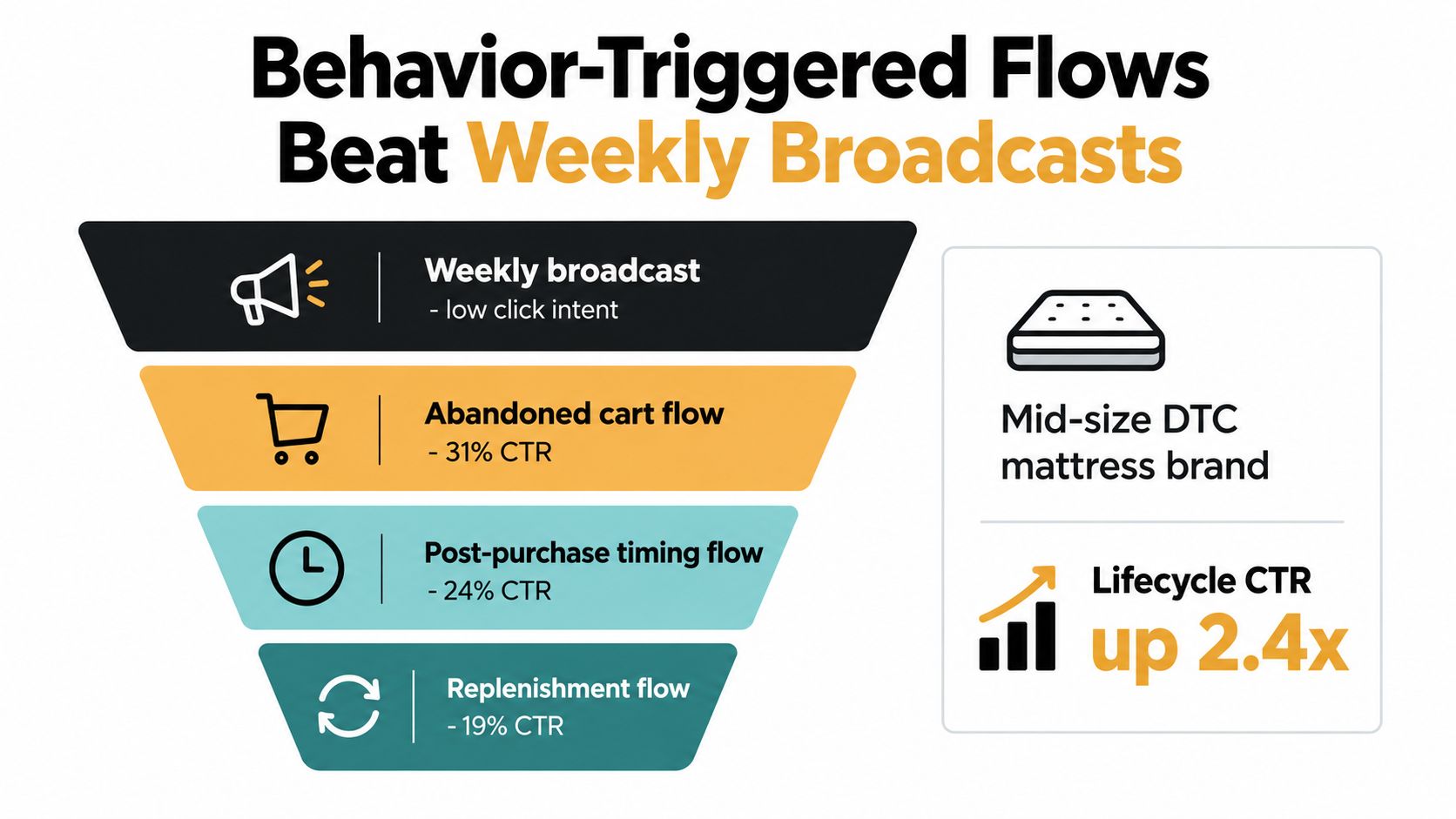
Consider a representative mid-size DTC mattress brand with a broad promotional calendar and a growing product range. Its weekly email might feature a sale, a new room scene, or a sleep article, but the message reaches people at different stages. One subscriber is researching firmness. Another has viewed a hybrid mattress twice. A third already purchased and needs setup guidance. The same email can't serve all three well.
The brand rebuilt its program around behavior-triggered messages rather than relying on a single broadcast rhythm. Independent benchmark summaries report automated email CTRs around 4.67% to 7.39%, compared with campaign averages around 1.3% to 2.0% (automated email CTR benchmarks). That difference supports a lifecycle redesign, but it doesn't guarantee a particular result for every list.
Build around the buyer's next question
The four core flows should each have a distinct job:
Welcome flow: Establish the brand, explain the product range, and use an incentive only when the economics support it. Urgency should be genuine, not manufactured.
Browse abandonment: Show the exact mattress or collection viewed, then add a comparison hook such as firmness, cooling, or sleeper suitability.
Cart abandonment: Address delivery, setup, trial, returns, and payment reassurance before reaching for another discount.
Post-purchase education: Explain care, setup, comfort adjustment, review timing, and referral opportunities. A useful education email can earn a click without asking for another purchase immediately.
Subject lines should be specific enough to establish a clear next step. “Your cooling mattress is on offer until Friday” is more useful than “Hot deals inside,” provided the offer is accurate. Personalization deserves testing rather than automatic deployment. One dataset reports personalized subject lines increasing opens by about 50%, and first-name personalization raising CTR by up to 22.2% (personalization benchmark summary). Yet another large benchmark found generic subject lines outperforming personalized ones on CTR, 2.74% versus 1.74%, while GetResponse's 2024 figures similarly reported non-personalized emails ahead on CTR, 4.23% versus 2.11%, and click-to-open rate, 10.09% versus 5.90% (MarTech benchmark analysis).
Email rule: If personalization lifts opens but weakens clicks, it has improved curiosity, not the campaign.
Suppress active purchasers from irrelevant promotional sends. Segment by sleep position, price tier, viewed construction, and lifecycle stage. Also check subject lines and email content for spam trigger words, especially when promotional urgency starts replacing useful product information.
Running CTR A/B Tests Without Fooling Yourself
A CTR test should produce a decision, not a decorative winning badge in a reporting deck. Mattress brands often test a tiny wording change, watch the first few hours, and declare a winner before the audience, device mix, and buying cycle have had time to stabilize.
Start with one channel and one audience. Define the destination before launch. A site click to a hybrid collection, a product-page visit, or a completed comparison interaction is a more useful primary metric than an email open when the commercial objective is traffic quality.
Set the test before seeing the result
Calculate the required sample size using your baseline CTR and the minimum detectable effect you care about. The exact requirement will depend on traffic and variance, so don't borrow a sample size from an unrelated campaign. Use sequential testing rather than repeatedly checking the dashboard and stopping when the first favorable movement appears.
Pre-agree the maximum runtime and the decision rule. If the test doesn't reach a reliable conclusion, record it as inconclusive. That result is more useful than promoting a weak variant because the team wants a winner.
Test variables that reflect mattress decisions
Change one meaningful element at a time:
Subject line: Benefit-led specificity versus a generic sale message.
Hero image: A room scene versus a clean silhouette or studio image.
CTA copy: “Compare hybrid mattresses” versus “Shop now.”
Offer framing: Delivery and removal reassurance versus a price reduction.
PDP hierarchy: Review and trial information higher on the page versus deeper in the experience.
Shorter subject lines can be worth testing, but “shorter always wins” is unsafe. One dataset found subject lines under 21 characters generated the highest open rates and a 12.9% click-to-open rate, while another benchmark found 41 to 50 characters produced the highest CTR at 17.57% (Data Axle subject-line analysis). The contrast is the point. Message type and context matter, so judge clicks alongside opens.
Keep a test log with audience, dates, variable, baseline, primary metric, result, and implementation decision. A result that improves opens but reduces product-page CTR should not become the new template.
Your 30-Day Mattress CTR Rollout and Final Checklist
A constrained team doesn't need a sprawling optimization program. It needs a sequence that fixes measurement first, then improves the places where the buyer sees and evaluates the mattress.
Week one should establish the baseline. Separate channel CTR, check GA4 events on product detail pages, and tag every email link with unique UTM parameters. Confirm that clicks on firmness selectors, comparison modules, reviews, financing, and primary purchase actions are distinguishable.
Week two should focus on owned creative. Rewrite priority title tags and meta descriptions, then test PDP hero imagery. Use silhouettes where shoppers need clarity, room scenes where context matters, and Digibuns when foam layers or hybrid construction need explanation.
Week three should address paid traffic. Test query-specific Google and Bing copy, product-feed quality, prospecting audiences, and retargeting messages. Keep display evaluation tied to engaged behavior and revenue per click, not CTR alone.
Week four should deploy lifecycle triggers. Launch or refine welcome, browse abandonment, cart abandonment, and post-purchase flows. Compare those journeys with broadcasts, then protect the list by suppressing customers who shouldn't receive the next promotion.
Use this checklist after the sprint:
Measurement: Every channel has its own CTR baseline and destination event.
SERP: Titles and descriptions reflect firmness, sleeper type, construction, or offer intent.
PDP: Product imagery, trust information, comparison tools, and purchase actions are easy to find.
Paid: Search, display, prospecting, and retargeting use separate objectives.
Email: Triggered flows are measured against broadcasts using clicks and downstream behavior.
Testing: Each experiment changes one variable and has a pre-agreed decision rule.
Commercial value: CTR is reviewed with conversion rate and revenue per click.
Bedhead Marketing works exclusively with mattress manufacturers, retailers, private label brands, and sleep product startups on SEO, paid media, product-page optimization, 3D mattress rendering, Digibun layer visuals, Silhouettes, Room Scenes, and mattress sales training. Mattress professionals can also join the free Bedhead Network for industry marketing insights, news updates, networking, training resources, an industry directory, and business tools.
If your team is evaluating where mattress clicks are leaking, BEDHEAD can help connect channel measurement with stronger product imagery, SEO, paid campaigns, lifecycle email, and conversion-focused product pages. Visit BEDHEAD to discuss a focused CTR diagnostic or the creative and testing work needed to turn more qualified clicks into mattress shoppers.