High Poly Models Explained for Mattress Marketing
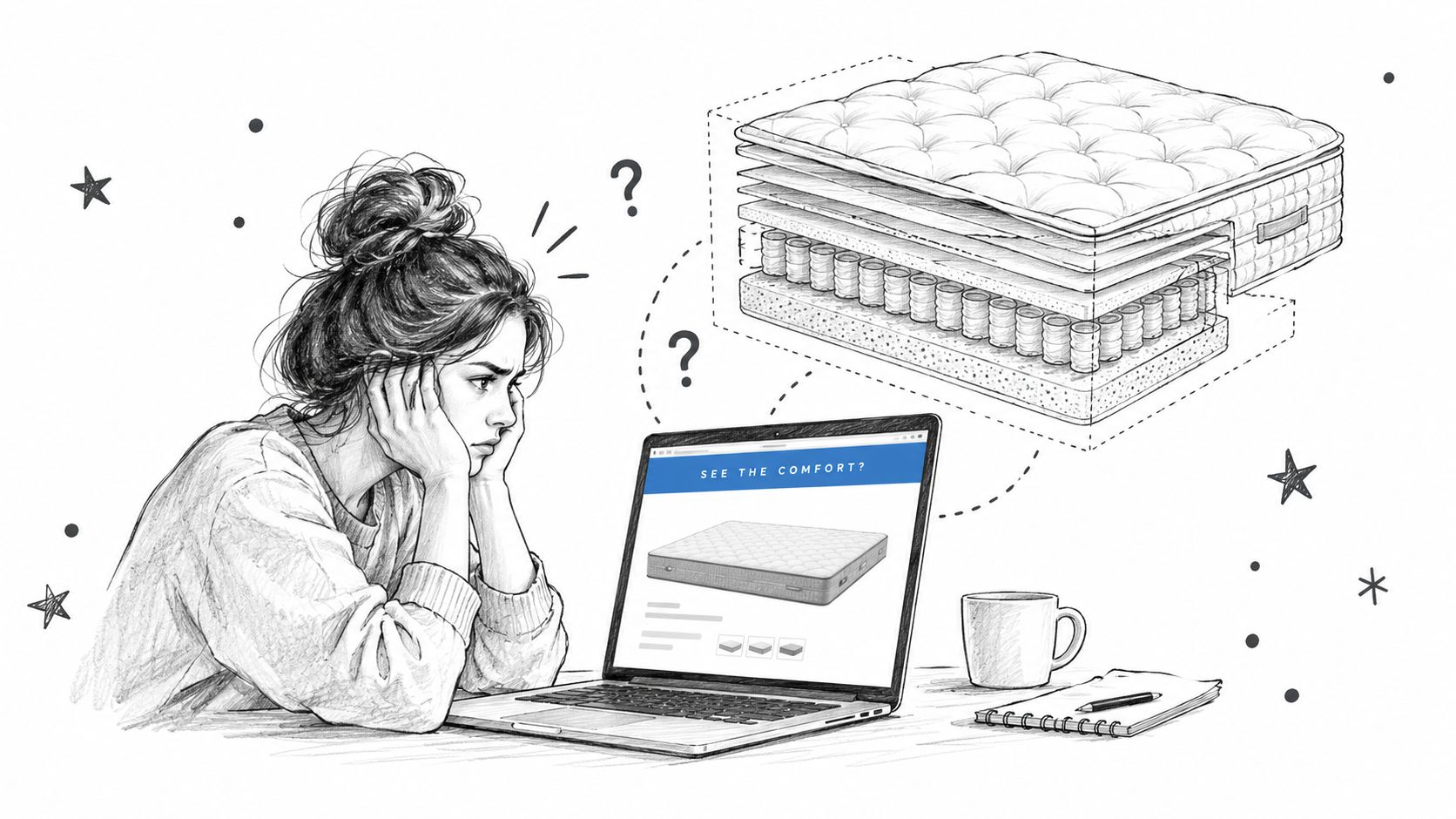
A mattress PDP can be technically accurate and still leave shoppers uncertain. A clean product photo may show the overall shape, but it often fails to communicate the raised quilt, the texture of the ticking, the firmness story hidden inside foam layers, or the edge definition of a gusset. The result is familiar to mattress marketing directors: a product that looks similar to every other bed online, a showroom associate who has to explain what the page didn't show, and a shopper who still can't picture the construction clearly enough to buy with confidence.
High poly models give mattress brands a way to represent those details digitally. They can support photorealistic hero renders, close-up product imagery, layered Digibuns, silhouettes, room scenes, and interactive experiences without requiring a new physical photo shoot every time a construction detail changes. Bedhead's guide to 3D rendering for mattress marketing describes how digital models can produce sell sheets, silhouettes, room scenes, cutaways, and interactive visuals from one product foundation.
This guide focuses on the practical decision behind the technology. You'll learn what high-poly means, how it compares with a lighter model, why detail matters for mattress storytelling, and when a dense source asset should stay dense or be baked down for web and interactive use.
Why Mattress Imagery Falls Flat Without Detail
A shopper can understand that a mattress is a hybrid from a specification list. Understanding how that hybrid feels, supports the body, and differs from another hybrid is harder. A photograph of a finished bed rarely reveals the transition between its quilt and comfort layers, the structure beneath the ticking, or the way the gusset frames the product.
That gap becomes more obvious on a product detail page. The brand may describe pressure-relieving foam, responsive coils, cooling fabric, and reinforced edges, yet the visual treatment shows only a mattress from one angle. Marketing has supplied information, but not enough visual evidence to help the shopper connect the claim to the product.
The showroom problem in digital form: If a retail associate would open the mattress, point to the quilt, and explain the foam layers, the PDP needs a visual equivalent.
High-poly geometry helps create that equivalent. A detailed model can reproduce the rounded compression of a quilted ticking, the clean transition at the border, and the layered construction exposed in a Digibun. Those details matter because a mattress is a tactile product, while eCommerce removes the ability to touch, sit, and inspect it.
From a flat product shot to a product story
Here is the rewritten paragraph with the flagged phrase removed:
Consider a premium hybrid mattress with a ticking, a pronounced quilt, multiple foam layers, and a defined edge system. A single photograph can show its finish, but a digital asset system can show the product in several useful ways:
Hero render: A polished PDP image that presents the mattress at its best angle.
Silhouette: A clean cutout for comparison charts, retailer listings, and sell sheets.
Digibun: A layered view that shows how the interior is built.
Room scene: A lifestyle composition that gives the mattress scale and context.
Close-up detail: A visual cue for ticking texture, quilting, and edge construction.
That flexibility is particularly valuable when specifications change across a collection. A revised foam layer or updated ticking can be reflected in the model and then repurposed across multiple channels instead of forcing the team to organize another physical shoot.
For teams working on marketplace PDPs, the same principle applies to the broader discipline of visual merchandising. A useful reference is this guide to Amazon listing design by Headline, especially when a mattress brand needs to turn technical features into a sequence of easy-to-scan visual messages.
The commercial point isn't that every mattress image needs maximum geometry. The point is that the asset should carry the level of visual information the buyer needs. High-poly models are most useful when detail changes the shopper's understanding of quality, comfort, or construction.
What High Poly Models Are and How They Work
A 3D model is built from small surfaces joined together to describe a form. Those surfaces are created from vertices and edges, and the collection of surfaces becomes the mesh. On a mattress, the mesh can define the broad rectangular shape, the curve of the corners, the height of the gusset, and the small changes created by quilting or fabric tension.
A high-poly model uses a very large polygon budget. Current industry references commonly place high-poly work in the range of hundreds of thousands to many millions of polygons, with guidance often starting around 100,000 polygons and some models reaching several million, as described in this overview of high-poly 3D modeling. Other references describe high-poly work from 80,000 or more polygons up to 1M or more, so the label isn't a rigid technical threshold.
Density controls the surface
Think about the difference between drawing a mattress with a few straight lines and describing it with a carefully stitched pattern. More geometric sections give the artist more control over curves and transitions. On a mattress, that can mean a smoother corner, a more convincing quilt puff, or a cleaner silhouette around a pillow-top profile.
Polygon density doesn't create every visual property by itself. Materials, lighting, texture maps, and camera position still matter. Geometry provides the physical structure that lets those other elements behave convincingly.
Why the definition keeps moving
The meaning of high-poly has changed with production technology. Early 3D graphics commonly used only a few hundred polygons, while high-end work in the late 1990s and early 2000s could reach tens of thousands. Modern high-poly assets can contain millions, reflecting improvements in processors, memory, GPUs, and modeling software. The historical progression is summarized in this discussion of high-poly model development.
That history matters for marketing teams because a polygon count isn't a quality score on its own. A mattress intended for a small thumbnail doesn't need the same density as a close-up render of its ticking. High-poly describes an asset built for visual fidelity, not a universal number that every deliverable must meet.
For a broader introduction to the building blocks behind these assets, Bedhead also explains what a 3D model is. The useful question for a brand isn't “How many polygons should we buy?” It's “Where will shoppers see enough detail for that investment to affect their decision?”
High Poly vs Low Poly Models Compared for Mattress Brands
High-poly and low-poly models aren't competing philosophies. They serve different jobs in the same visual system. A high-poly asset preserves fine construction detail, while a low-poly or optimized asset is easier to load, manipulate, and display in a real-time environment.
For a mattress brand, the right choice depends on the channel and the camera. A pre-rendered hero image can use a dense model because the viewer receives a finished frame. An interactive configurator, virtual showroom, or web viewer may need a lighter mesh, particularly when the shopper can rotate several products or change materials.
Attribute | High Poly Models | Low Poly Models |
|---|---|---|
Visual fidelity | Strong control over quilt contours, ticking texture, gussets, layers, and silhouette | Simplified geometry with detail carried more heavily by textures and lighting |
File and scene weight | Larger and more demanding to preview or manipulate | Easier to store, transfer, and use across interactive scenes |
Render behavior | Well suited to close-up and cinematic output | Better suited to real-time viewing and repeated assets |
Best mattress use cases | Hero PDP imagery, premium product renders, Digibuns, close-up advertising | Configurators, interactive viewers, secondary views, and scalable product libraries |
Camera distance | Close or medium distance where surface detail is visible | Medium or far distance where simplified geometry is acceptable |
Production role | Source asset or final pre-rendered asset | Optimized delivery asset for downstream channels |
The choice also depends on what the image needs to prove. If the selling point is a distinctive quilt pattern or a visible internal construction, detail earns its place. If the shopper only needs to compare mattress height and overall shape, a lighter model may be enough.
A practical channel decision
Use the dense source when:
The silhouette sells: A pillow-top, euro-top, or sculpted edge needs to read clearly against the background.
The surface carries meaning: Quilting, ticking, gusset stitching, or fabric relief supports the product promise.
The product opens up: A Digibun needs clean layer boundaries and credible transitions.
The image is pre-rendered: A sell sheet, paid ad, or PDP hero image can prioritize final visual quality.
Use an optimized version when:
The shopper controls the view: Rotation and zoom require responsive viewport behavior.
The scene contains many products: A virtual showroom or retailer library needs manageable assets.
The camera stays back: Room scenes and comparison layouts may not expose micro-detail.
The asset repeats across channels: One lighter delivery model can reduce friction in high-volume publishing.
A mattress-specific explanation of the underlying geometry is available in this guide to a 3D mattress mesh. The strategic takeaway is simple: keep detail where it changes perception, and optimize where responsiveness changes usability.
How High Poly Detail Powers Photorealistic Mattress Marketing
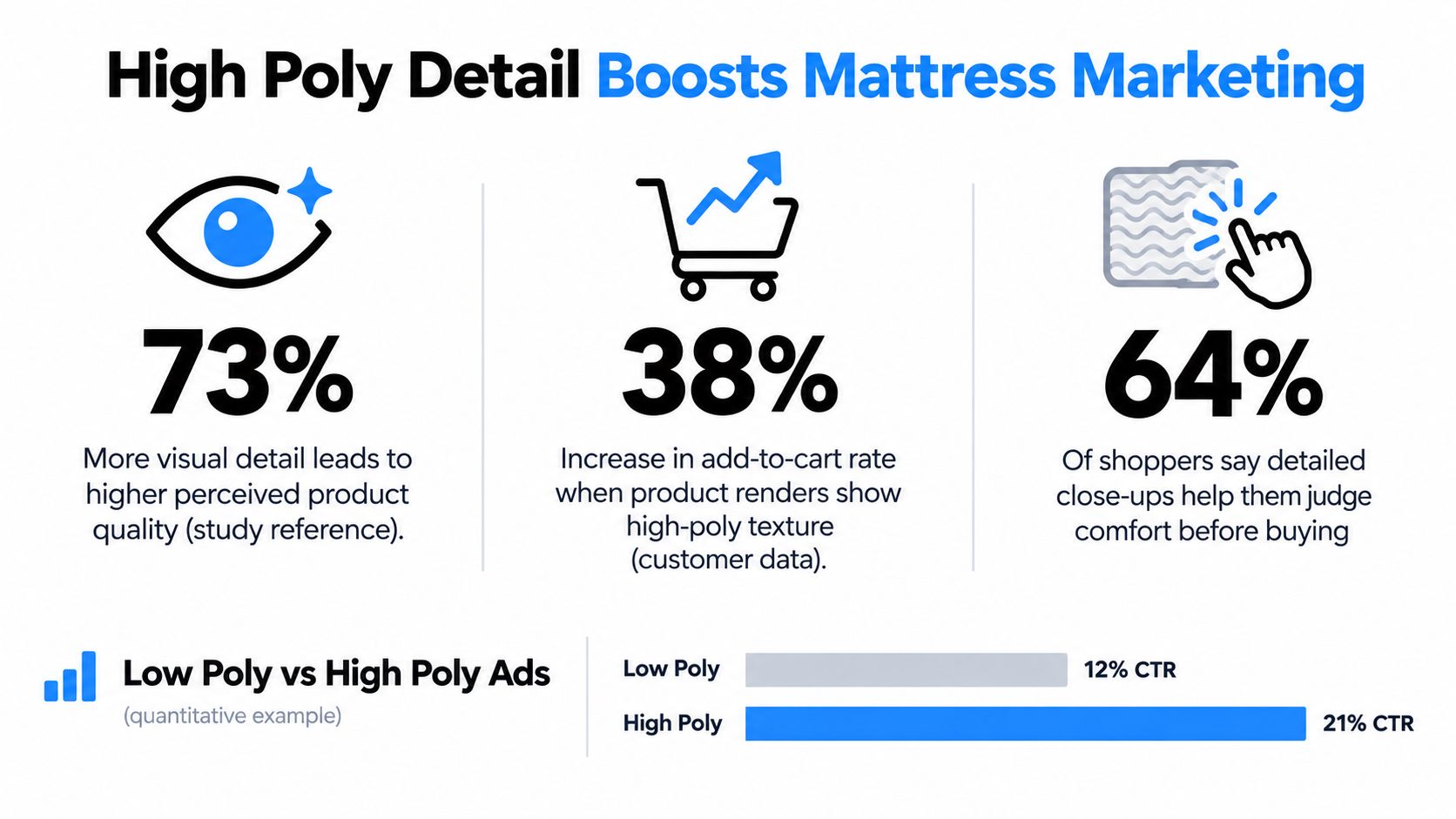
Photorealism depends on more than placing a mattress in a well-lit bedroom. The viewer needs to see believable interaction between shape, material, and light. A quilt should catch highlights across its raised sections. A ticking should show enough surface character to avoid looking like a flat color. A gusset should hold its edge rather than dissolve into a generic rectangle.
High-poly geometry supports those cues by describing the physical form at a finer level. It can help a render show the difference between a smooth foam transition and a heavily quilted cover, or between a rounded comfort layer and a structured border. For hybrid mattresses, that distinction helps marketing teams show what the shopper can't inspect through a sealed product.
The commercial context is expanding. One independent report values the global 3D product visualization market at USD 4.5 billion in 2025 and projects it to reach USD 18.6 billion by 2034, with an 18.2% CAGR across that forecast period. Those figures come from Bedhead's report on 3D product visualization services.
Where detail earns attention
A strong mattress visual usually gives each detail a job:
Quilt and ticking: Show the product's material character and help distinguish a premium cover from a generic surface.
Gusset and border: Clarify construction, height, and edge design in a way that a front-facing photo may not.
Foam layers: Explain the order and role of comfort materials in a Digibun or cutaway.
Hybrid components: Make the relationship between foam, coils, and support zones easier to understand.
Silhouette: Communicate the overall profile quickly in retail listings, comparison pages, and sell sheets.
Visual clarity can also support the return-reduction conversation, but it shouldn't be framed as a guaranteed outcome. A shopper who understands the product before checkout is better positioned to compare it with expectations after delivery. That makes accurate visualization a merchandising responsibility, not just a design preference.
A second market estimate places the 3D rendering market at USD 4.85 billion in 2025, with a projection of USD 19.82 billion by 2033 and a 19.6% CAGR, as reported in this overview of 3D rendering software. The figures are market projections, not a promise that every mattress PDP will improve by a fixed amount. They do show why reusable, detailed digital assets are becoming commercially relevant for brands that need consistent imagery across eCommerce, retail, advertising, and product education.
Inside the High Poly Workflow From Sculpt to Baked Asset
A high-poly mattress asset usually starts with the physical product and its construction information. Designers need accurate references for dimensions, ticking, quilt pattern, gusset shape, foam layers, coil arrangement, labels, and any visible edge treatment. The model should represent what the brand sells, especially when the asset will support a product page or retail training.
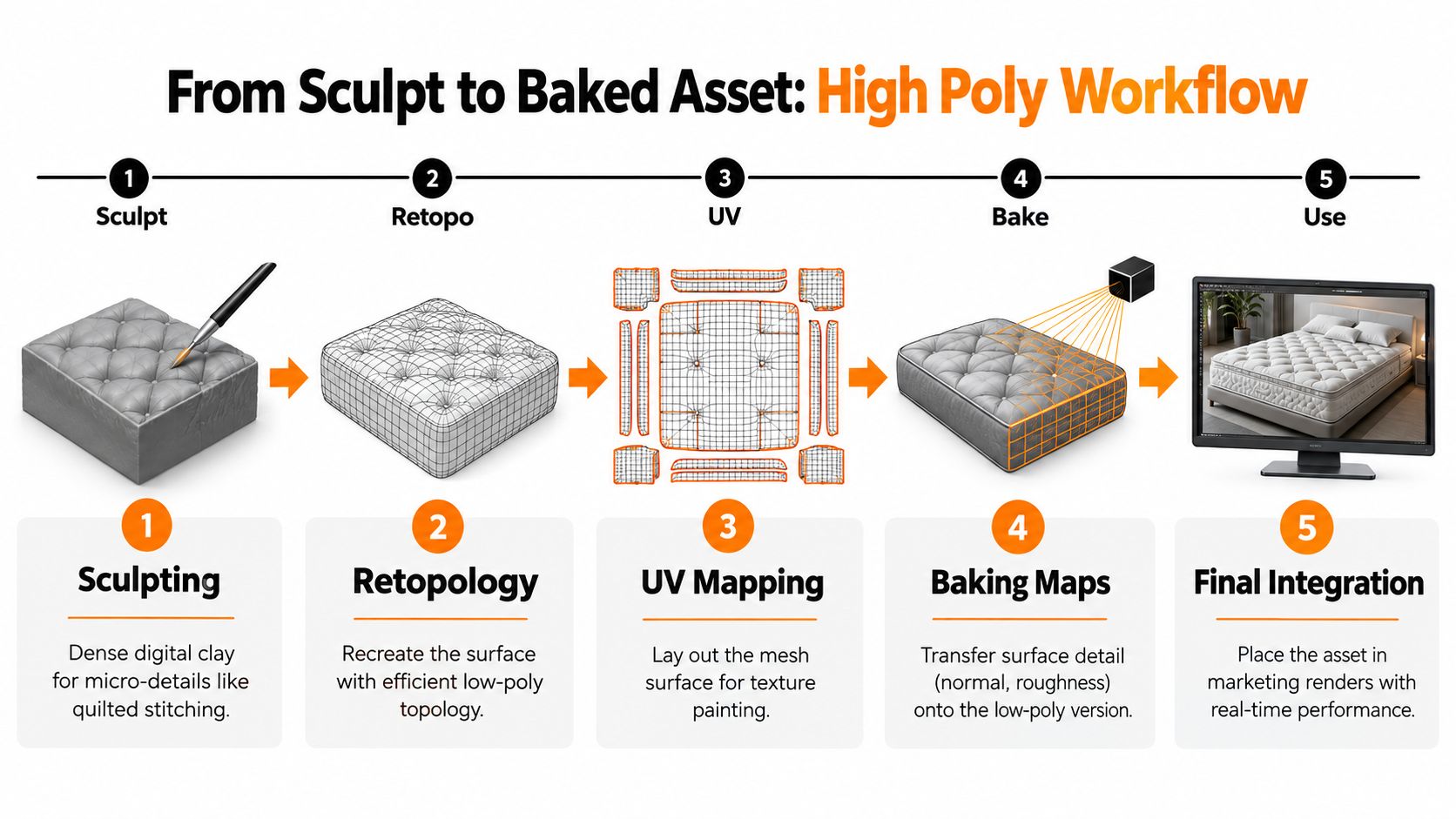
The workflow then moves through several connected stages.
Build the detail before optimizing it
Sculpting creates the dense version of the asset. The artist can shape the puff of a quilt, define the transition around a seam, and capture small surface changes that a simpler mesh can't hold cleanly. For a Digibun, the same principle applies to the internal layers, where precise edges help viewers understand what sits above and below each material.
Retopology creates a more efficient mesh over the detailed form. The artist decides where geometry is needed for the silhouette and where surface information can be represented through maps. This stage isn't about making the mattress look less accurate. It's about putting complexity where the camera and the interaction need it.
Transfer the surface information
UV mapping lays out the optimized mesh so texture information can be applied consistently. This matters when the ticking includes a repeat pattern, a branded label, or a controlled roughness response.
Baking transfers information from the dense source to the lighter mesh. Normal maps can describe how light should respond to small surface changes, while displacement maps can carry additional depth information where the delivery format supports it. The result preserves much of the high-poly appearance without requiring the real-time asset to carry every original surface subdivision.
The production principle is supported by guidance on polygon count and visual fidelity in real-time 3D. High-poly models are generally used as sculpting or source assets because their dense geometry can be expensive to render directly. Baking the detail into maps for a lower-poly render mesh helps preserve fidelity while reducing runtime vertex processing and memory bandwidth demands.
Final integration places the asset into the intended marketing output. That might be a pre-rendered PDP image, a paid social composition, a room scene, a retail sell sheet, or an interactive viewer. Bedhead's process guide on creating 3D renderings is useful for teams briefing this work because it connects the model to the final communication task rather than treating modeling as an isolated technical exercise.
Performance File Formats and Best Practices at Scale
A single high-poly mattress can be manageable. A full collection is an operational system. Every new SKU may bring another model, set of materials, textures, room scenes, camera views, and retailer adaptations. If the team stores only finished images, repurposing becomes difficult. If it stores dense scenes without clear controls, artists and marketers can lose time waiting for files to open, update, or render.
The right response isn't to remove detail everywhere. It's to separate the master asset, the rendering asset, and the interactive delivery asset. The master preserves the construction and visual information. The rendering version supports controlled output. The interactive version favors responsive behavior and manageable scene complexity.
Keep high poly at runtime when the view justifies it
A dense model can remain high-poly at runtime in limited cases. A premium product configurator with a close camera, a single hero mattress, and a strong need for accurate silhouette may justify the additional geometry. The key variable is what the viewer sees on screen. If triangles remain large in screen space, total vertex count may matter less than conventional optimization advice suggests, according to the engine discussion referenced in this practical conversation about high-poly optimization.
That doesn't make polygon count irrelevant. Materials, transparency, draw calls, hidden geometry, texture memory, and scene composition can all affect behavior. A team should test the actual experience rather than approve or reject an asset based only on a headline polygon figure.
Manage the scene, not just the mesh
Operational discipline becomes more important as the library grows:
Use proxies: Display lighter stand-ins while artists arrange room scenes or build retailer layouts.
Exclude hidden geometry: Don't load internal surfaces that no camera or interaction can reveal.
Control materials: Consolidate unnecessary material assignments so the scene doesn't carry avoidable rendering work.
Version by source: Keep construction changes connected to a master model so every derived image can be updated consistently.
Separate exports: Prepare formats suited to the handoff, whether the destination is a renderer, a game engine, a configurator, or an archive.
Document the asset: Record the SKU, ticking version, layer order, camera assumptions, and approved outputs.
Formats such as FBX, OBJ, and USD can all appear in 3D pipelines, but the best choice depends on the software receiving the file and the information that must survive the handoff. Bedhead's overview of 3D graphics file formats can help marketing teams ask the right delivery questions before a project begins.
The broader operational issue is significant for mattress businesses. An independent 3D asset market estimate places the 3D digital asset market at USD 33.8 billion in 2025, as cited in this production pipeline discussion. For brands, the practical bottleneck often shifts from creating one impressive model to storing, versioning, previewing, and repurposing a growing asset library across manufacturers, retailers, agencies, and internal teams.
Choosing the Right High Poly Approach for Your Mattress Brand
The right high-poly strategy starts with the selling task, not the software. Ask what the shopper needs to see, where the asset will appear, how close the camera will get, and whether the viewer will control the scene. Those answers determine whether the model should remain dense, be baked down, or be delivered in both forms.
A manufacturer launching a premium hybrid may need a detailed source model for a hero render, a Digibun, and a family of room scenes. A retailer may need lightweight product assets for a large catalog and clean silhouettes for comparison pages. A DTC brand may need both, because its PDP can use pre-rendered detail while an interactive feature requires faster viewport behavior.
Match the asset to the job
Use this decision framework:
Start with the product promise. If the differentiator is quilt construction, a specialty ticking, layered foam, or a shaped edge, model that detail accurately.
Define the closest expected view. A close-up of stitching needs more surface fidelity than a room scene viewed from a distance.
Separate communication from interaction. Pre-rendered imagery can prioritize visual realism. Interactive content needs tested performance.
Plan reuse before production. Decide whether the model will support PDPs, sell sheets, paid ads, retailer portals, showroom screens, sales training, and future product updates.
Approve a source and derivatives. Keep a detailed master, then create optimized versions for channels that don't need the full mesh.
Validate against the physical mattress. Check dimensions, quilt placement, layer order, ticking color, gusset proportions, and approved brand treatments before publishing.
The commercial case for this approach extends beyond imagery. Bedhead's mattress marketing guidance describes sales activation for manufacturers and retailers as a 6 to 12 week rollout involving trainers, role-play, certification, and quick-reference materials, and it cites an expected 15% to 25% sales lift in trained locations, along with reduced returns and higher average selling price, in its manufacturer marketing strategies guide. Those figures apply to the cited training context, not automatically to high-poly imagery, but they reinforce the value of connecting digital product explanation with showroom execution.
Bedhead Marketing works exclusively with the mattress and bedding industry across manufacturers, brick-and-mortar and eCommerce retailers, private-label brands, and sleep product startups. Its capabilities include 3D mattress rendering, layered Digibuns, silhouettes, room scenes, SEO, Google and Meta paid media, product page optimization, brand and USP development, presentation decks, and sales training for retail environments.
For continued education, Bedhead University offers mattress-focused learning resources. BEDNET, the free Bedhead Network, gives mattress professionals access to marketing insights, news updates, networking, training resources, an industry directory, and business tools.
Before commissioning another photo shoot or adding another format to your content calendar, audit one current mattress PDP. Can shoppers see the ticking, quilt, gusset, foam layers, and hybrid construction clearly? If not, the issue may not be the copy. It may be that the digital asset doesn't contain enough detail to tell the product story.
If your mattress brand needs a reusable high-poly source for photorealistic silhouettes, Digibuns, room scenes, PDP imagery, or optimized interactive assets, BEDHEAD can help evaluate the product and build the right deliverables for your channels. Visit the site to discuss your current imagery, construction files, and the next product visualization project.