Email Marketing Automation for Mattress Brands
B2B email delivery rates fell from 96.8% in 2022 to 92.1% in 2023, according to the DMA's 2024 email benchmarking report. For mattress manufacturers nurturing retailer accounts, that's a useful warning: email marketing automation starts with reach and permission, not clever subject lines.
A shopper comparing hybrid mattresses doesn't need another discount after booking a showroom appointment. A retailer requesting a line presentation doesn't need a consumer cart reminder. Good automation recognizes those differences, then earns its place through incremental orders, qualified conversations, and showroom outcomes.
What Email Marketing Automation Does for Mattress Brands
In 2024, 58% of marketing professionals reported using email marketing automation, making it the most-used automated marketing tactic in Ascend2's survey of 372 marketing professionals, as summarized by Jeff Bullas. Adoption, however, doesn't tell you whether a program is useful.
Think of a good showroom associate. They remember which floor models a shopper tried, what felt too firm, and whether the buyer asked about financing. Automation applies that follow-up logic to identifiable, eligible customers without requiring someone to send every message manually.
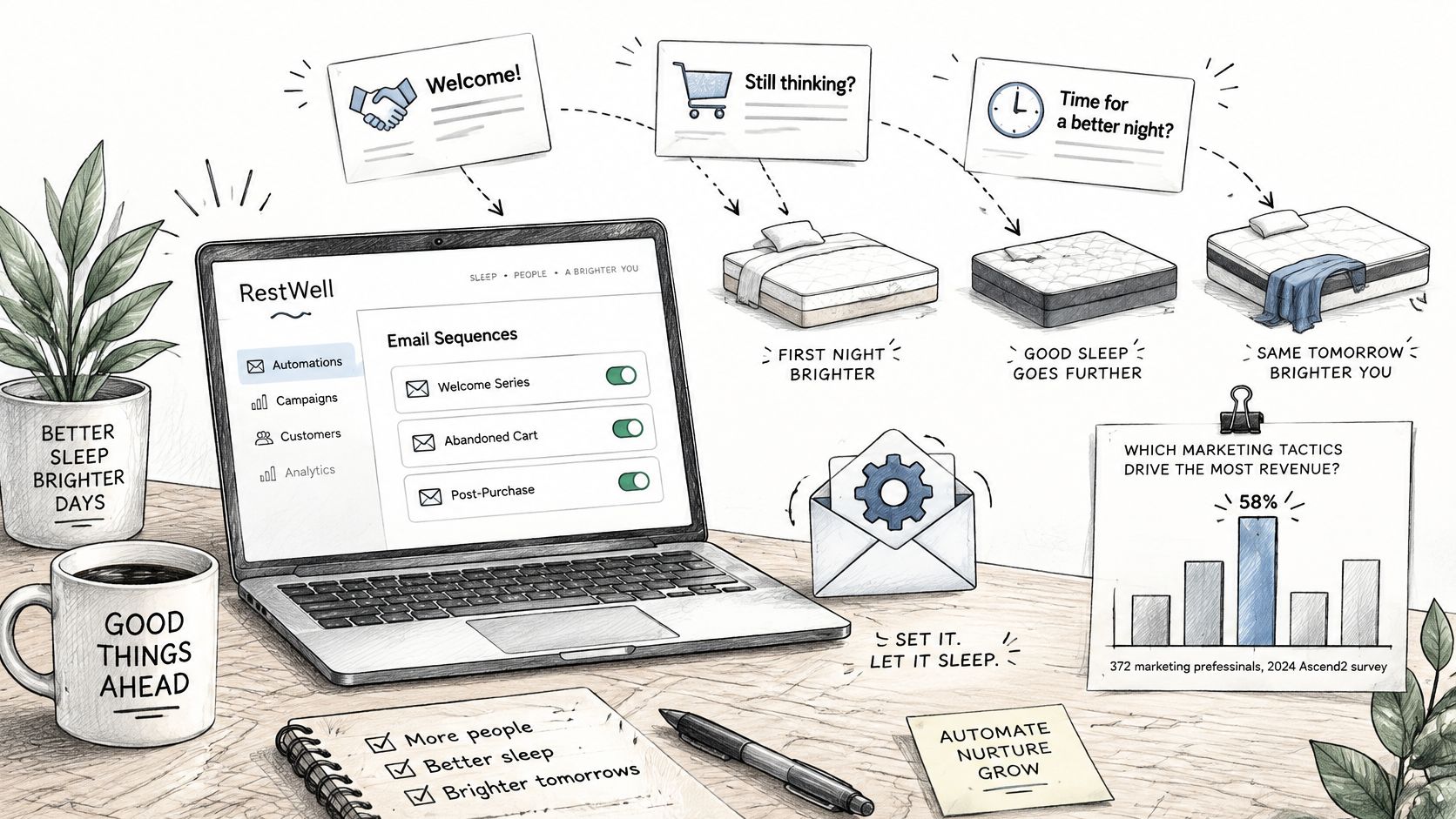
A flow responds instead of broadcasting
A broadcast announces a promotion to an audience. An automated journey responds to behavior or a milestone, such as a product-page visit, completed sleep quiz, or confirmed delivery.
Say a shopper compares coil counts across hybrid product pages. A useful follow-up explains how the support unit and foam layers work together, rather than sending an unrelated sale announcement.
Every flow has a simple structure:
Trigger: The customer performs an eligible action.
Condition: The system checks permission, purchase status, and current buying stage.
Action: It sends relevant information, alerts a salesperson, or pauses communication.
This is the practical foundation of lifecycle marketing for mattress businesses.
Manufacturers can nurture retailer leads toward a product presentation. Showroom operators can turn permission-based floor sign-ups into appointments, while eCommerce managers can address checkout hesitation.
Practical rule: Describe the customer action, eligibility check, and intended outcome before choosing an email template.
If you can say “send a construction explainer to an eligible hybrid shopper who hasn't purchased,” you've described a workable flow.
Deliverability and Authentication Before You Scale
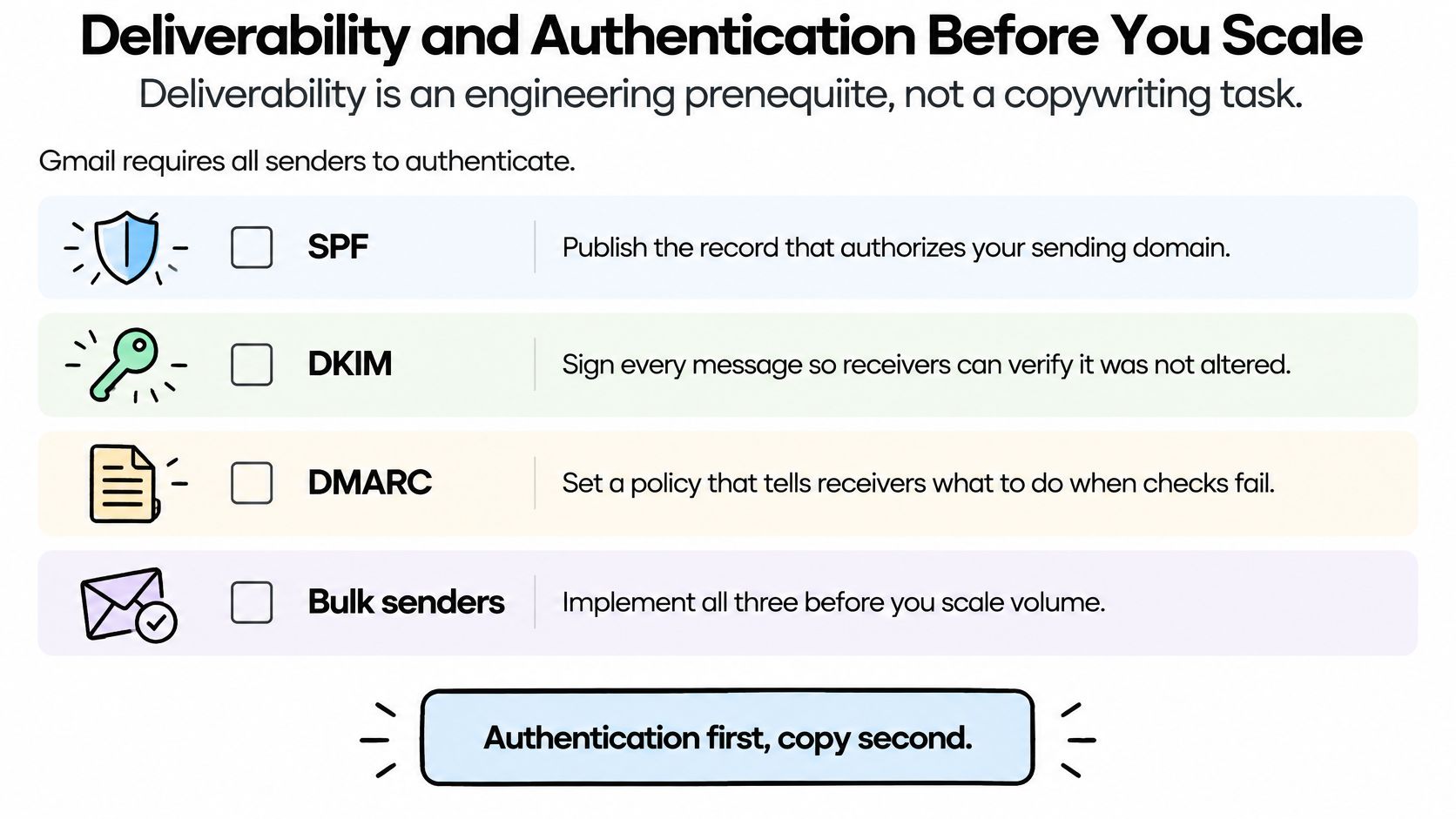
Deliverability is an engineering prerequisite, not a copywriting task. A polished mattress comparison is worthless if receiving systems reject it.
Gmail's sender guidance requires all senders to authenticate with SPF or DKIM, while bulk senders must implement SPF, DKIM, and DMARC. SPF authorizes sending infrastructure, DKIM lets receivers verify message integrity, and DMARC adds alignment checks, reporting, and policy.
A message can satisfy DMARC when either SPF or DKIM passes with the required alignment. Publishing records without checking alignment isn't enough.
Establish the sending foundation
Use a dedicated, authenticated sending subdomain. Give promotional automation an identifiable sending stream rather than mixing every department's mail together.
Keep SPF restrictive. Have your technical owner remove unnecessary third-party includes, particularly those left behind by retired marketing tools.
Protect and rotate DKIM keys. Assign responsibility to someone who can coordinate changes with your email platform.
Monitor DMARC before enforcing it. Identify legitimate senders first so an enforcement change doesn't unexpectedly block retailer communications.
Track authentication alignment, hard bounces, spam complaints, unsubscribes, and mailbox-provider deferrals by stream. A manufacturer's dealer newsletter and a retailer's abandoned-cart journey need separate visibility.
The Twilio email deliverability guide notes Gmail and Yahoo recommendations to keep spam complaints below 0.3%, with 0.1% or lower preferred. Treat rising complaints as a reason to investigate eligibility and relevance, not just rewrite the subject line.
For operational troubleshooting, use a structured email deliverability improvement process. Separate promotional flows from order confirmations, warranty notices, and delivery updates to limit reputation spillover, though separation doesn't eliminate shared-domain risk.
Capture permission alongside authentication
The ICO's electronic-mail marketing guidance explains that valid consent must be freely given, specific, informed, and unambiguous. Where you rely on consent for UK marketing, pre-ticked boxes, silence, and inactivity don't establish it.
Store the form version, timestamp, source, and consent wording with the subscriber record. Keep the permission request separate from unrelated terms and identify who will send marketing.
A showroom visitor giving an address for a delivery quote shouldn't automatically enter a promotional journey. Your system needs to distinguish a service request from marketing permission.
Core Mattress Workflows and the Triggers Behind Them
Core mattress email workflows by trigger
The timing below is a proposed starting configuration, not an industry standard.
Workflow | Trigger | Primary goal | Key metric | Suppression rule |
|---|---|---|---|---|
Welcome series | Newsletter or showroom sign-up | Introduce brand and product basics | Click-to-product rate | Stop once a purchase is made |
Browse abandonment | Two views of a hybrid or latex product page | Return to the product page | Product-page return visits | Stop after an order or 7 days |
Cart recovery | Mattress left in cart | Complete the order | Completed orders | Stop at checkout completion |
Sleep-quiz follow-up | Quiz completed | Recommend a model | Quiz-to-order rate | Suppress if a sales conversation is open |
Financing inquiry nurture | Financing page visit | Start an application | Application rate | Stop once an application is submitted |
Post-purchase education | Delivery confirmed | Set-up guidance and fewer returns | Return rate | Stop after 90 days |
Replenishment and accessories | 90 days after purchase | Pillow or protector attach | Accessory attach rate | Stop if the accessory is bought |
Reactivation | 180 days with no opens or clicks | Re-engage or clean the list | Reactivation click rate | Remove after no response |
Read the table from right to left before building. The suppression rule protects the customer experience, and the metric tells you whether the message deserves to continue.
MoEngage's email benchmark report/Email%20Benchmarks%20Report%20(EBR)%20for%202025_NA/Email%20Benchmarks%20Report%202025_NA.pdf) reports behavior-personalized conversion rates ranging from 2.8x to 300.7x those of non-personalized messages, depending on industry and use case. That spread is a reason to test relevance, not a mattress revenue forecast.
Match the message to buying intent
Welcome messages should orient subscribers: what distinguishes the range, where to try it, and how to choose. Don't make an immediate coupon the only reason to keep reading.
Browse abandonment should resolve comparison questions. For hybrid shoppers, explain the relationship between comfort foam, transition layers, and support rather than treating coil count as a complete quality score.
Cart recovery needs checkout-specific answers, such as delivery coverage, the selected size, or access to help. Quiz follow-up should explain why a model matches stated preferences without turning those answers into unsupported health claims.
Support the stages beyond checkout
Financing nurture should provide approved application information, not imply approval. Post-purchase education should explain foundation compatibility, setup, and care using the actual product instructions.
Treat the proposed accessory timing as a cross-sell test, not a claim that pillows or protectors require replacement that soon. Suppress irrelevant offers when the accessory is already on the order.
Use a shared frequency cap so quiz and cart journeys don't both send on the same day. Prioritize the message closest to the customer's current decision.
For the proposed reactivation flow, send a single re-permission message, then remove nonresponders from active marketing. Also check purchases and sales activity before declaring someone inactive, since opens alone are a weak signal.
Benchmarks That Show Whether a Flow Works
The Stripo email-automation benchmark report lists an average abandoned-cart conversion rate of 3.33%, a 4% to 7.69% top-quartile range, and 7.69% or higher as the top-decile threshold; it also lists a 50.5% average open rate, with below 30% categorized as concerning. These are cross-category diagnostics, not mattress-specific promises.
The DMA's email benchmarking report reports 2021 figures of nearly 3% clicked among delivered emails, a 19.7% average open rate, and a 13.2% click-to-open rate. Those broader measures provide context, not equivalent targets for an intent-driven cart flow.
Automation benchmarks and diagnostic thresholds
The table consolidates those benchmarks. Where the publisher provides no concern threshold, use a consistent internal baseline rather than inventing an industry cutoff.
Metric | Benchmark average | Concern threshold |
|---|---|---|
Abandoned-cart conversion rate | 3.33% | Below average warrants review, not an automatic failure verdict; 4% to 7.69% is top quartile; 7.69% or higher is top 10% |
Abandoned-cart open rate | 50.5% | Below 30% |
All-email open rate (DMA, 2021) | 19.7% | Investigate a sustained decline against the same audience's baseline |
All-email click-to-open rate (DMA, 2021) | 13.2% | Review alongside delivered-email clicks because open tracking affects the denominator |
All-email click rate (DMA, 2021) | Nearly 3% | Investigate a sustained decline with comparable targeting and offers |
Diagnose the step that failed
A weak open result calls for checks on sender reputation, list quality, and subject-line clarity before changing the offer. Healthy clicks without completed orders point toward a different problem: checkout friction, delivery uncertainty, financing questions, or an unconvincing product page.
For a showroom-led business, record appointments attended and resulting orders, not just booking clicks. Manufacturers should track qualified retailer conversations and account progression rather than equating a presentation download with a new dealer.
An email-attributed order isn't necessarily an order the email caused.
Privacy-related tracking changes and inbox summaries make opens an incomplete measure of attention. Use them as supporting diagnostics, while prioritizing clicks, completed orders, and sales-assisted outcomes.
Compare each flow with its own pre-automation baseline, accounting for promotions and traffic sources. A holdout provides a stronger causal check than a before-and-after chart alone.
Use email marketing benchmarks to identify questions worth investigating. Don't discount a mattress merely because a broad benchmark says your cart flow is below average.
How to Build Your First Automated Journey
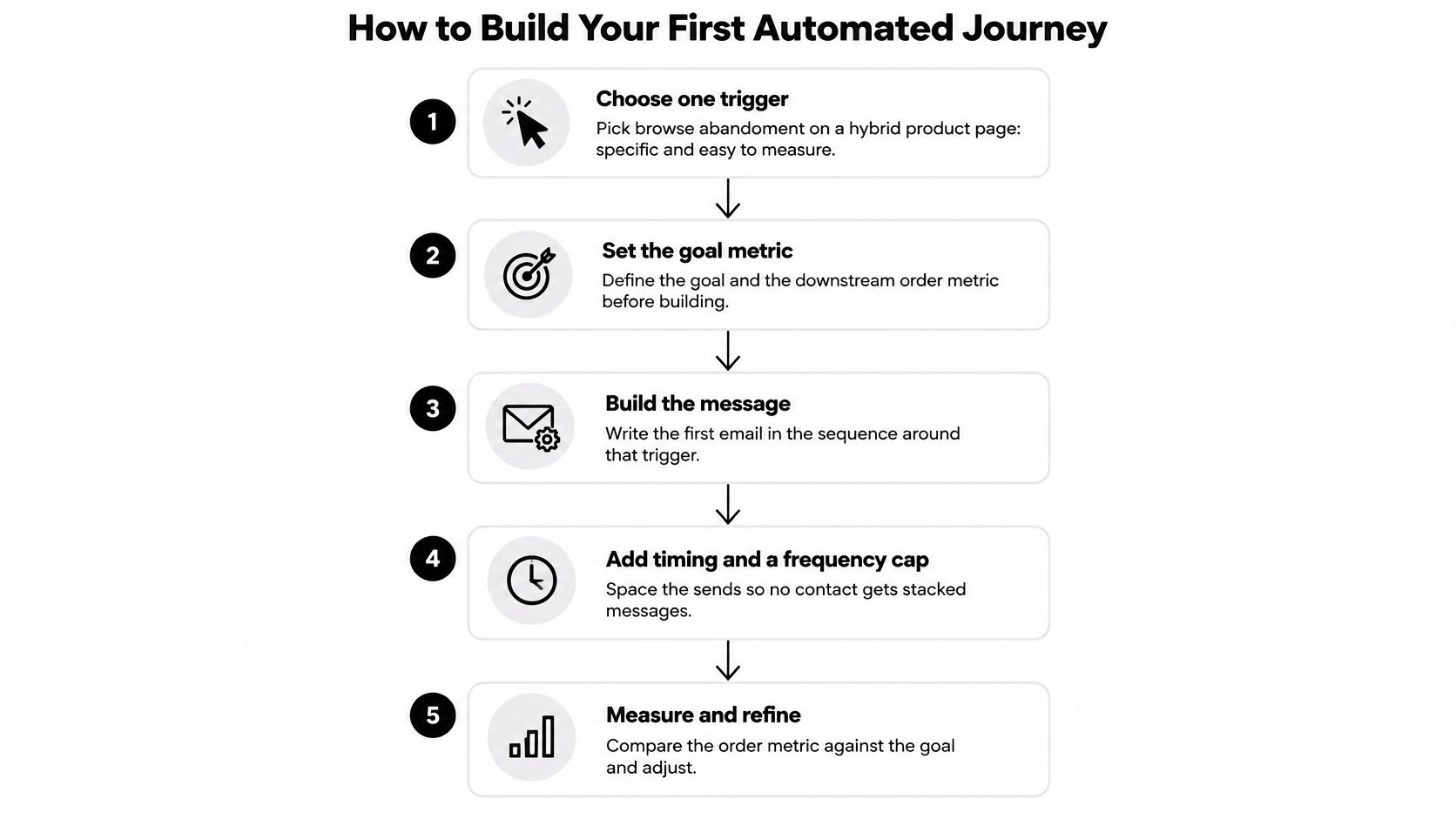
Start with a narrow buying question, not an elaborate branching diagram. A hybrid browse-abandonment journey is useful when your product pages attract interest but shoppers still need help understanding construction.
Build the rules before the creative
Choose an observable trigger. Use eligible, identifiable hybrid-product browsers and confirm that the platform receives the correct product identifier. Anonymous visits aren't permission to email.
Define the outcome before writing. Use return visits as the immediate signal and completed orders as the commercial outcome. For a showroom-led retailer, include attended appointments and salesperson-recorded purchases.
Set eligibility and exit logic. Connect purchase events and active sales status to the journey, then test the shared frequency cap. Give an owner responsibility for resolving delayed or missing events.
Build compliance into the template. The FTC's CAN-SPAM compliance guide requires accurate sender and routing information, nondeceptive subjects, a clear opt-out, and a valid physical postal address; the opt-out mechanism must process requests for at least 30 days after sending. Honor requests promptly and ensure unsubscribed contacts cannot re-enter through another integration.
Write for the unanswered question
Draft a compact sequence. As a starting design, use three messages: a construction explainer, a sleep-trial or return-policy explanation, and a final reminder. Show how foam layers and ticking relate to the product's intended feel, and reproduce policy conditions accurately rather than promising a risk-free experience.
Create a randomized holdout. For example, reserve 10% of eligible shoppers from this journey while keeping other treatment comparable. Compare order rate and revenue per eligible shopper, then account for discounts, returns, and margin before calling the difference profitable.
Schedule an initial review. A practical starting checkpoint is 30 days, but extend the test when order volume or the buying cycle leaves too little evidence. Check tracking and customer complaints immediately rather than waiting for that review.
Choose among email marketing platforms based on event reliability, suppression controls, CRM or point-of-sale integration, and holdout support. A beautiful editor won't compensate for a platform that learns about a showroom purchase after the reminder has already sent.
Your deliverables are concrete: a live journey, a tested suppression list, approved content, and a measurement plan.
Audit Your Flows and Avoid the Costly Mistakes
More automated messages don't automatically mean more profitable sales. Verified.email's email marketing report reports that automated flows account for about 2% of email volume while generating 41% of email revenue, and separately cites a 2026 analysis in which only 43.9% of processed email reached inboxes.
Those figures measure different things, so don't combine them into a mattress forecast. The more useful management question is whether your highest-intent messages reach eligible buyers and produce incremental orders rather than credited opens.
Test customer paths, not just reports
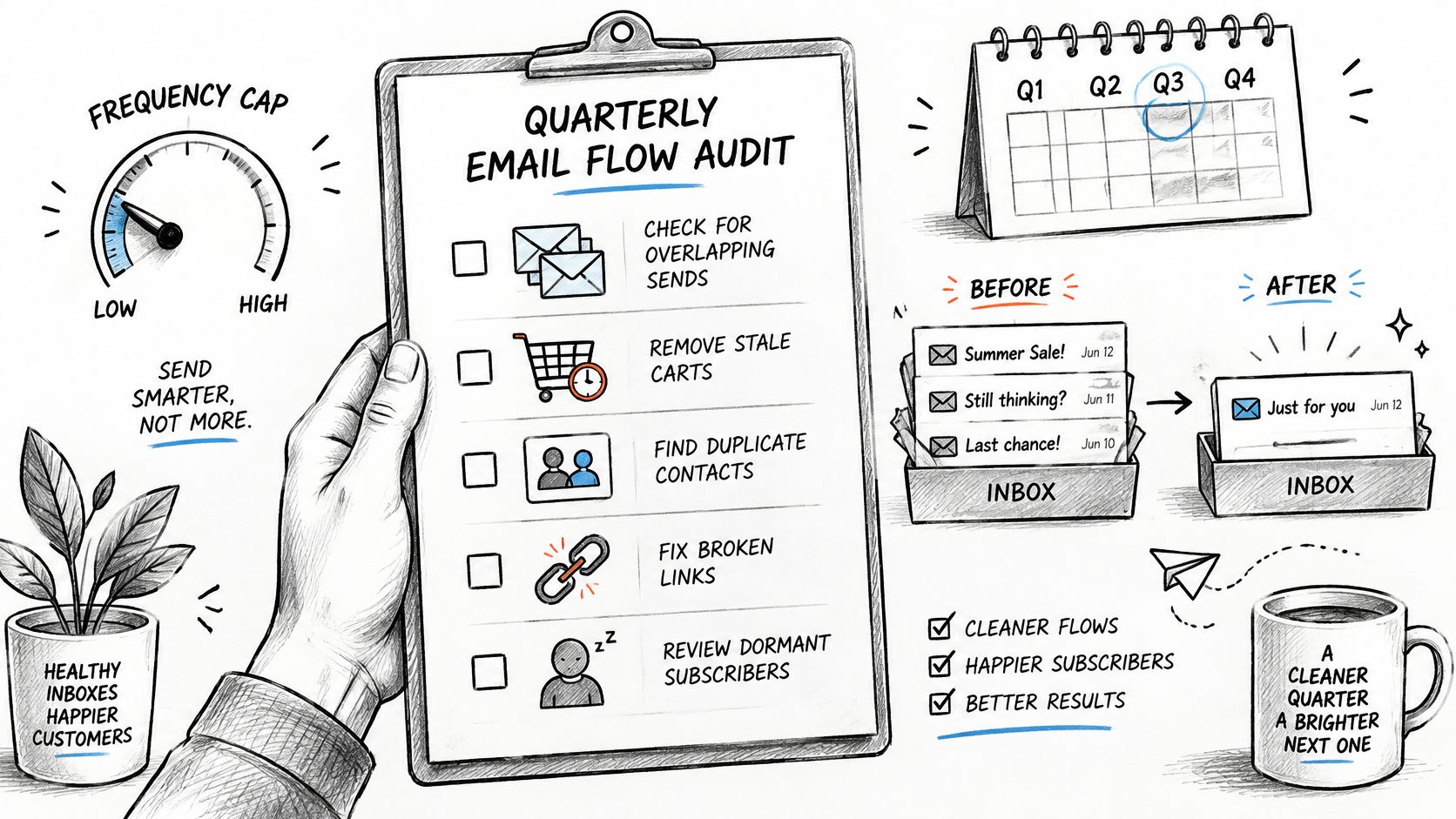
Run a quarterly audit using test profiles and real event logs. A send-volume dashboard won't catch a suppression rule that fires too late. Check these failure patterns:
Overlapping journeys: Simulate a shopper who completes a quiz and abandons a cart in the same session. Confirm that the intended priority wins instead of stacking messages.
Completed purchases: Place a test order and inspect pending sends. A suppression setting that exists in the interface can still fail when checkout data arrives hours late.
Active showroom conversations: Have an associate update the CRM status and verify that promotional follow-up pauses. Automation should support the salesperson working the floor, and a same-afternoon discount email can undercut their quote.
Open-led reporting: Trace a sample of attributed orders through delivery, clicks, sales assistance, and holdout results. Separate credited revenue from revenue the journey added.
Unapproved AI claims: Inspect dynamically generated copy for unsupported comfort, cooling, durability, and financing statements. Require human approval against product specifications and current policies.
Inspect the inputs and the product story
Pull a rolling quarter of results by trigger, product family, and sales channel. Check authentication alignment, complaint trends, deferrals, opt-out processing, and whether consent records retain the form version, timestamp, and source. A flow that drives orders while inflating complaints is borrowing against future inbox placement.
Use explicit preferences carefully, and don't convert a sleep-quiz answer into an inferred diagnosis. Keep approved fallback content available when personalization data is missing or a recommended model leaves the range.
Fewer messages are preferable when the alternative is irrelevant contact or an unverified product claim.
If eligible shoppers click but don't progress, inspect the product explanation. Does the image show the correct quilt and gusset? Can buyers distinguish the foam layers, and does the description match the floor model they'll try in store? Fixing that gap often does more for a flow than any resend rule.
BEDHEAD supports that work through digital marketing, ecommerce strategy, creative asset creation, product storytelling, and high-end visual content for mattress brands, bedding manufacturers, and retailers, including website design and 3D visualization. We don't guarantee specific results; outcomes depend on numerous factors beyond our control, so we scope the work, measure it, and let the numbers decide.
If your automated emails aren't connecting product interest to orders or showroom visits, visit BEDHEAD to discuss your journey logic, measurement gaps, and product content.