AR 3D Modeling for Mattress Brands: Practical Guide 2026
A shopper lands on a mattress product page from a paid ad. They see a white-background photo, one lifestyle image, and a close-up of the quilt. The page says “cooling,” “supportive,” and “premium comfort,” but the shopper still can't tell how the mattress will look beside their bed, how thick the gusset really is, or what sits beneath the ticking.
That gap creates work for everyone. The eCommerce team answers repetitive questions, the retailer explains construction on the showroom floor, and the buyer makes a high-consideration purchase with limited confidence. AR 3D modeling gives mattress brands a practical way to make the product easier to understand, provided the asset is built for mobile delivery and real retail workflows rather than created only as a beautiful demonstration.
Why Your Mattress Brand Needs AR 3D Modeling Now
A mattress can look impressive in a studio and still be difficult to sell online. A static image shows the surface, but it rarely communicates the relationship between the quilt, gusset, foam layers, edge support, and foundation. Even a strong room scene can leave shoppers guessing about scale.
That matters in both channels. In a showroom, a floor model gives the customer physical context, but the retailer still has to explain what the shopper can't see. Online, the brand has to replace that explanation with product content. AR 3D modeling allows a shopper to place a true-to-life mattress in a room, inspect proportions, and interact with a product story that isn't limited to a single camera angle.
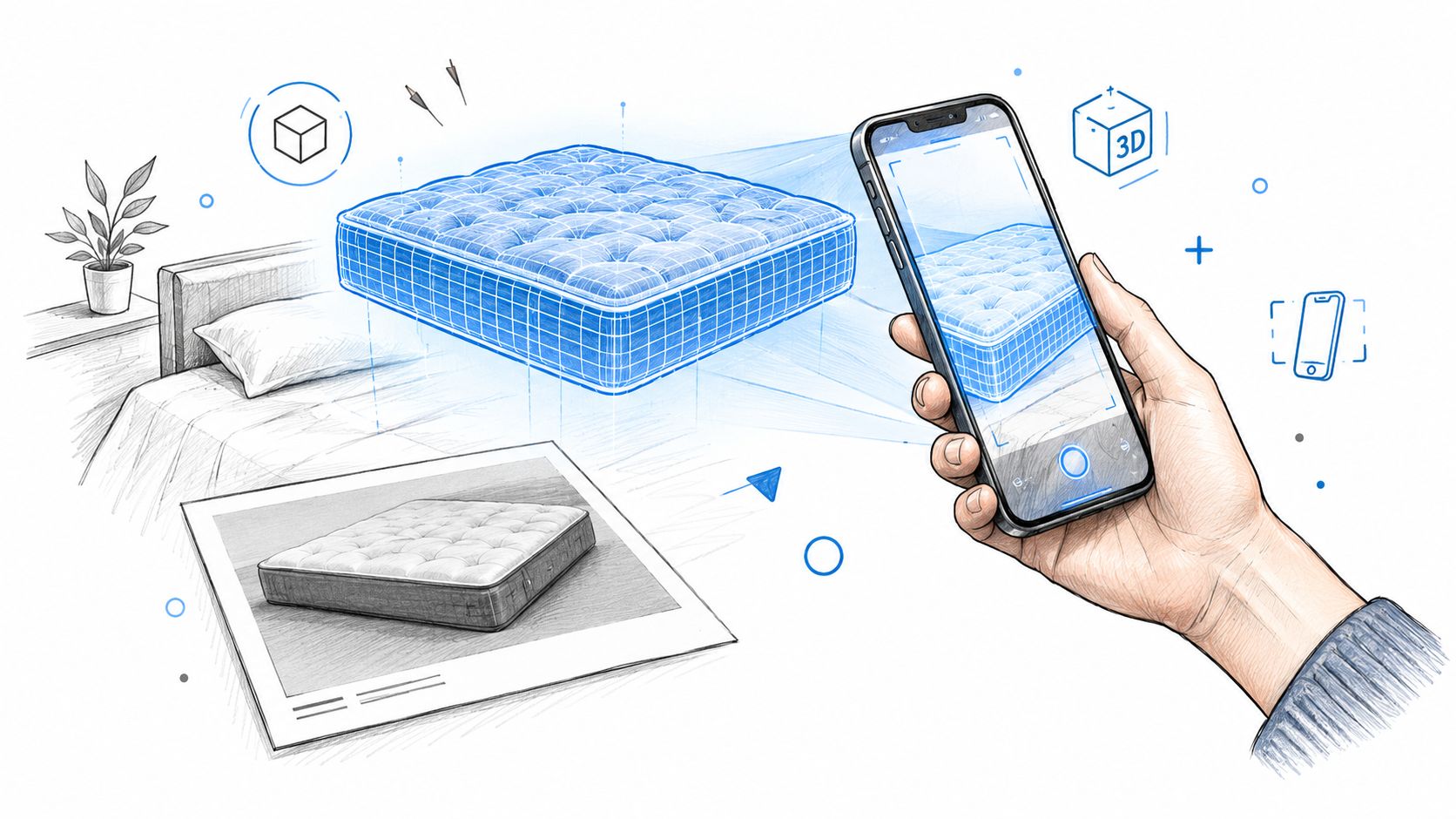
The commercial pressure is moving in that direction. A North America augmented reality and mixed reality market report projects the market to reach USD 237,378.41 million by 2029, with a 50.8% CAGR over the forecast period. The same report treats 3D modeling in AR and MR as a dedicated sub-segment, not as a minor add-on.
Static imagery leaves useful information on the table
A shopper comparing a hybrid mattress wants more than surface appearance. They want to understand whether the product looks substantial, whether its height fits the bedroom, and why the construction justifies the price. A lightweight interactive model can support those questions without requiring a sales associate or a physical sample of every configuration.
This is also where experience design matters. For marketers building a more useful digital journey, the experiential design guide for marketers offers helpful context for thinking beyond isolated product graphics. The principle applies directly to bedding: the experience should help the shopper make a decision, not just decorate the product page.
For a mattress brand, a sensible first step is to review how augmented reality product visualization could support existing product pages, showroom QR codes, and sales presentations. AR doesn't replace photography, product copy, or trained retail staff. It gives those assets another job, helping the shopper connect technical construction with a product that feels understandable and credible.
What AR-Ready 3D Modeling Means for Mattresses
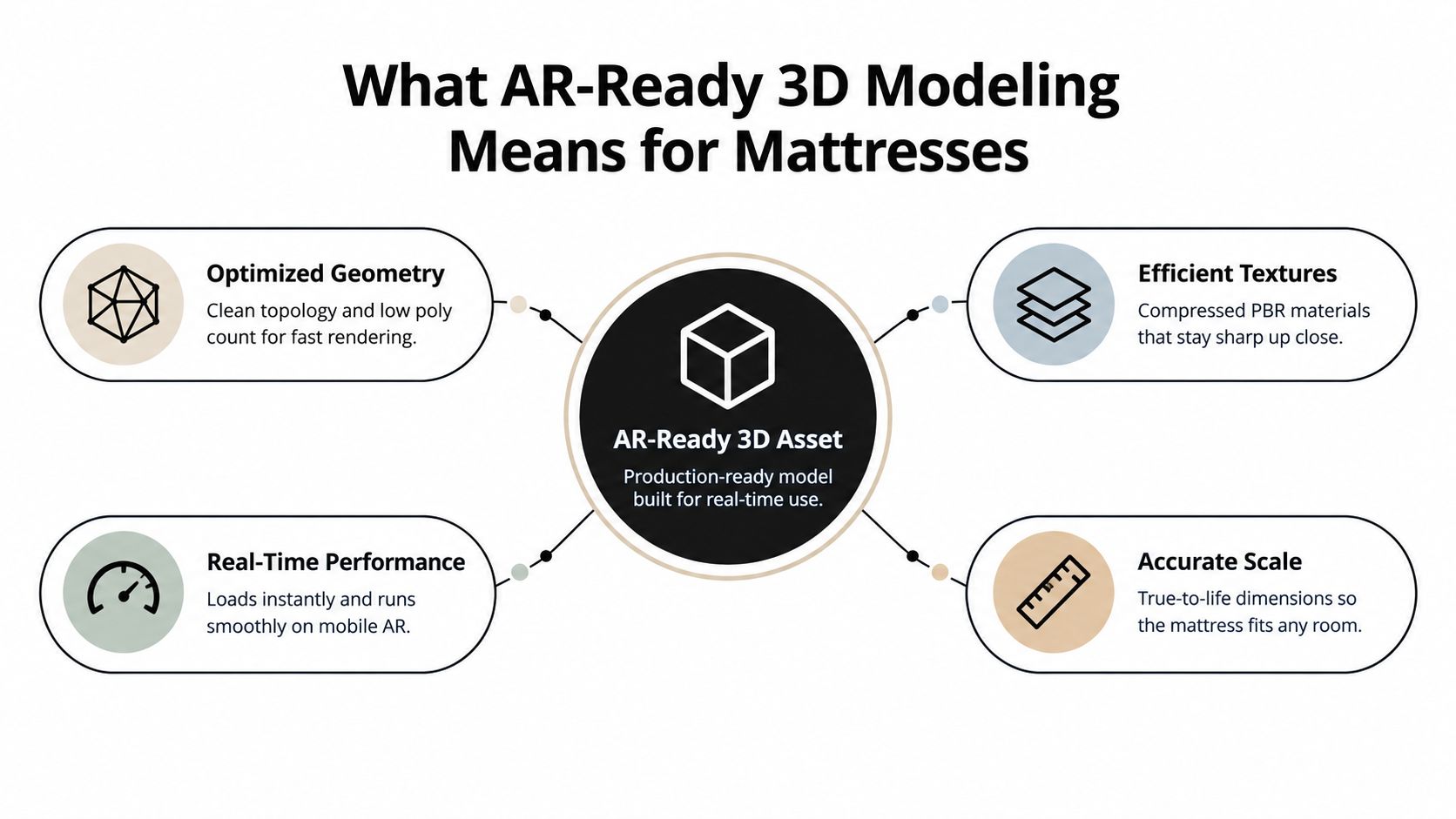
An AR-ready model isn't just a polished render exported from a design program. It's a production asset built to load, display, and respond in real time on the devices your customers and sales teams use.
That distinction changes the workflow. A traditional product render can prioritize maximum detail because the final output is a controlled image. An AR asset has to account for geometry, texture memory, file size, lighting response, scale, tracking, and interaction. A model that looks excellent in a workstation viewport may load slowly or behave poorly on a phone.
Build the asset around its delivery environment
A practical AR mattress asset usually includes:
Clean geometry: The mesh represents the mattress accurately without carrying unnecessary internal detail that customers won't see.
Efficient materials: Physically based rendering, or PBR, gives fabric, foam, thread, and quilting a believable response to light.
Reliable scale: The model uses the actual mattress dimensions so room placement has meaning.
Real-time exports: The asset can move into browser-based viewers, mobile AR experiences, or an engine without a complete rebuild.
Formats such as glTF and GLB are useful for web and real-time delivery because they package geometry and materials in a way modern viewers can handle efficiently. USD variations are valuable when a team needs a broader scene, asset, or digital twin pipeline. The correct choice depends on the destination, but the principle stays the same: export for the experience, not for the modeling software.
Use PBR to communicate material differences
Mattress shoppers may not know the technical names for every textile or foam, but they recognize visual cues. A quilt should look different from a smooth stretch-knit ticking. A gusset should read as a separate construction detail. A latex-style surface, a cooling cover, and a tightly woven fabric shouldn't all respond to light in the same way.
PBR materials help preserve those differences across lighting conditions. They don't prove that a mattress feels cool or supportive, so claims still need accurate copy and substantiation. They do make the visual explanation more convincing by showing the surface, sheen, roughness, and pattern with greater consistency.
Teams working with older interchange formats can also benefit from a plain-language Collada XML structure guide, particularly when diagnosing how geometry and material information move between programs. The file format is less important than maintaining a controlled source of truth, clear naming, and predictable exports for each channel.
A useful workflow creates one master model, then produces channel-specific versions for product pages, AR placement, room scenes, sales decks, and paid media. That prevents the common problem of a brand showing one mattress thickness online, another in a catalog, and a third in a retailer presentation.
Optimizing Polygons, Textures, and LODs for Mobile AR
The most expensive mistake in mattress AR is treating detail as automatically valuable. More polygons can improve the appearance of a quilt edge or seam, but mobile users experience the asset through loading time, frame stability, and placement responsiveness. If the model stutters, the customer stops examining the product.
A 2026 study on AR asset optimization found that polygon count strongly affects realism and performance. Higher geometric complexity improved visual ratings but sharply reduced smoothness and loading speed. Its practical recommendation is roughly 250K triangles with textures ranging from 8K to 2K, depending on architecture, as described in the research on polygon count and real-time AR performance.
That isn't a universal setting. A retailer's browser viewer, an iPhone-based AR experience, and an enterprise headset can have different constraints. Treat the recommendation as a starting point for testing, not a promise that one export will suit every device.
Spend geometry where shoppers see it
For mattresses, the visible priorities usually include the quilt pattern, top profile, gusset, corner construction, label placement, and the relationship between the mattress and the bed frame. Hidden underside detail rarely deserves the same geometry budget.
A disciplined optimization pass should ask:
What affects purchase confidence: Preserve geometry that helps shoppers judge thickness, scale, construction, or finish.
What can use normal maps: Fine stitching, shallow quilting, and small surface relief can often be represented through texture rather than dense mesh.
What can share materials: Similar fabric zones can use a shared material setup instead of separate heavy textures for every face.
What needs a separate SKU: Use distinct assets only when a firmness, height, or construction change is visually meaningful.
Use LODs instead of one oversized model
Levels of detail, or LODs, let the experience serve different meshes at different viewing distances. A shopper placing a mattress across a room doesn't need the same geometry as someone inspecting the corner up close. The distant version can be simpler, while the closer version introduces more surface detail when the device can handle it.
This is especially useful for showroom workflows. A QR code on a floor model may open an AR view where the shopper first sees the whole bed from a distance, then moves closer to inspect the cover. The model should respond to that behavior rather than forcing the phone to render maximum detail from the first frame.
Test tracking as part of modeling
Visual quality won't rescue unstable placement. Research on AR placement reports errors ranging from a few centimeters to several meters, depending on tracking method and conditions. The comparative study of AR model placement accuracy also identifies lighting, marker quality, camera distance, and SDK maturity as important variables.
Test the mattress in bright bedrooms, darker showrooms, patterned floors, and rooms with reflective surfaces. Calibrate dimensions against a known bed frame, test marker and markerless modes where relevant, and check whether the mattress appears to float, sink, or drift. The 3D mesh guidance for mattress visualization is useful when the team needs to connect modeling decisions with production-ready mattress imagery.
Practical rule: If the customer notices the tracking before the mattress, the asset needs more optimization, not more visual detail.
Tools and Workflows for Mattress 3D Teams
The right tool depends on what the brand already has. A manufacturer with CAD files, material specifications, and an established engineering team shouldn't begin by sculpting every mattress from scratch. A DTC brand with inconsistent photography may need a visualization-first workflow that builds a clean marketing asset from measurements, samples, and reference images.
There are three common starting points.
CAD is a strong source, not always a finished AR model
CAD data can preserve accurate dimensions, component relationships, and manufacturing intent. That makes it useful for a mattress manufacturer, especially when the model needs to support training, product documentation, or a digital twin.
The problem is that engineering geometry often contains detail that real-time viewers don't need. It may also have topology that isn't suitable for smooth deformation, efficient texture mapping, or rapid colorway changes. A production artist usually needs to clean the mesh, reduce unnecessary geometry, build usable UVs, and create materials that communicate the visible product.
Sculpting helps with soft goods
Mattresses aren't rigid appliances. Their edges, quilt crowns, compression zones, and fabric transitions need to look soft without becoming computationally expensive. A sculpting workflow can help artists establish the visual form, after which retopology creates a cleaner mesh for real-time use.
For color and material variations, a well-organized mesh is more valuable than a highly detailed one. Keep the cover, border, handles, labels, and relevant construction areas logically separated so a team can produce a new colorway without rebuilding the entire model. The same source can then generate a white-background silhouette, a room scene, a Digibun, and an interactive AR version.
A guide to 3D product visualization software can help teams compare workflows before they commit to a toolset. The decision should follow the output requirements, internal skills, source data, and approval process rather than software popularity.
Build a controlled handoff
A dependable mattress pipeline typically moves from:
Reference collection: Gather dimensions, CAD, fabric samples, quilt references, construction drawings, and approved color information.
Master modeling: Create the accurate source asset with consistent naming and material structure.
Real-time preparation: Retopologize, unwrap, compress textures, generate LODs, and confirm scale.
Channel exports: Produce GLB, USDZ, engine-ready files, still renders, room scenes, and sales assets as needed.
Review and versioning: Keep approved files tied to the correct SKU, height, construction, and cover option.
AR can also extend beyond consumer commerce. A Springer article on AR and digital twins describes AR experiences built from CAD models of real components, with 3D models and instructions supporting monitoring, predictive maintenance, performance optimization, and resource management. Manufacturing-focused research also identifies training, data visualization, plant design validation, and maintenance as relevant AR uses for digital twins, as outlined in this study of AR in manufacturing digital twin workflows.
That makes asset organization a business decision. The model may begin as a product page enhancement and later support a factory training module, a retailer education tool, or a service presentation.
Performance Considerations That Protect Customer Experience
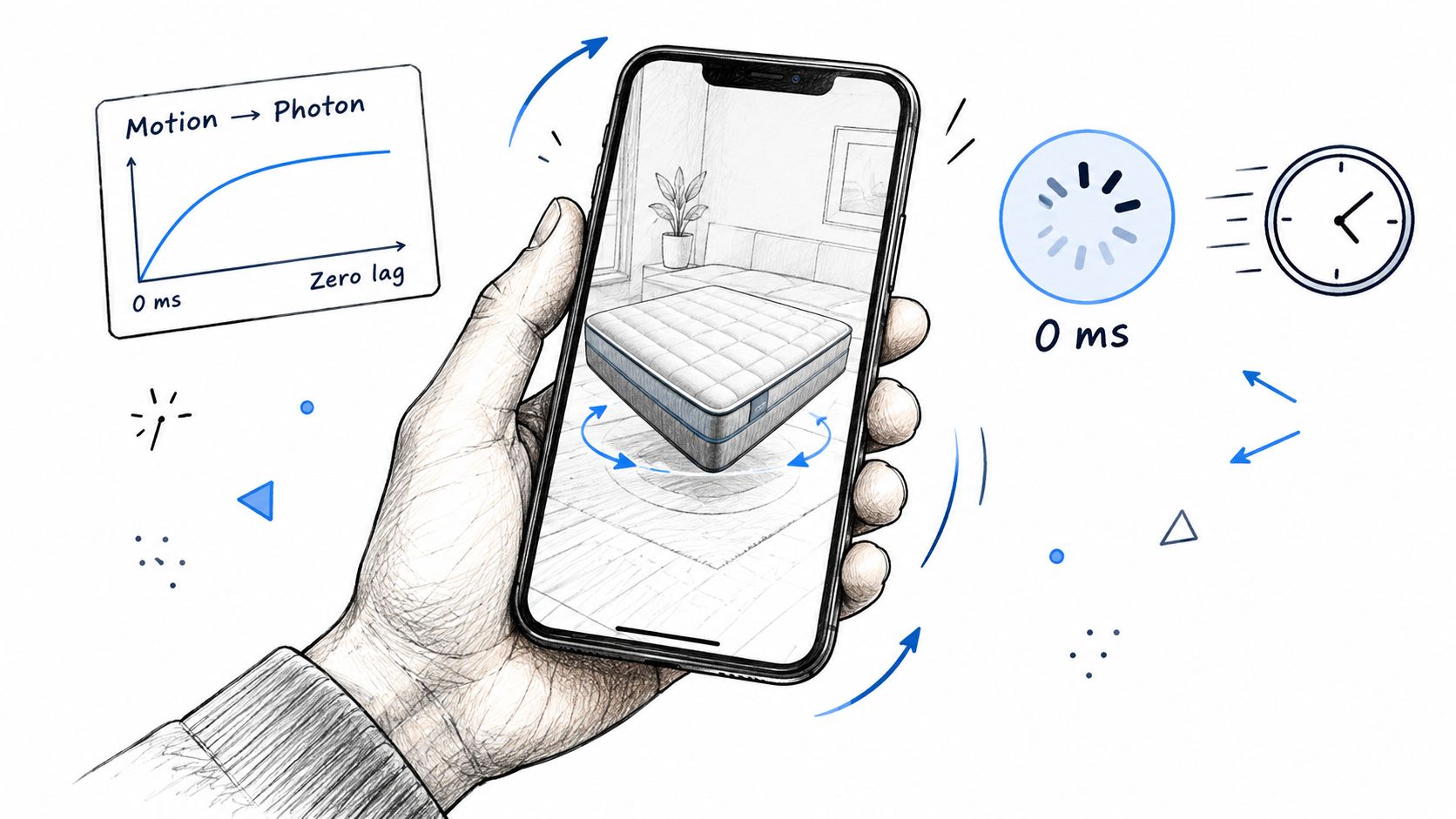
A mattress AR experience can be technically correct and still feel broken. The shopper moves a phone, the model follows late, and the mattress appears to swim across the floor. That delay weakens trust because the customer no longer believes the digital object is anchored to the room.
End-to-end latency includes tracker latency, compute time, render time, and display delay. Research on a mobile AR system reduced end-to-end latency to about 33 ms, achieved accurate 6DoF tracking, and reported 97% recognition accuracy on a 10,000-image dataset, as documented in research on low-latency mobile augmented reality. The lesson for a mattress team isn't to chase a particular research result. It's to evaluate responsiveness before adding visual complexity.
Test the experience on the phones customers use
A workstation preview tells you whether the asset looks good. It doesn't tell you whether a shopper can open it from a product page, grant camera permissions, find a suitable surface, place the mattress, rotate it, and return to the purchase path without frustration.
Run the experience through the actual customer journey:
Entry: Does the AR invitation make sense beside the gallery and product information?
Loading: Does the model appear promptly on a reliable mobile connection?
Placement: Can a shopper position it on a floor or bed frame without repeated attempts?
Interaction: Do scale, rotation, color swaps, and layer views behave predictably?
Recovery: Does the experience explain what to do if tracking is lost?
Commerce: Can the shopper return to size, firmness, delivery, and checkout information?
The mistake is to assess only the model. The customer experiences the entire sequence.
Protect memory and visual hierarchy
Uncompressed textures can create unnecessary memory pressure, especially when a mattress uses large fabric maps for details that are barely visible on a phone. Compress materials, remove unseen surfaces, and reserve high resolution for areas where shoppers inspect the product.
A live configurator also needs restraint. Color swaps are useful when a brand sells meaningful cover options, but a long list of trivial variations can make the interface harder to use. The same applies to animation. A short, purposeful transition can help explain a construction feature. Decorative motion that delays placement adds little value.
Smooth placement and clear product information usually sell more effectively than a technically impressive model that makes the shopper wait.
The 2026 industry conversation is also moving toward interoperability. Reporting on 3D modeling for AR and VR workflows highlights OpenUSD traction, WebGPU availability across major browsers, and a glTF extension for 3D Gaussian splatting. Those developments may expand what teams can deliver, but they don't remove the need for asset governance, compression, device testing, and clear retail use cases.
Practical AR Use Cases for Bedding Brands
The strongest mattress AR projects start with a selling problem, not a technology demo. A retailer may need to explain why a premium hybrid costs more. A DTC brand may need to help a shopper judge height and scale. A manufacturer may need one approved product asset that supports a catalog, sales deck, product page, and training session.
Room placement can clarify scale
A shopper can place a mattress in a bedroom and see how its height relates to the headboard, nightstands, and existing frame. That doesn't eliminate every delivery or fit question, but it makes the visual decision more concrete. For floor-model retailers, a QR code can extend the showroom conversation into the shopper's home without sending a physical mattress.
The experience should show the correct size and construction. A queen hybrid with a tall profile shouldn't use the same proportions as a low-profile foam model. Accurate dimensions matter because a false sense of scale creates disappointment rather than confidence.
Digibuns explain what a photograph cannot
A Digibun is a layered breakdown visual that reveals internal product layers customers normally can't see. It can show the relationship between the quilt, comfort foams, support core, edge reinforcement, and base materials without asking a shopper to interpret a technical cutaway.
The distinction between visual types matters. An exploded view separates layers outside the mattress while preserving their individual relationship. A cutaway removes part of the product while keeping the overall form. The mattress guide to Digibuns, exploded views, and cutaways explains that difference in product-education terms.
A Digibun doesn't need to become a confusing engineering diagram. Show the layers in a controlled sequence, use plain labels, and connect each component to a customer-relevant benefit only when the product claims support it. A retailer can use the same visual in a sales tablet, product page, training deck, or showroom display.
Interactive demos support the selling process
A trained RSA can use a 3D model to explain why a mattress feels different from another model in the same collection. A manufacturer can use an interactive construction view to keep retailer education consistent across regions. A DTC team can place the interaction next to firmness guidance, height information, warranty terms, and delivery details.
The interactive product demos resource is relevant when a brand wants to connect model interaction with a broader product education path. The model should answer a question that affects the purchase, not distract from it.
Start with one mattress family rather than attempting every SKU. Choose a product with meaningful construction differences, collect the approved dimensions and material references, then test the asset with showroom staff, customer service, and real shoppers. Track qualitative feedback first: where users hesitate, what they misunderstand, and whether the experience helps them ask better questions. That evidence will tell you which products and features deserve the next investment.
For mattress manufacturers, retailers, private label brands, and sleep product startups, this work often sits between design, merchandising, marketing, and sales. Bedhead Marketing operates across those mattress-specific needs, from Digibuns, silhouettes, and room scenes to SEO, paid media, product page optimization, brand development, and sales training. If you're building a broader education program, Bedhead University provides another resource for mattress industry teams.
A practical next move is to audit one product page, one showroom workflow, and one existing 3D asset. Check whether the mattress is dimensionally accurate, whether the file is light enough for mobile delivery, whether the tracking holds in realistic rooms, and whether the interaction explains construction better than the current photography. Then use those findings to define a focused AR pilot instead of commissioning a technology showcase with no retail job to perform.
If you're evaluating AR-ready mattress assets, Bedhead can help turn accurate product information into Digibuns, silhouettes, room scenes, interactive visuals, and channel-ready marketing content through BEDHEAD. Mattress professionals can also join the free Bedhead Network for industry insights, news, networking, training resources, a directory, and business tools.