Why Is Brand Consistency Important for Mattress Brands
Three versions of the same spec sheet are probably live right now. One sits in a retailer's portal, one in a shared drive from last spring, and one inside a distributor's trade show deck. The mattress hasn't changed. The story wrapped around it has.
Ask why is brand consistency important and most agencies reach for logos and color palettes. In bedding, the honest answer is narrower and more commercial: buyers judge a mattress by how well its story holds together, and that judgement decides whether they trust the associate standing next to the floor model, whether they recognize your name on a second shopping trip three weeks later, and what they'll pay.
The creative side of a mattress brand should flex by channel. The factual side can't. That split is the whole discipline, and it's why brand consistency in this industry looks less like a design manual and more like a data governance system.
Why Is Brand Consistency Important for Mattress Revenue
Picture a shopper in a showroom on a Saturday with her phone in her hand. The retailer's listing called the bed medium-firm. Your site calls it plush. The warranty paragraph on the carton doesn't match the warranty paragraph in the order email she got from a different retailer last month.
She liked the mattress. She leaves without it, because she can't tell which claim belongs to the product she just lay on.
Consistency matters because buyers judge a mattress by the consistency of its story, and that story drives trust, recognition and price. Align the facts and each touchpoint compounds on the last one. Let them drift and every touchpoint starts from zero.
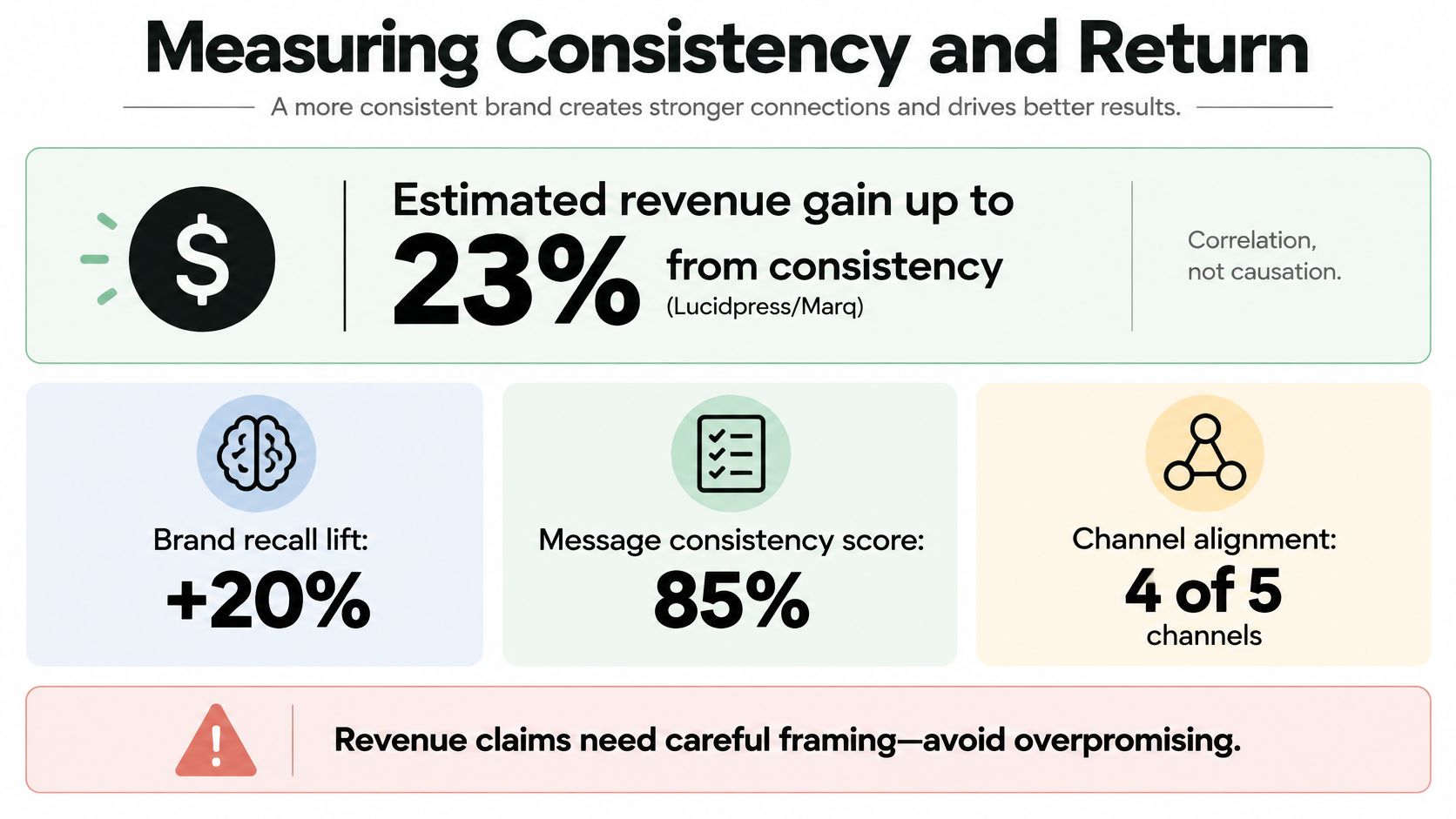
The revenue evidence is worth knowing, provided it's described accurately. Branddeck's review of the brand consistency statistics collects the two most cited figures from Lucidpress's research: a 2016 survey that linked consistent brand presentation to an estimated 23% revenue increase, and a 2019 follow-up that reported a potential increase of up to 33%.
Both came from surveys of brand-management professionals, not controlled before-and-after experiments. They capture what practitioners credit consistency with, which makes them a correlation and not a receipt.
Finding | Reported Figure | Source Type | What It Does Not Prove |
|---|---|---|---|
Revenue association, 2016 survey | Estimated 23% revenue increase | Survey of brand-management professionals | Does not prove consistency alone caused the increase |
Revenue association, 2019 follow-up | Potential increase of up to 33% | Survey of more than 200 organizations | Survey-based, not a guaranteed return |
Brand visibility | About 3.5 times more likely to achieve excellent visibility | Lucidpress and Demand Metric research series | Multiplier varies by dataset, with summaries citing 3 to 4 times |
Visibility explains the mechanism better than revenue does. A shopper can remember that a bed slept cool and still fail to remember who made it. Repeated, matching signals attach the memory to a name, which is why Marq's brand statistics collection reports consistently presented brands as about 3.5 times more likely to achieve excellent visibility, with other summaries of the same research series citing 3 to 4 times.
Practical rule: if two touchpoints describe the same mattress differently, you don't have a font problem. You have a file problem.
Use all of it as directional benchmarks for the budget conversation and as justification for an audit. Nobody can promise you a specific lift from fixing a spec sheet. You can promise yourself fewer contradictory claims in market.
How Mattress Buyers Lose Trust Across Touchpoints
Trust in a mattress builds slowly and breaks in a single contradiction.
Brand-trust research built on the Erdem and Swait signaling model explains why. Buyers read repeated, low-variance signals as evidence that a company's attributes are stable over time, and a brand is expected to keep its promises across its entire marketing mix (the Erdem and Swait-based brand trust study). Every touchpoint is a small test of whether you're the same company you were last week.
Apply that to one model. A queen hybrid with a gel memory foam layer, a 15-year warranty, a medium feel and a side-sleeper positioning carries five facts a buyer will compare across channels: firmness, materials, warranty, comfort benefit and who the bed is built for. Those five have to survive the website, a retailer product card, a paid social ad and a sales conversation on the floor.
When one channel leads with pressure relief, another implies a softer feel, and a third makes a cooling claim nobody in the building can substantiate, credibility drops. The mattress didn't change. The evidence around it did.
Consistency doesn't require identical copy on every channel. It requires the same verified facts underneath different formats.
The Path One Model Actually Takes
Follow a single SKU from a search result to a delivered bed and count the handoffs. The mismatches cluster at the stages below, and each one has a single fix.
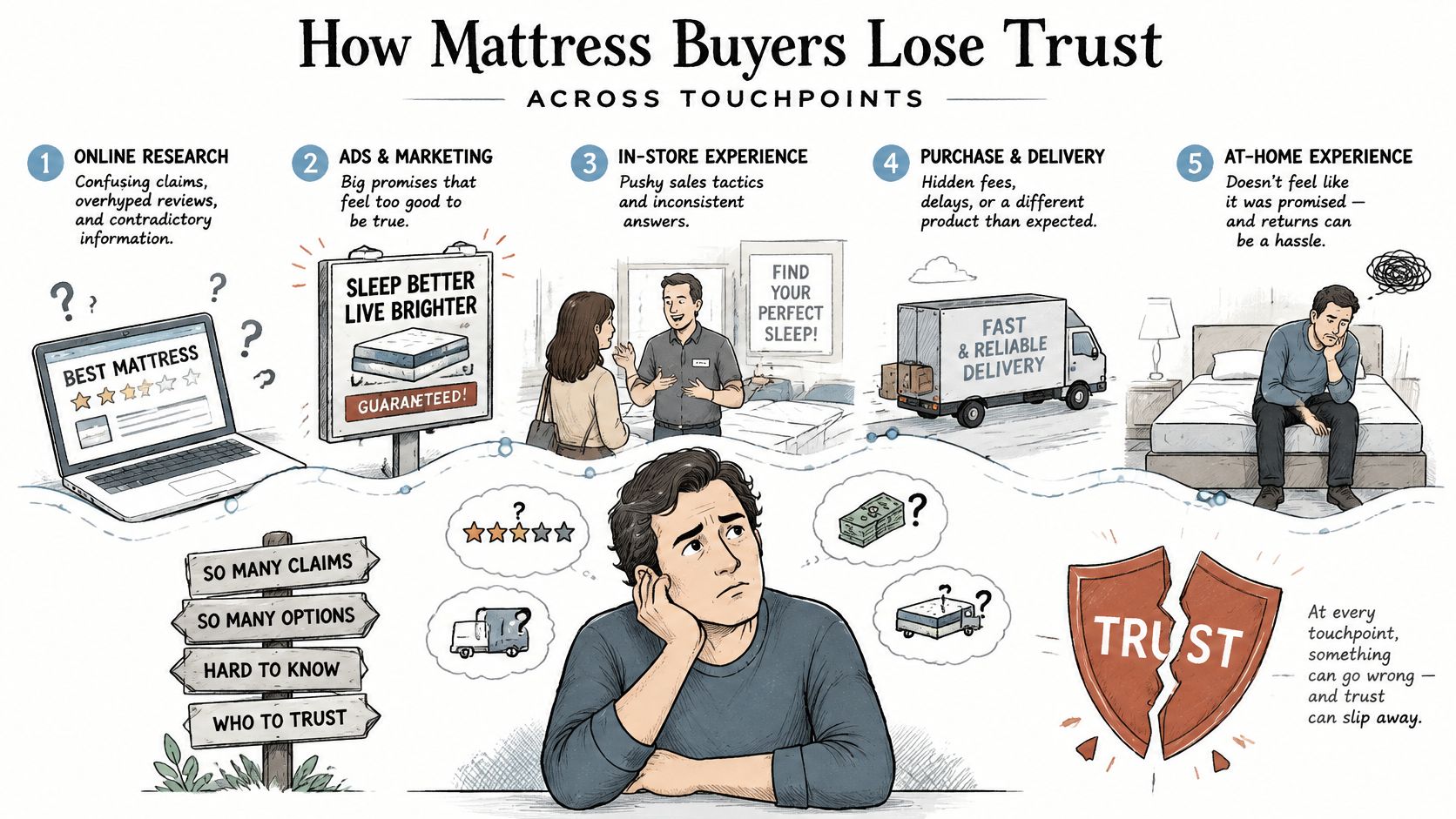
The path usually runs like this. A shopper searches a symptom, lands on a retailer's listing, opens your manufacturer site in a second tab, watches a review, visits a showroom, then gets a post-purchase email about rotating the mattress. Each stop is staffed by a different team working from a different file.
The wider the channel mix, the more places drift can start, which is why an omnichannel strategy that assigns one owner for product facts beats a channel-by-channel approach every time.
The pattern isn't unique to sleep, either. Furniture buyers research across weeks and repeat visits, a journey traced in from first research to final purchase by Indian River Furniture, and mattress shoppers follow the same shape on a shorter fuse because the purchase is more personal and the return is more painful.
Touchpoint | What Drifts | What the Buyer Concludes | Fix |
|---|---|---|---|
Retailer product card | Firmness listed as plush while the manufacturer sheet says medium | The brand is unclear about feel, so the buyer hesitates | Lock the firmness scale and wording in one source sheet |
Manufacturer website | Warranty shown as 10 years while packaging says 15 | Claims feel unreliable | Reuse one warranty block across all channels |
Showroom floor model | Floor tag names a gel layer that the spec sheet does not list | The sales pitch conflicts with the paperwork | Sync floor tags to the spec sheet every model year |
Paid social ad | Headline promises cooling that the spec does not support | The buyer doubts comfort claims | Keep an approved claims list for every ad |
Email or sales sheet | Retired model name still in use | The buyer cannot tell which model is current | Version-control product names and retire old ones |
Inconsistency Is Usually a Data Failure
Drift rarely starts in the design department. It starts in a spreadsheet. The firmness scale lives in a product team's file, the warranty block in a legal document, model names in a dealer portal, and the layer descriptions in a sell sheet from two seasons ago. Nobody reconciles them because nobody owns all four.
The scale of that execution gap shows up in the research. The 2019 Lucidpress State of Brand Consistency survey found that 81% of companies still dealt with off-brand content, according to the survey announcement. That points at execution across teams, not confusion about what the brand stands for. People know the rule. They don't have the current file.
A floor tag naming a gel layer that's missing from the spec sheet turns a strong associate's pitch into a credibility problem, and the associate usually discovers it after the customer does.
Three drifts do the most damage in mattress retail:
Firmness wording: one channel says plush, another says medium, and the buyer decides the brand doesn't know its own product.
Warranty terms: a 10-year block in one place and 15 in another puts a legal document in conflict with a marketing asset, and warranty is the claim buyers screenshot.
Model naming: retired names lingering in retailer portals make current models unfindable and old ones look available.
None of those are creative problems. All three get solved by one source sheet, a named owner, and a rule that no channel publishes a fact the sheet doesn't contain.
Which Mattress Brand Elements Must Never Change
The standard advice says repeat everything identically, everywhere. Follow it and a mattress brand ends up preserving a claim that stopped being true two foam generations ago.
Kearney Consumer Institute's Q1 2025 U.S. study found that 90% of consumers trust brands that consistently deliver, which attaches trust to fulfillment rather than to visual repetition (Kearney Consumer Institute quarterly briefing). The same briefing frames consistency as making minimal changes, or changes "within reason," rather than refusing to evolve.
Tier | Mattress Examples | Who Owns It | Change Rule |
|---|---|---|---|
Non-negotiables | Materials, layer build, certifications, warranty terms, comfort claims | Product and compliance team | Change only with documented testing |
Adaptable | Headlines, demonstrations, product imagery, local examples | Channel and regional teams | Change within the approved claims set |
Experimental | Campaign concepts, interactive shopping tools, new room scenes | Marketing team | Test first, then promote or retire |
That middle tier is where most of the daily work happens, and it's where brands get nervous. It shouldn't. A showroom associate, a retailer product page, a paid social ad and a packaging panel should never share identical copy. They should express the same verified proposition in the format each context allows.
The factual layer still has to hold hardest during adaptation. Adobe's 2025 survey of 1,001 Americans found that misleading claims and aggressive sales tactics were the largest purchase barriers, reported by 71% of respondents (Adobe's analysis of content consistency). Loosening a claim to fit a local market is how that number gets worse.
A brand entering a new region can swap lifestyle imagery, testimonials, promotions and calls to action without touching the firmness scale, the layer build or the warranty. Imagery is the most elastic layer in the system, and the guide to using mattress imagery covers how to adapt lifestyle scenes without misrepresenting what's inside the ticking.
The test: if a change alters a fact a buyer would use to compare two models, it belongs in the tier that requires testing and documentation.
Building Brand Guidelines Teams Actually Follow
A mattress guideline must answer a practical question quickly: which product facts and assets can a team use? If an ecommerce manager cannot find current dimensions and an approved product image before a listing goes live, the guideline is not doing its job. A short, searchable system is more usable than a long PDF that leaves teams rebuilding details from old emails.
Six Things a Mattress Guideline Needs
A single source of truth for dimensions, materials, certifications, firmness descriptions and warranty language. Teams should pull approved facts from this source rather than retype them.
Master files with clear filenames for logos, product photography and 3D renders. This helps associates identify approved assets instead of choosing an outdated file.
An approved claims list with substantiation notes. Keep claims that require testing or documentation distinct from copy that can be adapted for different channels.
Channel-specific adaptations for retailer portals, paid ads, showroom cards and email. A short headline and a floor tag can express the same approved promise in different formats.
A named owner and version control. Assign responsibility for updates and make the current version easy to identify.
A recurring content audit that records discrepancies and assigns fixes, so teams can correct conflicting product information before it reaches buyers.
Treat imagery as part of the same system. Digibuns layer breakdowns, Silhouettes and Room Scenes should draw on one master product specification. A cutaway, retailer listing image and campaign scene can vary in composition while accurately representing the same mattress build. This keeps creative execution flexible without letting product facts drift.
BEDHEAD offers digital marketing, ecommerce strategy, creative asset creation, product storytelling and high-end visual content for mattress and bedding brands. For guidance on structuring and rolling out the system, see building brand guidelines that stick and BEDHEAD's guide to creating brand guidelines for bedding product lines.
Measuring Consistency and Its Return Across Channels
Revenue is the wrong first metric for a consistency program, because too many other variables move at the same time. Start with the system that produces the revenue.
The published estimates sit in a wide band. Research summarized from Lucidpress and Marq studies puts estimated revenue gains at 10% to 20% on average, with larger potential gains when presentation stays consistent across channels (Omnibound's review of brand consistency statistics).
The mechanism behind those numbers is operational as much as psychological. Standardized visual systems (logo geometry, color values, typography, photography style, 3D rendering conventions, modular campaign templates) cut production variance and rework, so each exposure reinforces the same memory instead of competing with it.
What to Track Each Quarter
KPI | What It Reveals | Review Cadence |
|---|---|---|
Asset-reuse rate | How often teams pull approved files instead of rebuilding them | Quarterly |
Correction cycles per campaign | How many rounds ads or listings need before approval | Quarterly |
Time to launch a new model | How quickly approved assets and claims reach every channel | Per launch |
Message-match score across channels | Whether firmness, warranty and comfort wording match at each touchpoint | Quarterly |
Conversion rate by channel | Whether the product page converts at a similar rate to the showroom referral path | Quarterly |
Average selling price and discount rate by model | Whether consistent claims support price or push buyers toward discounts | Quarterly |
Take a manufacturer launching a new hybrid in March. Track how many channels used the approved firmness wording on day one, how many correction rounds the paid ads needed before legal signed off, and whether the product page converts at a rate close to the showroom referral path. If the page lags while the showroom converts, the mismatch is probably in the imagery or the spec block, not the media plan.
Then run a pricing check. Pull average selling price and discount rate by model for the two quarters before the audit and the two after. The survey work measures revenue association rather than price premium, so pricing power has to be tested in your own sales data, one model at a time. That's the only place it's real.
The full method for tying these numbers back to spend is covered in our guide to how to measure marketing ROI, which is worth reading before you set a baseline.
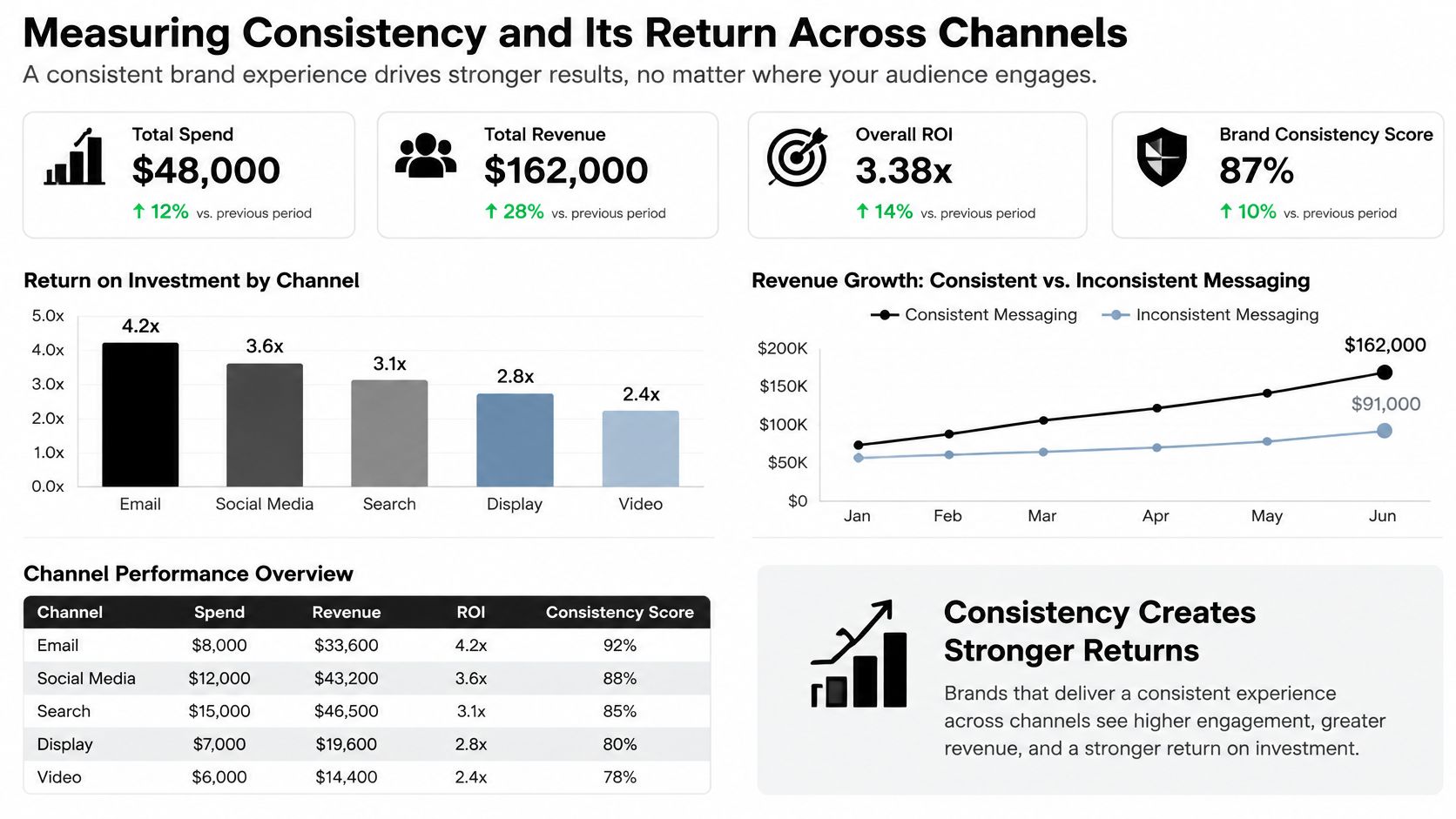
None of these estimates guarantee an uplift. They show whether the system is working: whether approved assets travel fast, whether claims survive the trip, and whether the channels that carry your best story also carry your best margin. Set the baseline, review it every quarter, and judge the pattern rather than one campaign.
Audit Your Touchpoints Before Your Next Campaign
Before launching a campaign, check whether shoppers see the same product facts on the showroom floor and online. The audit can start with an inventory, not a redesign.
List customer-facing locations for your top three models: your website, retailer listings, active ads, packaging, floor tags, sales sheets, and email templates.
Record four comparable facts from each location: firmness, materials, warranty, and comfort claims.
Flag mismatches and sort them into the three tiers, so the team can distinguish claims that need testing from files that need correction.
Assign one owner to the source sheet and update old model names across dealer portals and distributor decks.
Schedule the next audit and set the KPIs to review, making the work a recurring practice rather than a one-time project.
Start with the product page. It brings product claims and imagery together, giving the team a practical place to compare the buyer-facing story with retailer listings and showroom materials.
BEDHEAD helps mattress brands, bedding manufacturers, and retailers with digital marketing, ecommerce strategy, creative asset creation, product storytelling, and high-end visual content. Its services also include website design and 3D visualization. If firmness wording, warranty details, or model names differ across touchpoints, contact BEDHEAD to discuss how its team can support your brand.