Post Production Animation: Mattress Marketing Guide
A mattress marketing director can approve a beautiful hybrid render and still watch shoppers miss the point. The ticking looks expensive, the room scene feels polished, and the camera move is smooth, yet nobody understands where the cooling layer sits, how the support zones work, or why the mattress belongs in a showroom conversation. That gap is usually created after the model is built.
Post production animation is where a mattress render becomes a product explanation. Compositing, motion graphics, color grading, retouching, visual effects, editing, finishing, and sound determine whether a digibun clarifies foam layers or just makes them move. The same applies to a ticking close-up, a silhouette image, or a room scene built for an eCommerce product page.
Why Mattress Product Animations Often Look Great But Explain Nothing
A hybrid launch can fail visually without looking bad. The internal coils may be modeled accurately, the quilt may have convincing detail, and the room scene may sit perfectly on a 4K reference monitor. But if the camera reveals every layer at the same speed, the labels compete with the product, and the cooling claim appears after the relevant foam has disappeared, the animation has become decoration.
That's a product-communication problem, not necessarily a modeling problem. Mattress shoppers don't inspect a 3D file. They scan a product page between meetings, compare a floor model with another brand, or ask a retail sales associate a quick question. The animation has to make the right information obvious during that short decision moment.
What post production animation actually does
In plain terms, post production animation is the work that turns rendered frames and source assets into a finished, usable marketing asset. The production team may create the mattress, materials, camera movement, and lighting upstream. The post team decides how those elements are assembled, emphasized, qualified, timed, and delivered.
Here's what the core disciplines mean in a bedding project:
Compositing: combines render passes so a hybrid cutaway can show coils, foam, shadows, reflections, and the outer cover with separate control.
Motion graphics: adds layer names, support-zone markers, cooling callouts, pricing, logos, and a clear end card.
Color grading: keeps the ticking, quilt, foam, and neutral background consistent across shots and applications.
Retouching: removes distracting artifacts, cleans edges, and protects the visual quality of stitching, gussets, and fabric texture.
Visual effects: adds restrained glows, airflow cues, particles, or transitions when they help explain a physical feature.
Finishing: conforms the final edit, checks type, synchronizes disclosures, and creates channel-ready exports.
Audio mix: gives a layer reveal, camera move, or product close-up a deliberate rhythm instead of leaving the animation feeling silent and unfinished.
A vendor scope that lists these tasks isn't using jargon for its own sake. Each item affects whether the customer understands the product.
Practical rule: If a post-production decision doesn't improve clarity, accuracy, trust, or delivery, question why it belongs in the mattress animation.
Where premium visuals lose the message
The most common failure is overemphasis on atmosphere. A dark room scene can make a mattress feel luxurious, but it can also hide the quilt pattern and turn a neutral white cover gray. A dramatic rotating cutaway can show every foam layer, but it can make the support system impossible to follow. A bright cooling effect can imply an outcome that the physical product doesn't deliver.
The fix starts with a claim map. Before animation begins, connect every visual moment to one approved product fact:
The coil reveal explains the support system.
The foam movement explains pressure relief only if the physical behavior is supported.
The ticking close-up identifies the cover construction.
The airflow treatment supports a cooling explanation, but doesn't replace substantiation.
The closing frame gives the shopper a clear next action.
Bedhead works specifically across manufacturers, retailers, private label brands, and sleep product startups, so the same asset often has to serve a product page, a paid ad, a showroom screen, and a retailer presentation. That's why post production animation should be treated as a product-clarity discipline for bedding, not a generic visual-effects service.
Inside a Mattress Post-Production Pipeline
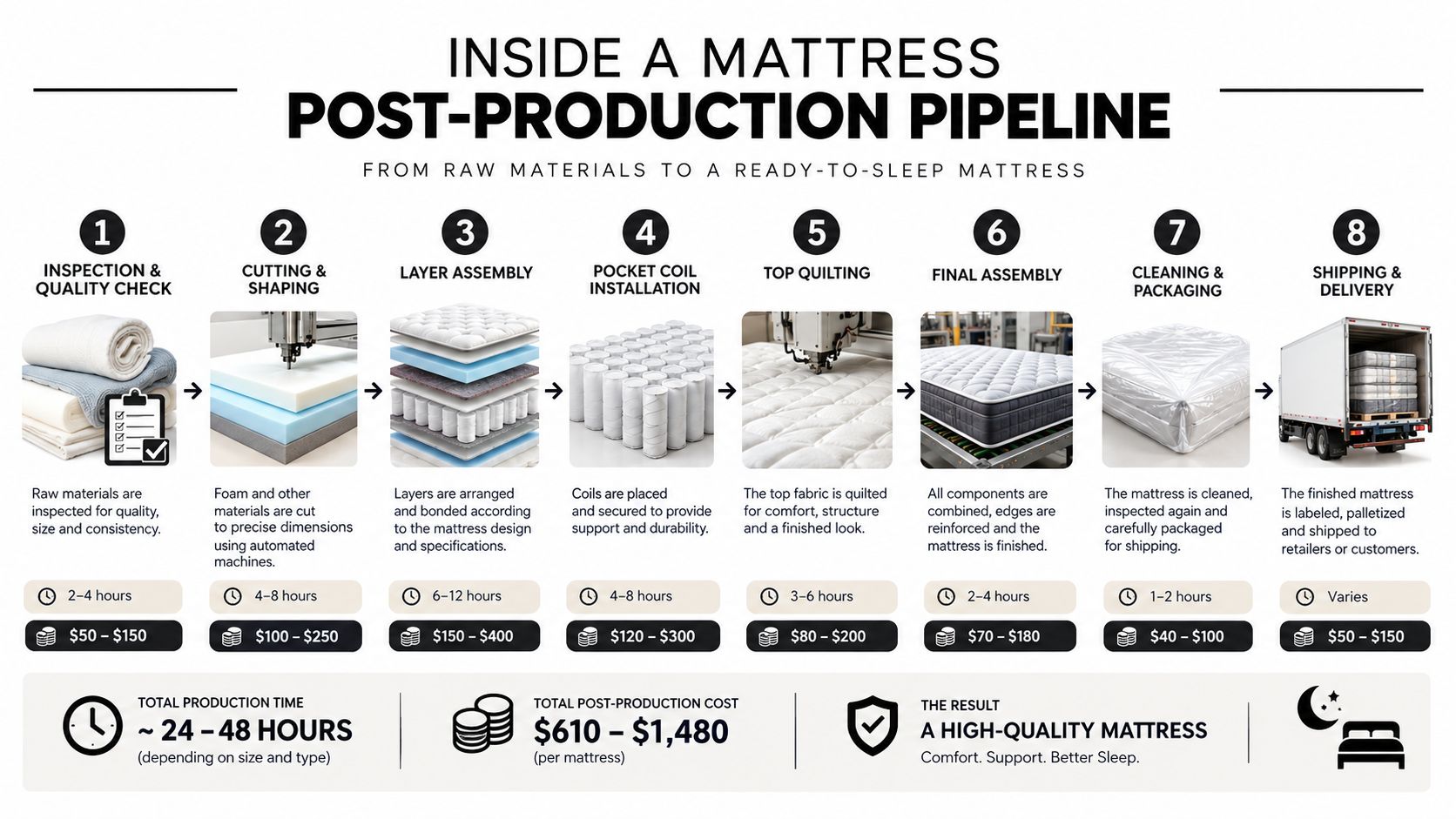
Once source renders, footage, illustrations, brand files, and approved claims leave the upstream teams, the pipeline needs order. A vendor status update should make it clear what has been ingested, what is being assembled, and what still requires approval.
Start with control, not effects
Ingest and organization come first. Confirm the current mattress model, ticking artwork, foam-layer names, gusset details, logo files, music references, voiceover, and claim language. A clean naming structure prevents an old quilt texture or discontinued layer from slipping into the final cut.
Color setup follows. Use one approved configuration across 3D, compositing, editorial, and finishing. OpenColorIO supports ACES workflows and helps preserve consistent scene-referred decisions between applications, which matters when fabric neutrals and foam tones need to match across a product page and a showroom display. The OpenColorIO project documentation explains the framework's role in visual-effects and computer-animation pipelines.
Compositing brings the layers together. Here the team balances shadows, reflections, masks, foam callouts, coil visibility, and room-scene integration. The process of rendering gives mattress teams useful context for understanding how source assets become finished visuals.
Build the explanation, then finish the file
Motion graphics should be attached to the object or claim they describe. A “cooling” label that floats independently of the relevant material creates confusion. Sound design can support a reveal, but it can't carry information that the picture and captions fail to show.
Final conform includes edit lock, caption checks, disclosure checks, audio review, aspect-ratio versions, and playback on the intended devices. Teams exploring broader visual workflows can also browse AI music video generator guides for ideas about how music, timing, and visual sequencing can interact, though a mattress claim still needs product-specific review.
Technical Decisions That Change How a Mattress Reads on Screen
A mattress can look different even when the rendered pixels are identical. If applications use different display transforms, the ticking may shift in hue, foam may lose separation, and a neutral-white background may become visibly warmer or cooler between review files. A shared color configuration prevents that kind of avoidable review cycle.
Color is a product-accuracy decision
Use a centralized configuration across 3D, compositing, editorial, and finishing. OpenColorIO is designed for animation and visual-effects workflows, supports ACES, and helps preserve repeatable transforms across CPU and GPU processing. For a mattress brand, the practical review questions are simple:
Does the ticking match the approved physical sample?
Do foam layers remain distinct without exaggerated contrast?
Does the room scene preserve the brand's intended white balance?
Does the export look consistent outside the reference monitor?
Motion blur needs the same level of attention. Adobe explains that frame rate and shutter angle control simulated exposure, while higher sampling can improve quality at a rendering cost. Blur that's too heavy can erase quilting, labels, edge geometry, and gusset detail. Blur that's too light can make a rotating mattress look mechanical and staccato.
Match the settings to the delivery
A project can span 24 to 120 frames per second, color depths of up to 32 bits per channel, and resolutions from high definition through 8K, depending on the intended output. At 24 frames per second, one minute contains 1,440 frames, while a 90-minute feature contains approximately 129,600 frames, before additional versions or effects passes are considered. These figures are explained in the history of computer graphics, and they illustrate why frame-rate and delivery decisions affect real production workload.
Decision | What It Controls | Mattress Symptom to Catch | Review Ask |
|---|---|---|---|
Color configuration | Appearance across applications and displays | Fabric hue shifts or foam loses separation | Which approved configuration is active from compositing through export? |
Shutter angle and samples | Length and quality of simulated motion blur | Quilting smears or camera movement feels rigid | Was blur tuned against the fastest shot? |
Resolution | Detail and crop flexibility | Stitching breaks down or text becomes soft | Which master supports the required channel versions? |
Frame rate | Motion cadence and file timing | Rotation feels too fast, slow, or uneven | Is the project frame rate locked before final animation? |
For a deeper explanation of how image dimensions affect graphics work, review resolution in graphics. A marketing reviewer doesn't need to operate the software, but should expect the vendor to explain these choices in visual terms.
Building a 30-Second Hybrid Mattress Cutaway From Start to Finish
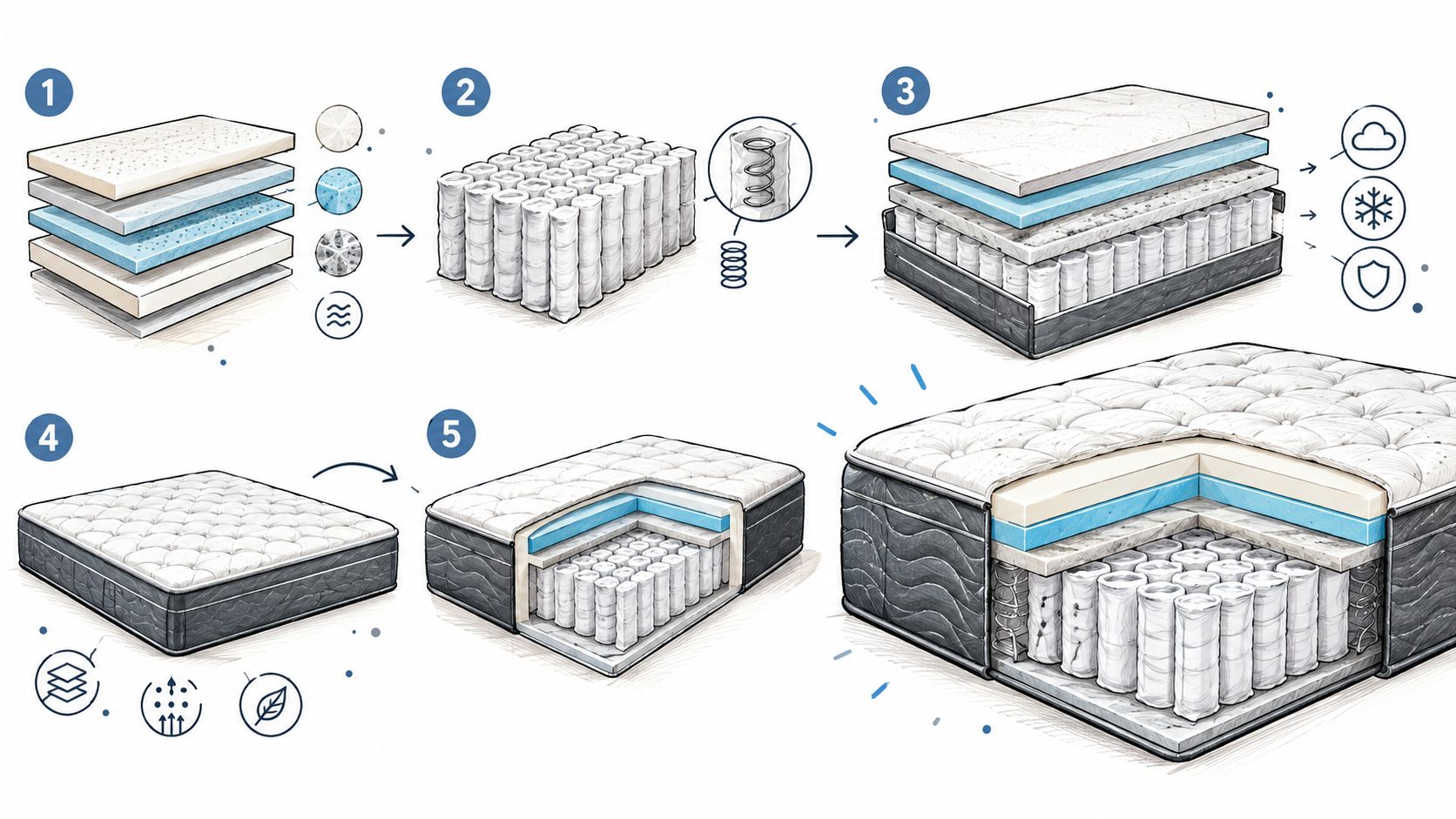
A 30-second hybrid digibun for a new launch has a clear job. It needs to explain construction quickly, make the mattress feel credible, and give the shopper a next action without turning the product into a technical diagram.
Give every beat a purpose
The opening shows the finished mattress in a clean product view. A controlled camera move reveals the quilt and ticking before the outer cover separates. The first motion-graphics label identifies the construction, rather than forcing the viewer to guess what the animation is showing.
The cutaway then exposes the comfort foams and coil unit in a deliberate sequence. Shadows and masks keep each layer readable. The compositor can adjust the balance between realism and legibility, while the editor gives each reveal enough time to register.
A cooling claim appears beside the relevant material, with any necessary qualification on screen at the same time. The gusset of the ticking receives its own close-up because it answers a construction question that a wide rotating shot would miss.
Let sound and type support the product
The sound mix carries the transitions. A soft separation sound marks the layer reveal, while the music stays underneath the product explanation. Type remains large enough for mobile viewing and doesn't sit over high-detail quilting or moving edges.
The final moments show the complete hybrid mattress, price or offer information where approved, and a clear CTA. A studio familiar with a broader 3D animation studio workflow can help a team think about pacing and scene construction, but mattress claims still require bedding-specific product governance.
For brands considering source asset preparation, Bedhead's 3D model service is relevant because the quality of post production animation depends on organized geometry, accurate materials, and usable layer separation upstream. The finished deliverable should be checked in its actual export, not only in the edit timeline.
Disclosure, Accuracy, and Trust in Animated Mattress Claims
A photorealistic cutaway can make an illustrative simulation feel like a measured product demonstration. That distinction matters when the animation shows cooling, pressure relief, motion isolation, natural materials, or internal support behavior.
The Federal Trade Commission says a disclosure triggered by a written advertising claim should be provided in writing, not only through an audio or video segment. For an animated mattress ad, the qualification belongs on the same visual surface as the claim. A narrator saying “cooling comfort” doesn't replace readable on-screen context when the wording also appears in the graphics.
Turn compliance into a finishing task
Reserve screen space before the compositor builds the final layout. The qualification needs to remain readable against ticking, foam, room-scene texture, and moving backgrounds. It should appear close to the claim it qualifies, use clear language, and stay visible long enough for viewers to notice, read, and understand it.
The FTC's online advertising disclosure guidance treats disclosure timing as functional rather than tied to one universal duration. That means a disclaimer can fail even when it technically appears in the file.
A disclosure that disappears during a fast transition has not done its job.
Review the exported file
The final compliance pass should inspect picture, type, sound, and pacing together. Check whether camera movement pulls attention away from the qualification, whether the contrast changes during a transition, and whether the wording remains understandable to the intended audience.
The FTC also evaluates proximity, prominence, distracting elements, ad length, repetition where needed, visual duration, audio treatment, and clarity of wording in digital advertising. Its digital advertising business guidance supports a practical approach: don't approve the storyboard and assume the export will behave the same way.
Every behavior shown in the animation should also be approved by the product or engineering team. If a foam layer moves more dramatically than the physical mattress allows, label the scene as illustrative or revise the motion. Trust is built when the animation explains the product without exaggerating it.
Accessibility and Performance Outputs From the Same Master
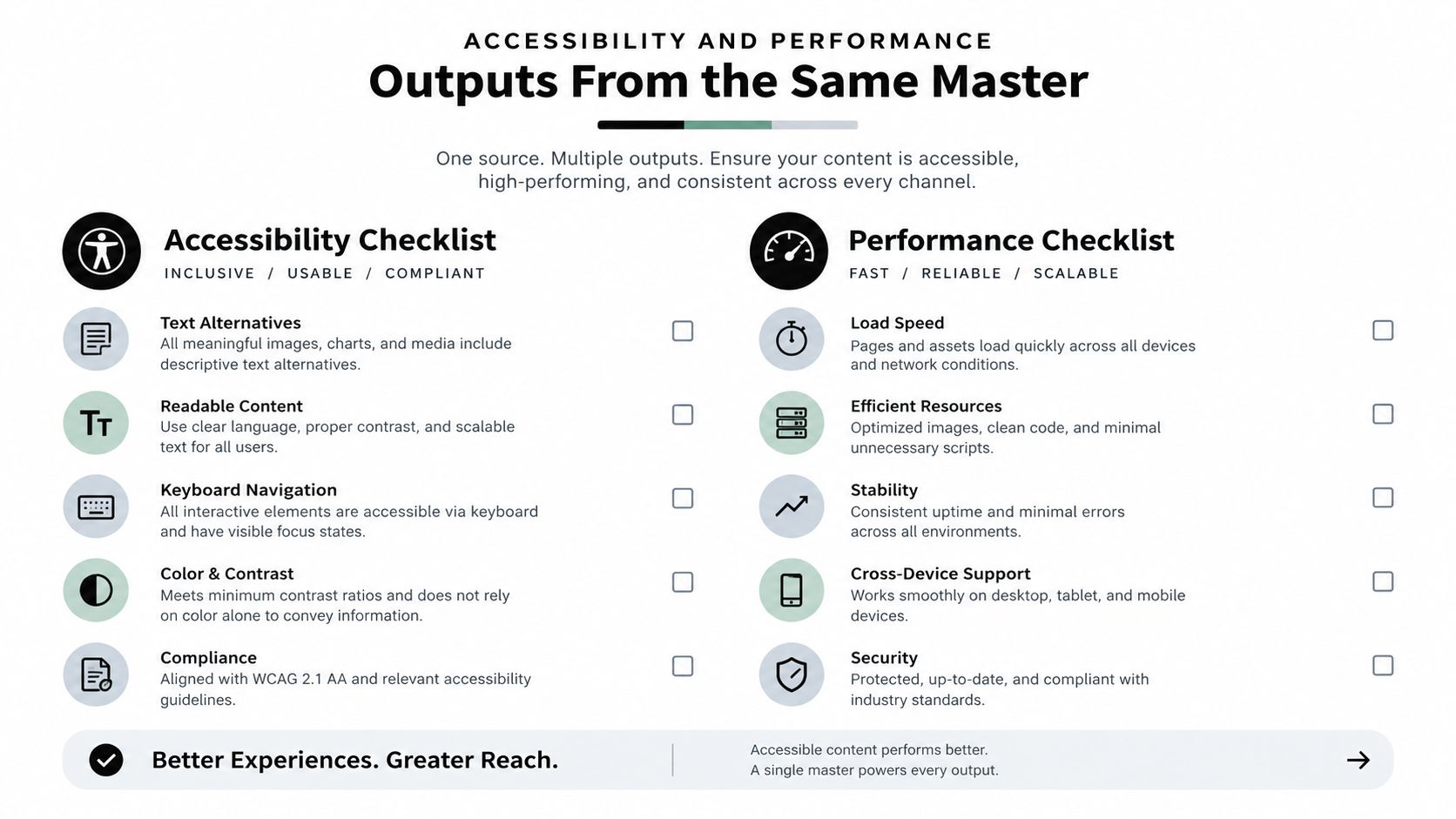
A premium animation isn't useful if a shopper with motion sensitivity can't control it, a screen-reader user receives no equivalent information, or a slower mobile connection never finishes loading the asset. Accessibility and performance belong in the post-production scope, not in a last-minute web handoff.
Non-composited animations still appear on an estimated 40 percent of mobile pages and 44 percent of desktop pages, creating avoidable layout shifts when animation changes page structure instead of using efficient properties such as opacity and transform, as documented by the HTTP Archive Web Almanac performance research.
Create variants before delivery
A mattress master should generate a practical family of outputs:
Full animation: The complete product story for a capable device and a controlled viewing environment.
Reduced-motion version: The same information with calmer movement or static transitions.
Captioned cut: On-screen dialogue, claims, and relevant audio cues for muted viewing.
Audio-described cut: Spoken descriptions for essential visual information.
Static storyboard or image sequence: A usable equivalent for shoppers who don't receive the animated asset.
Compressed mobile output: A lighter file designed for the channel rather than a miniature copy of the master.
The visual fallback should preserve essential information about foam layers, support zones, cooling, and construction. Decorative camera movement can disappear. Product meaning can't.
Before publishing, check layout stability, playback behavior, captions, reduced-motion handling, and image compression. Bedhead's guidance on optimizing images for the web is useful when a mattress team is deciding how the visual system should behave on product pages.
How to Brief a Post Production Vendor For a Mattress Project
A strong brief prevents the most expensive kind of revision, the one caused by missing information. Give the vendor enough product detail to understand what must be shown, what can be simplified, and what requires approval.
Supply the right source material
Include the current product specification, approved layer names, ticking and quilt references, gusset details, material samples, logo files, room-scene references, existing photography, and any CAD or 3D assets. For a private label program, identify which elements are fixed and which can be adapted for retailer requirements.
State the commercial purpose clearly. A showroom loop has different pacing from a paid social cut. A product-page digibun needs legibility and fallback images. A retailer presentation may need a clean silhouette, a room scene, and a layer breakdown that sales associates can explain.
Define approvals before animation starts
Name the people who approve:
Product construction and physical behavior.
Claim language and qualifications.
Brand, type, color, and music.
Retailer or channel requirements.
Final technical delivery.
Require a claim-to-render map for cooling, pressure relief, support, motion isolation, and natural-material language. Each claim should identify the visual evidence, the qualification, and the person responsible for approval.
Specify delivery and acceptance
List the required aspect ratios, resolution, frame rate, audio treatment, caption versions, reduced-motion output, static alternatives, file naming, and delivery location. Ask for a review export with burned-in timecode, then a clean master after approvals.
Acceptance criteria should cover product accuracy, readability, color consistency, disclosure placement, audio sync, edge quality, playback, and mobile behavior. This is also where you can decide whether the same assets will feed SEO product pages, Google and Meta ads, sales training, and retailer activation.
A vendor who can't explain these items before production starts may still create a nice-looking animation, but your team will carry the risk when the asset reaches shoppers.
What to Do Next With Your Mattress Post Production Animation
Start with one product, not an entire catalog. A hybrid or memory-foam launch is enough to test whether the team can connect construction, claims, visuals, disclosures, and channel delivery.
Lock these decisions early:
Color: Use one approved configuration through compositing and finishing.
Motion: Tune blur to the fastest shot and protect quilting, labels, and edges.
Claims: Time language to the relevant visual and place qualifications on screen.
Outputs: Plan full, reduced-motion, captioned, audio-described, static, and mobile versions from the same master.
Measurement: Compare how shoppers engage with static, live-action, and animated product explanations, then review assisted conversions, qualified retailer inquiries, and complaint or return signals rather than relying only on views.
If your team needs additional education, Bedhead University offers mattress-focused learning resources. For networking, industry news, marketing insights, training resources, an industry directory, and business tools, BEDNET at www.BedheadNetwork.com is free for mattress industry professionals. Teams also building distributed production capacity can review options to hire remote professionals, provided product governance and final approval remain clear.
The useful test is simple. Can a shopper understand the mattress without a sales associate standing beside the screen? If not, revise the post production animation before adding more effects.
Bedhead offers mattress-specific 3D assets, including Digibuns with layered product views, Silhouettes, Room Scenes, compositing, motion graphics, and channel-ready delivery. If you're evaluating a hybrid cutaway or a broader product-page visual system, visit BEDHEAD to discuss the product details, claims, and outputs your next project needs.