Email Marketing for Retailers That Actually Converts
A regional bedding retailer sends a 25%-off mattress promotion to its full list. The creative looks polished, the offer is competitive, and the subject line is clear. Yet the campaign produces a 22% open rate, a 0.4% click rate, and barely moves revenue.
That situation feels like a creative problem, but it usually isn't. The retailer has built a broadcast habit instead of a buying journey. Email marketing for retailers works best when the message responds to what a shopper has done, what they're considering, and what they'll need after delivery. In the mattress category, that means treating email as a frequency-management and lifecycle-engineering problem, not just a schedule for weekly promotions.
Why Most Retail Email Programs Leak Revenue
The weekly blast is easy to understand. A merchant chooses a promotion, assembles a product grid, sends it to the list, and reviews opens and clicks. The problem is that a promotion reaches a shopper whether that person is comparing hybrid mattresses, waiting for white-glove delivery, sleeping on a recently purchased foam mattress, or trying to avoid another sales message.
A retailer with no lifecycle engine often asks one email to do too much. It must introduce the brand, explain the quilt and ticking, overcome uncertainty about foam layers, recover a cart, and create urgency around a floor model sale. Those jobs belong to different messages, triggered by different customer actions.
Klaviyo's benchmark data makes the structural issue clear. In its 2026 benchmark, campaigns represented 94.7% of sends but about 59% of revenue, while flows generated nearly 41% of revenue from just 5.3% of sends. Automated flows also produced roughly 18 times higher revenue per recipient than campaigns, according to Klaviyo's email marketing benchmarks.
Three signals that the problem is structural
Revenue per recipient stays flat: More sends produce activity, but each delivered email contributes little additional revenue.
Unsubscribes rise faster than the list: Acquisition may be working, but the retailer is spending its audience faster than it's building trust.
Campaigns convert better than flows: That sounds positive, but it often means high-intent automated moments are underdeveloped or poorly configured.
A mattress shopper may tolerate a promotion when they're actively comparing firmness, dimensions, or adjustable-base compatibility. The same shopper may unsubscribe after receiving several unrelated offers while waiting for a delivery appointment. Retailers need to know which channel drives revenue across their customer journey, but email performance still depends on matching the message to the moment.
Practical rule: A campaign creates a temporary reason to shop. A flow captures a reason the shopper already gave you.
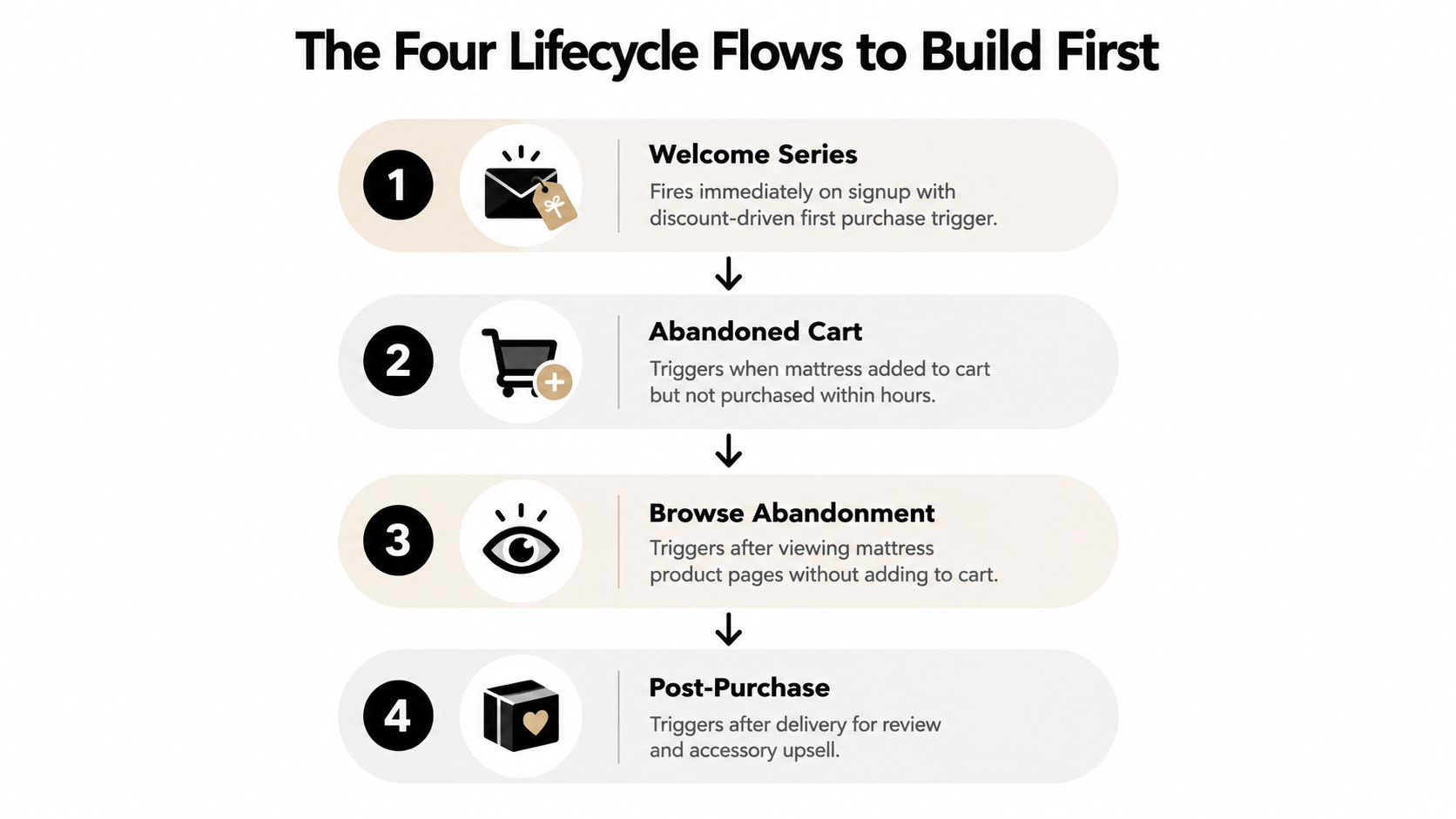
The four highest-priority flows are welcome, abandoned cart, browse abandonment, and post-purchase. They don't replace promotions. They give promotions a stronger foundation by making sure the retailer communicates with shoppers before, during, and after the transaction.
The Four Lifecycle Flows to Build First
Lifecycle email should follow the shopper's behavior. A useful sequence for mattress and bedding retailers starts with the moments where intent is clearest, then expands into education and retention.
Start with a welcome series
The first email should acknowledge the signup quickly and make the next action obvious. For a retailer, that might mean a first-purchase offer, a mattress comfort quiz, or a direct path to a consultation. The next message can explain the brand's approach to construction, from quilt and ticking choices to hybrid support systems and foam-layer specifications.
A useful welcome sequence also hands shoppers from education to selection. Someone who completes a quiz should receive content aligned with the result, not another generic catalog. The retailer can feature a room scene for shoppers who need help visualizing the mattress at home, or a Digibuns layered image for shoppers comparing internal construction.
For a deeper explanation of how these triggered sequences fit together, see this guide to what is lifecycle marketing.
Recover abandoned carts with context
Cart recovery shouldn't treat every mattress order the same. A lower-value cart containing sheets or pillows may need a shorter reminder and a simple checkout link. A premium mattress and adjustable-base combination usually deserves reassurance about delivery, setup, financing terms if offered, and the trial or exchange policy.
The message should answer the question that stopped the purchase. If the shopper added a room-in-a-box mattress, clarify unboxing and setup. If the cart contains a heavy hybrid, emphasize delivery coordination and support. A generic “you left something behind” email doesn't address either concern.
Re-engage product browsers
Browse abandonment captures shoppers who viewed a mattress product page, comparison tool, or category without adding anything to the cart. This flow is especially useful in a showroom-led category because many customers need time to compare firmness, height, edge support, and construction.
A browse message can return the exact product viewed, then add one useful comparison. For example, a shopper who viewed a hybrid mattress could see a concise contrast with an all-foam alternative, plus a link to schedule help or revisit the product page. The goal isn't to force a discount. It's to reduce uncertainty.
Treat post-purchase as part of the sale
The sale doesn't end at checkout. Delivery waitlist updates, white-glove scheduling, setup guidance, and trial-period education protect the customer relationship while the retailer coordinates fulfillment.
Build messages around the retailer's actual policies. If comfort swaps are available at 30, 60, or 100 nights, explain the relevant window clearly. An accessory cross-sell around day 21 can introduce pillows, protectors, or sheets after the customer has had time to experience the mattress. Review requests should align with the retailer's trial-period endpoint rather than arriving before the customer has formed a useful opinion.
Segmentation That Matches How Shoppers Actually Buy
Segmentation becomes useful when it changes the message, not when it creates more labels inside a platform. For mattress retailers, three axes usually provide enough detail to make communication relevant without producing an unmanageable number of tiny audiences.
Behavior shows current intent. Track recent product views, quiz completion, cart activity, purchase activity, and engagement with delivery or educational emails. Purchase stage separates prospects from first-time buyers, repeat customers, and lapsed shoppers. Product family distinguishes interest in ticking and quilt details, hybrid mattresses, foam construction, adjustable bases, and sleep accessories.
These axes should stack. A shopper can be a high-intent prospect who viewed a hybrid product, completed a comfort quiz, and hasn't purchased. Another can be a first-time buyer waiting for delivery of a mattress and base. They shouldn't receive the same campaign, even if both remain subscribed.
Axis | Segment Example | Primary Use |
|---|---|---|
Behavior | Viewed a hybrid product and completed a quiz | Send comparison content and a relevant product path |
Purchase stage | First-time buyer awaiting delivery | Provide scheduling, setup, and trial guidance |
Product family | Mattress and adjustable-base bundle buyer | Explain compatibility and recommend useful accessories |
Engagement | Opens regularly but hasn't clicked | Test content relevance before increasing frequency |
Recency | Previously purchased, no recent activity | Run a measured reactivation or preference update |
Klaviyo's campaign and flow split provides the commercial reason to prioritize this work. Flows generated nearly 41% of email revenue from 5.3% of sends, while campaigns accounted for most sends but a smaller share of revenue, as documented in the benchmark source cited earlier. The implication is practical: segmentation should first improve triggered moments, then refine promotional campaigns.
Retailers often over-segment by demographics because those fields are easy to collect. A shopper's recent interaction with a mattress comparison tool usually says more about the next message than a broad age or location category. For a practical framework on how to segment and personalize emails, focus on the data that changes product selection, timing, or reassurance.
A useful segment earns its place by changing one of three things: the product shown, the reason to buy, or the timing of the message.
Avoid mutually exclusive lists that force a customer into only one category. A bundle buyer can also be a recent purchaser, a high-value customer, and a shopper who engaged with an adjustable-base guide. Retailers can use those layers to suppress irrelevant campaigns while preserving the most useful service communication. Bedhead's education on what is customer segmentation provides a relevant foundation for building that structure.
Cadence, Frequency, and Avoiding the Unsubscribe Spiral
“Send more” is incomplete advice for mattress retailers. More messages can create more opportunities, but they can also make the brand feel careless, especially when a customer is waiting for delivery or deciding whether to use a comfort exchange.
Consumer survey data reported by Litmus shows the tension clearly. 67% of shoppers unsubscribe because retailer emails arrive too frequently, and 39% delete emails unopened because their inbox is overloaded. At the same time, email remains the top channel influencing purchase decisions at 28%, ahead of social ads at 22%. These figures appear in Litmus' analysis of email frequency and customer fatigue.
Preferences aren't uniform. 32% of shoppers prefer weekly email, while 20% prefer two to three messages per week. During the holidays, 33% prefer the same frequency with better content, and 32% prefer fewer, higher-quality messages, according to the same source.
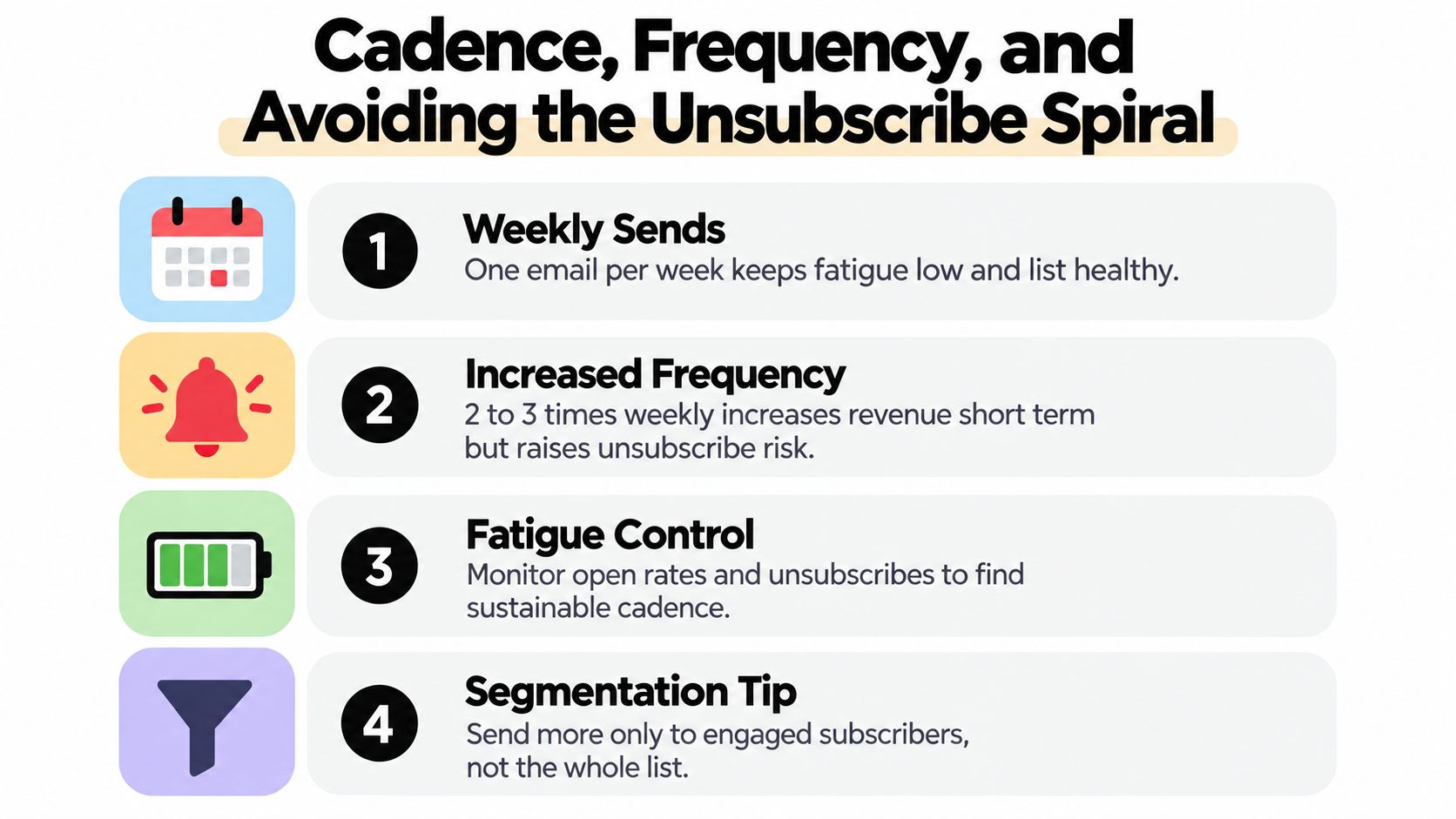
A retailer shouldn't apply one cadence to everyone. A shopper who browsed a mattress yesterday can receive a timely browse message. A subscriber who hasn't interacted recently shouldn't receive the same promotional pressure.
Use a sequencing rule that protects the relationship:
Suppress overlap: Don't place a full-list promotion over an active cart, delivery, or post-purchase sequence.
Throttle inactive prospects: Reduce promotional volume for subscribers who repeatedly ignore campaigns.
Protect buyers: Keep delivery and trial communications clear, even when marketing messages are suppressed.
Recover sleepers carefully: Give inactive subscribers a preference option or a focused reactivation message before retiring them.
The right question isn't “How often should we email?” It's “How much relevant information has this shopper earned?” A promotion can be useful when it follows intent. It becomes expensive when it interrupts service, education, or recovery.
Deliverability Foundations Retailers Keep Breaking
A strong email can't convert if it never reaches the inbox. Mattress retailers also have a special deliverability obligation because delivery confirmations, white-glove scheduling messages, and setup instructions carry immediate customer value. A damaged sender reputation can affect both marketing and service communication.
Start with the technical basics. Confirm that the sending domain has correctly configured SPF, DKIM, and DMARC alignment through the retailer's email platform and domain provider. The practical question isn't whether someone once added a record. It's whether the authenticated sending identity matches the domain customers recognize and whether the platform reports alignment problems.
A pre-send checklist
Confirm authentication: Check SPF, DKIM, and DMARC status inside the sending platform.
Review the audience: Remove invalid addresses, suppress repeated bounces, and exclude role addresses when they aren't appropriate for marketing.
Check complaints: Suppress subscribers with a history of spam complaints instead of repeatedly testing their patience.
Inspect the content: Verify links, unsubscribe controls, product prices, images, and mobile rendering.
Review overlap: Check whether recipients are already inside a cart, delivery, or post-purchase flow.
Protect service mail: Keep transactional delivery and white-glove messages separate from promotional frequency rules.
A sunset flow gives inactive subscribers a controlled path out. Send a preference message, make the value of staying clear, and suppress people who don't re-engage. This isn't about shrinking the list for appearance. It protects the deliverability of messages sent to customers who want information about mattresses, accessories, delivery, and comfort support.
Retail teams that need a technical review can use this guide on email deliverability for marketers. Bedhead also covers practical steps in its guide to how to improve email deliverability.
Subject Lines, Dynamic Content, and Personalization That Earn the Open
A generic promotion tells subscribers what the retailer wants them to know. An event-triggered message reflects what the shopper already did. That difference matters in a category where customers may spend considerable time comparing mattress height, firmness, ticking, quilt patterns, foam layers, and base compatibility.
Compare two approaches:
Generic: “20% Off Everything This Weekend”
Event-triggered: “Still comparing the hybrid you viewed?”
Cart-specific: “Your mattress and adjustable base are waiting”
Post-purchase: “Preparing for your white-glove delivery”
The first subject line may work for a broad sale, but it gives the recipient no reason to believe the message is relevant. The other examples connect the subject to a product view, cart, or service event.
MoEngage's 2025 benchmarks found behavior-based emails were the strongest-performing type for retail and ecommerce, with a 60.7x conversion rate and 22.6x click-to-open rate in its analysis. The same report noted declining retail engagement since 2022, including a 2.8 percentage point decline in click-to-open rate and a 1.4 percentage point decline in click-through rate, with 2024 retail CTO at 6.3% and CTR at 2.3%. Those figures are reported in MoEngage's 2025 email benchmarks release.
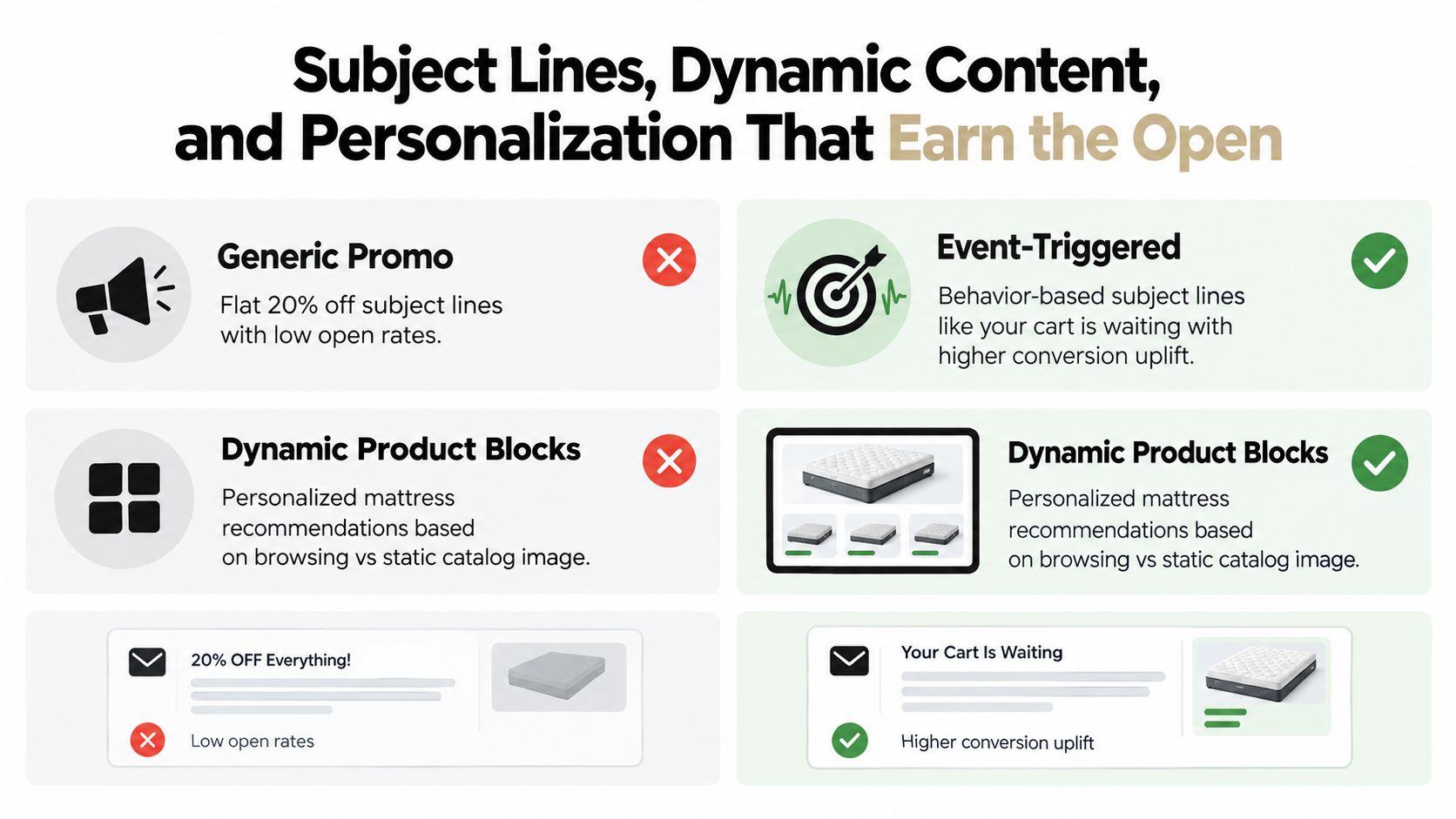
Dynamic content lets one template adapt to multiple customer profiles. A recent hybrid product view can swap the hero image and comparison copy. A premium cart can display delivery reassurance and the correct price block. A post-purchase recipient can see a pillow or protector recommendation instead of another mattress sale.
Personalized subject lines are also associated with 26% more opens, while one cited industry source reports personalized emails achieving 188% higher open rates than non-personalized emails. These figures are summarized by Campaign Monitor's email marketing statistics roundup. Use them as directional evidence, then validate performance against revenue and placed orders for your own audience.
For mattress brands, what is personalization in marketing becomes concrete when the email changes the shopper's next decision. A product image, a firmness explanation, and a CTA should reflect the customer's latest useful signal.
Measuring What Matters and Building a Testing Loop
Open rate is a diagnostic signal, not a business outcome. A retailer can earn opens with curiosity and still lose the sale because the product page lacks construction detail, delivery clarity, or a credible comfort policy.
Build a dashboard around four measures:
Metric | What It Measures | Benchmark for Mattress Retailers |
|---|---|---|
Revenue per recipient | Revenue generated per delivered email | Compare weekly by segment and flow type |
Placed-order rate | Orders attributed to recipients | Use to separate purchase activity from clicks |
Flow-attributed revenue share | Contribution from automated programs | Compare against the benchmark pattern where flows produce nearly 41% of revenue from 5.3% of sends |
Unsubscribe rate | Audience fatigue and relevance | Monitor by campaign, segment, and cadence |
The benchmark for email ROI is also worth keeping in context. Widely cited 2026 benchmarks place average returns around $36 to $42 for every $1 spent, while retail and ecommerce programs are often reported around $45 per $1, according to this email marketing statistics roundup. Treat that as a market reference, not a promise for a particular mattress retailer.
Test one decision at a time
A useful testing loop starts with a single hypothesis. Test whether a browse-abandonment email featuring the viewed hybrid performs better than a general category message. Test whether delivery reassurance reduces cart abandonment for a premium mattress and base bundle. Test a subject line, CTA, hero image, or offer, but don't change all of them simultaneously.
Review performance by segment rather than only at the account level. A campaign can look average overall while working well for active quiz completers and poorly for inactive subscribers. Record the losing version as carefully as the winner, because it prevents the team from repeating an unproductive idea during the next promotion.
Retail email should earn its place in the broader mattress buying journey. The same product story used in a showroom, product detail page, paid Google campaign, or Meta ad should remain consistent in the inbox. Bedhead Marketing works with mattress manufacturers, brick-and-mortar and ecommerce retailers, private-label brands, and sleep product startups across email, SEO, paid media, product storytelling, sales training, and 3D assets such as Digibuns, Silhouettes, and Room Scenes. Those assets can help an email explain what a customer is buying, not merely announce that it's on sale.
If your mattress retail program relies too heavily on weekly blasts, BEDHEAD can help map the four priority lifecycle flows, refine segmentation, and connect email messaging with product-page content and mattress-specific visuals. Visit BEDHEAD to discuss a practical email strategy built around delivery, comfort decisions, product education, and revenue measurement.