Digital Ads Strategy for Mattress Brands That Convert
A shopper sees your mattress ad at breakfast, checks the firmness description during a commute, studies foam layers that evening, reads reviews before bed, and visits a showroom days later. Your platform dashboard may credit one click, while the retailer sees a walk-in and the manufacturer sees a delayed sale. A practical digital ads strategy for mattress brands has to connect those moments instead of treating each channel as an isolated source of conversions.
Digital advertising now influences discovery, comparison, product education, and showroom intent. For mattress manufacturers, brick-and-mortar retailers, private label brands, and sleep-product startups, the commercial question isn't how to generate clicks. It's how to turn paid attention into confident decisions, qualified store visits, profitable ecommerce orders, and measurable retailer demand.
Why Most Mattress Ad Budgets Leak Before the Sale
A shopper researching a hybrid mattress rarely moves from ad to checkout in one step. They compare comfort claims, ticking, quilt construction, gusset height, foam layers, coil systems, warranties, reviews, delivery terms, and price. They may visit a product detail page, save the brand on social media, call a retailer, test a floor model, and purchase through a different path.
That journey creates familiar leakage. Search campaigns may attract high-intent queries, but the landing page doesn't explain the build. Social ads may create interest, but the store locator is difficult to use. Retargeting may chase a shopper who already bought in a showroom. A retailer may receive the sale without a clean way to connect it to the advertising that created demand.
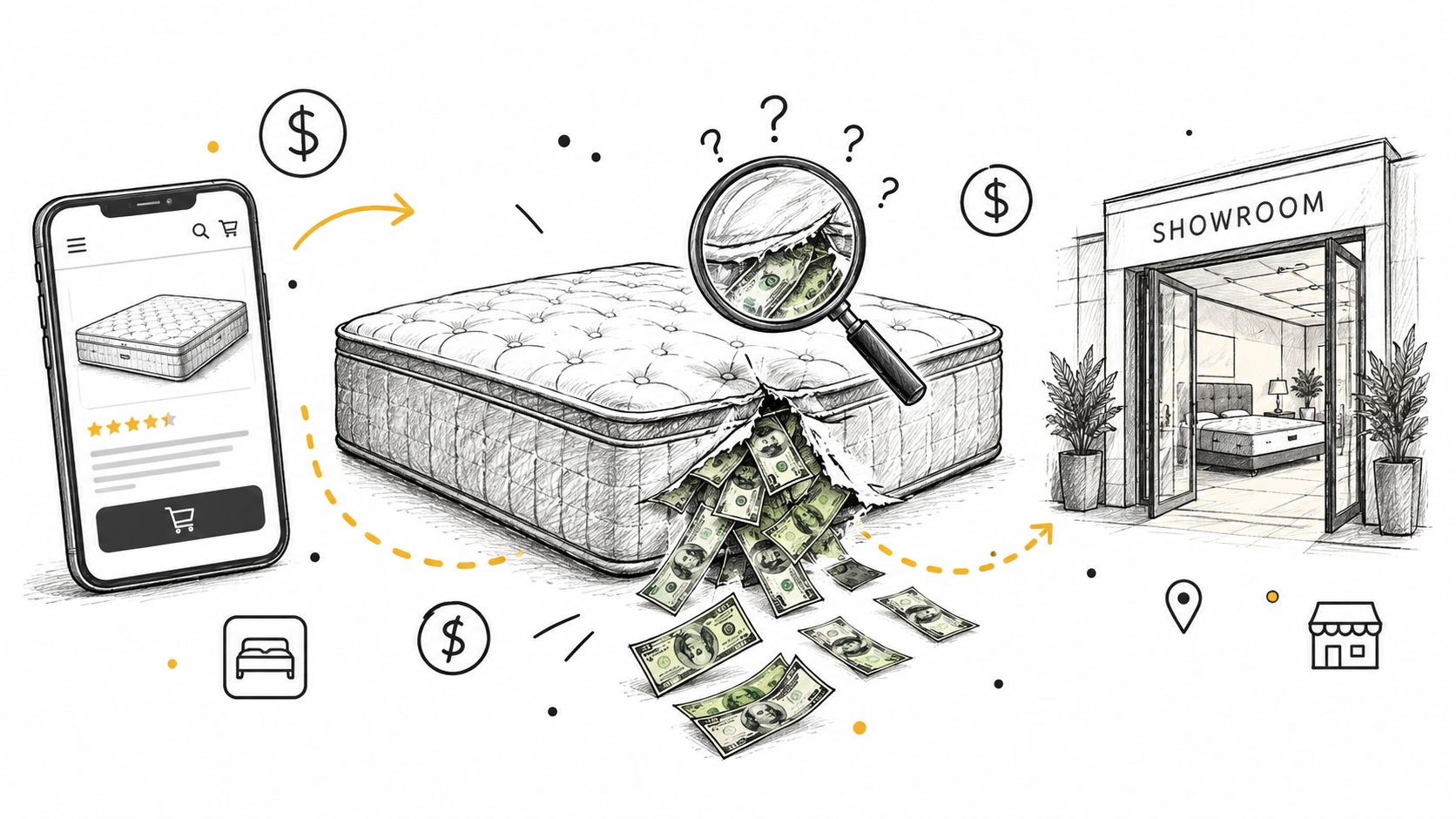
The research journey is longer than the dashboard
Google's 2011 Shopper Sciences Macro Study surveyed 5,000 shoppers across 12 product categories and examined more than 50 information sources, including search, display advertising, mobile, social media, retailer sites, manufacturer sites, and in-store channels. It found that 84% of shoppers conducted pre-shopping activities, such as online research or comparison shopping, before visiting a physical store, as reported in the Google Shopper Sciences purchase-journey research.
That finding remains highly relevant to mattresses. A customer may need confidence before testing a bed, and confidence often comes from several consistent messages rather than one persuasive ad. Product education, reviews, visual proof, financing details, and showroom availability all reduce uncertainty at different stages.
Practical rule: Treat the ad as the beginning of the mattress conversation, not the entire sales pitch.
Stop judging every channel by the final click
A search ad can capture demand created by a video. A social campaign can introduce a construction story that later makes a branded search more likely. Programmatic display can keep a local retailer visible while a shopper compares competing hybrids. Last-click reporting often assigns too much credit to the final interaction and too little to the work that built consideration.
That doesn't mean every impression deserves budget. It means the account needs distinct jobs, creative handoffs, and conversion definitions. Before changing spend, map the role of each channel, the page it sends traffic to, and the offline outcome it should influence.
Executives also need a planning discipline that connects available funds to objectives, testing capacity, and sales timing. A practical resource on how to plan your ad budget can help structure that financial conversation, but mattress brands still need category-specific decisions about showroom support, seasonal floor models, retailer territories, and ecommerce margin.
The mindset shift is straightforward: don't optimize for cheap traffic when the business needs qualified demand. Build coordinated search, video, display, and social campaigns that help shoppers discover the brand, understand the product, compare alternatives, and act with confidence.
Know Your Sleep Shopper and Map the Research Journey
Audience planning should start with the buying problem, not the platform menu. A manufacturer selling through retailers has different data and conversion options from a direct-to-consumer sleep startup. A regional retailer may care about store-radius demand and phone calls, while an online-first brand may prioritize add-to-carts, financing inquiries, and completed purchases.
Begin with four practical audience views:
Manufacturers: Identify the product stories retailers need to sell, such as foam layering, component quality, durability, or a distinct comfort proposition.
Retailers: Separate shoppers who need showroom guidance from those ready to reserve, call, or visit a specific location.
Private label brands: Clarify which value, construction, or exclusivity message distinguishes the line from familiar national brands.
Sleep startups: Use education and proof to reduce skepticism around a new material, niche sleep solution, or unfamiliar product format.
Turn category language into audience signals
Search queries reveal the questions customers ask before they trust a mattress. Group them by intent rather than treating every keyword as interchangeable:
Problem intent: Queries about back support, pressure relief, overheating, motion transfer, or sleep position.
Construction intent: Searches involving hybrid mattresses, foam layers, coils, ticking, quilt, gusset, or edge support.
Commercial intent: Product, price, financing, delivery, warranty, comparison, and retailer availability queries.
Local intent: Store names, showroom searches, directions, appointments, and nearby mattress shopping.
Review analysis adds a second layer. Pull recurring language from retailer reviews, customer service tickets, showroom associates, and returns. If shoppers repeatedly ask whether a quilted cover feels plush, whether a mattress sleeps cool, or whether a floor model matches the online description, those questions belong in ad copy and PDP content.
Use Bedhead University as an educational reference for mattress-specific marketing and product communication, especially when internal teams need a shared vocabulary across manufacturing, ecommerce, and retail. A useful companion is this guide on how to create buyer personas, provided the personas remain tied to actual search behavior and sales conversations rather than fictional demographics.
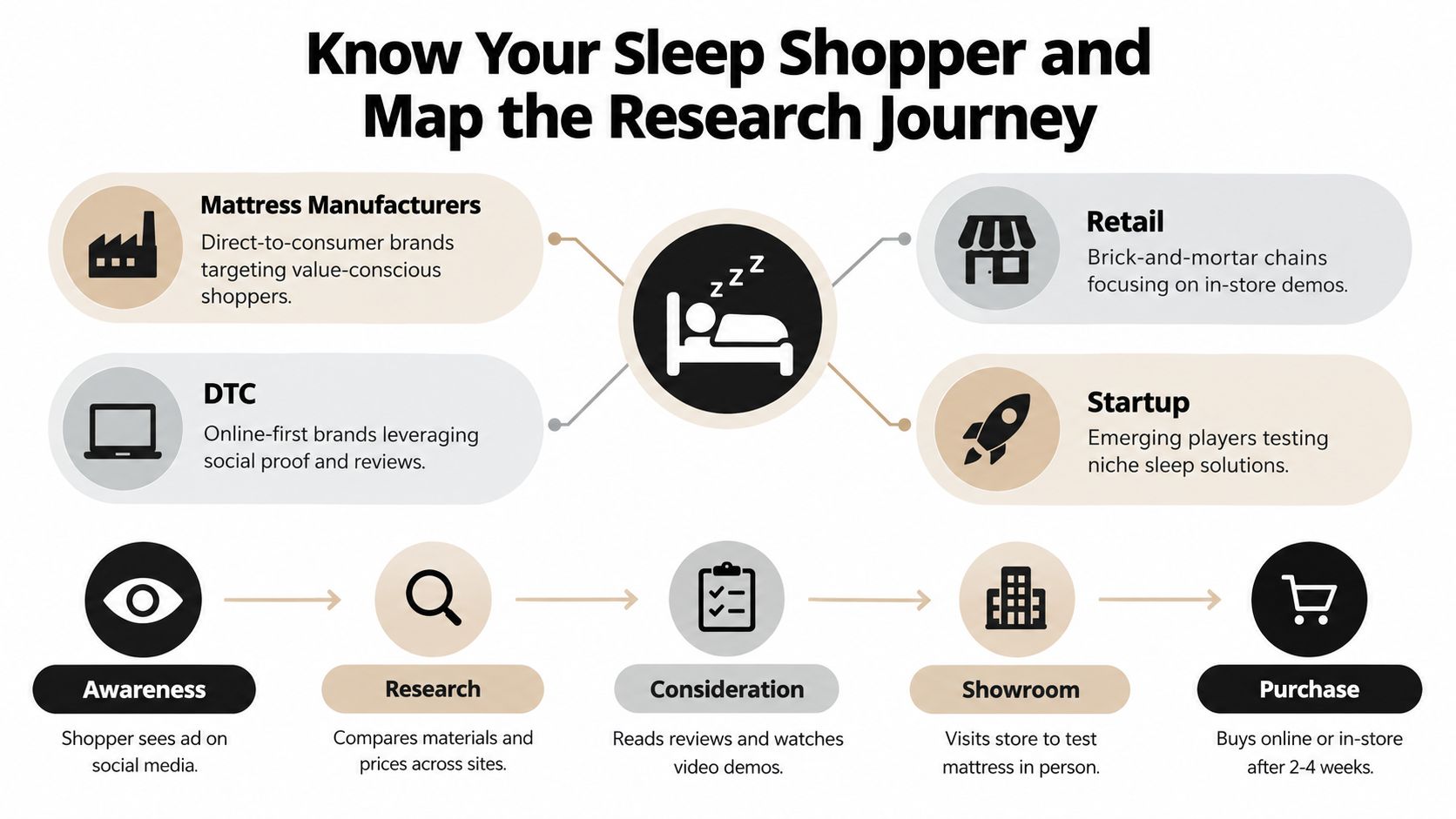
Give every stage a useful destination
A prospecting ad about cooling materials should lead to a page that explains the material clearly. A high-intent search for a specific hybrid should lead to the relevant PDP, not a generic homepage. A shopper near a retailer should see store hours, inventory guidance, directions, and a reason to visit.
Build the journey around five destinations:
Awareness content introduces the sleep problem or product difference.
Research pages explain construction, comfort, care, warranty, and value.
Consideration assets provide reviews, comparison tools, videos, financing, and FAQs.
Showroom pages make the visit easy and give retail sales associates useful talking points.
Purchase paths support checkout, calls, appointment requests, or retailer inquiries.
Retargeting should reflect the last meaningful action. Someone who watched a construction video needs different messaging from someone who abandoned checkout. Someone who used a store locator shouldn't keep seeing generic awareness creative. The stronger the audience signal, the more specific the next message can be.
Choose Channels That Match Intent and Visualization Needs
Channel selection should follow the shopper's job. Search captures an expressed need. Social creates and shapes interest. Programmatic display and video extend reach, reinforce memory, and support local or category-level demand. None of these channels can compensate for a weak PDP or unclear showroom handoff.
The scale of the market makes disciplined selection important. In the United States, internet advertising revenue reached approximately $258.6 billion in 2024, a 15% year-over-year increase, while search advertising reached $102.9 billion, or 39.8% of total digital advertising revenue, according to the IAB 2024 internet advertising revenue report.
Match the channel to the commercial job
Channel | Best Job | Creative Edge |
|---|---|---|
Google Search | Capture active demand for comfort, construction, price, and local availability | Precise copy, product-led headlines, extensions, and intent-matched landing pages |
Meta and TikTok | Build awareness, demonstrate lifestyle benefits, and retarget engaged shoppers | Short video, creator-style demonstrations, room scenes, reviews, and visual hooks |
Programmatic display | Maintain consideration, support conquesting, and extend regional reach | Sequential banners, contextual placements, retailer geography, and frequency control |
Online video | Explain construction and create confidence before a showroom visit | Layer breakdowns, comfort demonstrations, associate education, and product storytelling |
Search deserves the most rigorous query control because mattress terms can mix research and purchase intent. Separate construction questions from retailer-ready searches, and avoid sending a shopper searching for a specific model to a broad category page.
Social is strongest when the product can be understood visually. A room scene can establish scale and lifestyle. A short video can show a person pressing into a comfort layer or explain the difference between a traditional foam build and a hybrid. Retargeting then answers the objections that first exposure couldn't resolve.
Programmatic is useful when the brand needs presence beyond active search. It can support a regional showroom launch, surround retailer territories, or keep a new collection visible while shoppers compare alternatives. It becomes wasteful when the audience is too broad, the creative is repetitive, or the team can't connect exposure with store activity.
A retailer shouldn't use the same creative system as a DTC brand. The retailer needs location, availability, appointments, and floor-model confidence. The DTC brand needs delivery, returns, financing, product education, and PDP clarity. For a broader review of channel choices, online advertising platforms can provide useful context, but channel roles still need to reflect mattress margins and offline buying behavior.
Channel principle: Use search to harvest intent, social to create confidence, and programmatic to maintain useful presence across the research window.
Build Creative That Sells Comfort Without the Guesswork
Mattress creative has a communication problem that ordinary product photography can't always solve. A flat image may show the ticking and quilt, but it rarely explains what sits below the cover, how thick the comfort layers are, or why a hybrid feels different from an all-foam model.
That is where product visualization earns its place in the media plan. The asset isn't decoration. It carries the explanation from the ad to the PDP, from the PDP to the showroom, and from the showroom to the sale.
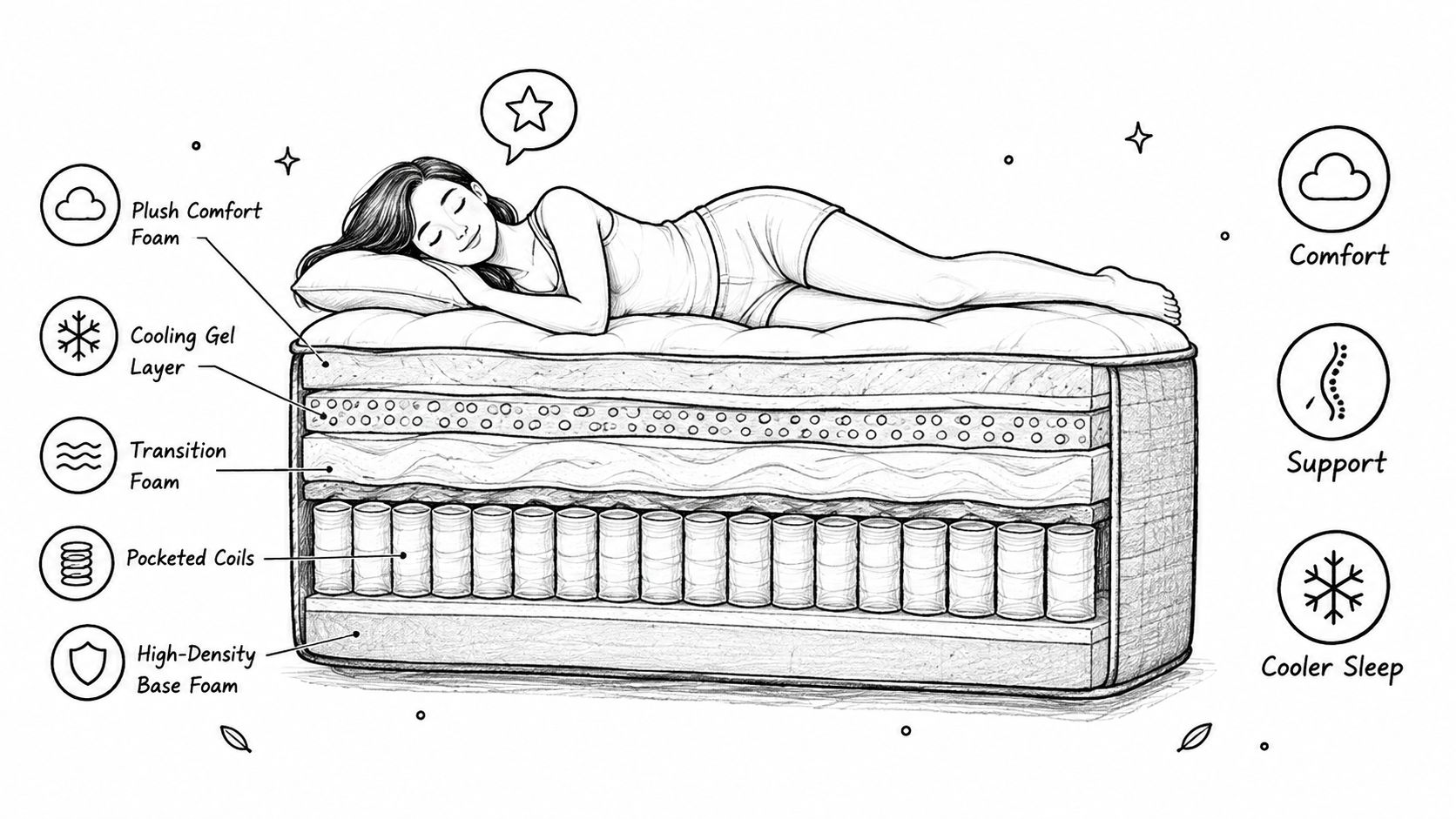
Build a visual system, not isolated ads
A strong mattress asset library usually includes three complementary formats:
Digibuns: Layered images of the inside of a product that make foam layers, coils, support cores, and comfort systems understandable.
Silhouettes: Clean product images for comparison modules, shopping feeds, search assets, and retailer catalogs.
Room Scenes: Lifestyle renders that show scale, bedroom context, styling, and the emotional result of owning the mattress.
These assets solve different objections. A Digibun answers “what is inside?” A Silhouette answers “which model is this?” A Room Scene answers “how will this fit into my home and life?” Combining them gives paid traffic a stronger path from curiosity to confidence.
The same visual language should appear in ads, PDP galleries, sales decks, retailer pages, and showroom signage. If an ad calls a layer “cooling comfort foam” but the product page uses a different name, the shopper has to reconcile the discrepancy. That friction can delay a purchase or create a return expectation the retailer can't meet.
Brief creative around decisions, not features
For a hybrid launch, lead with the sleep problem and then prove the construction. A short video might open with pressure relief, reveal the foam and spring system, and finish with a direct route to the PDP or nearest showroom. A static ad can feature a cross-section next to a plain-language explanation of support and comfort.
For a retail floor-model campaign, use the same product story but change the action. The creative should make the local visit feel useful, with a store locator, directions, appointment option, or invitation to test the model. The showroom associate should have matching language so the shopper doesn't encounter a completely different promise in person.
A practical testing backlog includes:
Headline focused on comfort versus headline focused on construction.
Digibun versus Room Scene as the first visual.
Review-led proof versus warranty-led reassurance.
“Shop the model” versus “Find a retailer” as the call to action.
Product page with a visible layer diagram versus one led by lifestyle imagery.
Product imagery should earn space by answering a question. The guide to using imagery is useful when teams need to connect visual choices to the buyer's decision rather than add more gallery images.
Protect the post-click experience
The PDP must support the ad's promise with clear firmness language, dimensions, materials, delivery, returns, warranty, financing, and retailer availability. If a shopper clicks a cooling claim and lands on a page where cooling is buried below generic copy, the media team pays for confusion.
Google allows eligible products to gain richer unpaid search visibility through Product structured data, Merchant Center free listings, or both. Product structured data can help Google understand details such as product name, price, and availability, while Merchant Center supports merchant-listing eligibility for pages where customers can purchase, as explained in Google's Product structured data documentation.
Treat the PDP as part of the ad. A high-quality creative system can't rescue a page that hides the construction, makes returns difficult to understand, or sends a local shopper searching for a showroom address.
Set Budgets Bids and Measurement That Prove Real ROAS
A mattress budget works better when it pays for business outcomes, not just clicks. A completed order, a qualified retailer inquiry, a phone call, an add-to-cart, and a page view all matter differently, so the account needs conversion actions that reflect both ecommerce and showroom behavior.
Start by separating the actions that move revenue:
Purchases and completed orders.
Quote requests and qualified lead forms.
Phone calls and booked consultations.
Retailer inquiries and store-locator engagement.
Add-to-carts and financing inquiries.
Offline showroom purchases or sales-qualified opportunities.
Assign revenue or estimated margin values where possible, starting from your customer acquisition cost so each conversion action carries a defensible value. A retailer lead that becomes a stocked account has different value from an unqualified form submission. A showroom call that ends in a sale may be worth more than several low-intent online actions.
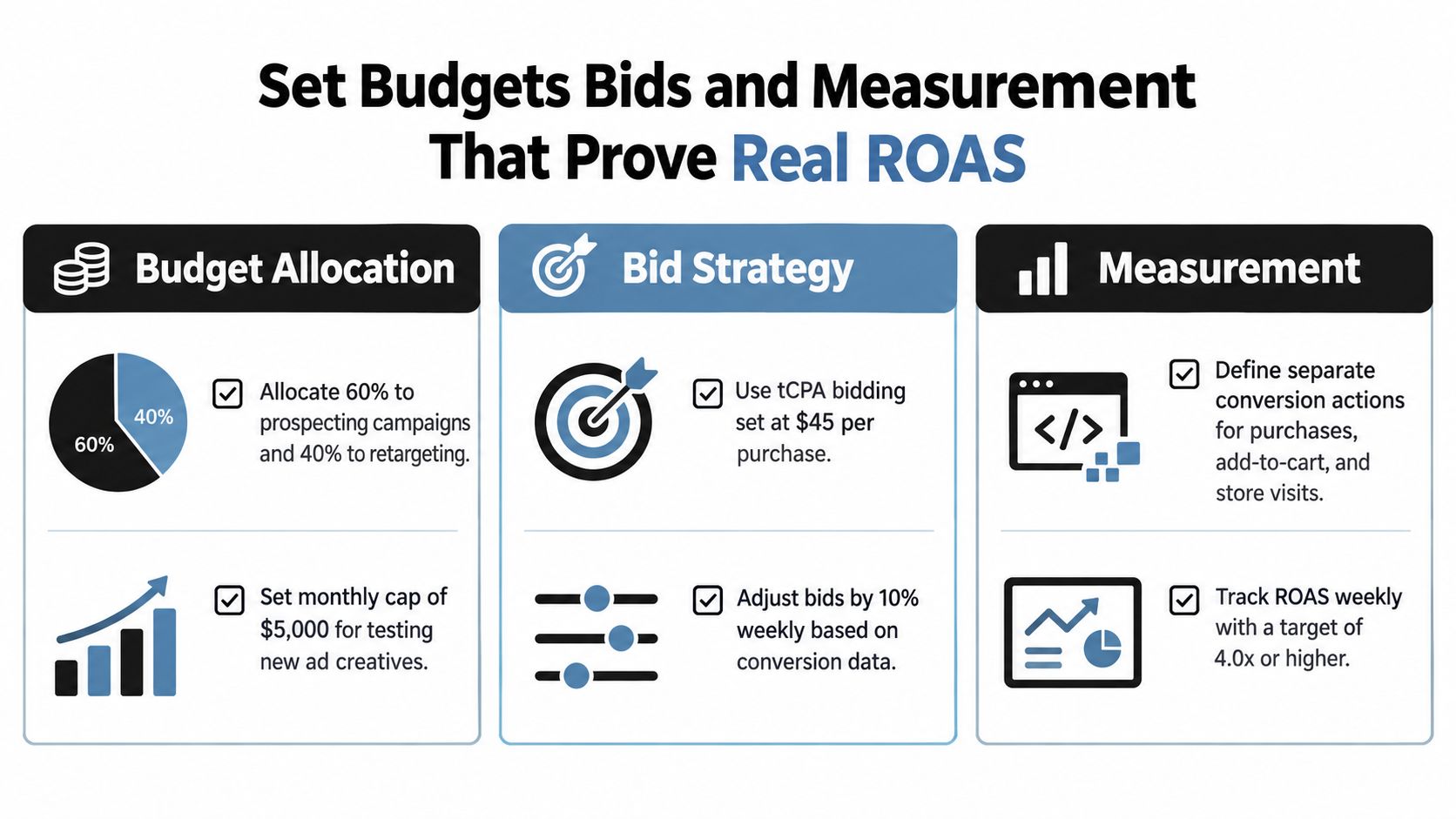
Install the measurement foundation before changing bids
Install the Google tag or Google Tag Manager, then validate events across devices, PDP templates, checkout steps, forms, calls, and landing pages. Google's conversion tracking guidance frames the basic math in one line. Conversion rate is conversions divided by ad interactions, cost per conversion is spend divided by conversions, and ROAS is conversion value divided by spend.
Those formulas are simple. The hard part is feeding them real business actions. Duplicate events, unqualified leads, missing phone calls, and inconsistent purchase values can make a campaign look efficient while margin slips away. A showroom call may deserve a higher value than an add-to-cart if the call usually leads to a store visit and a higher-ticket sale.
Use click-through rate as a diagnostic, not the scorecard. It helps show whether the message gets attention, but it does not prove that the shopper understood the mattress or moved toward a profitable outcome. A channel-specific reference such as good CTR benchmarks by channel is useful during creative review, but mattress teams should judge success on qualified actions and revenue.
Add CRM and offline evidence
Platform reporting helps with bidding, but it should not be the only record. Keep first-party CRM data, connect leads to qualification stages, import offline outcomes where allowed, and reconcile platform, analytics, and CRM totals with the same attribution windows and deduplication rules. For mattress brands that sell through retail partners, that step keeps showroom activity from disappearing inside paid media dashboards.
Google's consent-mode framework has two configurations. In basic consent mode, Google tags do not load until the visitor interacts with the consent banner, and conversion modeling uses a general model. In advanced consent mode, tags load when the site opens, but full measurement data is sent only after consent, which allows an advertiser-specific model, according to Google's consent mode implementation documentation.
Google generally requires 700 ad clicks over a seven-day period for each country and domain grouping for consent-mode conversion modeling eligibility, along with correct consent implementation, as stated in Google's conversion modeling requirements. Smaller regional campaigns should not expect the same modeled coverage as higher-volume accounts.
For imported showroom purchases, phone orders, retailer outcomes, or qualified leads, the advertiser must have permission to share the data and represent consent through account-level settings or the relevant imported conversion payload, as documented in Google's Google Ads API conversion guidance.
Measurement discipline: Reconcile reported conversions with qualified opportunities and closed revenue before reallocating budget.
Run a weekly review that checks tracking, removes duplicate or low-intent events, segments results by product, audience, geography, device, and query, compares value against cost, and shifts spend only when the evidence is stable enough to support the move. That is how search, social, and programmatic stay tied to actual mattress demand, not just platform activity.
Test Optimize and Scale Winners Into Retail Growth
Testing should connect media performance to the outcomes mattress executives and retail owners care about. Start with one clear hypothesis, such as whether a layer breakdown attracts more qualified hybrid shoppers than a lifestyle image, or whether a store-radius message produces better showroom inquiries than a generic discount.
Keep the test clean. Change one major variable at a time, preserve the landing-page match, and record the audience, creative, bid approach, product, geography, and conversion definition. A campaign that produces more leads isn't necessarily a winner if those leads don't answer calls, visit stores, or progress toward a sale.
Use a 30-day operating rhythm
During the first phase, verify tracking, search terms, consent behavior, PDP alignment, and call quality. In the next phase, compare creative by product and shopper intent, then identify which messages produce qualified actions rather than inexpensive engagement. After that, expand only the combinations that hold up across relevant locations, devices, and product lines.
Scaling can include:
Extending a proven search message into social video.
Turning a successful Digibun into programmatic display variations.
Building retailer-specific landing pages around store availability.
Using contextual sleep content and store-radius geography when first-party data is limited.
Comparing online actions with retailer sell-through and showroom activity.
Running geographic holdouts or controlled budget changes to estimate incremental demand.
Privacy changes make this discipline more important. First-party CRM and consent-based showroom capture can support useful measurement, but brands shouldn't assume every exposed shopper can be followed across sites and devices. Contextual targeting, aggregated reporting, retailer data, and incrementality testing provide a more durable approach.
Retail-media buyers show the tension clearly. 88% of European buyers rank ROAS as a desired metric, while 71% also demand incrementality measurement and 58% want unified online and offline reporting, according to the IAB Europe retail-media attitudes report. A lower platform ROAS can represent stronger business performance when it reflects additional sales rather than conversions that would have occurred anyway.
Pre-sell landing pages can also help teams test the offer and message before sending expensive traffic to a full ecommerce experience. Resources such as Landra's pre-sell landing pages are useful for thinking through that validation step, provided the page remains consistent with the actual mattress, retailer path, and commercial terms.
BEDHEAD provides mattress-specific digital ads strategy, SEO, paid media, product-page optimization, 3D visualization, and sales training across manufacturing, retail, private label, and DTC environments. Its work can connect a Digibun or Room Scene to campaign creative, a PDP, and showroom talking points rather than treating each deliverable as a separate project.
The next move is practical: audit one product line, one priority market, and one conversion path. Fix the tracking and PDP gaps first, then test a coordinated search, social, and showroom message before expanding the budget.
Bedhead Network is free for mattress industry professionals and provides marketing insights, news updates, networking, training resources, an industry directory, and business tools.
If your mattress campaigns are generating clicks but not enough qualified purchases, showroom visits, or retailer demand, BEDHEAD can help connect paid search, paid social, programmatic media, product-page strategy, 3D assets, and mattress sales training. Visit BEDHEAD to discuss a measurement-led digital ads strategy built around your products, retail footprint, and actual customer journey.