360 Product Viewer for Mattress Brands: A Practical Guide
A shopper has narrowed the choice to two mattresses, but the product page leaves the important questions unanswered. How does the quilted ticking wrap around the corner? Does the gusset sit neatly against the foundation? Will the side panel look substantial once a fitted sheet covers the top? Static images often show the mattress from carefully selected angles, yet they still leave room for doubt.
That doubt matters on a high-consideration purchase. The shopper zooms, swipes, reads reviews for clues about construction and feel, then opens another tab to compare. A 360 product viewer can close part of that visual gap by letting her inspect the mattress horizontally without guessing. For mattress brands, the feature isn't a decorative upgrade. Used selectively, it can support better merchandising, clearer product storytelling, and a more confident path to purchase.
Why Mattress Shoppers Stall on the Product Page
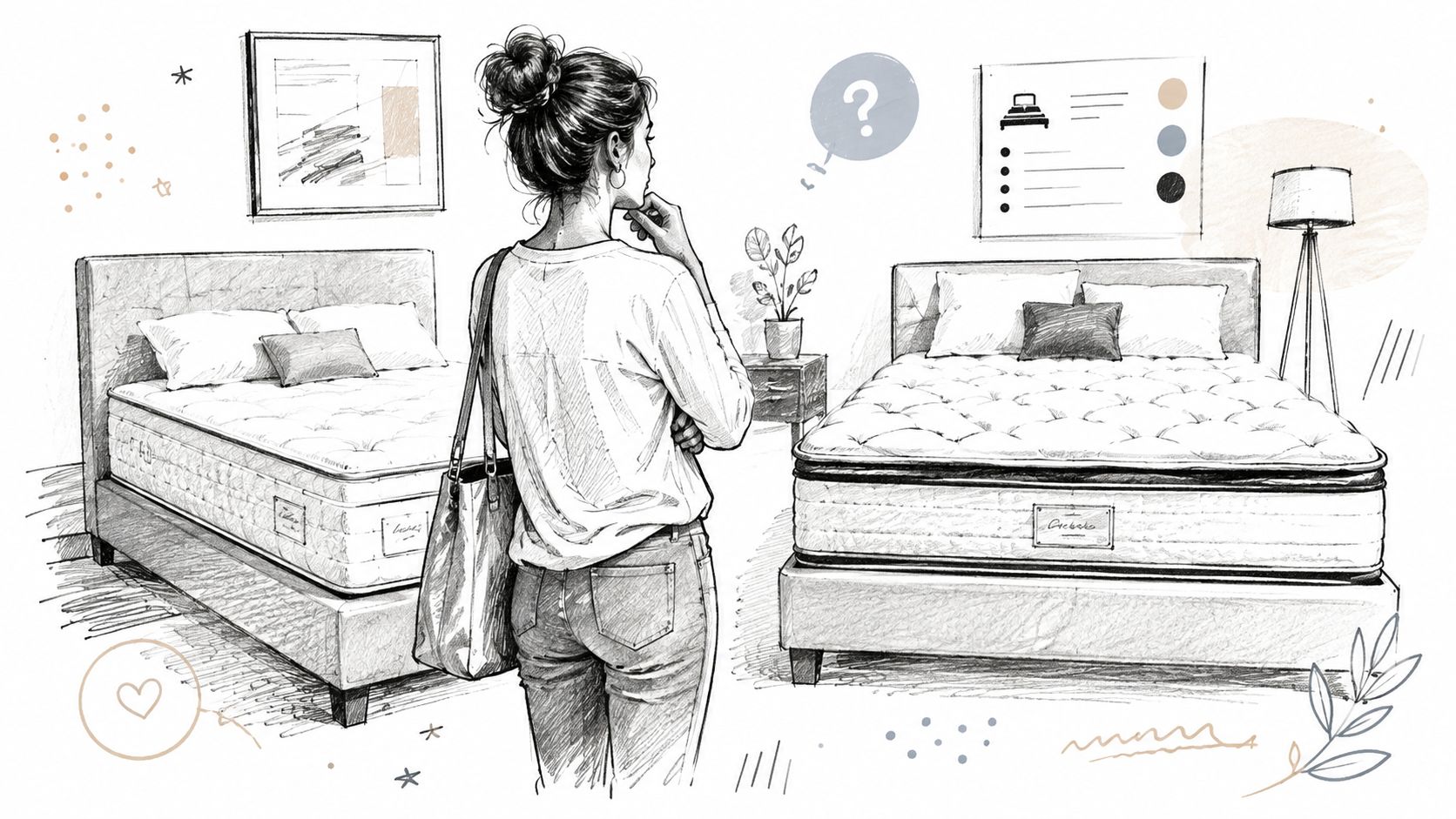
A mattress PDP has to perform a job that a showroom floor model handles naturally. In a store, a shopper can walk around the bed, crouch to inspect the side panel, run a hand over the quilt, and look at how the profile meets the foundation. Online, she gets a hero image, a handful of stills, perhaps a video, and technical copy. Each asset answers a different question, but the shopper has to assemble the complete picture herself.
That becomes harder when two models share similar lifestyle photography. A hybrid mattress may have a visibly different edge construction, quilting pattern, or side height, but those distinctions disappear when every image uses the same bedroom scene. The buyer may understand the foam layers from a specification chart while still lacking a clear sense of the finished product's proportions.
The visual questions that create hesitation
The stall usually isn't caused by one missing image. It comes from several small uncertainties arriving together:
Surface and quilt: Does the cover look smooth, quilted, plush, or tightly stitched?
Side construction: Is the gusset broad enough to show the mattress's actual profile?
Base relationship: Does the mattress sit flush with the foundation, adjustable base, or platform?
Scale: Will the height look appropriate beside a headboard and nightstand?
Finish details: Are handles, ventilation panels, labels, and border stitching visible?
A static gallery can support these questions, but it makes the shopper follow the brand's chosen sequence. A 360 product viewer gives the shopper control over the inspection order. She can drag directly to the side profile, pause on a corner, and return to the hero angle without leaving the primary media area.
Practical rule: Use the spin to remove visual uncertainty, not to compensate for missing product information.
The feature also has limits. Baymard usability testing found that 83% of users didn't try a 360 feature when it was available, while 59% skipped product videos during product-page testing (Baymard's e-commerce usability findings). That behavior doesn't make interactive viewing irrelevant. It means the viewer must sit beside a strong still gallery, not replace it. Shoppers who want a quick visual confirmation should get one immediately, while shoppers who need to inspect the edge, corner, or rear panel should have an obvious path to do so.
What a 360 Product Viewer Actually Is
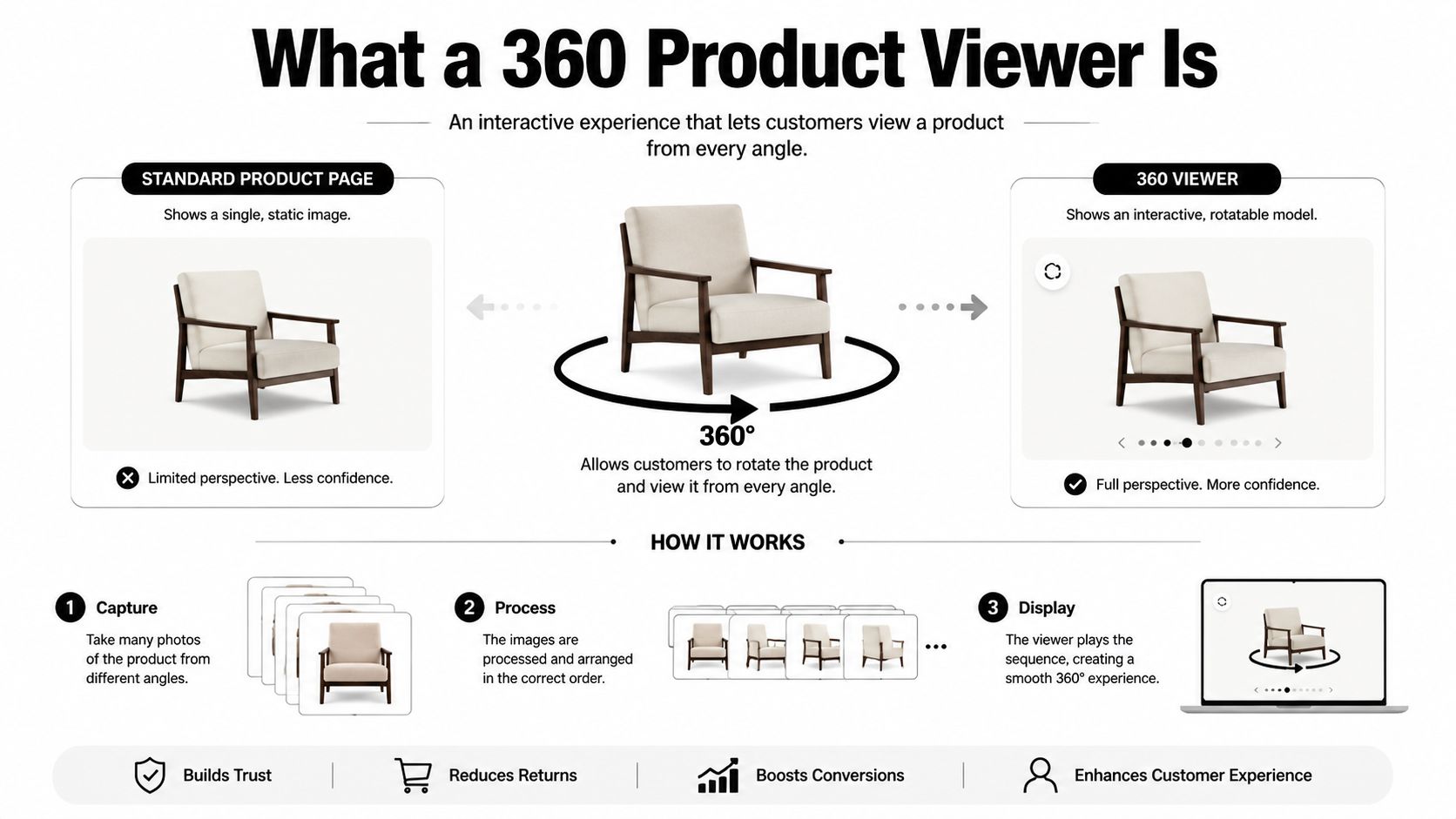
A 360 product viewer is an interactive PDP element that lets a shopper rotate a product horizontally by dragging with a mouse or swiping on a touchscreen. The experience is usually built from a sequence of overlapping images captured as the mattress turns on a controlled setup. The viewer displays those frames in order, creating the impression that the product is rotating beneath the shopper's hand.
That differs from a standard image gallery. A gallery presents a fixed set of curated angles, and the shopper moves from one image to the next. A full 3D or augmented reality experience uses a real-time model, which can support more advanced behaviors such as changing materials, exploring construction layers, or placing a product into a space. A spin viewer is more focused. It gives the buyer a controlled horizontal inspection of the finished mattress.
How a mattress spin set is built
For a finished-cover mattress, the production process generally follows a straightforward sequence:
Prepare the product. The mattress is dressed consistently, with the intended ticking, quilt, gusset, handles, labels, and base presentation visible.
Capture or render the angles. The product is photographed on a turntable or generated from a 3D model as the view moves around the mattress.
Correct the frames. The team aligns the product, standardizes lighting and background, removes distracting artifacts, and makes sure each frame maintains the same scale.
Publish the sequence. A viewer loads the frames into a responsive interaction that supports dragging, swiping, and appropriate fallback behavior.
The exact production approach depends on the merchandising question. A finished hybrid may need the physical texture of its quilt to read accurately. A premium line with interchangeable comfort constructions may benefit from a 3D-rendered spin paired with a Digibun, meaning a layered image that reveals the foam layers and internal build separately.
A horizontal spin typically shows the details shoppers can inspect on a showroom walkaround. It doesn't automatically explain firmness, pressure relief, temperature performance, or motion separation. Those claims still need clear copy, diagrams, reviews, and comparison content. The viewer's role is to make the physical presentation less ambiguous.
How 360 Viewing Moves the Needle on Engagement and Conversion
A mattress shopper may rotate the product to inspect the side profile, then leave the page without adding to cart. That interaction is useful only if it clarifies the product story or supports the next merchandising action. A viewer should therefore be judged by what happens after the spin, not by activity alone.
Broader commerce evidence gives a directional reference. Threekit's 2022 3D commerce statistics report a 94% higher conversion rate for products with 3D or AR content, 82% activation when a 3D view is available, and 34% continued interaction beyond 30 seconds (Threekit's 2022 3D commerce statistics). These figures combine 3D and AR experiences rather than mattress-only 360 viewers. Use them to frame a test, not to promise a result.
Engagement is useful when it signals inspection
A spin event confirms that a shopper used the control. It does not show whether she examined the edge construction, checked the ticking, or dragged once by accident. Track viewer activation alongside gallery engagement, product-detail clicks, add-to-cart activity, and the order of actions that follows. A mattress PDP can attract interaction without reducing uncertainty.
The academic discussion of 360 product imagery links rotatable images with higher purchase intention and identifies sensory vividness as part of the mechanism for shoppers who are not cognitively overloaded (the academic discussion of 360 product imagery). In bedding, that supports quick loading, intuitive drag behavior, and complete coverage of the front, side, and rear views. Motion effects matter less than showing the cover finish, border treatment, and profile clearly.
The viewer also needs a job within the page. Pair it with copy and diagrams that explain firmness, pressure relief, temperature performance, and motion separation. A spin presents the finished mattress. It does not explain how the bed feels.
Conversion and returns require careful attribution
A shopper may rotate the mattress, leave the PDP, return through branded search, and purchase later. A last-click report can hide that contribution. Giving every later purchase full credit creates the opposite problem. Compare viewer interaction with add-to-cart rate, purchase rate, and assisted paths, using catalog and traffic groups that can support a fair test.
Returns require the same discipline. A spin can set expectations about height, visible construction, fabric, and edge treatment. It cannot establish firmness or comfort. Separate return reasons tied to material expectations and visual mismatch from comfort-related reasons, then compare similar mattress pages with and without the feature.
Metric | Typical range | Mattress evidence |
|---|---|---|
Conversion rate | No universal range should be assumed | Broader 3D and AR benchmarks report a 94% higher conversion rate for products with that content, but the benchmark is not mattress-specific, as noted in Threekit's 2022 3D commerce statistics. |
Viewer activation | No universal range should be assumed | The same benchmark reports 82% activation when a 3D view is available. Treat that as context, not a forecast for every mattress PDP. |
Continued interaction | No universal range should be assumed | The benchmark reports 34% interacting beyond 30 seconds. Pair that measure with downstream actions rather than treating time as proof of intent. |
Return reduction | No standard benchmark established here | Measure visual-mismatch reasons separately from comfort-related returns. |
For implementation details, teams can review Grumspot AR implementation tips. Before launch, align the viewer with product detail page optimization guidance from Bedhead, so it supports the mattress story instead of competing with buying information.
Photography Spins Versus 3D-Rendered Spins
The production route should follow the mattress story. A photographic spin captures a real finished product from multiple angles. That makes it the natural choice when the buyer needs to see the exact quilting, ticking texture, seam treatment, or subtle variation in the fabric.
The workflow is familiar to teams that already produce product photography. The mattress is placed on a turntable against a controlled background, each frame is captured, then the images are straightened, retouched, and stitched into a sequence. The result preserves the way physical cloth catches light, which can matter on a premium cover with a distinctive quilt or border.
A 3D-rendered spin starts with a digital model. It becomes more valuable when the line includes multiple colorways, construction options, or internal configurations. One lighting setup can be applied consistently across the catalog, and a model can support a Digibun or other construction visual without requiring a new physical shoot for every variation.
The choice depends on the catalog, not the technology label
Criterion | Photography spin | 3D-rendered spin |
|---|---|---|
Cover realism | Strong for actual ticking, quilt texture, and stitched details | Depends on the quality of materials and the accuracy of the model |
Construction visibility | Shows the finished exterior | Can show foam layers, coils, cutaways, and configurable builds |
Colorway changes | Requires additional capture or careful post-production | Easier to manage once the model and material library are ready |
Catalog consistency | Can vary with studio setup and product condition | Supports repeatable lighting, framing, and camera treatment |
Revision friction | Changes to the physical mattress may require a new shoot | Digital revisions can be efficient when the model is structured well |
Best fit | Hero models and tactile premium covers | Long-tail colorways, inner-spring variants, and layered product stories |
A photographic spin also exposes physical inconsistencies. If one corner is compressed differently from another or the cover isn't dressed correctly, the sequence will show it. That isn't a flaw in the medium. It's a production-control issue that the team must catch before publishing.
The right question isn't whether 3D is more advanced. It's whether the chosen asset shows the product truthfully and supports the buying decision.
Bedhead's overview of rendering 3D models is relevant when a mattress line needs more than a finished exterior. In practice, the strongest catalog often uses both routes. Use a photographic spin for the hero mattress whose cover and finish sell the product. Use a rendered spin for extended colorways, variants that are difficult to photograph consistently, and products where the internal architecture deserves equal attention.
Integration Essentials for Mattress E-Commerce
A 360 product viewer can hurt a PDP if it loads heavily, captures gestures badly, or appears after the shopper has already moved past the media area. The implementation needs to respect the way people shop for mattresses on phones, where screen space, bandwidth, and thumb control all shape the experience.
Start with delivery. The still hero image should remain available quickly, while the spin can load lazily when the gallery approaches the viewport. That keeps the initial page responsive and avoids making every visitor download an interactive sequence before showing interest. Image dimensions, compression, responsive behavior, and modern delivery formats deserve attention in the same workflow as the viewer itself. Bedhead's guide to optimizing images for the web provides a useful foundation for that work.
Build the viewer into the gallery hierarchy
The spin should appear beside the primary product media, not in a distant tab or buried under technical specifications. A clear rotate icon, a short “Drag to view” label, or a visible frame cue tells the shopper that the image is interactive. On desktop, a hover-to-spin behavior can offer a fallback, but it shouldn't replace a clear control for shoppers using keyboards or touchpads.
On mobile, test the viewer with the same care used for a sticky add-to-cart bar. A horizontal swipe should rotate the mattress without unexpectedly moving the page. Pinch-to-zoom, tap targets, loading states, and the ability to exit the interaction need to work without confusing the gallery navigation.
The viewer also has to coexist with the rest of a bedding PDP:
Still gallery: Keep hero, room scene, close-up, and detail images available for quick scanning.
Video: Use a short loop to show compression, unboxing, adjustable-base movement, or fabric behavior that a spin can't communicate.
Configuration: Connect the viewer to size, height, color, and foundation selections where the product changes visually.
Construction modules: Place a Digibun or cutaway beside the spin when foam layers and coil systems influence the purchase.
Retail content: Link the visual story to showroom availability, warranty details, delivery expectations, and comparison tools.
Shopify, BigCommerce, Magento, and composable commerce stacks can all support interactive media, but the integration method varies. A spin-ready template should fit the existing PDP layout, analytics events, and content workflow instead of forcing the merchandising team to manage a separate microsite. Test the experience on representative product pages before applying it across the catalog.
Autoplay should be restrained. A single introductory rotation may help a desktop visitor notice the feature, but repeated motion makes a mattress page feel busy and can distract from price, financing, comfort details, and the add-to-cart decision.
Measuring ROI and Choosing the Right Mattress Lines
The business case for a 360 product viewer belongs in the merchandising review, not in a design-only presentation. The question is whether the asset helps a shopper understand the mattress well enough to move forward, and whether that understanding improves commercial or operational outcomes.
Start with a clean measurement plan. Record viewer activation, meaningful drag activity, time in the gallery, add-to-cart rate, conversion behavior, return reasons, and support contacts related to visible product expectations. Compare those signals with a suitable control or pre-launch baseline, while accounting for traffic source, price, promotion, device, and model popularity.
Separate activity from commercial value
A high interaction count can look impressive and still be unhelpful. Decision-grade reporting connects the viewer to actions that matter:
Engagement quality: Did shoppers inspect the spin and continue into size, construction, delivery, or comparison content?
PDP performance: Did add-to-cart behavior change for visitors exposed to the viewer?
Purchase behavior: Did conversion improve for the selected line, with assisted paths included in the analysis?
Expectation management: Did visual-mismatch returns or material-related support questions decline?
Operational value: Can the same asset serve retailer portals, sales decks, paid media, and showroom screens?
Research supports a selective rollout. Academic work on visual presentation found that richer formats can improve conversion in home décor contexts, while research on 3D rotation reported a 21% increase in purchase likelihood for experience goods where texture and proportion matter (the Tilburg University research repository). Mattresses fit that experience-good logic, but the result shouldn't be generalized to every SKU.
Choose the lines with the most uncertainty
Prioritize models where visual inspection can influence the decision:
Flagship and premium mattresses with distinctive quilting, elaborate gussets, visible handles, or layered construction.
Boxed-bed lines where shoppers need a clearer sense of the compressed product, package-to-bed transformation, and finished profile.
Hybrid and adjustable-base combinations where geometry, edge treatment, and component relationships are difficult to explain through one hero image.
High-traffic PDPs where enough qualified shoppers can interact with the experience to produce a useful read.
Replacement-only lines, low-traffic variants, and products with minimal visible differentiation may be better served by sharper stills, a comparison chart, or a construction graphic. The cost of a spin should be judged against the value of reducing uncertainty on that specific line, not against the appeal of deploying the same module everywhere.
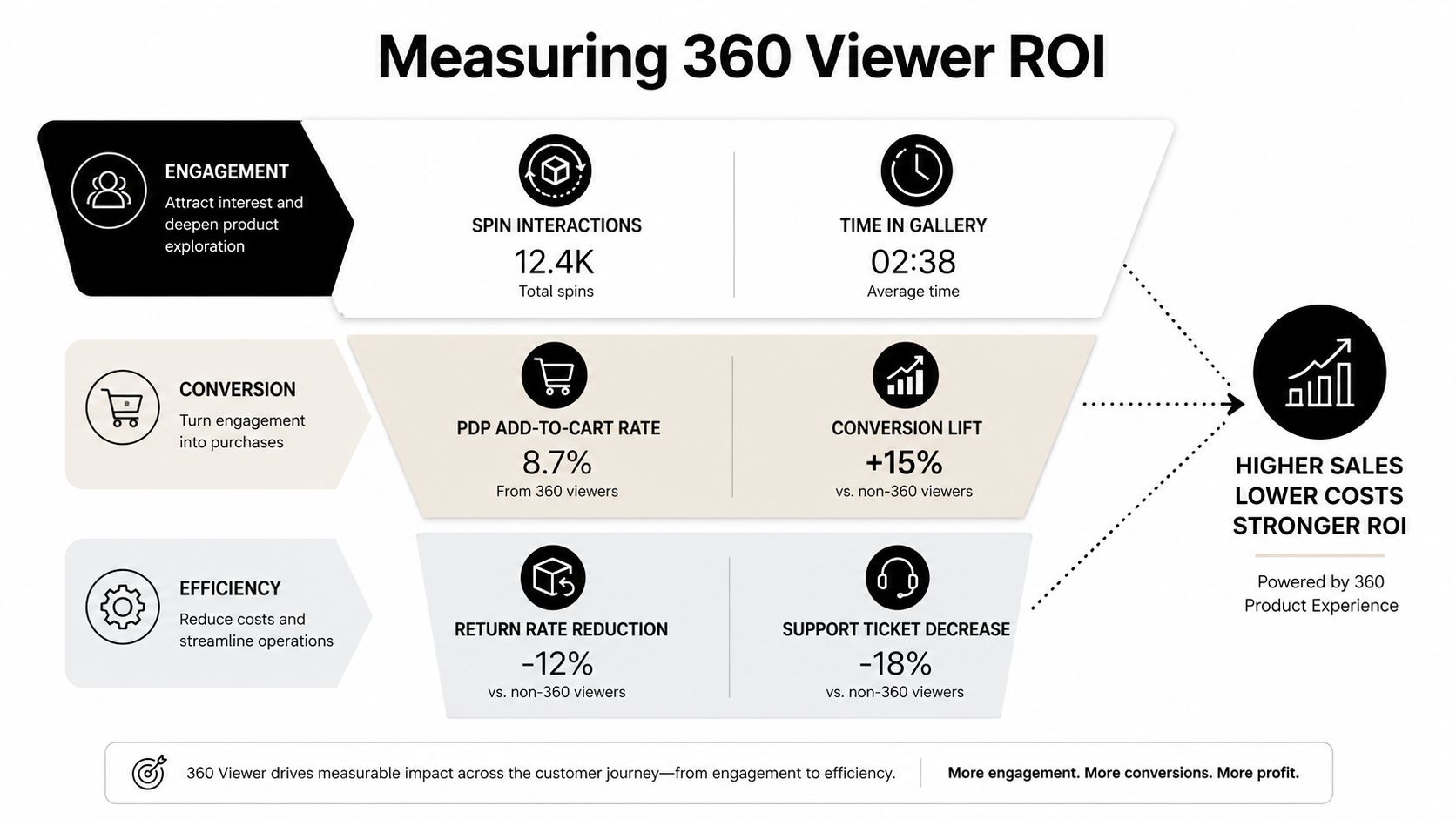
A practical payback sketch uses the current contribution margin, PDP traffic, conversion baseline, average order value, and return-related costs. Estimate the incremental orders required to recover the asset budget, then validate the estimate with an initial rollout on the lines where the visual problem is clearest. Don't put the entire case on an unverified conversion lift. Include reduced production reuse, fewer clarification contacts, and potential merchandising use across retailer and sales channels where those benefits can be measured.
Examples, Best Practices, and Common Mistakes
The most effective bedding deployments give the spin a specific merchandising assignment. A premium mattress may use the rotation to show a complex quilt, border, and side treatment, while a boxed mattress may use it to establish the finished height and communicate what the buyer should expect after opening the package. An adjustable base benefits from a different story, because rotation can clarify the relationship between the mattress, platform, and moving mechanism.
A spin can also support a layered product explanation. The exterior view shows the finished ticking and gusset. A nearby Digibun reveals the foam layers or coil arrangement. The shopper doesn't have to choose between product beauty and construction clarity because each asset has a defined role.
Patterns that tend to work
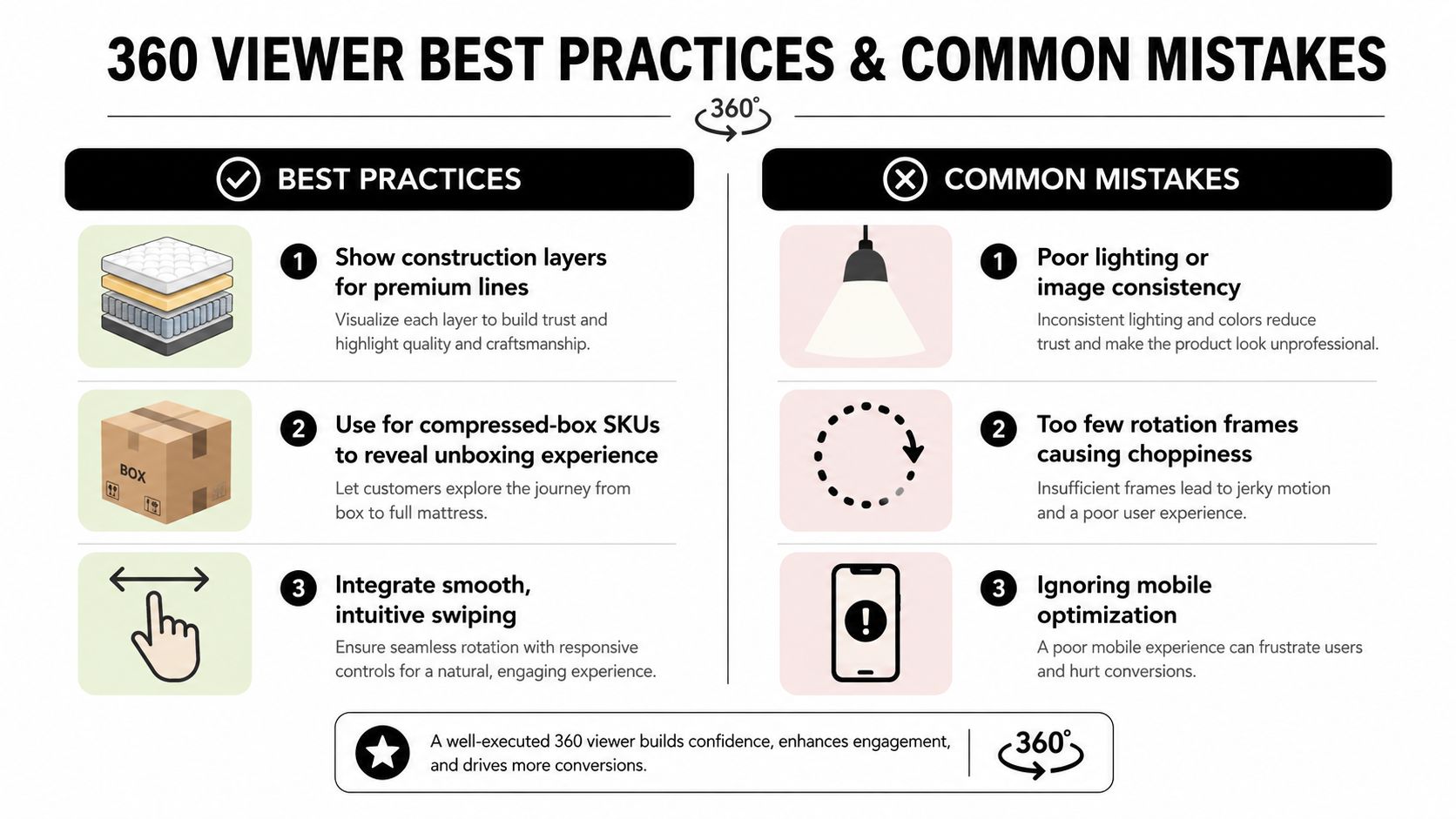
Place the control beside the hero image. The shopper should see that the mattress can rotate before leaving the primary media area.
Match rotational coverage to complexity. A simple solid build may need less visual treatment than a quilted cover with handles, vents, and prominent side panels.
Label the interaction. “Rotate to inspect the side profile” is more useful than an unexplained circular icon.
Pair the spin with a short video. Video can communicate compression, unboxing, base movement, or fabric response that still frames cannot show.
Use the same visual discipline across the line. Consistent scale and lighting make model-to-model comparison easier.
A premium rollout often fails for mundane reasons. The drag control sits below the gallery, the frames look soft on a mobile screen, or the viewer loads while the user is trying to swipe to the next still. Another recurring mistake is using one identical asset strategy for an entry mattress and a flagship model. Their construction stories, margins, customer questions, and content requirements aren't the same.
Audit the experience on real devices
Don't approve a viewer from a desktop preview alone. Test on a current phone, an older phone, different browsers, and a slower connection. Confirm that a low-bandwidth visitor still receives a useful still gallery, because Baymard's findings show that many shoppers won't activate interactive media even when it's present. The spin should reward intentional inspection without punishing everyone else.
For the production foundation, Bedhead's mattress product photography guidance can help teams evaluate lighting, consistency, framing, and asset reuse. Those fundamentals determine whether the interactive layer looks trustworthy.
Next Steps for Bedding Brands and a Note on Bedhead Network
A category manager can prepare a sensible rollout in one planning meeting:
Audit PDPs with the highest return or expectation issues.
Flag mattresses where construction, scale, ticking, or side profile creates hesitation.
Choose photographic spins for hero models and rendered spins for long-tail variations where appropriate.
Define mobile QA, gallery placement, fallback images, and analytics events before production.
Select the two or three commercial and operational metrics that will decide whether the program expands.
Bedhead Marketing works exclusively with mattress manufacturers, retailers, private-label brands, and sleep-product startups. Its capabilities include 3D mattress rendering, Digibuns, silhouettes, room scenes, SEO, paid media, PDP optimization, brand development, and sales training, supported by education through Bedhead University.
Mattress professionals can also join Bedhead Network, a free hub for industry marketing insights, news updates, networking, training resources, an industry directory, and business tools.
If your mattress PDPs leave shoppers guessing about profile, quilting, gusset construction, or internal layers, BEDHEAD can help you evaluate whether a photographic spin, 3D-rendered viewer, Digibun, or stronger still gallery is the right investment. Visit BEDHEAD to discuss a mattress-specific visualization and PDP plan built around the lines where better product understanding can support conversion and merchandising results.