One Stop Marketing for Mattress Brands: A Practical Guide
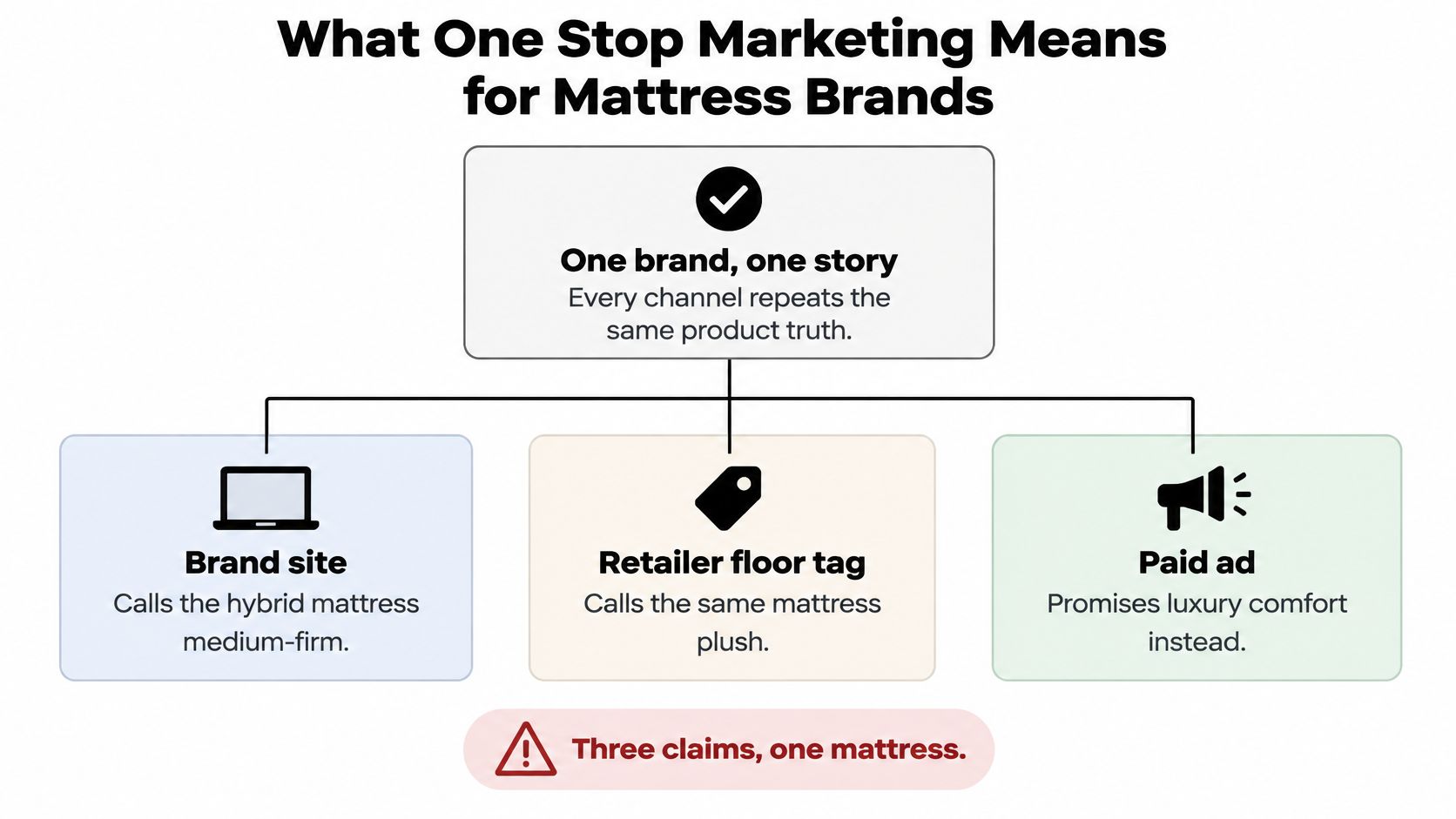
Your hybrid mattress is described as medium-firm on the brand site, plush on the retailer's floor tag, and luxury comfort in a paid social ad. The retailer wants corrected artwork, the media buyer wants another landing page, and nobody can say which description is approved. One stop marketing should solve that problem before it adds another campaign.
For mattress businesses, consolidation works when the people creating demand and the people explaining the product use the same facts. A larger service menu alone won't fix contradictory claims, weak showroom handoffs, or reporting that never reaches sell-through.
What One Stop Marketing Means for Mattress Brands
One stop marketing means one accountable partner, or one coordinated team, running marketing from a shared product fact base. That includes brand language, 3D imagery, websites, search, paid media, email, social, and sales enablement. It doesn't mean putting unrelated suppliers on one invoice.
A hybrid works when the pocketed coils, foam layers, ticking, and quilt are assembled to one specification. Marketing needs that same discipline. The person writing the floor tag shouldn't have to guess what the person building the product page meant by supportive comfort.
What consolidation should improve
For a manufacturer, the immediate benefit is fewer dealer corrections. For a retailer, it's a more dependable connection between online information and the showroom experience. For an eCommerce manager, it's a product page that doesn't contradict the ad bringing shoppers to it.
A properly coordinated arrangement provides practical advantages:
Fewer approval loops. Writers and designers work from approved claims rather than asking separate departments to resolve the same questions.
Cleaner SKU launches. The brief, presentation deck, ads, and floor tags begin with the same construction and comfort information.
Clearer accountability. One reporting owner connects channel activity with sell-through, while acknowledging gaps in retailer sales visibility.
The underlying approach isn't new. Oxford Academic's overview of integrated marketing communications describes the coordination of advertising, public relations, direct marketing, and digital media as a management discipline, not just a creative preference.
The trade-off is concentrated risk
One partner can reduce coordination work, but that partner also becomes a dependency. Establish which specialties are handled in-house, which are subcontracted, and who corrects a subcontractor's copy when it contradicts the approved brief.
BEDHEAD helps mattress brands, bedding manufacturers, and retailers grow. The useful starting point for that work is ownership, not a channel shopping list.
Accountability test: Who owns the product facts, who approves each channel's copy, and who reports sell-through?
If those answers are unclear, consolidating suppliers may only concentrate the confusion.
The Services a One Stop Partner Should Cover
Use this service map to evaluate whether a partner can support the shopper's path from understanding the mattress to buying it.
Services a one stop partner should cover for a mattress brand
Service | What it produces | Where shoppers see it | Usual owner if split |
|---|---|---|---|
3D rendering (Digibuns, silhouettes, room scenes) | Layered views, clean product cut-outs, and lifestyle renders | Product pages, sell sheets, showroom screens | Creative studio or in-house designer |
Product page optimization | Specs, comfort language, and foundation notes written from one brief | Brand site and retailer product pages | Web developer or eCommerce manager |
SEO for mattress terms | Pages and content for firmness, pressure relief, and foundation queries | Organic search results | SEO agency |
Paid search and paid social | Google and Meta ads tied to approved product claims | Search results and social feeds | Media buyer |
Email and dealer communications | Launch sequences and retailer updates with approved claims | Inbox and dealer portal | Email vendor or sales operations |
Brand and USP development | Positioning, presentation decks, and proof points | Sales decks, trade shows, pitch materials | Brand consultant |
Sales training | Mattress selling framework and floor scripts | Showroom conversations with sales associates | Training consultant or no assigned owner |
Measurement | Shared event tracking and sell-through reporting | Internal dashboards | Analytics contractor or no assigned owner |
Build assets around the buying decision
Digibuns are layered views of the inside of a product. They help explain construction, while silhouettes provide clean product images and room scenes show the mattress in a bedroom setting. Each format has a different job, so requesting attractive renders without naming their placement is an incomplete brief.
Product page optimization turns those assets into a usable buying explanation. Put the construction diagram beside the relevant material description, make dimensions easy to find, and place foundation requirements where shoppers choose their configuration.
SEO should address real mattress questions, including firmness, pressure relief, and foundation compatibility. Google and Meta campaigns then need landing pages that support the advertised benefit, rather than sending every shopper to an undifferentiated collection page.
Include the dealer and showroom
Email isn't only a consumer retention channel. Dealer launch messages should tell accounts what changed, which assets are approved, and which floor models or tags need attention.
Brand positioning and USP development give sales decks a defensible argument. Sales training converts that argument into questions associates can ask, demonstrations they can perform, and product comparisons they can explain without inventing claims.
The distinction between channels and their roles matters; BEDHEAD's guide to examples of marketing channels provides useful context for mapping the work.
When these services sit with separate vendors, each can develop its own product description. Each can also report success using metrics that don't reconcile with the others.
Ask a prospective partner: Which of these services can you deliver from one shared product brief?
Where Mattress Sales Leak Between Channels
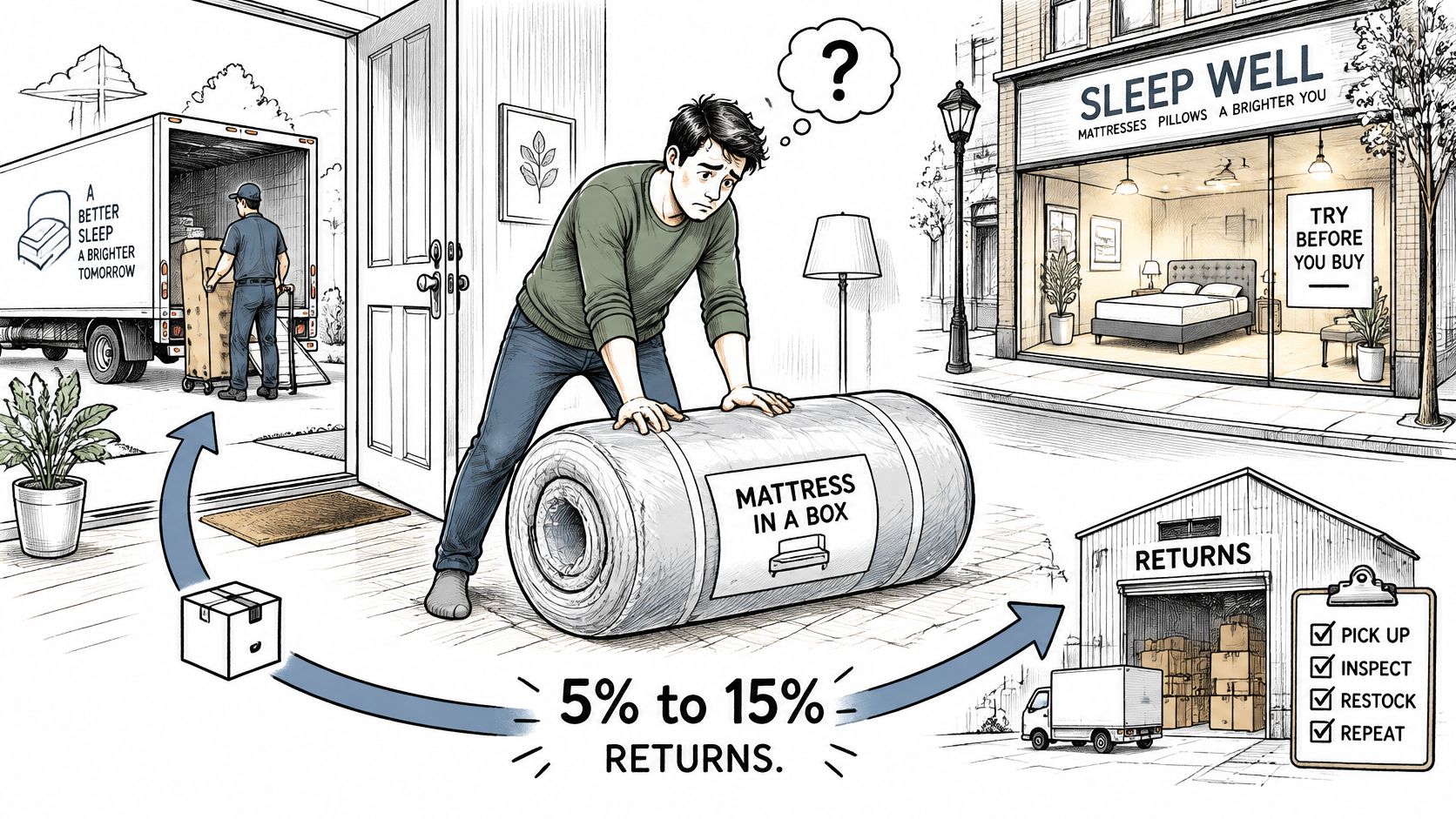
A shopper buying online can't lie down on the mattress before ordering. MattressNut's compilation of industry surveys and trade sources reports online direct-to-consumer returns at roughly 5% to 15% of units sold, depending on brand and product line, compared with approximately 2% to 3% for traditional in-store retail.
Those reported ranges aren't a prediction for an individual business. They do make product-fit education worth examining alongside traffic and conversion rates.
Return exposure by buying path
Buying path | Typical return rate | What the shopper must judge without testing |
|---|---|---|
Online direct-to-consumer | Roughly 5% to 15% of units sold | Comfort, construction, support, height, and setup, relying on imagery and specs |
Traditional in-store retail | Roughly 2% to 3% | Less reliance on untested descriptions because a floor test and associate explanation are available |
Mixed path: research online, buy in store | No separate rate established by the cited compilation | Whether the online description matches the floor model and tag |
Find the handoff that breaks
The first leak is a product page that describes construction differently from the approved product documentation. A shopper comparing foam layers shouldn't encounter a different layer order on the retailer's site.
The next is the showroom handoff. If the floor tag uses a different firmness description, the associate must spend the conversation resolving uncertainty instead of helping the shopper evaluate fit.
Paid ads create another leak when they promise comfort without qualification. A broad comfort statement needs a landing page that explains the intended feel, construction, and relevant limitations.
Use comparison charts. Show meaningful differences between models, not a repeated list of interchangeable benefits.
Show the structure. A Digibun can explain internal layers; detailed silhouettes can show ticking and gusset treatment. Room scenes provide scale and bedroom context, not proof of internal construction.
Answer setup questions. Cover height, sleep-position considerations, foundation compatibility, and delivery preparation without promising a universal comfort outcome.
An omnichannel strategy becomes practical at this point: shoppers should recognize the same mattress when they move from research to a floor test.
For a one-week check, choose a currently promoted hybrid and collect its ad, product page, floor tag, and associate explanation. Mark every contradiction and assign an owner before buying more traffic.
Measuring Revenue Impact Across Channels
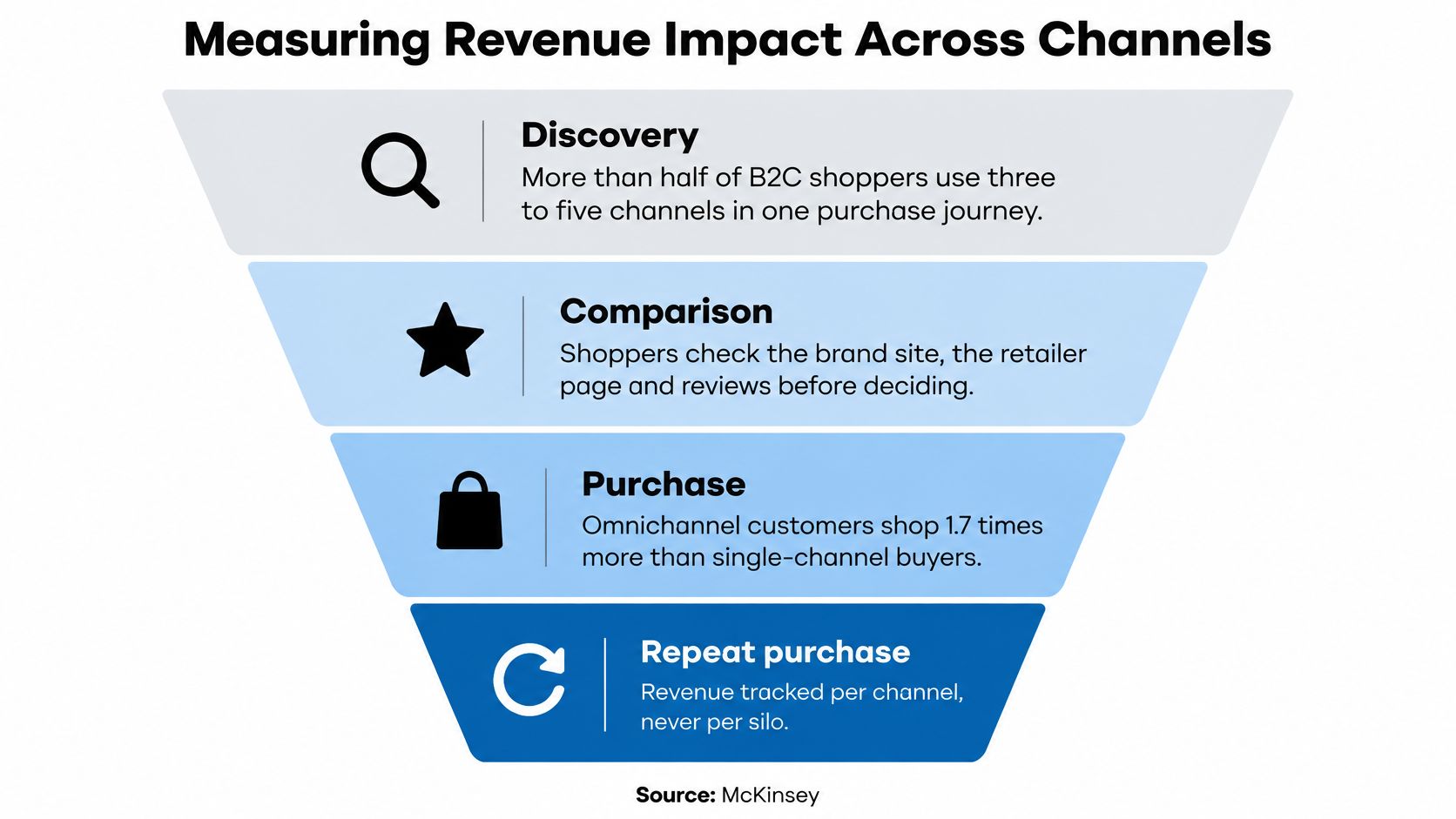
McKinsey's omnichannel explainer reports that more than half of B2C customers use three to five channels during a purchase or service-resolution journey and that omnichannel customers shop 1.7 times more than single-channel shoppers; the accompanying measurement evidence includes Nielsen's 2024 global marketer survey finding that 56% use marketing-mix modeling, while 44% don't use or have access to it.
These are broad marketing findings, not mattress-specific performance promises. For bedding teams, the operational question is how to connect discovery, product evaluation, dealer inquiries, floor visits, and purchases without crediting every channel for the same sale.
Agree on the measurement rules before launch
Define shared events. Include product-page engagement, retailer-locator use, brochure downloads, lead forms, dealer inquiries, and purchases. Keep engagement events separate from commercial outcomes.
Standardize campaign parameters. Use consistent source, medium, and campaign naming across search, social, email, and video. Preserve those values when a lead enters the CRM.
Deduplicate conversions. Don't count a form submission and its CRM import as separate leads. Map CRM statuses so sales-qualified inquiries can be distinguished from incomplete or irrelevant submissions.
Fix attribution windows and compare models. Choose windows that reflect the buying process, then compare two or three models rather than treating one as ground truth.
Establish baseline sales. Record pre-campaign sell-through, promotions, stock availability, and distribution changes. Otherwise, a new retail account can look like an advertising improvement.
Check market-level demand lift. Periodically compare sales, retailer coverage, media spend, geography, and seasonality to assess whether marketing created demand or captured purchases likely to happen anyway.
Google Analytics' cross-channel conversion guidance explains how attribution models allocate credit across touchpoints, including data-driven attribution based on historical conversion paths. Attribution describes credited influence; it doesn't, by itself, prove incremental demand.
Govern assets alongside events
Give every render, spec sheet, and product photo metadata for SKU or collection, market, channel, audience, version, approval status, and expiration date. Someone must also retire superseded assets from dealer portals, not merely upload replacements.
For implementation decisions, BEDHEAD's guide to measuring marketing attribution helps frame the relationship between channel reporting and business outcomes. Where retailer transaction matching isn't available, report that limitation and use aggregated sell-through rather than inventing precise attribution.
Leadership reporting rule: No channel report goes upstairs without a sales line beside it.
Impressions and email opens can diagnose delivery. They can't explain away flat sell-through.
Evaluating a One Stop Partner Before You Sign
A polished rendering portfolio doesn't establish that a partner can manage dealer updates, paid media, and showroom training. Evaluate the operating model as carefully as the creative work.
Use these criteria to separate genuine coordination from a bundled proposal.
Criteria for screening a one-stop marketing partner
Criterion | Strong sign | Red flag |
|---|---|---|
Mattress-specific work | Named projects for manufacturers, retailers, or private-label brands | Generic case studies from unrelated categories |
Product fact control | One shared spec brief used for labels, product pages, decks, and ads | Each channel writes its own firmness and construction claims |
Measurement plan | Events, attribution windows, and baseline sales agreed before launch | Reporting on impressions and clicks only |
Compliance awareness | Claims checked against the product's applicable standard and label wording | Broad safety language with no reference to the standard |
Retail enablement | Floor staff trained on the same product story as online copy | Digital team never speaks with showroom or dealer staff |
Contract clarity | Written deliverables, asset ownership, and reporting cadence | Promises of guaranteed sales or revenue |
Check whether category knowledge reaches production
Ask the team to explain a hybrid project, including how it handled layer diagrams, ticking details, foundation compatibility, and retailer versions. A relevant example should reveal who supplied the facts and who approved the finished work, not just show a beautiful room scene.
Compliance awareness needs the same specificity. The Consumer Product Safety Commission's mattress guidance identifies 16 CFR Part 1632 for smoldering resistance and 16 CFR Part 1633 for open-flame resistance of mattress sets.
Foundation wording also requires care. Under 16 CFR 1633.12, the permanent label must identify the applicable use configuration; a mattress intended to be sold without a foundation must state “THIS MATTRESS IS INTENDED TO BE USED WITHOUT A FOUNDATION.”
Marketing should reproduce approved facts accurately. It shouldn't improvise regulatory wording or substitute broad safety assurances for the applicable compliance statement.
Put boundaries in the agreement
Asset ownership should cover finished images, editable source files where included, retailer adaptations, and access after the engagement ends. Reporting terms should name the decision-maker, delivery cadence, and responsibility for obtaining retailer sales information.
Also establish who owns corrections when manufacturing changes a component after artwork approval. A marketing partner can update the communication, but the manufacturer must supply and approve the changed specification.
BEDHEAD doesn't guarantee specific results from its services. Marketing outcomes can vary because of factors beyond our control, including product availability, pricing, dealer execution, and competitive conditions.
Before signing, request a sample product brief and a sample dashboard. Those documents reveal whether the proposed relationship has working controls behind its service list.
How One Stop Marketing Plays Out by Business Type
The right starting deliverable depends on where the business loses control of its product story. These illustrative scenarios show how the same operating model serves different mattress businesses without assuming identical budgets or sales channels.
An independent manufacturer supplying regional retailers
An independent manufacturer is preparing a hybrid collection for several regional accounts. Each account wants its own sell sheet layout, image dimensions, and merchandising language, but the manufacturer can't allow those adaptations to change the product facts.
The partner's first deliverable is a master specification and dealer asset pack. It includes approved construction language, firmness terminology, retailer-ready 3D assets, and clear rules for what an account may adapt.
The first metric to watch is sell-through by participating account, interpreted alongside floor placement, inventory, and promotion timing. Asset distribution is useful operational information, but it isn't evidence that shoppers bought the collection.
A partner can prepare the material. The manufacturer still has to confirm specifications and persuade accounts to replace outdated content.
A regional retailer with a showroom and online store
A retailer advertises a mattress online, but the shopper arrives to find an older floor tag and an associate using a different selling story. The immediate task isn't a rebrand. It's making the floor model and digital listing describe the same purchase.
The first deliverable is a matched product-page and floor-model activation kit. That means corrected copy, corresponding tags, an associate demonstration framework, and a clear explanation of which advertised model sits on the floor.
Watch completed sales from tracked showroom inquiries, with associates recording whether the shopper tested the advertised model. Keep the interpretation honest when walk-ins or incomplete records prevent reliable matching.
The retailer must still maintain presentable floor models, appropriate staffing, and available stock. Marketing can't train around an unavailable product indefinitely.
A private-label sleep startup
A startup has a manufacturing partner and a collection concept, but its positioning consists of benefits competitors also claim. Launching ads immediately would spread an unfinished proposition.
The first deliverable is a positioning brief, USP, and presentation deck grounded in the actual product. Product pages, search content, and social creative follow that foundation, with conversion tracking agreed before launch.
For a direct-to-consumer launch, watch contribution after advertising and expected return costs, not revenue alone. A sale that consumes the available margin isn't a sound basis for scaling.
The startup must still settle product economics, fulfillment, and customer support. Across all these scenarios, the model fails when the partner handles only ads and never receives the product brief.
Audit Your Marketing Stack This Quarter
A quarterly audit works best as a fixed routine with a written output, not a general review meeting. Five steps cover the ground.
Compare the wording. Pull firmness, construction, height, and warranty language from the product page, label, floor tag, sell sheet, and latest ad. Flag contradictions and any compliance claim unsupported by the applicable standard. A ticking described as breathable on the website and standard-issue on the floor tag is exactly the kind of split this step exists to catch.
Write down ownership. Name the owner of the master product brief and the approver for each channel. Include who authorizes changes after a component substitution, since a swapped foam layer or cover fabric can invalidate approved copy overnight.
Inspect event names. List tracking on product pages, retailer locators, dealer forms, and purchases. Confirm that the same action carries one name across tools, otherwise cross-channel reporting compares mismatched definitions.
Reconcile reporting with sales. Compare last quarter's channel reports with sell-through for the same period. Mark missing retailer information rather than treating missing sales as zero.
Choose the first deliverable. Decide whether the immediate gap is visualization, search, paid media, floor training, or measurement. Don't commission a full rebuild when a corrected product brief is the necessary first step.
Turn the audit into a scoped conversation
BEDHEAD Marketing is a digital marketing agency and 3D design studio serving the mattress and bedding industry. We work with manufacturers, brick-and-mortar and eCommerce retailers, private-label brands, and sleep product startups, offering digital marketing, eCommerce strategy, creative asset creation, product storytelling, website design, 3D visualization, and high-end visual content.
Use marketing resource management principles to assign the audit's work across internal staff and outside partners. Questions about our Terms and Conditions can go to info@bedheadmarketing.com or the contact form at bedheadmarketing.com/contact.
Bring your completed audit, a current product brief, and a recent channel report to BEDHEAD to discuss a practical starting scope for one stop marketing. The audit tells you where product facts and measurement rules break down; the scope conversation decides which break gets fixed first and who owns the fix.