Email Marketing Lead Generation for Mattress Brands
A mattress manufacturer returns from High Point Market with a stack of dealer cards, promising to follow up after the show. The cards enter a generic newsletter, the newsletter runs for a few weeks, and then the database goes quiet. Meanwhile, retailers still need product education, sales teams still need qualified inquiries, and shoppers are still comparing foam layers, ticking, quilt patterns, trial policies, and showroom options.
That gap is where email marketing lead generation earns its place. Mattress purchases rarely follow a quick click-to-cart path. A buyer may research online, visit a retailer, compare hybrid mattresses, ask about a gusset or warranty, and delay the decision until the next shopping trip. A good email program keeps the conversation useful while intent develops.
Why Email Still Wins for Mattress Lead Generation
The mattress category has a longer consideration cycle than many everyday purchases. A shopper may want to understand firmness, support, cooling materials, edge construction, and the difference between a quilted cover and a simple ticking. A dealer may need product specifications, margin information, shipping details, floor-model support, and a clear reason to add another SKU.
Email fits that behavior because it gives the brand permission to continue the conversation after the first interaction. Search and paid social can bring a prospect to a product page or showroom offer, but each campaign typically has to earn attention again when the buying cycle restarts. A permission-based email list gives the manufacturer or retailer a durable channel for education, product updates, dealer communication, and follow-up.
Practical rule: A mattress lead isn't always ready for a quote. It may be ready for the next useful answer.
Consider a retailer who downloads a hybrid mattress product sheet at a trade show. The first email can provide the promised information. A later message can explain the construction, show a clean silhouette of the mattress, and offer a conversation about floor models. A manufacturer can also use a Digibun, a layered image showing the inside of the product, to make foam layers and support components easier for a retail sales associate to explain.
For shoppers, the sequence may look different. A sleep-position quiz can lead to firmness education, a showroom appointment, or a dealer-locator prompt. A consumer who later asks about wholesale purchasing should move into a different path rather than receiving the same promotional message.
Email also supports repeat engagement. Mattress replacement, warranty questions, accessory purchases, and retailer referrals create reasons to reconnect without treating every message as a discount push. That matters for both manufacturers and retailers, particularly when the original inquiry began with a showroom visit rather than an online transaction.
The channel's strength depends on execution. Bedhead's guidance on email marketing benchmarks is useful when a team needs to separate inbox health, engagement, and actual lead progress instead of treating every open as success. For mattress companies, email works best as an owned nurture system, not as a digital version of the same broad dealer blast that caused the database to go quiet.
The Business Case for Email Marketing Lead Generation
Email remains attractive because its economics support continued nurturing. Industry summaries report that businesses earn about $36 to $42 for every $1 spent on email, equivalent to roughly 3,600% to 4,200% ROI, as summarized by Marketful's email marketing ROI statistics. The point for a mattress business isn't to promise that every campaign will reach that return. The point is that a channel with this underlying efficiency can justify the operational work required to segment, automate, and maintain it.
The same source reports that automated email flows can generate 30x higher returns than single campaigns. That distinction matters in bedding. A one-off sale email might reach a shopper who already knows what they want, while an automated sequence can answer questions about firmness, construction, trial terms, store availability, and product fit over time.
Adoption also shows how central email has become in lead programs. A 2026 benchmark reports that 78% of companies use email campaigns for lead generation (Martal). The same source reports that 74.7% of marketers are actively growing their email lists, 59% rate email as the most reliable channel for driving leads, and 83% of B2B marketers say email marketing is important for lead generation.
Those figures support a practical distinction between audience size and opportunity quality. A focused dealer list can be more commercially useful than a large pool of unqualified shoppers if the smaller audience contains buyers who can place orders, request samples, or schedule a product review. A retailer's consumer list has a different value. It may support showroom appointments, product education, accessory sales, and reactivation, but it shouldn't be judged by the same standard as a wholesale pipeline.
Metrics that belong on a mattress P&L
The available benchmarks don't provide reliable, universal figures for bedding open rates, time to qualified lead, or revenue per lead. Those fields should come from each brand's CRM and sales history rather than invented industry averages.
Audience | Typical Open Rate | Avg. Time to Qualified Lead | Est. Revenue per Lead |
|---|---|---|---|
Wholesale buyers | Establish a clean internal baseline | Track from inquiry to accepted sales opportunity | Calculate from accepted opportunities and margin |
Retail showroom prospects | Compare by source and sequence | Track from signup to appointment or retailer referral | Calculate from attributable sales |
DTC shoppers | Compare education flows with promotional flows | Track from signup to qualified product interaction or order | Calculate after returns and margin |
The measurement challenge is especially important for mattresses because revenue may happen offline. A shopper might click an email, visit a store, test a floor model, and buy through a retail associate. If the reporting system only credits the final transaction to the retailer, marketing may underestimate email's contribution.
Automated flows also solve a common follow-up failure. 70% of marketers stop after one email, potentially leaving 76% of total leads unrealized, and one benchmark identifies four emails as a possible sweet spot (Email Vendor Selection). For a mattress brand, that supports a planned sequence instead of a single thank-you email followed by silence.
Building a Mattress List That Compounds Over Time
A strong list begins with a useful reason to subscribe. “Join our newsletter” is weak because it asks for attention without identifying the problem the email will solve. Mattress buyers and dealers respond better when the offer matches a real decision.
A manufacturer might gate a dealer price book, sample request, construction guide, or trade-show appointment. A retailer might offer a firmness comparison guide, sleep-position quiz, product availability alert, or showroom consultation. A DTC brand can use a warranty registration flow or post-delivery education series, provided the consent language clearly explains what the subscriber will receive.
Place capture points where intent appears
Product detail pages should give visitors a logical next step when they're not ready to buy. A form beside a hybrid mattress can invite a shopper to compare firmness or receive a local retailer recommendation. A page showing foam layers can offer a construction guide. The offer should feel connected to the product, not pasted into a generic sidebar.
In stores, teams can use a kiosk or QR code after a product demonstration. Post-delivery inserts can invite customers into care, warranty, and replacement education. At trade shows, badge scans should be paired with a clearly stated follow-up purpose, especially when the contact may represent a dealer rather than a shopper.
Use separate fields and tags for:
Wholesale intent: Dealer inquiry, sample request, price-book request, or trade-show meeting.
Retail intent: Showroom appointment, store availability, comfort consultation, or retailer referral.
Consumer intent: Bed size, firmness interest, product category, or education preference.
Protect the list before you scale it
A single CRM can serve manufacturers, retailers, and DTC operations, but only if the records carry meaningful source and intent data. A dealer inquiry shouldn't enter a consumer discount series, and a shopper who signs up through a retailer's product page shouldn't automatically receive wholesale inventory updates.
Purchased lists are a poor shortcut. Unverified addresses create bounces, complaints, and weak engagement, which can damage sender reputation before a team has learned anything from its creative tests. Permission-based acquisition gives the brand cleaner behavioral signals and a better foundation for future automation.
Bedhead works in this category across manufacturers, brick-and-mortar and eCommerce retailers, private label brands, and sleep product startups. That industry focus matters when a list-building offer needs to reflect margin, floor models, product activation, or the difference between a retail lead and a wholesale opportunity.
Segmenting Manufacturers, Retailers, and Shoppers
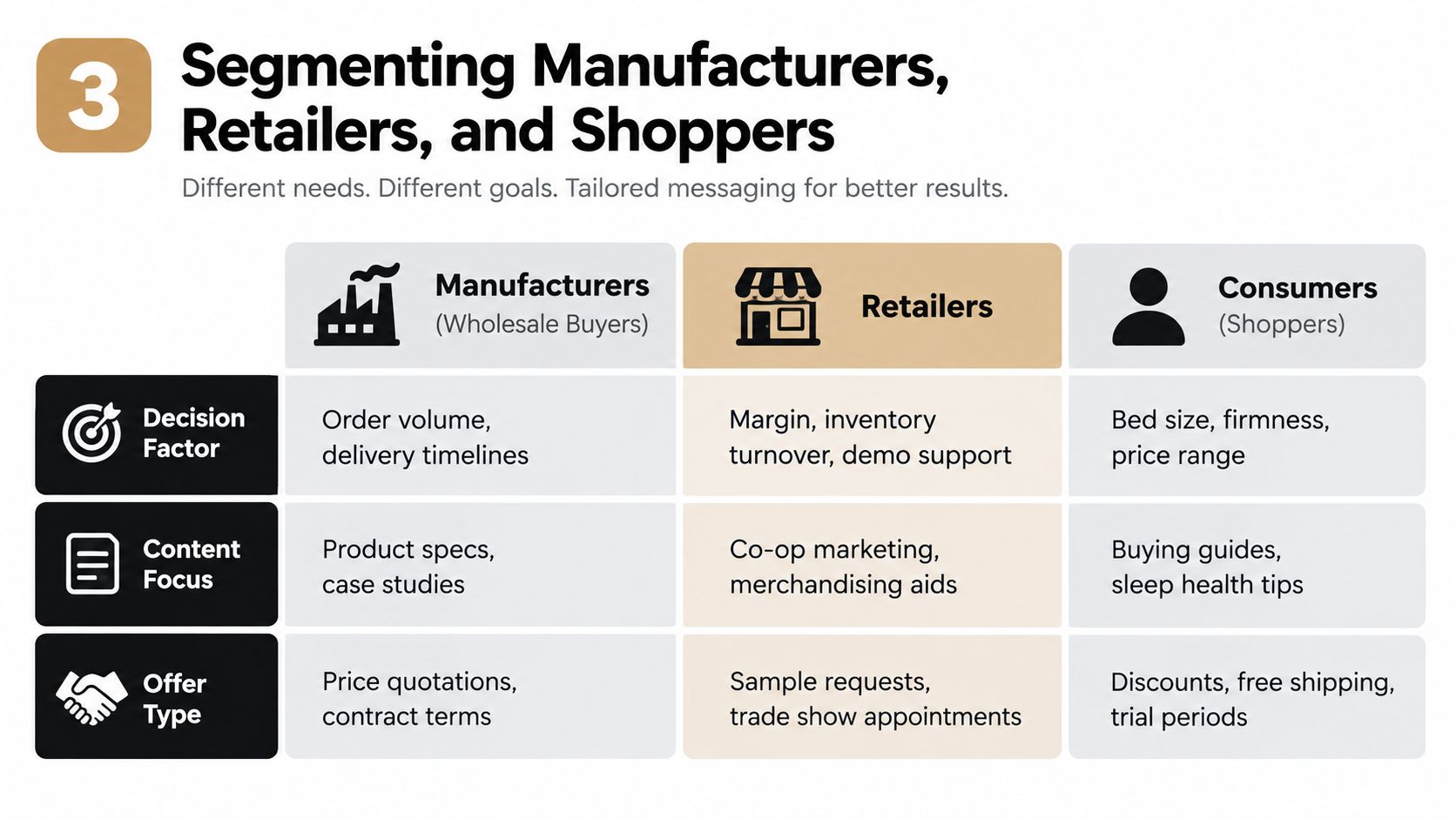
Segmentation should mirror the way a mattress deal closes. Email platforms often default to broad demographic groups, but mattress intent appears more clearly in the action that created the contact.
A wholesale buyer who submits a dealer inquiry is evaluating a business relationship. That person may need SKU ranges, order volume guidance, delivery timelines, pricing sheets, inventory feeds, and merchandising support. A useful sequence should help a sales representative decide when to follow up and give the buyer enough information to make that conversation productive.
A retail prospect has a different set of questions. They may care about margin, inventory turnover, demo support, store credit programs, and whether a product can be explained clearly on a showroom floor. Manufacturer emails to this audience should emphasize retail activation, product training, sample availability, and sales tools rather than consumer discount language.
The shopper's path is more personal and usually more education-led. Bed size, firmness, price range, sleep position, partner preferences, trial terms, and return policies shape the decision. A retailer or DTC brand can use a quiz result, repeated product-page activity, or a showroom request to determine which educational path is most relevant.
Use intent signals instead of guesses
A contact's source often says more than an inferred demographic profile. Useful signals include:
Dealer inquiry forms: Route to a wholesale nurture and sales notification.
Trade-show scans: Record event, conversation topic, and requested materials.
Product-page activity: Trigger education tied to the specific mattress construction.
Showroom requests: Offer appointment support and local store information.
Purchase or warranty events: Shift communication toward care, accessories, and future replacement needs.
A manufacturer may also encounter a dealer who enters a consumer giveaway or a retail associate who downloads a product guide for personal use. Those overlaps don't require separate databases, but they do require suppression rules and priority logic. The most recent high-intent action should usually determine the next message.
For a more detailed framework, what is customer segmentation provides useful context for organizing contacts around meaningful differences rather than arbitrary lists.
Undifferentiated sends create a double problem. They reduce relevance for the recipient, and they make it harder for the sender to identify which audience, offer, or sales process worked. In the mattress industry, that confusion can spread across wholesale, retail, and DTC programs at once.
Lead Magnets, Welcome Flows, and Follow-Up Cadence
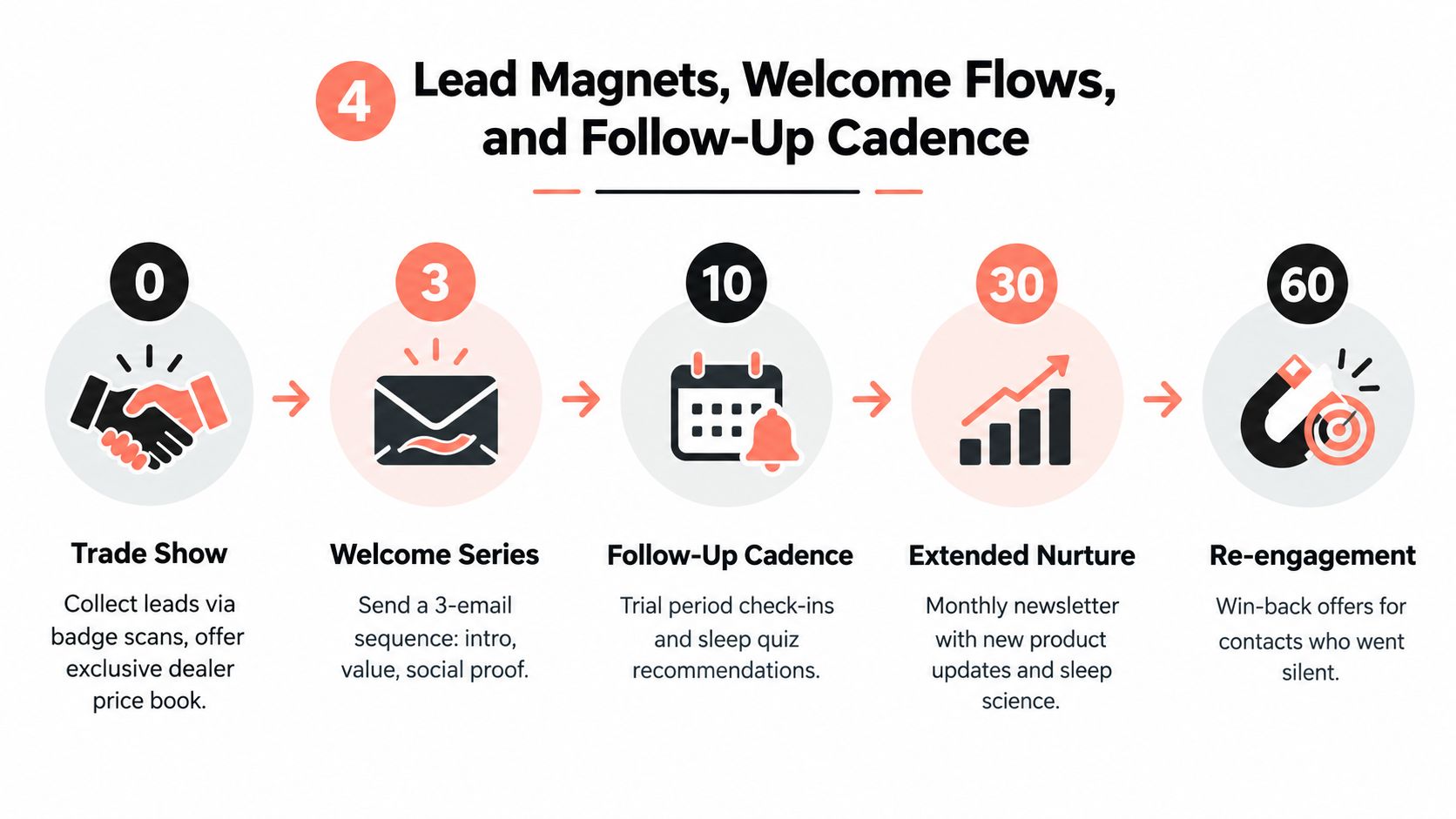
The best mattress lead magnet answers a question the prospect is already asking. A dealer price book is high intent because it connects directly to an ordering decision. A firmness quiz is lower commitment but still useful because it reveals product interest and gives the brand permission to educate.
Match the follow-up to the entry point:
Dealer price books and sample requests: Deliver the asset immediately, then use a longer nurture before sales handoff. The sequence can address product construction, merchandising, availability, and next steps.
Sleep guides and firmness quizzes: Use a three-to-five-email educational series built around the result, comfort concerns, and showroom or product recommendations.
Price-drop and back-in-stock alerts: Keep the path shorter and focused on the specific product, availability, and purchase friction.
Warranty registrations: Shift toward care information, product support, accessories, and future replacement relevance instead of treating the customer as a new prospect.
A retailer should avoid sending a price promotion to every quiz subscriber. Someone comparing plush and firm models may need a clear explanation of quilt, gusset, support core, and hybrid construction before a discount becomes persuasive. A dealer may need several useful contacts before a representative is ready to accept the inquiry as sales qualified.
A follow-up sequence should earn the next conversation, not demand the sale before the buyer understands the product.
The first delivery email should provide exactly what the form promised. Later messages can answer adjacent questions, show a Digibun or room scene, introduce a showroom option, or provide a product comparison. For sales teams building these messages, marketing team email templates for B2B sales can help organize outreach without replacing mattress-specific language.
A dealer who also enters a consumer promotion needs frequency control. Suppress duplicate sends, prioritize the higher-intent wholesale path, and preserve a clear record of why the contact entered each sequence. For teams refining those preference signals, Bedhead's explanation of what is zero-party data offers a useful way to think about information customers intentionally provide.
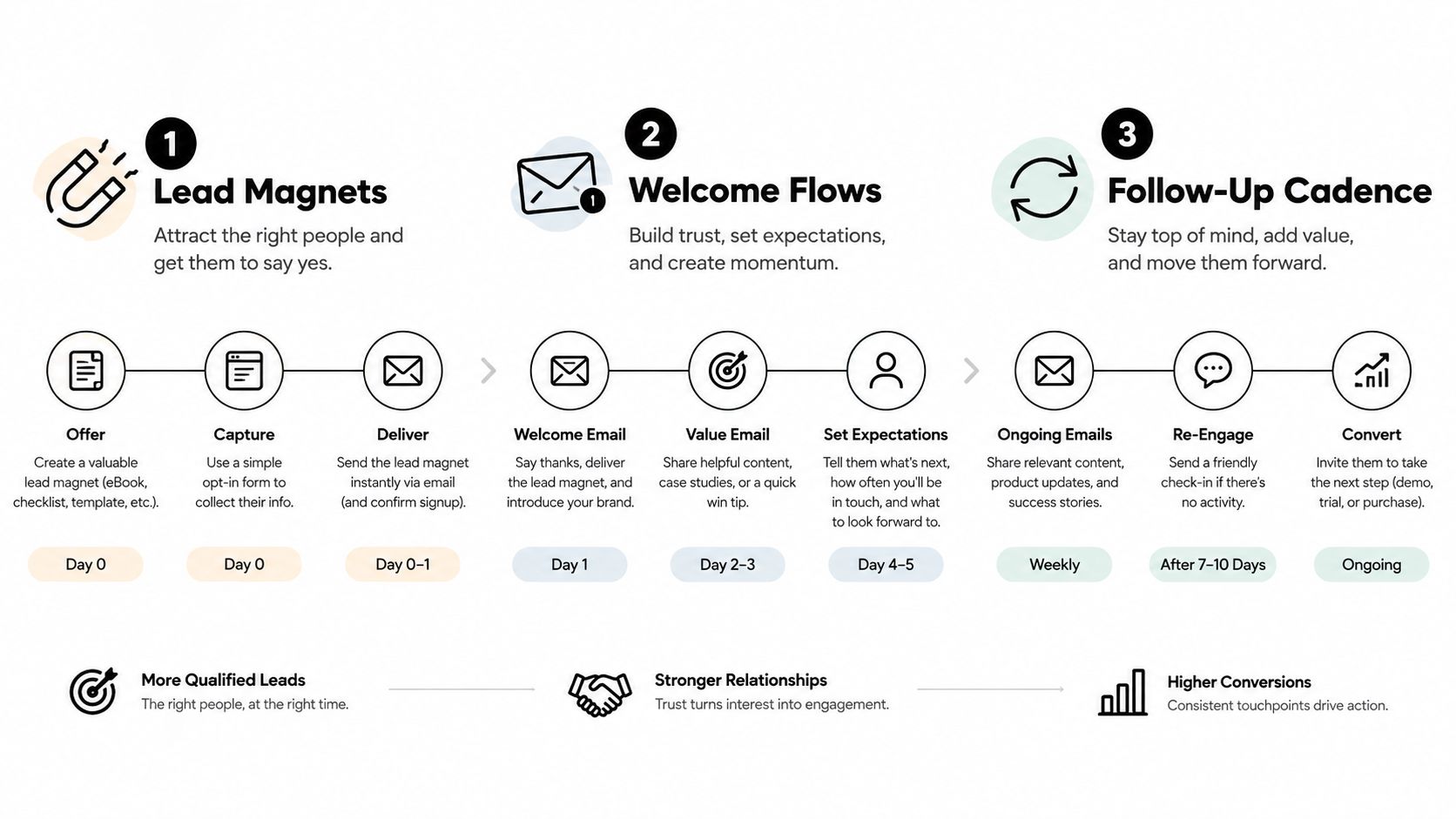
Cadence should also reflect the calendar. Promotional sends can increase pressure around seasonal retail events, while educational messages can maintain relevance between buying periods. The system should reduce frequency when engagement falls and stop sending to contacts who no longer have permission or a credible reason to hear from the brand.
Inbox Placement as a Lead Generation Problem
A message that lands in spam cannot generate a showroom appointment, dealer inquiry, or product-page visit. Inbox placement belongs in the lead funnel, alongside landing-page conversion and sales acceptance.
One 2026 source reports that roughly one in six B2B emails never reaches the inbox, with global inbox placement averaging 83.5%, meaning about 16.5% may be filtered or blocked before recipients see the message (Apollo). That loss occurs before a subject line, product image, or call to action can influence behavior.
Mattress senders have several predictable risk factors. Image-heavy templates can look promotional when the text offers little context. Dealer blasts from legacy lists may contain old addresses or contacts who never expected ongoing communication. Volume spikes around Presidents' Day or Memorial Day promotions can also look abnormal when the program has been quiet.
The technical and behavioral minimum
A sender should verify SPF, DKIM, aligned DMARC, unsubscribe mechanics, and one-click unsubscribe. The technical setup won't compensate for poor list hygiene, but missing authentication creates an avoidable weakness.
Failure Mode | Root Cause | Lead Generation Impact |
|---|---|---|
Shared sending domains | Wholesale and retail programs use the same reputation without clear separation | A weak segment can reduce visibility for higher-value dealer messages |
Legacy trade-show imports | Old or unverified contacts remain active | Bounces and complaints weaken future delivery |
Promotional volume spikes | Seasonal campaigns depart sharply from normal sending behavior | Important offers may receive less inbox access |
Image-heavy templates | Large product visuals carry more weight than useful text | Messages can appear promotional or render poorly |
Broad dealer blasts | One message serves buyers with different roles and needs | Low engagement reduces the quality of future sends |
Brands should treat deliverability as an operating discipline. Bedhead's practical resource on how to improve email deliverability covers the authentication, list hygiene, and warm-up considerations that support this work. Subject-line testing still has a place, but it can't recover leads lost before inbox placement.
Automating and Measuring for Real Lead Quality
Automation should connect a contact's behavior to a useful next action. A dealer who submits a sample request may need an alert to a sales representative. A shopper who repeatedly studies hybrid construction may need a comparison email. A showroom prospect who requests local availability may need a callback task rather than another general newsletter.
Use three measurement layers.
Layer | Metric | Mattress Benchmark | Why It Matters |
|---|---|---|---|
Inbox health | Delivery, complaints, and inbox placement | Establish a clean internal baseline | Confirms whether recipients can see the message |
Engagement | Opens, clicks, replies, and second-touch timing | Compare by segment and source | Shows whether the message earns continued attention |
Pipeline | MQLs, showroom bookings, sample requests, and qualified orders | Compare with CRM outcomes | Connects email activity to commercial value |
The verified benchmarks provide useful guardrails. Strong inbox placement is generally around 80% to 90%, while B2B lead-generation opt-in rates typically fall around 0.5% to 2%, and eCommerce promotional email opt-ins around 1% to 5%, according to LA Growth Machine's email marketing KPI guide. These are comparison points, not promises. A mattress brand should track definitions consistently because delivered mail isn't the same as inbox placement.
Independent B2B research reports that email contributes about 1.3% of total MQLs but 2.24% of revenue, with those leads converting about 11.3% faster than the blended average and moving through the sales cycle roughly 7% quicker than inbound leads overall (Cirrus Insight). Those figures reinforce the need to judge a mattress program by opportunity quality, not list volume.
Lead scoring should prioritize actions such as a dealer inquiry, sample request, wholesale pricing-page visit, sleep-science download, showroom booking, or repeated engagement with a specific product family. Marketing and sales should review these definitions together. If outbound coverage is limited, a team can also evaluate specialist support such as hire cold callers for qualified wholesale follow-up, while keeping email responsible for the education and context that make the call relevant.
Run hygiene checks weekly. Review bounces, complaints, unsubscribes, suppressed contacts, authentication status, and segment volume. Review pipeline and creative tests monthly, including which offers produced accepted dealer opportunities, showroom activity, sample requests, or profitable DTC orders.
Bedhead helps mattress manufacturers, retailers, private label brands, and sleep product startups build practical email programs around qualified dealer inquiries, showroom intent, and DTC education. The team also supports mattress SEO, paid media, product-page optimization, 3D Digibuns, Silhouettes, Room Scenes, brand development, and sales training. Visit BEDHEAD to evaluate your current lead-generation system and identify the next improvement worth funding.